

Running a small business means juggling endless marketing tasks. You know you should nurture leads, send timely emails, and track customer journeys, but there’s never enough time. Marketing automation workflows can increase leads by up to 451% while cutting repetitive marketing tasks by 75%. This guide walks you through creating workflows that save time and drive real growth for your business.
Key takeaways
| Point | Details |
|---|---|
| Marketing automation workflows dramatically boost leads and productivity | Properly implemented workflows can increase lead generation by 451% while saving 75% of time spent on repetitive tasks. |
| Clear goals and quality data are foundational | Success requires setting measurable objectives and maintaining clean, accurate customer data before launching automation. |
| An 8-step process ensures smooth workflow implementation | Following a structured approach from goal-setting through phased launch minimizes risk and maximizes adoption. |
| Avoiding common mistakes protects your results | Poor data quality, unclear goals, and skipping tests can reduce effectiveness by 40%, but these pitfalls are easily preventable. |
| Expect measurable ROI quickly | SMBs typically see 75% time savings, 85% lead conversion increases, and 25%+ marketing ROI improvements within 90 days. |
Introduction to marketing automation for SMB growth
Marketing automation workflows are sequences of automated actions triggered by specific customer behaviors or time intervals. When a prospect downloads your guide, a workflow sends a welcome email, schedules follow-ups, and assigns tasks to your sales team, all without manual intervention. For small businesses competing with larger companies, why SMBs need marketing automation becomes clear: automation levels the playing field.
Workflow automation transforms how you attract, nurture, and convert customers. Instead of manually sending every email or remembering to follow up with each lead, your system handles these tasks consistently and at scale. This consistency builds trust with prospects while freeing you to focus on strategy and growth.
The marketing automation benefits for SMBs are substantial:
- Dramatically increased lead generation through timely, personalized outreach
- Massive productivity gains by eliminating repetitive manual tasks
- Enhanced customer engagement with relevant messages at perfect moments
- Better lead quality through automated scoring and segmentation
- Improved conversion rates with nurture sequences that build relationships
451% increase in leads and productivity gains by automating repetitive tasks represent the upper range of what well-executed workflows achieve, but even modest implementations deliver meaningful results.
The technology powering these workflows has become accessible for small businesses. Modern marketing automation platforms integrate with CRM systems, email marketing tools, and multi-channel communication, creating a unified system that tracks every customer interaction. You don’t need a massive budget or technical team. The right platform makes automation simple and affordable.

Prerequisites for successful marketing automation implementation
Before building your first workflow, lay the groundwork for success. Jumping into automation without preparation leads to frustration and poor results. Start with crystal-clear business goals tied to measurable outcomes. Do you want to increase qualified leads by 30%? Reduce time spent on email follow-ups by half? Improve customer retention by 20%? Write down specific numbers and deadlines. Vague goals like “get more leads” won’t guide your automation strategy effectively.
Data quality makes or breaks automation. Your workflows rely on accurate contact information, behavioral data, and customer preferences. Outdated emails, duplicate records, and incomplete profiles cause messages to miss their mark or annoy recipients. Before launching automation, audit your existing data. Remove duplicates, verify email addresses, and fill in missing information. This cleanup might feel tedious, but it’s essential.
Choosing the right platform requires balancing features, cost, and ease of use. Cost-effective unified platforms reduce complexity and expenses critical for SMBs. Look for solutions that combine marketing automation with CRM functionality, eliminating the need for multiple tools that don’t talk to each other. Affordable marketing automation options designed for small businesses offer robust features without enterprise pricing.
Your technology infrastructure should support automation seamlessly:
- A CRM system to centralize customer data and track interactions
- Email marketing capability with templates and personalization
- Landing pages and forms to capture leads
- Analytics dashboards to monitor workflow performance
- Integration capabilities to connect your existing tools
Pro Tip: Before launching any workflow, run a complete data audit. Clean up duplicates, verify contact information, and establish data entry standards for your team. This investment pays off immediately with better deliverability and engagement rates.
Done-for-you setup services reduce implementation complexity and speed up adoption by at least 50%. If technical setup feels overwhelming, partner with a provider offering hands-on implementation support. Having experts configure your workflows, import your data, and train your team accelerates time to value. You get proven templates and best practices instead of learning through trial and error.
The done-for-you setup benefits extend beyond speed. Professional setup ensures workflows follow best practices, comply with email regulations, and integrate properly with your existing systems. This foundation prevents costly mistakes and rework later.
Step-by-step workflow implementation process
Building effective marketing automation workflows follows a clear sequence. This 8-step workflow process has been proven across thousands of SMB implementations:
- Define specific objectives: Start with one measurable goal per workflow, such as converting 25% of webinar attendees into sales calls within two weeks.
- Assess current technology: Document your existing tools, identify gaps, and determine what integrations you need for seamless data flow.
- Select your platform: Choose an affordable marketing automation solution that matches your budget, technical capability, and growth plans.
- Map customer journeys: Chart the path from awareness to purchase, identifying key touchpoints where automation adds value.
- Configure workflows: Build the actual automation sequences with triggers, actions, delays, and conditional logic.
- Test thoroughly: Run test scenarios with real data to catch errors before launching to your full audience.
- Train your team: Ensure everyone understands how workflows operate, what their responsibilities are, and how to monitor results.
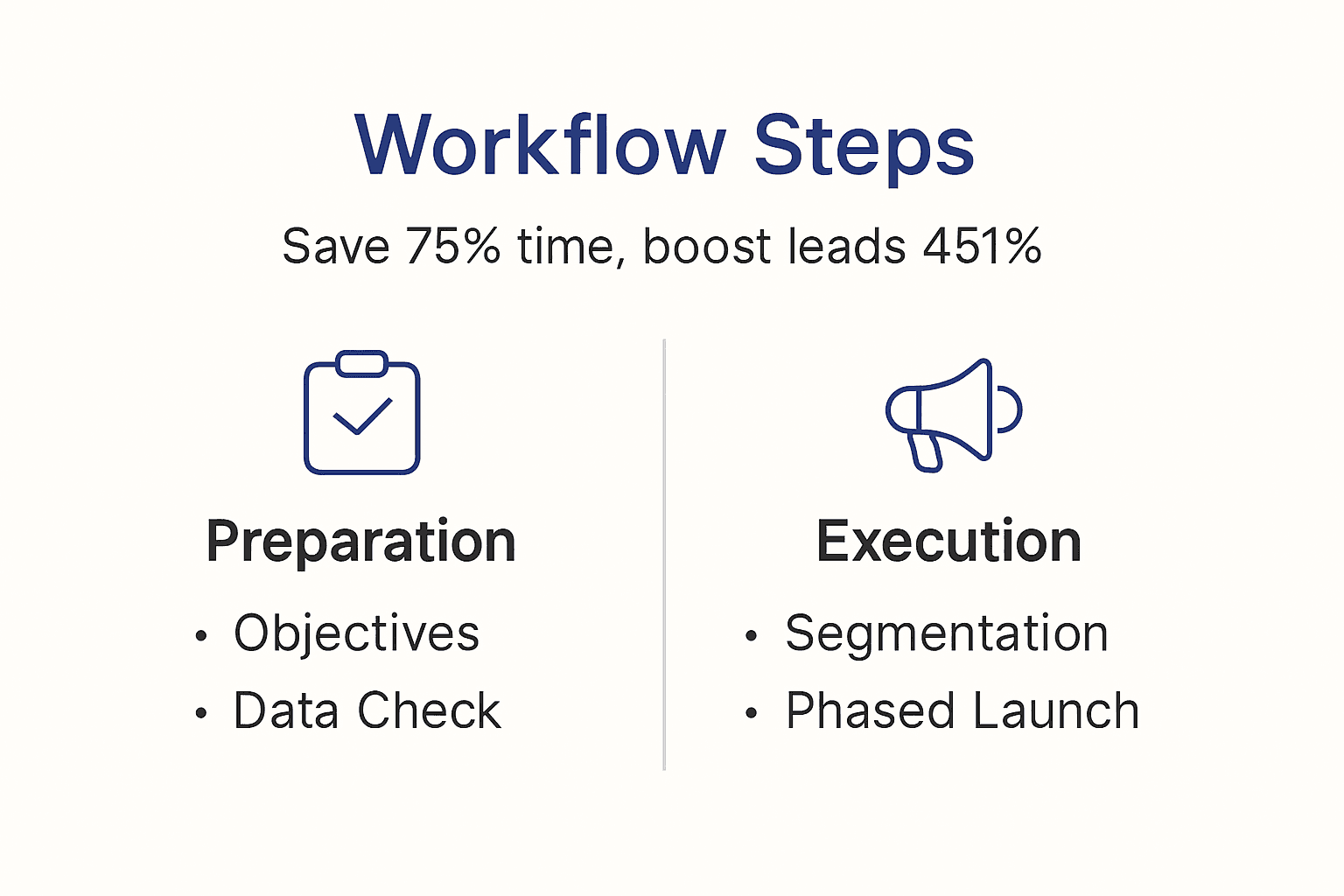
- Launch in phases: Start with a small audience segment, validate results, then gradually expand to your full contact list.
Eight key steps from defining objectives to phased launch optimize marketing automation success by reducing risk and enabling continuous improvement.
Segmentation and personalized workflows can increase email open rates by over 20%. Instead of sending identical messages to everyone, divide your audience by characteristics like industry, company size, behavior, or purchase history. A first-time website visitor needs different content than a returning customer evaluating your premium service.
| Step | Key Actions | Desired Outcome |
|---|---|---|
| Define objectives | Set SMART goals with specific metrics | Clear success criteria guiding workflow design |
| Assess technology | Inventory tools, identify gaps | Understanding of integration requirements |
| Select platform | Evaluate features, pricing, support | Right-sized solution matching your needs |
| Map journeys | Document touchpoints, pain points | Visual guide for automation opportunities |
| Configure workflows | Build triggers, actions, conditions | Functional automation sequences ready for testing |
| Test thoroughly | Run scenarios, validate logic | Error-free workflows preventing embarrassing mistakes |
| Train team | Educate users, document processes | Team confidence and consistent execution |
| Launch in phases | Start small, validate, expand | Controlled rollout minimizing risk |
Your workflows should integrate seamlessly with your CRM and support multi-channel marketing. When a lead fills out a form, your workflow should create a CRM record, send a welcome email, add them to a nurture sequence, notify your sales team, and schedule a follow-up task. This coordination ensures nothing falls through the cracks.
Pro Tip: Launch workflows in phases rather than all at once. Start with 10% of your audience, monitor results for a week, make adjustments, then expand to larger segments. This approach catches problems early when they affect fewer people.
To automate marketing workflows effectively, focus on high-impact, high-volume tasks first. Welcome sequences for new subscribers, abandoned cart reminders, and post-purchase follow-ups deliver quick wins. Once these foundational workflows prove successful, expand to more sophisticated sequences. The step-by-step marketing automation approach builds confidence and demonstrates ROI before major investments.
Email segmentation and personalization go beyond using the recipient’s first name. Reference their specific interests, previous purchases, or browsing behavior. If someone downloaded your pricing guide, send workflows focused on ROI and implementation. If they read blog posts about a specific feature, nurture them with case studies showcasing that capability.
Common mistakes in marketing automation and how to avoid them
Even with the best intentions, SMB owners stumble into predictable traps when implementing automation. Recognizing these pitfalls helps you avoid frustration and wasted effort. Poor data quality, inadequate goal setting, and skipping tests reduce automation effectiveness by up to 40%.
The most frequent mistakes include:
- Unclear or missing goals: Launching workflows without specific success metrics makes it impossible to know what’s working. Fix: Set SMART goals (Specific, Measurable, Achievable, Relevant, Time-bound) for every workflow before building it.
- Poor data quality: Outdated contacts, duplicate records, and incomplete profiles sabotage personalization and deliverability. Fix: Conduct regular data audits, establish data entry standards, and use validation tools to keep information current.
- Skipping thorough testing: Sending untested workflows to your full list risks embarrassing errors and damaged relationships. Fix: Create test scenarios covering all workflow branches, use seed lists, and validate every trigger and action.
- Lack of team collaboration: Marketing automation affects multiple departments, but silos prevent coordination. Fix: Involve sales, customer service, and marketing in planning; establish clear handoff processes and shared success metrics.
- Overcomplex workflows: Building elaborate sequences with dozens of branches confuses your team and makes troubleshooting difficult. Fix: Start with simple, linear workflows that solve one problem well, then add complexity gradually based on results.
Avoiding these common marketing automation mistakes can improve your automation impact by up to 40%, translating directly to more leads and revenue.
Many small business owners try to automate everything immediately. This approach overwhelms teams and creates fragile systems that break easily. Instead, identify your most time-consuming, repetitive tasks and automate those first. Build confidence with simple workflows before tackling complex customer journeys.
Another trap: treating automation as “set it and forget it.” Markets change, customer preferences shift, and your business evolves. Workflows that performed well six months ago might underdeliver today. Schedule quarterly reviews to analyze performance, test new approaches, and retire underperforming sequences. For guidance on avoiding these issues, see marketing automation mistakes to avoid.
Ignoring mobile optimization represents a costly oversight. Most emails get opened on smartphones, yet many workflows send messages formatted for desktop screens. Test every email on multiple devices before launch. Use responsive templates that adapt to screen size automatically.
Expected results and metrics to track for SMB marketing automation
Implementing marketing automation workflows delivers measurable improvements across multiple business areas. SMBs save up to 75% time on repetitive tasks and see up to 85% increase in lead conversions. These results don’t require months of optimization. Most businesses see meaningful improvements within 30 to 90 days.
Expected outcomes from well-executed workflows include:
- Up to 75% reduction in time spent on repetitive marketing tasks
- 85% increase in qualified lead conversions through timely nurture sequences
- 25% or higher improvement in overall marketing ROI from better targeting
- 20%+ increase in email open rates through segmentation and personalization
- Faster sales cycles as leads receive relevant information at optimal moments
- Improved customer retention through automated onboarding and engagement
| Metric | Definition | Typical Improvement Range |
|---|---|---|
| Time savings | Hours recovered from automation vs. manual tasks | 50-75% reduction |
| Lead conversion rate | Percentage of leads becoming customers | 60-85% increase |
| Marketing ROI | Revenue generated per dollar spent | 25-40% improvement |
| Email open rate | Percentage of recipients opening messages | 15-25% increase |
| Customer lifetime value | Total revenue per customer over relationship | 20-35% growth |
| Sales cycle length | Days from first contact to closed deal | 20-30% reduction |
To verify and optimize your workflow performance, monitor these key metrics:
- Workflow completion rates: What percentage of contacts complete each sequence? Low rates signal disengagement or workflow problems.
- Email engagement: Track opens, clicks, and replies to gauge message relevance and timing.
- Conversion rates by stage: Measure how many contacts progress through each workflow step to identify bottlenecks.
- Revenue attribution: Connect closed deals back to specific workflows to prove ROI.
- Unsubscribe and complaint rates: Watch for increases signaling poor targeting or excessive frequency.
Pro Tip: Review workflow performance monthly during your first quarter, then quarterly once results stabilize. Compare performance across segments to identify which audiences respond best, then apply those insights to other workflows.
The time savings and conversion increase you achieve depend on your starting point and implementation quality. Businesses with zero automation see the most dramatic improvements. Those with basic email marketing in place still gain substantial benefits from sophisticated workflows and better segmentation.
Tracking marketing automation ROI for SMBs requires connecting marketing activities to revenue outcomes. Use UTM parameters on links, track form submissions back to specific campaigns, and coordinate with sales to understand which leads close. Most CRM systems include revenue attribution reports showing which marketing efforts generate the most valuable customers.
Don’t expect perfection immediately. Your first workflows establish a baseline. Continuous testing and optimization drive incremental improvements that compound over time. A 2% conversion rate improvement might seem small, but across hundreds of leads per month, it translates to meaningful revenue growth.
Enhance your small business growth with Go Online Now marketing automation
Ready to implement workflows that save time and boost leads? Go Online Now-Connect delivers everything you need in one affordable platform. Our marketing automation software combines email, SMS, CRM, and funnel builders specifically designed for small businesses. Unlike complex enterprise tools, we focus on simplicity without sacrificing power.
Our done-for-you setup service configures your workflows, imports your contacts, and trains your team at no extra cost. You get proven templates and expert guidance instead of struggling through technical setup alone. Real human support via chat, email, and live onboarding ensures you never feel stuck. We’ve helped hundreds of SMBs achieve the results discussed in this guide: 75% time savings and up to 85% conversion increases within 90 days.
Explore how our platform can boost SMB conversions, drive SMB growth, and simplify your entire marketing operation. Our complete guide to marketing automation walks you through every feature and capability.
Frequently asked questions about marketing automation workflows for SMBs
What is a marketing automation workflow, and why is it important for SMBs?
A marketing automation workflow is a sequence of automated actions triggered by specific customer behaviors or time intervals. For small businesses, workflows eliminate repetitive manual tasks like sending follow-up emails or assigning leads to sales reps. This automation saves time while ensuring consistent, timely communication that nurtures prospects into customers. Without workflows, leads slip through the cracks and opportunities get missed.
How can a small business choose the right marketing automation platform affordably?
Focus on all-in-one platforms that combine marketing automation, CRM, and essential tools in one system rather than paying for multiple subscriptions. Look for transparent pricing with no hidden fees, month-to-month terms instead of long contracts, and done-for-you setup included. Compare total cost of ownership, not just monthly fees. Some “cheap” platforms require expensive add-ons or consultants to implement. Request competitor pricing comparisons and ask about matching guarantees.
What are the easiest first steps for SMBs new to marketing automation workflows?
Start with a welcome sequence for new email subscribers and a follow-up workflow for form submissions or downloads. These simple workflows deliver quick wins without overwhelming your team. Map out the customer journey on paper first, identifying 3 to 5 key touchpoints. Build one workflow completely, test it thoroughly with a small audience, and validate results before creating additional sequences. To automate marketing workflows successfully, master basics before attempting complex branching logic.
How do I measure if my marketing automation is improving my business growth?
Track time savings by comparing hours spent on marketing tasks before and after automation. Monitor lead conversion rates, email engagement metrics, and revenue attribution to specific workflows. Most platforms provide dashboards showing workflow performance, contact progression, and ROI. Set baseline metrics before launching automation, then measure improvements monthly. Look for 50% or greater time savings and 20% or higher conversion rate increases as indicators of successful implementation.
What common pitfalls should SMB owners watch for when implementing automation?
The biggest mistakes include launching without clear goals, using poor quality data, skipping thorough testing, building overly complex workflows too soon, and treating automation as set-it-and-forget-it. Avoid these by starting with simple, well-defined workflows, cleaning your data before import, testing every sequence with seed lists, and scheduling regular performance reviews. Poor data quality alone can reduce effectiveness by 40%, so invest time in data hygiene upfront. Remember that automation amplifies both good and bad practices.
Recommended
- Lead Management for Small Businesses: Converting More Prospects – Go Online Now
- Small Business Automation Strategies for Faster Growth – Go Online Now
- How to Nurture Leads Effectively for Real SMB Growth – Go Online Now
- How to Automate Email Marketing for Fast SMB Growth – Go Online Now
- Healthcare Site Growth – 6X Traffic & 600+ New Clients in 6 Months – 1on1 SEO