

Over half of American small businesses say they waste hours each week on repetitive marketing tasks. Time lost to manual processes does more than drain resources, it can stall growth and limit your market reach. Understanding where your marketing workflow slows down is the first step to making better use of your tools and team. This guide walks you through practical steps that help any American business build smarter, more efficient marketing systems.
Step 1: Assess current marketing tasks and tools
Assessing your current marketing workflow is a strategic foundation for successful automation. The goal is to create a comprehensive inventory of existing marketing tasks, tools, and potential inefficiencies that can be streamlined through targeted automation strategies.
Start by mapping out every marketing task your business currently performs. This includes email campaigns, social media posting, lead generation, customer segmentation, and tracking marketing performance. The U.S. Small Business Administration recommends a structured approach to evaluating marketing strategies, which involves thoroughly documenting each workflow step. Categorize these tasks based on their frequency, time consumption, and strategic importance.

Next, conduct a thorough audit of your existing marketing tools. Identify which platforms you currently use for tasks like email marketing, customer relationship management, social media scheduling, and analytics. Digital marketing tools like Mailchimp, ActiveCampaign, and SEO platforms such as Ubersuggest can help optimize your marketing efforts. Create a detailed spreadsheet that lists each tool, its cost, primary function, and how effectively it supports your current marketing objectives.
Pro Tip: Create a visual workflow diagram that highlights bottlenecks and repetitive tasks. This mapping will reveal precise opportunities for automation and help you prioritize which processes to tackle first.
Here’s a summary of common marketing tasks and potential automation benefits:
| Marketing Task | Current Challenge | Automation Benefit |
|---|---|---|
| Email campaigns | Manual scheduling, slow response | Faster sends, personalized timing |
| Social media posting | Time-consuming, inconsistent | Regular posts, saved hours |
| Lead generation | Missed follow-ups, slow tracking | Instant lead capture, faster response |
| Customer segmentation | Complex sorting, errors | Accurate, dynamic grouping |
| Performance tracking | Tedious reporting, lagging data | Real-time dashboards, actionable insights |
Step 2: Identify automation opportunities for efficiency
In this critical step, you will learn how to pinpoint specific marketing tasks that are prime candidates for automation, helping you streamline your workflow and reclaim valuable time for strategic activities.
Identifying automation opportunities requires a systematic approach to analyzing your current marketing processes. Start by creating a comprehensive log of all repetitive marketing tasks your team performs regularly. Look for activities that consume significant time but require minimal creative decision making such as social media scheduling, email follow ups, lead scoring, and performance reporting. Evaluate these tasks based on three key criteria: frequency of execution, time investment, and potential for standardization.
The Universal Business Council highlights that effective digital marketing automation can significantly improve brand consistency and operational efficiency. Focus on tasks that follow predictable patterns and have clear, repeatable steps. Common automation opportunities include welcome email sequences, customer segmentation, social media content posting, performance tracking reports, and lead nurturing workflows. Prioritize tasks that are currently manual, time consuming, and directly impact your marketing effectiveness.
Pro Tip: Create a time tracking spreadsheet to quantify exactly how many hours each marketing task consumes weekly. This data will help you objectively prioritize which processes to automate first and demonstrate the potential ROI of implementing marketing automation.
Step 3: Select and configure marketing automation software
In this crucial stage, you will learn how to choose the right marketing automation platform that aligns with your business needs and configure it effectively to maximize your marketing efficiency.
Small businesses are increasingly adopting automation tools to streamline their operational processes. Begin by creating a comprehensive list of your specific marketing requirements, including email marketing, customer relationship management, lead tracking, and performance analytics. Evaluate potential software based on key criteria such as ease of use, integration capabilities, scalability, and pricing. Look for platforms that offer intuitive interfaces, robust feature sets, and flexible pricing models that can grow with your business.
Marketing tools like HubSpot and MailerLite provide powerful solutions for small businesses seeking to optimize their digital marketing strategies. When configuring your chosen automation software, focus on setting up core workflows that address your most time consuming marketing tasks. This includes creating automated email sequences, developing lead scoring models, establishing customer segmentation rules, and setting up performance tracking dashboards. Take time to customize the platform to match your brand voice, integrate your existing tools, and create templates that can be easily replicated across different marketing campaigns.
Pro Tip: Schedule a comprehensive onboarding session with the software provider and allocate dedicated time for your team to learn the platform. Many automation tools offer free training resources that can significantly accelerate your team’s proficiency and help you unlock the full potential of the software.
Compare leading marketing automation platforms on key criteria:
| Platform | Ease of Use | Integrations | Scalability for Growth | Example Use Case |
|---|---|---|---|---|
| Mailchimp | Very user-friendly | Email, CRM, e-commerce | Good for small/medium | Newsletter automation |
| HubSpot | Intuitive interface | CRM, sales, websites | Excellent, robust | Multi-channel campaigns |
| ActiveCampaign | Simple workflows | CRM, analytics | Flexible, affordable | Drip email sequences |
| MailerLite | Easy setup | Email, websites | Grows with business | Automated lead nurturing |
Step 4: Build workflow automations for key processes
In this essential stage, you will learn how to transform your identified marketing tasks into streamlined, efficient automated workflows that save time and enhance your marketing performance.
Small businesses can dramatically improve operational efficiency by implementing strategic workflow automations. Begin by prioritizing the most repetitive and time consuming marketing tasks you identified earlier. Start with straightforward processes like welcome email sequences, lead nurturing campaigns, social media scheduling, and customer follow up communications. Map out each workflow step carefully, identifying trigger points, decision branches, and specific actions that can be automated without losing the personal touch.
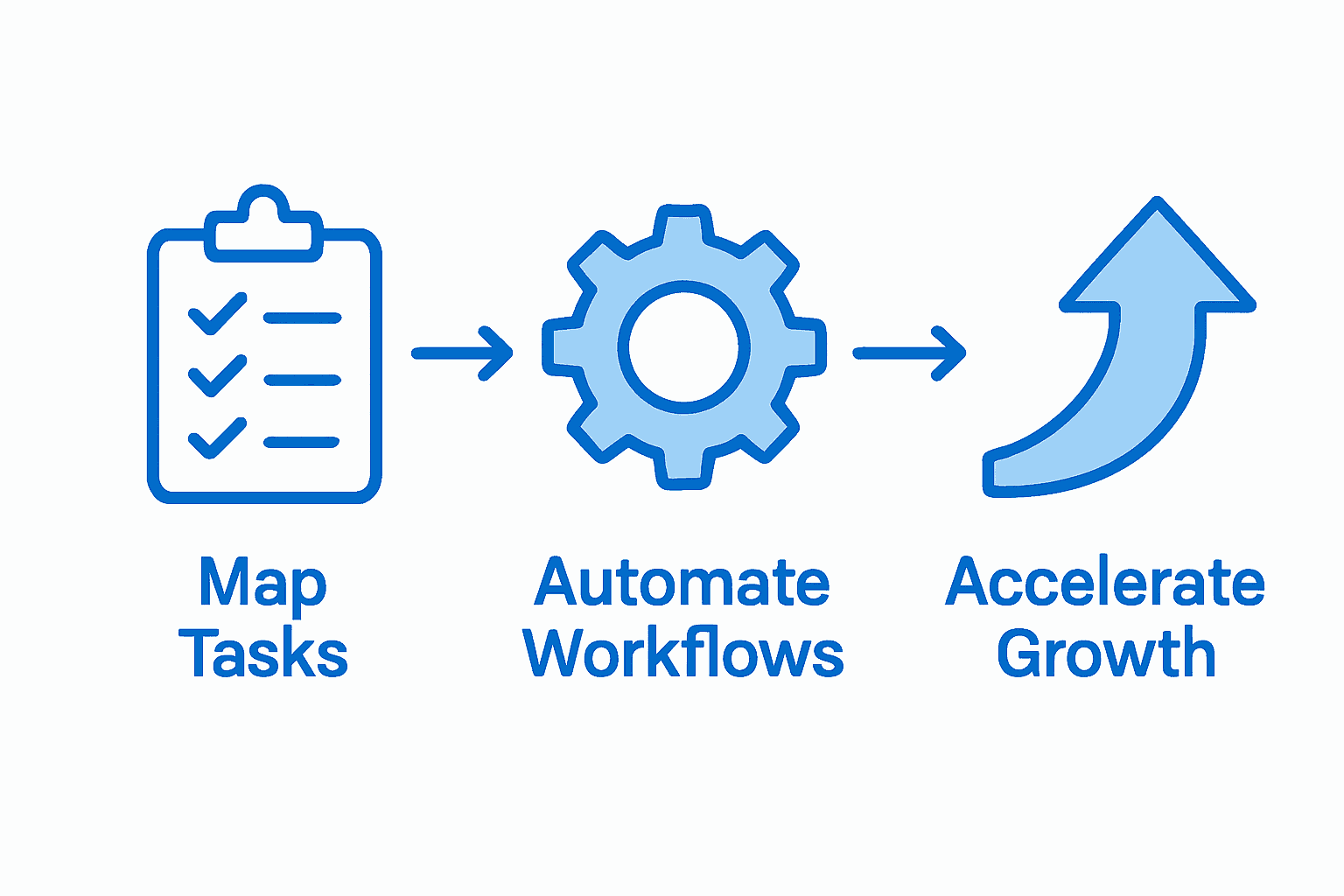
Building effective workflow automations requires a systematic approach to analyzing time investment and potential efficiency gains. Configure your automation software to create logical sequences that move leads through your marketing funnel automatically. This includes setting up rules for lead scoring, segmenting contacts based on behavior, triggering personalized email responses, and generating performance reports. Ensure each workflow maintains a conversational and authentic feel by using dynamic content that adapts to individual customer characteristics and interactions.
Pro Tip: Create a test workflow with a small segment of your contacts first. Monitor performance metrics closely, gather feedback, and refine your automation before rolling it out to your entire contact database. This approach allows you to identify and resolve potential issues while minimizing potential disruptions to your marketing efforts.
Step 5: Test and measure results for continuous improvement
In this critical final stage, you will learn how to systematically evaluate your marketing automation performance, ensuring your workflows deliver tangible business results and remain adaptable to changing market conditions.
Digital marketing automation requires robust performance tracking and continuous measurement strategies. Start by establishing clear key performance indicators (KPIs) that align with your specific business objectives. These might include metrics like conversion rates, email engagement percentages, lead generation volume, customer acquisition cost, and overall return on investment. Leverage analytics tools to generate comprehensive reports that provide granular insights into how your automated workflows are performing across different marketing channels.
Small businesses should approach marketing measurement as an ongoing process of strategic refinement. Compare your current marketing automation results against your initial baseline measurements, looking for trends and patterns that reveal both successful strategies and areas needing improvement. Implement A/B testing for different workflow components, experimenting with variables like email subject lines, content sequence, timing of communications, and segmentation criteria. Pay close attention to how small adjustments impact your overall marketing performance, and be prepared to iterate quickly based on real world data.
Pro Tip: Schedule monthly review sessions with your team to discuss automation performance metrics. Create a standardized reporting template that makes it easy to track progress, identify opportunities, and maintain accountability for continuous marketing improvement.
Accelerate Your SMB Growth with Seamless Marketing Automation
Struggling with manual email campaigns and inconsistent social media posting wastes your precious time and holds back growth. This article highlights the challenges of automating marketing workflows and streamlining lead nurturing to save hours while boosting conversions. At Go Online Now, we understand SMBs need simple yet powerful tools to automate email marketing, lead management, and customer segmentation without the overwhelm.
Discover how our all-in-one platform combines Marketing Automation Software, CRM, and expert Digital Marketing Services specifically tailored for small businesses. Say goodbye to disjointed systems and hello to one transparent, affordable solution that delivers up to 85% more conversions and 75% time saved in 90 days. Ready to simplify your marketing and grow smarter? Explore our Automation Archives and Digital Marketing Archives to learn how our done-for-you setup and real human support can transform your workflows. Take the next step today at Go Online Now.
Frequently Asked Questions
How can I identify which marketing tasks to automate for my small business?
Start by analyzing your current marketing processes and documenting tasks that are time-consuming and repetitive. Focus on tasks like email follow-ups, social media scheduling, and performance reporting, and then choose a few to automate first based on their frequency and impact on your marketing strategy.
What criteria should I use to select a marketing automation software?
Evaluate potential platforms based on ease of use, integration capabilities, and pricing flexibility. Create a checklist of your essential marketing needs and identify software that meets these criteria effectively, allowing your small business to scale efficiently.
How do I create effective automated workflows once I’ve selected a software?
Begin by mapping out each marketing task you wish to automate, detailing the steps and decision points involved. Set up trigger actions and automated responses that maintain a personal touch, ensuring your workflows enhance customer engagement while saving time.
How can I measure the effectiveness of my automated marketing workflows?
Establish clear key performance indicators (KPIs) that align with your business goals, such as conversion rates and lead generation volume. Use your analytics tools to generate reports and regularly review performance metrics, adapting your strategies based on the insights you gather.
What should I do if my automated workflows aren’t delivering the expected results?
If your workflows are underperforming, conduct A/B testing to experiment with different variables like email subject lines and timing. Analyze the results to identify what changes lead to better engagement and fine-tune your automation accordingly.
How often should I review and optimize my marketing automation strategies?
Schedule monthly review sessions to assess the performance of your automation efforts. By regularly evaluating your strategies, you can adapt to market changes and continually drive improvement in your marketing outcomes.
Recommended
- Marketing Automation Software: Smarter Growth for SMBs – Go Online Now
- Marketing Automation Software: Complete Guide for SMBs – Go Online Now
- Marketing Automation Software: Complete Guide for SMBs – Go Online Now
- How to Automate Marketing Tasks for SMB Growth Success – Go Online Now
- Machine Learning in Content Marketing Explained