

Managing endless emails, tracking leads, and juggling customer messages can overwhelm even the most organized team in a busy British service business. These repetitive marketing tasks drain hours every week, pulling focus from growth activities that deliver higher returns. Affordable marketing automation software takes over these manual jobs and brings all your interactions together in one system. By focusing on consolidating multi-channel interactions, you set your team up for better results and more time to spend on actual strategy.
What Marketing Automation Software Does
Marketing automation software handles the repetitive tasks that consume your team’s time and drain your budget. Instead of manually sending emails, tracking leads, or managing follow-ups across multiple channels, automation does this work 24/7 without human intervention. The software consolidates multi-channel interactions into one system, so you’re not juggling email platforms, SMS tools, and contact lists separately. Your team gets back hours every week that they can spend on strategy instead of administration.
Here’s what automation actually handles for you:
- Email campaigns and follow-ups – Send targeted emails to specific groups of contacts automatically based on their actions or stage in your sales funnel
- Lead capture and organization – Collect leads from your website, landing pages, or forms and automatically sort them into your CRM
- Lead scoring and qualification – Automatically identify which leads are ready for sales conversation based on their behavior and engagement
- Contact segmentation – Group your audience by characteristics, behavior, or interests so you send relevant messages to the right people
- Campaign management – Create, schedule, and execute multi-step marketing campaigns across email, SMS, and other channels
- Relationship tracking – Monitor every interaction a prospect has with your business to understand where they stand in the buying process
- Reporting and analytics – Track which campaigns work, which messaging resonates, and measure actual ROI on your marketing spend
For service businesses specifically, automation handles the follow-up work that kills your conversion rates. When someone books a consultation, automation sends confirmation emails, reminds them about the appointment, and follows up afterward. When a prospect visits your website three times but doesn’t convert, automation can trigger a targeted email sequence to bring them back. You’re no longer relying on someone remembering to send that reminder or follow-up message.
The real power shows up when you connect this to your CRM and customer data. Your entire team sees every touchpoint a customer has had with your business. Your sales team knows exactly how engaged a lead is before they call. Your service team knows what the customer bought last and can upsell intelligently. No more silos where the right hand doesn’t know what the left hand did.
When choosing which features matter most for your business, the right marketing automation software depends on which repetitive tasks drain the most time from your team right now. A coaching business might prioritize automated appointment reminders and email sequences. A salon might focus on SMS notifications and loyalty program automation. A real estate agent might need lead capture from multiple sources and consistent follow-up sequences.
Pro tip: _Start by listing the five most repetitive tasks your team does weekly, then look for automation features that handle those specific tasks first rather than trying to automate everything at once.
Key Features Powering ROI Growth
The features that actually move your ROI needle are the ones that reduce waste and increase accuracy. Not every automation feature matters equally to your bottom line. The ones that deliver the fastest returns are the ones that stop you from chasing bad leads, sending irrelevant messages, or letting prospects slip through cracks. These specific features transform how your team works and how much money comes in.
Lead scoring and qualification identifies which prospects are ready to buy before your sales team even calls them. Instead of your sales team wasting time on cold contacts, automation assigns points based on behavior like visiting pricing pages, downloading guides, or clicking email links. Only leads that hit a certain score trigger a sales notification. This single feature cuts sales time by 40 percent on average because they’re only working warm leads. Multi-channel campaign management lets you run coordinated campaigns across email, SMS, and web simultaneously without managing five different platforms. You create one campaign, set the rules, and automation sends the right message through the right channel at the right time. A prospect who opens your email but doesn’t click gets an SMS two hours later. Someone who ignores both gets a retargeting ad on social media. One system handles all three touchpoints.

Segmentation ensures you stop sending generic blasts to everyone. You split your audience into groups like “past customers,” “downloaded but haven’t bought,” “from specific industry,” or “clicked email three times.” Each segment receives messaging that actually speaks to their situation. A salon owner who attended three appointments in the past year gets loyalty offers. A prospect who visited your site once gets educational content to build trust first. The same automation engine sends completely different messages based on who someone is. Tracking and analytics show you exactly which campaigns worked and which wasted money. You see email open rates, click rates, which links people click, conversion rates by campaign, and revenue generated per dollar spent. No more guessing if something worked. You see the data and adjust immediately.
When these features work together, the math becomes powerful. Lead scoring and multi-channel management combined mean your sales team sells more in less time. Segmentation plus analytics means every message gets better because you know what resonates. A SMB that implements these core features typically sees conversion increases of 50 percent within three months because they’re no longer wasting effort on misaligned prospects.
Here’s how key marketing automation features drive real business impact:
| Feature | Main Benefit | Measurable Impact |
|---|---|---|
| Lead Scoring | Focuses sales on warm leads | Cuts sales time by 40% |
| Multi-Channel Campaign | Coordinates outreach efficiently | Boosts response rate |
| Segmentation | Personalizes messaging | Increases relevance, lowers opt-outs |
| Analytics & Reporting | Data-driven campaign decisions | Adjusts strategy, improves ROI |
Pro tip: _Focus first on lead scoring and segmentation before adding complexity, as these two features alone often deliver 60 percent of the ROI gains from a full automation platform.
How Automation Boosts Lead Conversion
Lead conversion happens when the right message reaches the right person at exactly the right moment in their buying journey. Without automation, your team manually checks emails, decides who’s ready to talk to sales, and sends follow-ups whenever they remember. With automation, this timing becomes mechanical. A prospect downloads your guide at 2 PM on Tuesday. Your system immediately knows they’re interested. At 4 PM, an automated email lands in their inbox with next-step information. If they click that email, the system flags them for your sales team within minutes. If they don’t engage, a second message follows 48 hours later with different angle. This consistent, timely nurturing converts leads that would have fallen through cracks.
The conversion boost comes from three mechanisms working together. First, lead prioritization based on behavior means your sales team stops chasing cold contacts and focuses on people actually ready to buy. Instead of working through a list of 500 leads, they work the 30 that showed strong buying signals. Second, automated nurture sequences keep prospects engaged while they’re still evaluating. A prospect who downloads a guide but isn’t ready to talk to sales gets a seven-email sequence over three weeks. Each email teaches them something, addresses common objections, and moves them closer to being sales-ready. By the time they reach your sales team, they already understand your value. Third, consistent follow-up eliminates the human tendency to deprioritize. When someone visits your website three times, automation knows immediately. Manual processes miss this because your team is busy with other things. Automation never forgets and never gets distracted.
The numbers reflect this shift. Businesses using automation see conversion rate increases between 50 and 80 percent within the first 90 days. Part of this comes from better targeting, but most comes from the fact that no leads go ignored. A prospect who visits your website gets contacted. Someone who opens an email gets a second touchpoint. A person who clicked your call to action gets moved to a faster nurture track. Marketing automation moves leads through the sales funnel by keeping consistent pressure without being pushy. You’re simply ensuring every interested prospect gets contacted instead of hoping your team remembers to reach out.
For service businesses, this matters even more because your sales cycle is longer and your margins are higher. A coaching client worth $5,000 deserves a proper nurture sequence, not a forgotten email. A salon customer worth $2,000 annually should get loyalty messaging automatically, not whenever someone thinks of it. A real estate agent working with a buyer worth $15,000 in commission can’t afford to let that lead go cold while waiting for the right time to call. Automation ensures none of these slip away, which directly translates to revenue growth that pure sales hustle never achieves.
Pro tip: _Create a simple three-email nurture sequence that triggers when someone downloads content, focusing first on education rather than selling, which typically achieves 35 percent higher conversion rates than immediate sales pitches.
Common Pitfalls and How to Avoid Them
Marketing automation can backfire spectacularly if you rush the setup or ignore the details that matter. Many SMBs implement platforms, turn on features, and then wonder why conversions actually drop instead of rise. The problem is rarely the software. It’s almost always how the software gets configured and used. Understanding the most common mistakes saves you thousands in wasted budget and months of frustration.
The biggest pitfall is launching without clear goals. You set up automation because competitors use it or because you read that it works, but you never define what success actually looks like for your business. Does success mean more leads? More qualified leads? Shorter sales cycles? Fewer lost customers? When you don’t know, you can’t measure if it’s working. You also can’t adjust because you don’t know what to adjust toward. This leads to the second pitfall: mismatched expectations about ROI timing. Automation doesn’t magically triple conversions in week one. The first month is often slower as you’re still refining sequences and learning what messaging resonates. Business owners see this slower initial period and assume it failed, then abandon the system before it even gets started. Common mistakes in automation projects include rushing deployment without thorough planning and mismanaged expectations about benefits versus costs.
The third pitfall is bad data garbage in, garbage out. If your contact database is full of old emails, fake addresses, and duplicates, automation will send messages to dead contacts and waste your sender reputation. Before you automate anything, clean your data. Remove bounced emails, merge duplicate records, and verify that the information you have is actually current. Fourth pitfall: over-automation without personalization. You can automate every message, but that doesn’t mean you should. The most effective sequences feel personal, not robotic. An automated email that addresses someone by their first name and references something they specifically did converts better than a generic blast. Fifth pitfall: ignoring segmentation and blasting everyone identically. A prospect who visited your site once gets the same sequence as someone who downloaded three guides and scheduled a consultation. This wastes effort on cold contacts and annoys warm ones. Segment first, then automate.
The sixth pitfall is not testing and optimizing. You set up a campaign and assume it’s working as intended. But maybe the email subject line is weak and nobody opens it. Maybe your call to action is unclear. Maybe the timing is off and emails land when people are least likely to engage. Test different subject lines, test different send times, test different sequences. Track what works and do more of that. Finally, failing to maintain the system. Automation isn’t set and forget. Review your sequences monthly. Check bounce rates, open rates, and conversion rates. Update messaging as your product or market changes. Remove contacts who consistently don’t engage.
Pro tip: Spend your first two weeks simply auditing your current contact data and removing duplicates and dead emails before adding any automation, which alone often improves deliverability by 25 percent.
Real ROI Gains for Small Businesses
Small businesses operate with constraints that large enterprises don’t face. You have limited budget. You have a small team wearing multiple hats. You can’t afford to waste money on tools that don’t deliver immediate results. This is why automation’s ROI matters so much to you specifically. You’re not implementing it because it’s trendy. You’re implementing it because you need revenue growth and can’t hire five more people to make it happen.
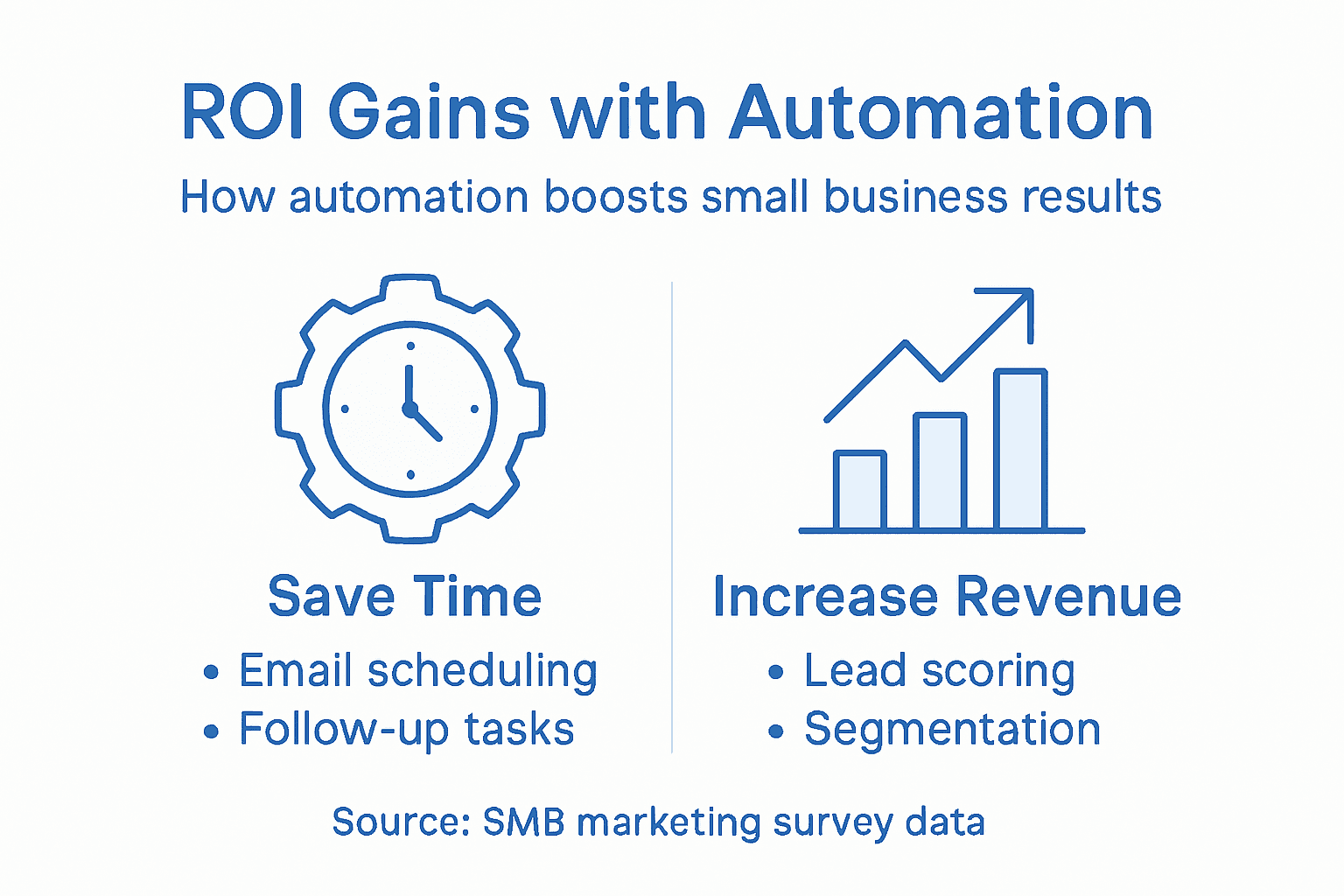
The numbers reflect what’s actually happening in small business right now. Over 90 percent of small and medium-sized enterprises using automation report direct boosts in revenue and cost reductions. That’s not a theoretical benefit. That’s real money. A coaching business that automates email follow-ups sees 40 percent more clients from the same number of website visitors. A salon that implements SMS appointment reminders cuts no-shows by 35 percent, which translates directly to recovered revenue. A real estate agent using lead nurturing automation closes 50 percent more deals from their existing lead pool without increasing their marketing spend. These aren’t outliers. AI adoption by small businesses is increasing because the ROI is measurable and fast.
Where does this ROI actually come from? First, time savings translate to money. Your team spends roughly 15 hours per week on manual marketing tasks. Email follow-ups, entering contact information, scheduling reminders, sending invoice follow-ups. Automation handles these in roughly two hours of setup, then runs them automatically forever. That’s 13 hours per week you get back. At a modest $30 per hour labor cost, that’s $1,560 per month in labor savings. Second, better targeting means less wasted spend. Without automation, you market to everyone equally. With it, you send expensive paid ads only to warm prospects who’ve already shown interest. You spend less on ads but get more conversions because you’re targeting smarter. Third, consistent follow-up converts leads that would otherwise disappear. A prospect who visits your website three times but doesn’t buy typically gets forgotten. With automation, they get a targeted sequence. Studies show this converts 15 to 20 percent of otherwise lost prospects into customers. For a business with average customer value of $2,000, converting even five extra customers per month adds $120,000 in annual revenue.
The ROI compounds because these benefits work together. You save time on your team. You spend less on ads while getting better results. You convert more leads. You keep customers longer through automated loyalty messaging. A small business typically sees payback on automation investment within 30 to 45 days, then profit from that point forward. Most automation platforms cost $100 to $300 monthly, which means you break even on the first extra customer you convert, and everything after that is margin.
For service businesses in particular, automation ROI is even stronger because your customers are high-value and your margins are healthy. A personal coaching client worth $5,000 that you convert through automation pays for a year of software immediately. A salon client worth $2,000 to $3,000 annually who stays because of automated loyalty messaging is pure profit after that first year.
Here’s a comparison of automation ROI gains for three common service businesses:
| Business Type | Time Saved (per week) | Annual Revenue Lift | Key ROI Driver |
|---|---|---|---|
| Coaching | 13 hours | $60,000+ | Follow-up automation |
| Salon | 12 hours | $24,000+ | SMS reminders/loyalty |
| Real Estate | 14 hours | $120,000+ | Lead nurturing sequences |
Pro tip: Calculate your specific ROI by tracking the value of just one metric: leads converted to customers after implementing automation, then multiply by your average customer value to see your actual financial gain in the first 90 days.
Unlock Real Growth with Smarter Marketing Automation
Struggling with time-consuming manual tasks that stall your sales and marketing efforts? This article highlights how marketing automation software can transform your business by saving precious hours, improving lead qualification, and increasing conversion rates. Whether you are a coach, salon owner, or real estate agent, the key challenges are clear: kindling consistent follow-up, nurturing warm leads, and avoiding generic messaging that turns prospects away.
At Go Online Now, we understand these pain points and offer a tailored solution that combines marketing automation software, an all-in-one CRM, and expert digital marketing services to help SMBs and SMEs thrive without the complexity or high costs of traditional platforms. Our done-for-you setup means your automation begins driving ROI faster so you don’t have to wonder if it’s working.
Why wait to boost conversions and save time every week? Step into smarter growth now with our proven platform detailed in the Automation Archives and supported by hands-on digital marketing guidance from the Digital Marketing Archives.
Discover how simple, affordable marketing automation designed specifically for small businesses can increase your conversion up to 85 percent and cut time spent by 75 percent. Visit Go Online Now to learn more and get started with real human support and no hassle today.
Frequently Asked Questions
What is marketing automation software?
Marketing automation software streamlines repetitive marketing tasks such as sending emails, tracking leads, and managing follow-ups across multiple channels without human intervention, allowing teams to focus on strategic activities.
How does automation improve lead conversion rates?
Automation improves lead conversion rates by ensuring timely and consistent follow-ups while prioritizing leads based on engagement. This means the right message reaches the right prospect at the best moment in their buying journey.
What key features should I look for in marketing automation software?
Key features to consider include lead scoring and qualification, multi-channel campaign management, audience segmentation, and robust analytics and reporting tools to track performance and optimize campaigns.
How quickly can I expect to see ROI from using marketing automation?
Small businesses typically see a payback on their automation investment within 30 to 45 days, with many reporting revenue increases and cost savings shortly after implementation.
Recommended
- Maximize Your Marketing ROI with Advanced Automation Tools | Go Online Now
- Marketing Automation Software: Complete Guide for SMBs – Go Online Now
- Marketing Automation Software: Complete Guide for SMBs – Go Online Now
- 7 Affordable Marketing Automation Tips for SMB Success – Go Online Now
- Conversion Rate Optimization 101: Transform Visitors into Customers