

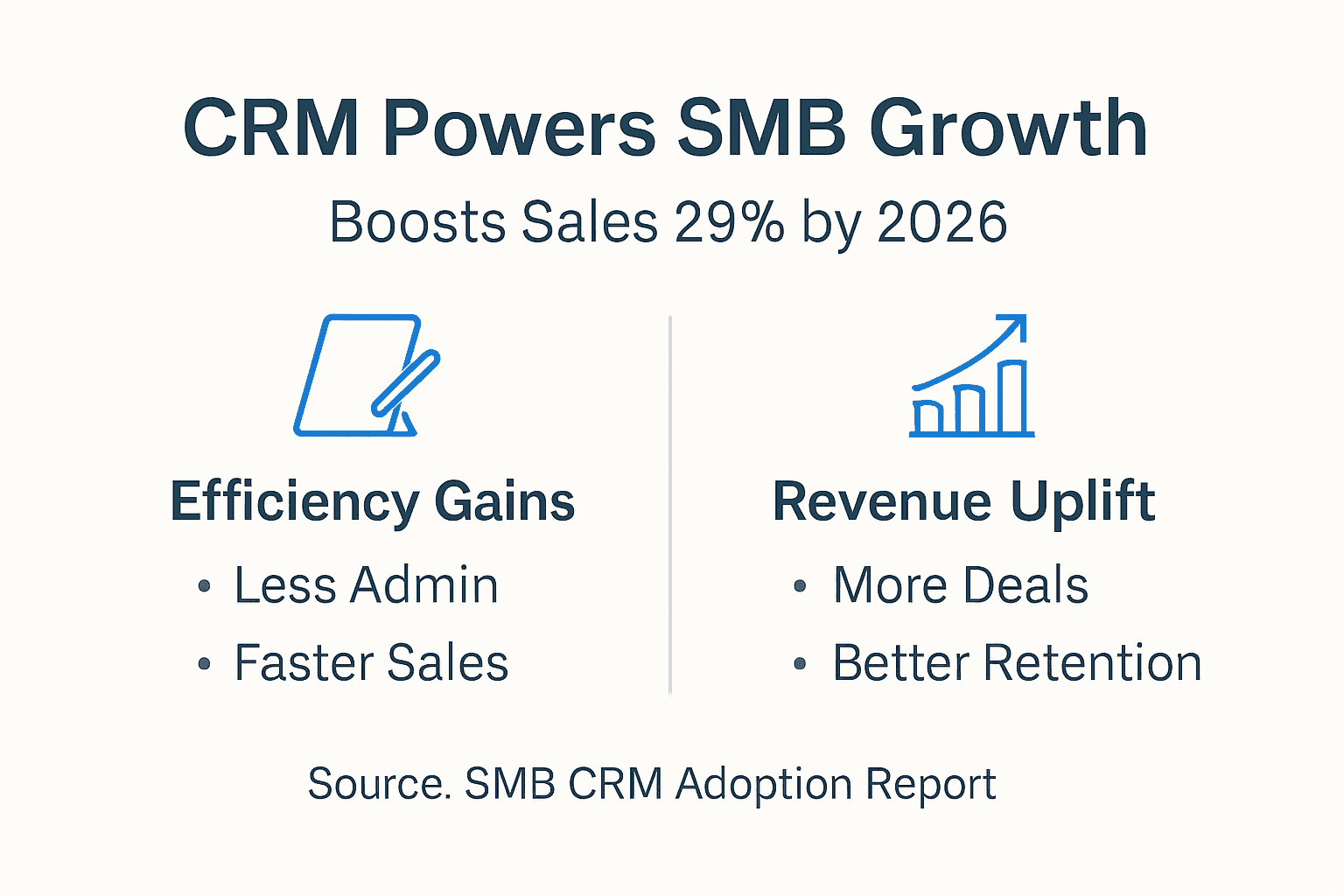
Small businesses using CRM systems see up to a 29% increase in sales revenue due to better customer data organization and automation. Yet many owners struggle with fragmented customer data and assume CRM tools are too costly or complex. This guide explains CRM’s role tailored for small businesses: core functions, affordability, measurable benefits, and practical steps to adopt the right system confidently.
Key Takeaways
| Point | Details |
|---|---|
| CRM drives measurable sales growth | Small businesses see up to 29% sales increases by organizing data and automating follow-ups. |
| Modern SMB CRMs are affordable and simple | Integrated platforms save up to 50% versus multiple tools, busting complexity myths. |
| Integration multiplies growth potential | Connecting CRM with marketing automation boosts lead conversion by 85%. |
| Real support ensures adoption success | Done-for-you setup and human support maximize CRM ROI and user buy-in. |
Understanding CRM and Its Core Functions for Small Businesses
A CRM system is software designed to manage customer data, sales pipelines, and communications in one place. For small businesses, CRM organizes contact details, tracks deals through each pipeline stage, and automates repetitive tasks like follow-up emails or appointment reminders.
Core features that matter most for SMBs include:
- Contact management to store customer history and preferences
- Pipeline tracking to visualize deal progress and forecast revenue
- Communication automation for email sequences and SMS campaigns
- Appointment scheduling integrated directly into your workflow
Small businesses need CRM differently than large enterprises. You lack dedicated IT teams and massive budgets. You need simplicity, not endless customization. Modern SMB-focused CRMs are designed for simplicity and affordability without sacrificing essential features. The trend is clear: platforms now prioritize ease of use and transparent pricing over complexity.
Pro Tip: Choose CRM solutions offering done-for-you setup and real human support to ease adoption. This removes the technical burden and accelerates time to value, so your team can focus on customers instead of configurations.
How CRM Enhances Operations and Sales Efficiency in Small Businesses
CRM transforms daily operations by eliminating manual data entry and repetitive admin work. CRM-driven automation reduces administrative workload by 15-25%, freeing your team to focus on growth activities like prospecting and closing deals. Imagine automated follow-up sequences that nurture leads while you sleep, or appointment reminders that reduce no-shows without lifting a finger.
Pipeline tracking tightens your sales process dramatically. When every deal is visible in one dashboard, you spot bottlenecks fast and coach reps effectively. Studies show sales cycles speed up by 40% when teams use CRM pipeline tools consistently. Faster cycles mean more deals closed per quarter and improved cash flow.
Unified customer data across teams improves coordination and decision-making. Marketing sees which campaigns generate qualified leads. Sales knows exactly when a prospect opened the proposal. Service teams access purchase history instantly. This visibility eliminates duplicate efforts and ensures every customer interaction feels informed and personal.
Key operational improvements include:
- Automated appointment scheduling synced with team calendars
- Follow-up reminders that prevent leads from falling through cracks
- Real-time dashboards showing pipeline health and revenue forecasts
- Task assignments that keep everyone accountable
Statistic Spotlight: CRM automation cuts admin time by 15-25% and accelerates sales cycles by 40%, directly boosting sales for SMBs who implement systems properly.
Benefits of CRM for Customer Relationship Management and Retention
CRM enables personalized engagement at scale. You can segment contacts by behavior, send targeted messages based on purchase history, and follow up at optimal times. This relevance builds trust and loyalty faster than generic outreach ever could.

Retention rates improve by approximately 27% when businesses use CRM to drive consistent, personalized engagement. Existing customers feel valued when you remember their preferences and anticipate their needs. Automated birthday emails, renewal reminders, and exclusive offers keep your brand top of mind without manual effort.
Lead nurturing features increase conversion rates from prospect to customer. Drip campaigns educate leads over weeks, warming them gradually until they’re ready to buy. CRM tracks every interaction, so sales reps know exactly where each prospect stands and can tailor conversations accordingly.
Real case examples demonstrate impact. A coaching business used CRM to automate client onboarding sequences, improving retention by 22% in six months. A salon implemented appointment reminders and post-visit follow-ups, cutting no-shows by 30% and boosting rebooking rates. These results stem from consistent, timely communication that CRM makes effortless.
Key relationship benefits include:
- Personalized email campaigns based on customer behavior
- Automated check-ins that maintain engagement between purchases
- Feedback loops that capture satisfaction data systematically
- Loyalty programs managed through CRM segmentation
Common Misconceptions About CRM for Small Businesses
Many small business owners avoid CRM due to outdated beliefs about complexity and cost. Let’s debunk the most common myths with current facts.
Myth: CRM is too complex for small teams without IT staff.
Fact: Modern CRMs are designed for simplicity and affordability, with intuitive interfaces and done-for-you setups that require zero technical expertise. You can be up and running in days, not months.
Myth: CRM subscriptions are prohibitively expensive for SMBs.
Fact: Integrated all-in-one CRM platforms reduce costs by up to 50% compared to assembling multiple standalone tools. You eliminate redundant subscriptions and integration fees while gaining more functionality.
Myth: Only large enterprises with thousands of customers benefit from CRM.
Fact: Small businesses experience measurable sales increases and retention gains from CRM. The 29% sales boost and 27% retention improvement apply directly to SMBs who implement systems properly.
“The biggest barrier to CRM adoption isn’t cost or complexity anymore. It’s the misconception that these systems are only for big companies. Today’s platforms are built specifically for small businesses, with pricing and features that match real SMB needs.”
Proper onboarding and training are critical to reduce abandonment and maximize ROI. When staff understand how CRM saves them time and helps them sell more, adoption soars. Choose platforms offering free training resources, live onboarding calls, and responsive support to ensure your team succeeds. Debunking these CRM misconceptions opens the door to real growth.
Comparing All-in-One CRM Solutions versus Modular Tool Stacks for SMBs
Small businesses face a critical choice: invest in an integrated all-in-one CRM platform or piece together separate tools for sales, marketing, and operations. Each approach has trade-offs that impact costs, efficiency, and growth potential.
| Feature | All-in-One CRM | Modular Tool Stack |
|---|---|---|
| Subscription Cost | Up to 50% lower total cost due to bundled pricing | Higher cumulative cost from multiple subscriptions |
| Data Integration | Unified data flows automatically across functions | Fragmented data requiring manual syncing or paid connectors |
| User Experience | Single login and consistent interface | Multiple logins and learning curves |
| Setup Complexity | Done-for-you setup with guided onboarding | DIY integration and configuration |
| Support | Centralized support for all features | Separate support tickets across vendors |
| Scalability | Easy to add features as you grow | Complex to integrate new tools later |
All-in-one platforms deliver significant advantages for resource-constrained SMBs. Unified workflows eliminate data silos, so marketing sees which leads sales is nurturing and service teams access complete customer histories instantly. You avoid manual exports and imports that waste time and introduce errors.
Key benefits of integrated CRM solutions:
- Single source of truth for all customer data
- Simplified billing and vendor management
- Faster onboarding with cohesive training materials
- Built-in integrations between marketing, sales, and recruitment tools
Modular stacks offer flexibility but at a cost. You can choose best-of-breed tools for each function, but connecting them requires technical skills or expensive middleware. Data often lives in silos, forcing reps to toggle between screens and reducing productivity. Support becomes fragmented when issues span multiple vendors.
For most small businesses, an affordable all-in-one CRM platform like Go Online Now-Connect delivers better ROI by reducing complexity and costs while providing everything needed to grow.
How Integrating CRM with Marketing Automation and Recruitment Drives SMB Growth
Integrating CRM with marketing automation and recruitment tools multiplies your growth potential. When these systems share data seamlessly, you close more deals faster and build stronger teams with less effort.
Marketing automation software connected to CRM can lift lead conversion rates by up to 85%. Automated email sequences nurture prospects based on their CRM profile and behavior. When a lead reaches a certain score, CRM notifies sales instantly for personalized outreach. This coordination ensures no lead falls through cracks and every prospect receives timely, relevant communication.
Digital recruitment automation integrated with CRM reduces hiring costs by up to 30%. Your CRM tracks candidate interactions, schedules interviews automatically, and manages the entire hiring pipeline just like sales deals. This visibility helps you identify top talent faster and onboard new hires systematically.
Streamlined data across sales, marketing, and HR departments eliminates duplicate data entry and keeps everyone aligned. Marketing sees which campaigns generate qualified leads. Sales knows exactly which content prospects engaged with. HR accesses candidate communication history instantly. This transparency improves decision-making and accountability.
Steps for effective CRM integration:
- Choose a platform offering native marketing automation and recruitment modules
- Map your lead nurturing workflows to trigger CRM actions automatically
- Connect candidate sourcing channels to populate your recruitment pipeline
- Train teams on unified data visibility and cross-functional collaboration
- Monitor conversion rates and hiring metrics to optimize integrated workflows
Pro Tip: Prioritize CRMs offering seamless marketing automation and recruitment modules over platforms requiring third-party connectors. Native integrations are more reliable, easier to maintain, and provide better data consistency.
Practical Steps for SMBs to Implement and Maximize CRM Benefits
Successful CRM adoption requires a clear roadmap from selection through ongoing optimization. Follow these steps to ensure your investment delivers sustained value.
- Assess your business needs by identifying pain points like lost leads, slow follow-up, or fragmented customer data
- Prioritize affordability and simplicity when evaluating CRM platforms, focusing on solutions offering transparent pricing and done-for-you setups
- Select a platform with real human support, not just chatbots or help articles, to guide your team through challenges
- Schedule onboarding training focused on pipeline tracking and automation benefits so staff understand immediate value
- Import existing customer data carefully, cleaning duplicates and incomplete records before migration
- Configure automation for repetitive tasks like appointment reminders, follow-up sequences, and lead scoring
- Set up dashboards tracking key metrics: sales growth, retention rates, and time saved by automation
- Encourage daily CRM use by making it the single source of truth for customer interactions
- Review analytics monthly to identify bottlenecks and optimization opportunities
- Continuously measure sales growth, retention improvements, and admin time reductions to justify ongoing investment
Done-for-you setups remove technical barriers and accelerate time to value. When the vendor configures automations, imports data, and trains your team, adoption rates soar because staff see immediate productivity gains instead of struggling with setup complexity.
Training should emphasize how CRM saves time and helps individual team members hit their goals. Sales reps care about closing deals faster. Marketing wants better lead quality. Service teams need quick access to customer history. Tailor training to show each role exactly how CRM makes their job easier.
Pro Tip: Continuously measure sales growth, customer retention rates, and time saved by automation to adjust CRM usage and demonstrate ROI to stakeholders. What gets measured gets optimized.
Summary and Next Steps: Unlocking Growth with the Right CRM for Your Small Business
CRM systems help small businesses streamline operations, boost sales by up to 29%, and increase customer retention by 27% cost effectively. The key is choosing affordable, integrated platforms that reduce complexity rather than add to it.
Modern all-in-one CRM solutions lower overall costs by up to 50% compared to assembling separate tools while delivering better data consistency and user experience. When CRM integrates seamlessly with marketing automation and recruitment, small businesses unlock even greater growth potential through improved lead conversion and faster hiring.
Effective adoption requires proper onboarding, training, and ongoing support to ensure teams actually use the system daily. Done-for-you setups and real human support dramatically increase success rates compared to DIY implementations.
Now is the time to assess your customer management needs and explore CRM solutions designed specifically for small business growth. The right platform will simplify your operations, accelerate sales, and strengthen customer relationships without breaking your budget or overwhelming your team.
Discover Go Online Now-Connect: Affordable CRM Tailored for SMB Growth
Ready to experience the benefits of affordable SMB CRM with marketing automation? Go Online Now-Connect delivers everything covered in this guide in one simple, transparent platform built specifically for growing small businesses.
Our all-in-one system combines CRM, marketing automation, and recruitment automation for small businesses with done-for-you setup and real human support included at no extra cost. We help SMBs streamline operations, boost sales conversions by up to 85%, and reduce hiring time by 30% through proven automation workflows.
Explore our marketing automation software that boosts SMB conversions and discover tailored packages fitting your budget without complexity or hidden fees. Our Fair Pricing Guarantee means we’ll match or refund any competitor’s price, and you can cancel anytime with no contracts.
FAQ
What features should a small business look for in a CRM?
Prioritize contact management, pipeline tracking, communication automation, and appointment scheduling as core must-haves. Look for platforms offering done-for-you setup, real human support, and transparent pricing without hidden fees. Integration with marketing automation and simple dashboards matter more than endless customization options.
How can small businesses afford CRM without breaking the budget?
Choose integrated all-in-one platforms that bundle CRM, marketing automation, and other tools at a single price, saving up to 50% versus separate subscriptions. Many modern SMB CRMs offer month-to-month plans with no long-term contracts, so you can start small and scale as revenue grows. Fair pricing guarantees and competitor price matching further reduce costs.
What is the best way to onboard staff to ensure CRM adoption?
Focus training on how CRM saves each role time and helps them hit personal goals, not just feature lists. Use done-for-you setups so staff see immediate productivity gains instead of struggling with configuration. Provide ongoing support through live onboarding calls and responsive help channels. Make CRM the required single source of truth for all customer interactions.
Can CRM actually improve customer retention for small businesses?
Yes, CRM improves retention rates by approximately 27% through consistent, personalized engagement that manual processes cannot match. Automated check-ins, renewal reminders, and targeted offers keep customers feeling valued between purchases. CRM tracks preferences and history so every interaction feels informed and relevant, building loyalty over time.
How does CRM integrate with marketing automation and recruitment tools?
Modern all-in-one platforms offer native integrations where CRM, marketing automation, and recruitment modules share data automatically without third-party connectors. Lead scoring in CRM triggers marketing sequences, while candidate interactions populate recruitment pipelines just like sales deals. This unified data visibility improves conversion rates by up to 85% and reduces hiring costs by 30%.