

Most American small businesses discover quickly that customer data can be both a goldmine and a headache. With over 75 percent of small businesses in the United States reporting that consistent customer engagement is their top challenge, finding the right strategy matters. The right Customer Relationship Management approach can take scattered information and turn it into meaningful, actionable insights that lead to better growth and stronger customer loyalty.
CRM for Small Businesses Demystified
Customer Relationship Management (CRM) isn’t just a fancy tech term – it’s the strategic backbone that helps small businesses transform customer interactions into growth opportunities. At its core, a CRM system acts like a sophisticated digital rolodex, tracking every meaningful touchpoint between your business and its customers, from initial contact to long-term relationship management.
For small businesses, implementing a robust CRM can be transformative. According to research exploring CRM adoption by small and medium enterprises, platforms like these enable businesses to enhance customer relationships and increase sales capabilities. The key is finding a system that doesn’t overwhelm but instead simplifies your customer engagement processes. Modern CRM solutions offer features designed specifically for SMBs, including contact management, sales pipeline tracking, communication logging, and automated follow-up tools.
The most effective CRM systems go beyond mere data storage. They provide actionable insights that help small business owners make smarter decisions. These platforms can track customer preferences, purchase history, communication patterns, and potential sales opportunities – all from a single, intuitive dashboard. By centralizing customer information, businesses can personalize interactions, predict customer needs, and ultimately drive more targeted, effective marketing and sales strategies.
Pro Tip – CRM Selection Strategy: Research and test multiple CRM platforms before committing, focusing on ease of use, integration capabilities, and scalability that matches your specific business growth trajectory.
Understanding CRM Essentials for Small Businesses
Successful CRM implementation isn’t about having the most complex system – it’s about finding a tool that seamlessly integrates with your existing workflows and provides clear, actionable insights. Small businesses should prioritize CRM solutions that offer:
- Intuitive user interfaces
- Affordable pricing models
- Flexible contact management
- Basic reporting and analytics
- Easy integration with existing tools
By selecting a CRM that truly understands small business needs, entrepreneurs can transform customer data from a jumble of information into a strategic asset driving meaningful growth.
Different CRM Types for SMB Needs
Navigating the world of Customer Relationship Management (CRM) can feel overwhelming for small businesses, but understanding the different types of CRM systems can help entrepreneurs make more informed decisions. CRM systems are fundamentally categorized into strategic, operational, and analytical types, each serving unique purposes in helping businesses manage and optimize customer relationships.
Strategic CRM focuses on building long-term customer relationships by creating a customer-centric culture. This approach prioritizes understanding customer needs, preferences, and behaviors to develop more personalized interactions. Operational CRM, on the other hand, automates key business processes like sales tracking, marketing campaigns, and customer service workflows. These systems streamline day-to-day operations, helping small businesses reduce manual work and improve efficiency. Analytical CRM takes data-driven insights to the next level, using advanced analytics to help businesses predict customer behavior, identify trends, and make more strategic decisions.
When selecting a CRM, small businesses should consider their specific needs and growth objectives. Comparing different CRM providers can reveal nuanced features that might perfectly match a business’s unique requirements. Some businesses might need robust sales pipeline tracking, while others prioritize customer service management or marketing automation. The key is finding a flexible system that can grow and adapt alongside your business.
Pro Tip – CRM Type Selection: Match your CRM type to your primary business goal – operational for process efficiency, strategic for relationship building, or analytical for data-driven insights.
Key considerations when choosing a CRM include:
- Scalability of the platform
- Integration with existing tools
- User-friendly interface
- Pricing structure
- Specific features aligned with business needs
By understanding these different CRM approaches, small businesses can transform customer data from a complex challenge into a powerful growth strategy.
Here’s a quick comparison of the main CRM types to help guide your selection:
| CRM Type | Main Purpose | Typical Features | Best for Businesses Wanting |
|---|---|---|---|
| Strategic CRM | Build lasting relationships | Personalization tools, feedback | Long-term customer loyalty |
| Operational | Streamline daily processes | Sales automation, task workflows | Higher efficiency and productivity |
| Analytical | Generate actionable insights | Reporting, data analytics | Smarter, data-driven decisions |
Essential CRM Features and Integrations
Choosing the right CRM for a small business requires understanding the core features that can transform customer management from a complicated task to a strategic advantage. Modern CRM systems offer comprehensive tools designed to streamline sales processes, track customer interactions, and provide actionable insights, making them invaluable for businesses looking to grow smarter and more efficiently.
Essential CRM features go far beyond simple contact storage. Lead management capabilities allow businesses to track potential customers through every stage of the sales funnel, from initial contact to conversion. Email tracking features enable teams to monitor communication effectiveness, understanding which messages resonate and which need refinement. Sales pipeline visualization helps entrepreneurs quickly assess potential revenue, identify bottlenecks, and prioritize high-value opportunities. Robust reporting tools transform raw data into meaningful insights, giving small business owners a clear view of their performance and areas for improvement.
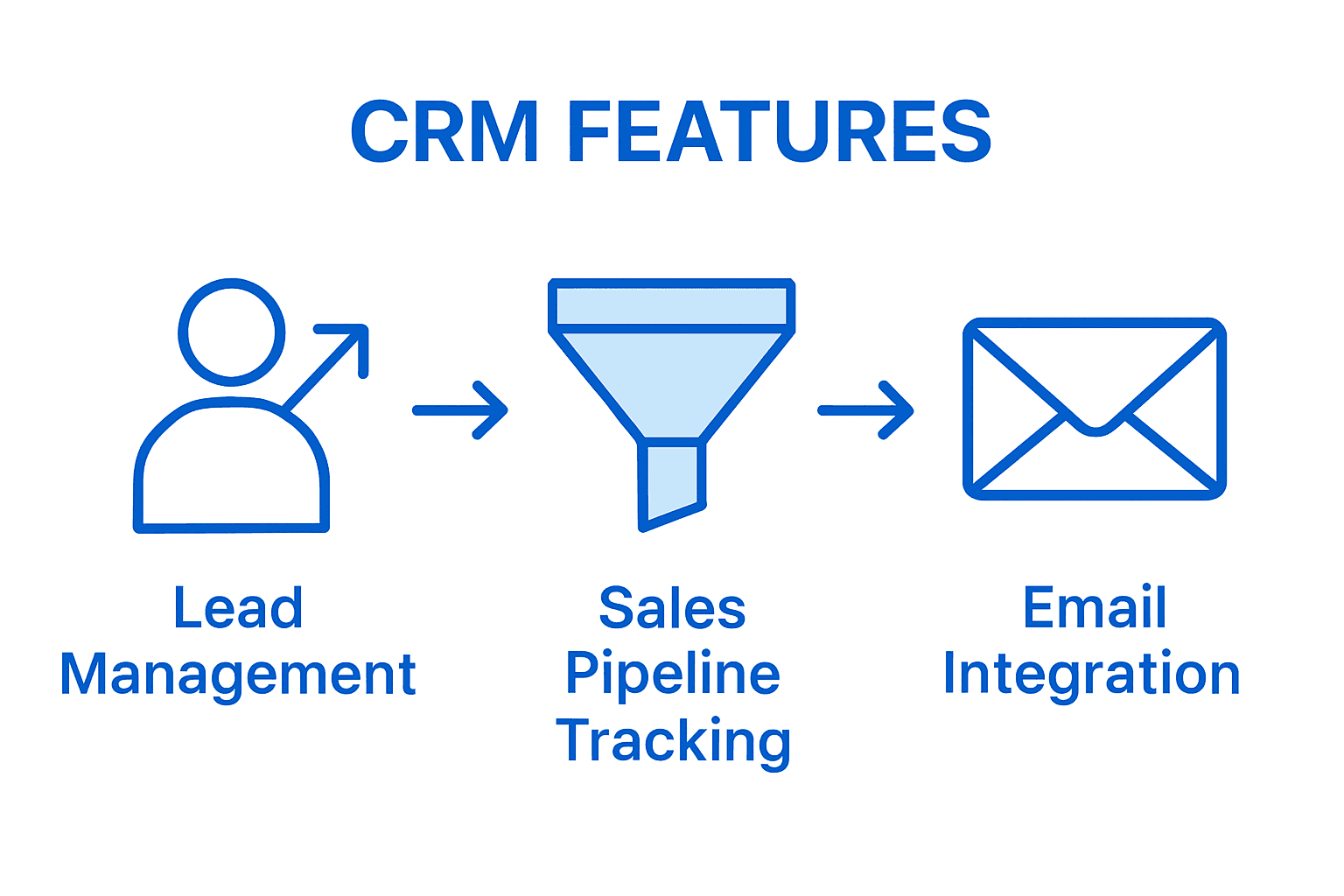
Integration capabilities separate good CRM systems from great ones. The most powerful CRMs seamlessly connect with existing business tools like email platforms, accounting software, marketing automation systems, and communication channels. This interconnectedness eliminates manual data entry, reduces errors, and creates a unified view of customer interactions across different platforms. Small businesses can leverage these integrations to create more personalized customer experiences, automate repetitive tasks, and free up valuable time for strategic thinking and relationship building.
Pro Tip – CRM Integration Strategy: Prioritize CRM platforms that offer native integrations with your most-used business tools, and always test compatibility before full implementation.
Key features small businesses should look for in a CRM include:
- Customizable contact profiles
- Automated follow-up reminders
- Mobile accessibility
- Real-time collaboration tools
- Advanced reporting and analytics
By selecting a CRM with the right mix of features and integrations, small businesses can transform customer data from a overwhelming challenge into a powerful growth engine.
How CRM Drives Sales and Efficiency
Small businesses often struggle with managing customer relationships effectively, but Customer Relationship Management (CRM) systems have emerged as powerful tools for transforming sales processes and operational efficiency. CRM tools provide practical applications that can dramatically streamline customer interactions and sales workflows, helping entrepreneurs focus on growth instead of administrative tasks.

At the core of CRM’s sales impact is its ability to automate and optimize critical business processes. Sales pipeline management becomes significantly more transparent and actionable, allowing businesses to track potential deals from initial contact through closure. Automated follow-up systems ensure no potential customer falls through the cracks, sending timely reminders, personalized emails, and strategic communications that keep prospects engaged. By centralizing customer data, CRM systems eliminate the inefficiencies of scattered spreadsheets and disconnected communication channels, providing a holistic view of each customer’s journey.
Efficiency gains extend far beyond simple contact management. CRM platforms enable businesses to segment customers, create targeted marketing campaigns, and predict sales opportunities with unprecedented precision. Advanced analytics help entrepreneurs understand customer behavior patterns, identify high-value prospects, and allocate resources more strategically. Sales teams can spend less time on administrative work and more time building relationships and closing deals. The result is a more agile, responsive business model that can adapt quickly to changing market conditions and customer needs.
Pro Tip – Efficiency Optimization: Regularly clean and update your CRM data to maintain accuracy and maximize the system’s predictive capabilities.
Key efficiency benefits of CRM implementation include:
- Reduced manual data entry
- Automated communication workflows
- Real-time performance tracking
- Improved team collaboration
- Enhanced customer insights
By leveraging CRM technology strategically, small businesses can transform their sales processes from reactive to proactive, creating a foundation for sustainable growth and customer satisfaction.
Real Costs, Returns, and Common Pitfalls
Navigating the world of CRM investments requires a nuanced understanding of potential returns and hidden challenges that small businesses frequently encounter. Comprehensive CRM comparisons reveal significant variations in pricing, features, and potential business impact, making it crucial for entrepreneurs to approach these platforms with strategic foresight.
The financial investment in a CRM system extends far beyond the monthly subscription price. Implementation costs can include initial setup fees, data migration expenses, staff training, and potential productivity dips during the transition period. Small businesses should anticipate spending between 1% to 3% of their annual revenue on CRM adoption, with additional investments in customization and integration. However, the potential returns can be substantial: businesses often see a 15% to 25% increase in sales productivity and a significant reduction in administrative overhead when CRM systems are correctly implemented.
Consider these potential hidden costs and returns of CRM investment:
| Cost/Return Area | Description | Impact on Small Business |
|---|---|---|
| Data Migration | Moving info from old to new system | Time-consuming, can disrupt work |
| User Training | Educating staff on CRM use | Boosts adoption, avoids confusion |
| Feature Customization | Tailoring CRM to business needs | Improves fit but adds expense |
| Productivity Gains | More sales, less admin time | Increases revenue and efficiency |
Common pitfalls that small businesses must carefully navigate include overcomplicated system selection, poor user adoption, and inadequate data management. Many entrepreneurs make the mistake of choosing a CRM with excessive features that create complexity instead of solving problems. The most effective CRM implementations focus on core functionalities that directly address specific business needs. User training becomes critical, as even the most sophisticated system will fail if team members find it difficult to use. Data quality represents another crucial challenge – inaccurate or incomplete customer information can render a CRM system virtually useless, making consistent data entry and maintenance essential.
Pro Tip – Cost-Benefit Analysis: Calculate your potential CRM return on investment by comparing expected productivity gains against implementation and subscription costs.
Key financial considerations for CRM investment include:
- Total cost of ownership
- Potential productivity improvements
- Staff training requirements
- Integration complexity
- Long-term scalability
By approaching CRM investment with a critical, strategic mindset, small businesses can transform these platforms from expense lines into powerful growth engines that deliver measurable financial returns.
Unlock Smarter Growth With the Right CRM and Marketing Automation
Managing customer relationships without stress is one of the biggest challenges small businesses face today. This article highlights how important it is to use an all-in-one CRM that simplifies lead management, automates follow-ups, and centralizes customer data for smarter decision making. If you want to avoid overwhelming complexity or scattered tools and instead focus on meaningful growth, the key lies in choosing a platform built specifically to meet the needs of SMBs and SMEs.
Go Online Now-Connect is designed to deliver exactly that. Unlike over-engineered and costly systems, it offers an affordable all-in-one CRM combined with marketing automation software that includes email and SMS campaigns, sales pipeline tracking, and appointment scheduling. With real human support and done-for-you setup, it helps businesses save time, reduce errors, and boost conversions without frustration or tech headaches.
Check out how we integrate seamless customer relationship management with effective digital marketing solutions in our Digital Marketing Archives – Go Online Now. Discover how outsourcing key tasks to expert virtual assistants can free up your time in the Virtual Assistance Archives – Go Online Now.
Ready to transform your customer data into a powerful growth engine? Visit Go Online Now today, and see how you can get up to 85 percent more conversions and save 75 percent of your time within 90 days. Start growing smarter now with one simple, affordable platform that puts you in control.
Frequently Asked Questions
What is the purpose of a CRM system for small businesses?
A CRM system helps small businesses manage customer interactions, track sales processes, and improve customer relationships, ultimately transforming customer data into growth opportunities.
What are the different types of CRM systems available for small businesses?
The main types of CRM systems are strategic, operational, and analytical. Each serves a unique purpose: strategic CRMs focus on building relationships, operational CRMs streamline processes, and analytical CRMs provide data-driven insights.
What essential features should a small business look for in a CRM?
Small businesses should prioritize features like lead management, email tracking, sales pipeline visualization, customizable contact profiles, and automated follow-up reminders to enhance customer management.
How can implementing a CRM system improve sales efficiency?
A CRM system automates and optimizes sales processes by centralizing customer data, streamlining communication, and providing actionable insights, which allows businesses to focus more on relationship building and closing deals.