

TL;DR:
- Inbound marketing lead nurturing builds personalized relationships to guide prospects toward purchasing decisions over time. Structured nurture programs convert leads more effectively, lower costs, and keep prospects engaged through multiple touches and channels. Proper segmentation, multi-channel outreach, and alignment between marketing and sales are essential for a successful nurturing strategy.
Inbound marketing lead nurturing is the process of building personalized, ongoing relationships with prospects to guide them toward a purchase decision over time. The industry term for this practice is “lead nurturing,” and it sits at the heart of every effective inbound marketing funnel. Platforms like HubSpot, Marketo, and ActiveCampaign have made this process accessible to businesses of all sizes. Companies that run structured nurture programs generate 50% more sales-ready leads at 33% lower cost per lead. That single finding explains why marketing professionals and SMB owners are prioritizing lead nurturing strategies above almost every other growth tactic in 2026.
What does the evidence say about inbound marketing lead nurturing?
The business case for structured lead nurturing is clear and well-documented. 50%–80% of leads are not ready to buy at the moment they first contact your business. That means the majority of your marketing spend goes toward prospects who need time, education, and trust before they will commit.
Companies that address this reality with formal nurture sequences see measurable results:
- Conversion rate lift: Structured nurture programs convert leads 2–3 times more effectively than businesses with no nurturing process.
- Cost efficiency: The same programs reduce cost-per-lead by 33%, making every marketing dollar work harder.
- Touch frequency: 44% of sales reps stop following up after a single contact, yet it takes an average of eight touches to secure a first meeting.
- Buyer avoidance: 73% of buyers actively avoid outreach they consider irrelevant, which means poor nurturing is worse than no nurturing.
The eight-touch finding deserves special attention. Most SMBs give up far too early. A prospect who downloaded your pricing guide last month and then went quiet is not a dead lead. They are a lead in the middle of a longer decision cycle. A well-designed nurture sequence keeps your business visible and credible throughout that cycle without requiring your sales team to manually follow up every week.
Pro Tip: Track which content assets your leads engage with most. Leads who open case studies are typically closer to a buying decision than leads who only read blog posts. Use that signal to adjust your follow-up timing.
Consistent follow-up, delivered through the right channels at the right intervals, is what separates businesses that close deals from businesses that generate traffic but not revenue. The data supports investing in a formal process rather than relying on individual sales reps to manage follow-up manually.

How does lead nurturing differ from drip marketing?
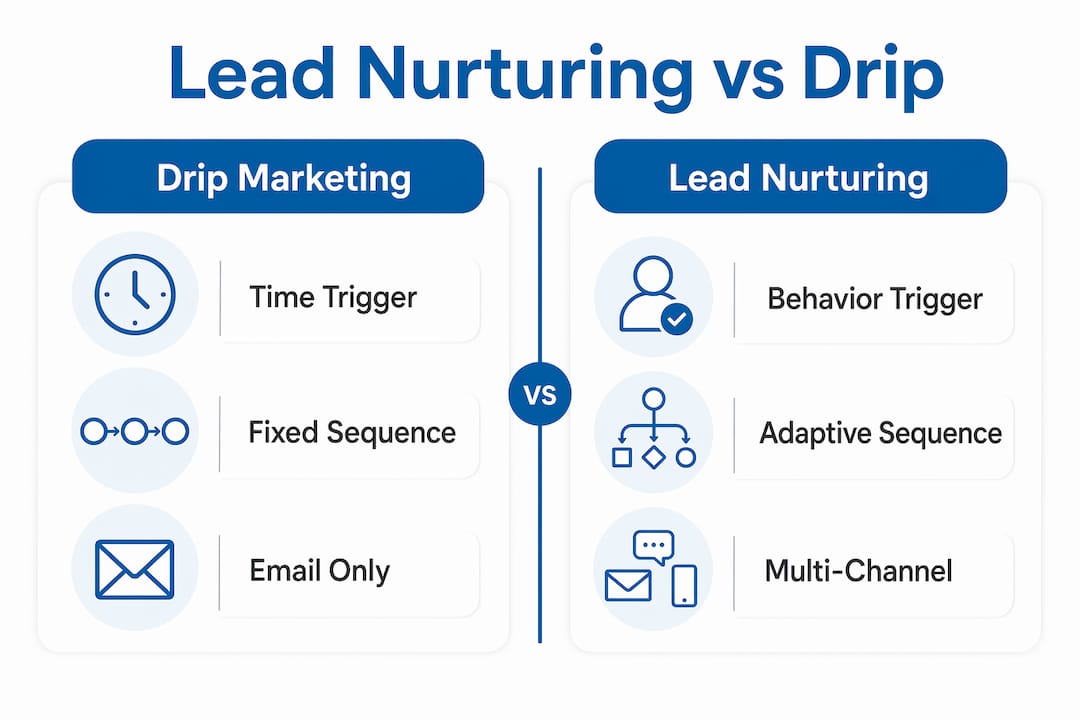
Lead nurturing and drip marketing are related but not the same. Drip marketing sends a fixed sequence of emails on a predetermined schedule, regardless of what the prospect does. Lead nurturing responds to prospect behavior, adjusting content and timing based on actions like page visits, email opens, form submissions, and content downloads.
| Feature | Drip marketing | Lead nurturing |
|---|---|---|
| Trigger | Time-based schedule | Behavior and intent signals |
| Personalization | Name and basic fields | Persona, stage, and engagement history |
| Content | Generic sequence | Stage-aligned, persona-specific content |
| Channels | Email only | Email, LinkedIn, SMS, direct sales outreach |
| Outcome focus | Message delivery | Sales readiness and pipeline progression |
The distinction matters because relevance drives results. A prospect in the awareness stage who receives a pricing comparison email will disengage. A prospect who just attended your webinar and then receives a case study from the same industry is far more likely to respond. Segmentation by persona and buying stage is what makes the difference between a nurture sequence that converts and one that gets ignored.
Lead nurturing also extends beyond email. LinkedIn outreach, SMS follow-ups, and direct sales calls all play a role in a complete nurture strategy. The goal is to meet prospects where they are, not to push them through a channel that works for your team but not for them.
Pro Tip: Build at least three distinct nurture tracks: one for early-stage awareness leads, one for mid-stage evaluation leads, and one for late-stage decision leads. Each track should use different content formats and a different call-to-action intensity.
What are the best practices for an effective nurture strategy?
A strong lead nurturing strategy is built on five core components. Each one addresses a specific failure point that causes nurture sequences to underperform.
-
Segment before you send. Group leads by persona, industry, and buying stage before writing a single email. A real estate agent and a salon owner have different problems, different language, and different timelines. One generic sequence will not serve both.
-
Front-load your cadence. The recommended nurture cadence sends 3–5 emails in the first two weeks, then tapers to weekly or bi-weekly contact. Early engagement is highest right after a lead converts. Use that window to deliver your strongest content.
-
Integrate multiple channels. Email is the backbone, but it should not be the only channel. LinkedIn connection requests, SMS reminders for webinars, and a well-timed sales call all reinforce your message. Multi-channel prospects see your brand consistently, which builds trust faster than email alone.
-
Score leads and trigger handoffs. Lead scoring assigns points based on behavior: email opens, page visits, content downloads, and demo requests. When a lead crosses a defined score threshold, the system automatically alerts a sales rep. This prevents high-intent leads from sitting in a marketing queue while a competitor closes them.
-
Build explicit exit conditions. Every nurture sequence must have exit criteria that remove a lead automatically when they become sales-qualified, request a demo, or initiate direct contact. Without exit conditions, leads receive nurture emails after a sales rep has already started a conversation. That creates confusion and damages trust.
You can find practical nurture strategy examples that apply these principles specifically to SMB growth contexts. The framework above is not theoretical. Each component maps directly to a common failure point that SMBs encounter when they run nurturing without a structured process.
How can SMBs implement automated lead nurturing with CRM tools?
Marketing automation platforms make lead nurturing repeatable and measurable. HubSpot, Marketo, and ActiveCampaign each offer workflow builders that trigger emails, assign lead scores, and notify sales reps based on prospect behavior. The right platform depends on your team size, budget, and technical capacity.
Here is what an effective automated nurture workflow looks like for an SMB:
- Day 1: Lead downloads a guide. Automation sends a welcome email with a related resource.
- Day 3: Lead opens the welcome email. Automation sends a case study matched to their industry.
- Day 7: Lead visits the pricing page. Lead score increases. Sales rep receives an alert.
- Day 10: No pricing page visit. Automation sends a comparison article.
- Day 14: Lead registers for a webinar. Score threshold reached. Lead moves to sales queue.
CRM integration is what makes this workflow useful rather than just automated. Sharing engagement history with sales reps, including which content a lead downloaded, which pages they visited, and which emails they opened, allows sales conversations to start with context rather than a cold introduction. A sales rep who opens with “I saw you read our guide on email automation last week” will always outperform one who opens with “I wanted to check in.”
Marketing and sales alignment around clear definitions of Marketing Qualified Lead and Sales Qualified Lead is the operational foundation of this process. Without agreed definitions, leads fall through the gap between teams. Marketing thinks sales is following up. Sales thinks the lead is not ready. The prospect moves on to a competitor.
| Metric to track | Why it matters |
|---|---|
| Email open rate | Measures subject line and send-time effectiveness |
| Click-through rate | Shows content relevance to the lead’s stage |
| Lead score progression | Tracks movement toward sales readiness |
| Time to MQL | Reveals how long your nurture cycle takes |
| MQL-to-SQL conversion rate | Measures handoff quality between teams |
Avoiding “black hole” sequences is a practical priority for every SMB. Failing to apply exit criteria creates situations where a lead who booked a demo last Tuesday still receives a top-of-funnel awareness email on Thursday. That kind of disconnect signals to the prospect that your business does not pay attention. It is a credibility problem, not just a process problem. You can review a lead management checklist to make sure your automation covers every stage of the lead lifecycle.
What I have learned from watching SMBs build nurture systems
Working with SMBs across coaching, real estate, and professional services, I have seen one pattern repeat itself more than any other. Teams invest in the technology and then skip the strategy. They connect HubSpot or ActiveCampaign, build a five-email sequence, and call it a nurture program. Six months later, they wonder why conversion rates have not moved.
The technology is not the hard part. The hard part is deciding what to say, to whom, and when. Personalization beyond inserting a first name requires you to actually understand your buyer’s decision process. What questions do they ask before they buy? What objections do they raise? What content format do they prefer? Those answers come from talking to customers, not from configuring software.
The second pattern I see is teams that treat nurturing as a marketing responsibility and hand leads to sales with no context. Sales reps receive a name and an email address. They have no idea what the lead read, what problem they are trying to solve, or how close they are to a decision. That handoff wastes the entire investment made in nurturing. The fix is simple: share the engagement history. Make it a non-negotiable part of your CRM setup.
The businesses that get lead nurturing right treat it as a cross-functional process, not a marketing campaign. Marketing builds the sequences. Sales provides feedback on lead quality. Both teams agree on what a qualified lead looks like before the first email goes out. That alignment is what turns a nurture program into a revenue engine.
— Go
How Goonlinenow supports your lead nurturing process
Goonlinenow builds marketing automation specifically for SMBs that want results without the complexity of enterprise platforms.
The Goonlinenow platform combines email automation, CRM, lead scoring, and pipeline tracking in one system. Every nurture sequence you build includes behavior-based triggers, segmentation by buyer stage, and automatic sales handoff when a lead crosses your defined threshold. Setup is done for you by the Goonlinenow team, so you are not spending weeks configuring workflows before your first email goes out. Explore the marketing automation software built for SMB conversions, or review proven ROI outcomes from businesses that have already made the switch.
FAQ
What is inbound marketing lead nurturing?
Inbound marketing lead nurturing is the process of sending personalized, behavior-triggered communications to prospects over time to guide them toward a purchase decision. It differs from generic email blasts by responding to what each lead actually does rather than following a fixed schedule.
How many touches does it take to convert a lead?
It takes an average of eight touches to secure a first sales meeting, yet 44% of sales reps stop after just one follow-up. A structured nurture sequence automates those touches so no lead is abandoned too early.
What is the best email cadence for lead nurturing?
The most effective cadence sends 3–5 emails in the first two weeks, then tapers to weekly or bi-weekly contact. Front-loading engagement captures leads when their interest is highest.
How does lead scoring work in a nurture program?
Lead scoring assigns points to prospect behaviors such as email opens, page visits, and content downloads. When a lead reaches a defined score, the system triggers a sales alert or moves the lead into a sales queue automatically.
What is the difference between an MQL and an SQL?
A Marketing Qualified Lead is a prospect who meets marketing criteria for engagement and fit. A Sales Qualified Lead has demonstrated buying intent and is ready for direct sales contact. Clear definitions of both are required for a smooth handoff between marketing and sales teams.