

TL;DR:
- Modern sales funnels require automation to improve efficiency and conversion rates.
- Essential tools include CRM, landing pages, email automation, and analytics platforms.
- Continuous optimization and data analysis are key to long-term funnel success.
Many small businesses invest real money in marketing, only to watch leads quietly disappear before they ever become customers. The problem is rarely the marketing itself. It’s the funnel, or the lack of one. Without a clear, automated path from first contact to final sale, prospects fall through the cracks every single day. This guide walks you through exactly how to build a modern, automated sales funnel in 2025 that actually converts. From choosing the right tools to measuring what works, you’ll get a practical, step-by-step approach designed for SMBs that want results without the complexity.
Key Takeaways
| Point | Details |
|---|---|
| Modern funnel essentials | Automated sales funnels boost conversions by streamlining lead management for SMBs in 2025. |
| Choose the right tools | An integrated CRM, landing page software, and email automation are necessary to support your funnel from end to end. |
| Follow a structured process | Break down your funnel build into clear steps for consistent, fast results and improved ROI. |
| Continuously optimize | Monitoring and adjusting your funnel with data leads to higher performance and fewer lost leads. |
Understanding modern sales funnels
A sales funnel is the structured path a prospect takes from first hearing about your business to making a purchase. Think of it as a journey with four key stages: awareness (they discover you), interest (they want to learn more), decision (they compare options), and action (they buy). Each stage requires a different type of message and a different level of engagement.
For SMBs in 2025, the biggest shift is that this journey now needs to be largely automated. Customers expect fast responses, personalized communication, and a smooth experience across every touchpoint. If your process still relies on manual follow-ups and spreadsheets, you’re already behind. Staying competitive means embracing 2025 automation trends that allow you to engage more leads with less effort.
The data backs this up. 75% of SMBs using automation have improved their lead generation outcomes. That’s not a marginal gain. That’s a fundamental shift in how growing businesses operate.
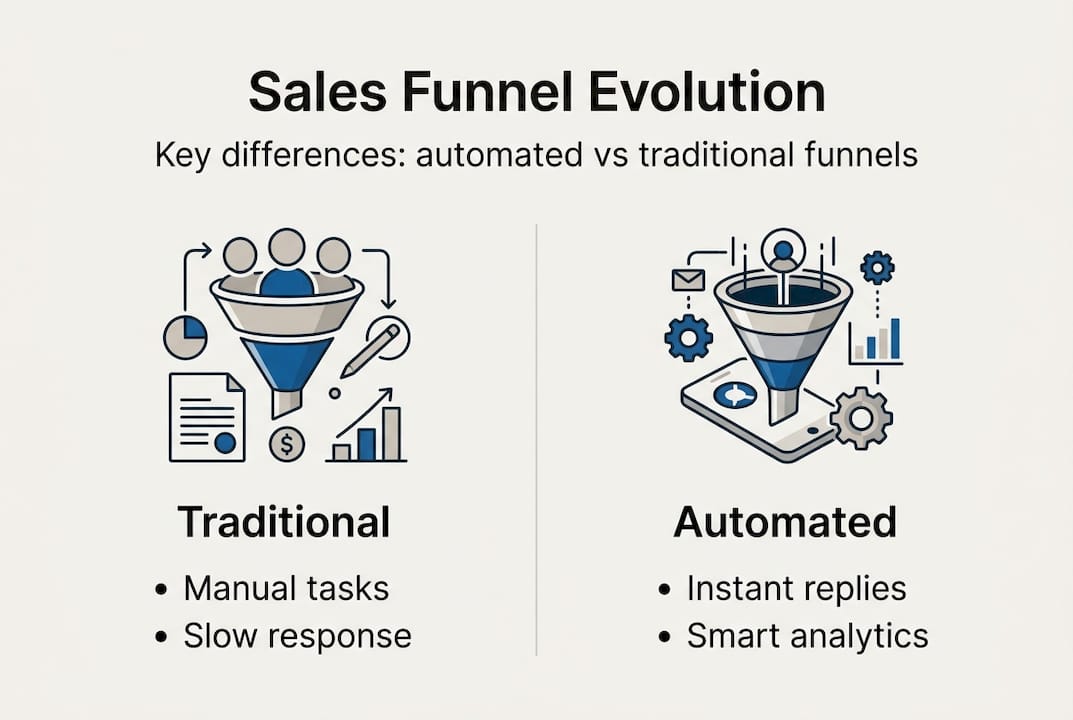
Here’s a quick comparison of traditional versus modern sales funnels:
| Feature | Traditional funnel | Automated funnel |
|---|---|---|
| Lead follow-up | Manual, often delayed | Instant, triggered automatically |
| Personalization | Generic messaging | Behavior-based, segmented |
| Reporting | Spreadsheets or guesswork | Real-time analytics dashboards |
| Scalability | Limited by team size | Scales without adding headcount |
| Cost over time | Higher labor costs | Lower cost per lead |
The advantages of an automated funnel go beyond saving time. You get data-driven decisions at every stage, which means you stop guessing what’s working and start acting on real numbers. Conversion rates improve because the right message reaches the right person at the right moment. Sales velocity, meaning how quickly a lead moves from first contact to closed deal, increases significantly when automation handles the repetitive steps.
Following best funnel practices for 2025 means building a system that works for you around the clock, not just during business hours. That’s the real power of a modern funnel.
What you need to build your sales funnel
Before you build anything, you need the right tools in place. Trying to patch together a funnel from disconnected apps is one of the most common mistakes SMBs make. It creates data gaps, manual work, and a frustrating experience for both your team and your leads.
Here are the core tools every SMB needs:
- CRM (Customer Relationship Management): Tracks every contact, conversation, and deal stage in one place.
- Landing page builder: Creates focused pages designed to capture leads or drive a single action.
- Email automation platform: Sends the right emails at the right time based on lead behavior.
- Analytics suite: Measures performance at every funnel stage so you can make informed decisions.
Automated tools and CRM integration streamline each stage of the customer journey, reducing the manual handoffs that cause leads to go cold. When your tools talk to each other, your funnel runs smoother.
Here’s a practical breakdown of what each tool does for your SMB:
| Tool type | Key features | SMB use case |
|---|---|---|
| CRM | Contact management, pipeline tracking | Follow up with leads systematically |
| Landing page builder | Templates, A/B testing, forms | Capture leads from ads or social media |
| Email automation | Triggers, sequences, segmentation | Nurture leads without manual effort |
| Analytics suite | Conversion tracking, drop-off reports | Identify where leads are leaving |
On the human side, you don’t need a large team to get started. One person who understands your customer and can write clear, direct copy can launch a basic funnel. Budget two to four weeks for initial setup if you’re starting from scratch, and plan for ongoing refinement as you gather data.
Review the marketing automation success guide to understand which platforms fit your specific business model before committing to a subscription.
Pro Tip: Start with a single, all-in-one platform rather than stitching together five separate tools. It keeps costs predictable and eliminates the integration headaches that slow most SMBs down. As your business grows, a unified platform scales with you without forcing a painful migration later. Learn how to automate marketing tasks efficiently from day one.
Step-by-step process for building your sales funnel
Building a funnel is not complicated when you follow a clear sequence. Here’s how to do it:
- Map your customer journey. Start by writing out every step a lead takes from first discovering your business to making a purchase. Identify where they get stuck or drop off today.
- Select and connect your software. Choose your CRM, landing page builder, email tool, and analytics platform. Make sure they integrate or use a single platform that combines all four.
- Build your landing pages. Create a focused page for each stage of your funnel. Your awareness-stage page should capture attention. Your decision-stage page should address objections and make it easy to act.
- Set your email triggers. Define what actions cause an email to send. A new form submission, a page visit, or a link click can all trigger a personalized follow-up sequence automatically.
- Segment your leads. Not every lead is the same. Group them by behavior, industry, or interest level so your messaging stays relevant. Automated marketing increases sales opportunities because it treats each lead as an individual, not a number on a list.
- Set up your analytics. Before you go live, make sure you’re tracking conversion rates at each stage, email open and click rates, and the total cost per acquired customer. Review the automation ROI guide to set meaningful benchmarks.
- Launch and monitor. Go live, then watch your data closely for the first two weeks. Look for drop-off points and respond quickly.
Use a lead management checklist to make sure nothing falls through the cracks during setup.

Pro Tip: Before a full rollout, test your landing pages and email sequences with a small segment of your audience, around 10 to 15% of your list. This gives you real feedback without risking your entire lead pool on an untested message.
Optimizing and troubleshooting your sales funnel
Launching your funnel is just the beginning. The businesses that see the biggest results are the ones that treat their funnel as a living system, not a finished product.
Start by tracking these key metrics every week:
- Drop-off rates at each funnel stage (where are leads leaving?)
- Email open rates (is your subject line compelling?)
- Click-through rates (is your email content driving action?)
- Landing page conversion rates (is your offer clear and persuasive?)
- Time to conversion (how long does it take a lead to become a customer?)
Here are the most common funnel problems and how to fix them quickly:
- Low email open rates: Test new subject lines. Personalize with the lead’s first name or reference their specific interest.
- High landing page bounce rates: Simplify the page. One message, one call to action. Remove distractions.
- Broken automation sequences: Audit your triggers monthly. A single misconfigured trigger can silently stop your follow-up from reaching leads.
- Poor lead segmentation: If everyone gets the same message, engagement drops. Revisit your segments and tighten your criteria.
- Unclear offer: If leads aren’t converting, your value proposition may not be specific enough. Get more direct about what they gain and what it costs.
- No social proof: Add testimonials or case studies at the decision stage. Leads need to trust you before they buy.
“Continuous adjustment, based on analytics, separates growing SMBs from those stuck in neutral.”
Businesses using analytics and iterative optimization report up to 30% higher conversion rates. A/B testing is your best friend here. Test one variable at a time, whether it’s a headline, a button color, or an email send time, and let the data guide your next move. Small improvements compound fast.
Also track how automation improves SMB lead generation over time. Comparing your month-one results to month-six results will show you exactly how much your system has improved.
What most sales funnel guides miss in 2025
Here’s something most funnel guides won’t tell you: building a sales funnel is not a project you finish. It’s a process you maintain. The businesses that struggle most are the ones that set up their funnel, declare it done, and then wonder why results plateau six months later.
Real growth comes from staying curious about your data and genuinely caring about the customer experience at every stage. It’s less about chasing the latest funnel hack and more about shortening the feedback loop between what you test and what you learn.
The good news is that affordable, scalable automation is far more accessible in 2025 than it was even three years ago. You don’t need an enterprise budget or a technical team. What you do need is consistency and a willingness to adjust based on what your numbers tell you.
Focus on speed of feedback and relationship quality. Those two things, grounded in the right automation trends perspective, will take you further than any trendy tactic.
Automate your growth with affordable sales funnel tools
If you’re ready to move from theory to action, Go Online Now-Connect gives SMBs everything they need to build, automate, and optimize a high-converting sales funnel in one place.
Our platform combines affordable automation software with a built-in CRM, email automation, landing page tools, and real-time analytics, all configured for you by our team at no extra cost. You don’t need to figure it out alone. Whether you’re starting from scratch or improving an existing funnel, explore the automation ROI benefits our clients experience within 90 days. See how our software for SMB growth can become the engine behind your next stage of growth.
Frequently asked questions
What are the main stages of a sales funnel?
The main stages are awareness, interest, decision, and action, guiding prospects from discovery to becoming customers. Each stage requires tailored messaging to move leads forward effectively.
Which tools are essential to build an automated sales funnel for SMBs in 2025?
Key tools include a CRM, email automation, landing page builder, and analytics suite that integrate seamlessly. CRM integration ensures every stage of the customer journey is connected and trackable.
How do I know if my sales funnel is working?
Track metrics like conversion rates, email engagement, and customer drop-off to measure and improve funnel performance. Analytics and iterative optimization can lift conversion rates by up to 30%.
Why is automation important for sales funnels in 2025?
Automation boosts productivity, ensures timely follow-up, personalizes outreach, and increases the number of leads you can nurture without adding headcount. 75% of SMBs using automation report improved lead generation outcomes.
Recommended
- How to Create Sales Funnels That Convert Customers – Go Online Now
- Funnels in Customer Acquisition: Unlocking 85% More Conversions – Go Online Now
- Small business sales workflow guide for 2026 growth – Go Online Now
- How to Nurture Leads Effectively for Real SMB Growth – Go Online Now
- Lead Generation Strategies for Business Growth Success | Ibrandmedia