

TL;DR:
- Structured content marketing methods that leverage automation and consistency enable small businesses to achieve nearly three times higher ROI in 2026 without requiring large teams or budgets. These methods involve systematic processes for ideation, creation, distribution, and measurement, emphasizing automation of repetitive tasks while maintaining human oversight for strategy and voice. Prioritizing quality combined with steady publishing and multi-channel distribution enhances lead generation and long-term growth for SMBs.
Small businesses that embrace a structured content marketing method consistently outperform competitors who rely on ad spend alone. Median B2B content ROI in 2026 sits at 287%, which means thoughtful content, distributed through the right channels, can return nearly three times your investment. The catch? Most small business owners assume these results require large teams and large budgets. They don’t. With the right approach and the right automation tools, affordable and repeatable content marketing is within reach for any SMB, regardless of industry or team size.
Key Takeaways
| Point | Details |
|---|---|
| Automation with Oversight | Automate repetitive content tasks, but keep humans in charge of strategy and brand voice. |
| Focus on ROI Metrics | Always measure content effectiveness by conversions and pipeline—not just awareness metrics. |
| Blend Quality and Consistency | Frequent, multi-channel publishing plus differentiated quality content earns the best ROI in 2026. |
| Avoid Common Traps | Don’t ignore mid-funnel or decision content; align automation with real buyer journeys. |
| All-in-One Tools Help | Integrated platforms make best-practice methods affordable and easy to run for SMBs. |
What is a content marketing method?
A content marketing method is not simply “writing a blog post” or “posting on social media.” It is a systematic, repeatable process for planning, creating, distributing, and improving content over time. The key word here is repeatable. A one-off campaign is not a method. A method is something you can run consistently, measure clearly, and improve steadily.
For smaller businesses, the challenge has always been bandwidth. You may have one person managing marketing alongside five other responsibilities. That is exactly where modern methods become valuable, because they are designed to separate the tasks a machine can handle from the decisions only a human should make.
Content marketing automation is defined as software handling the repetitive lifecycle tasks: research support, brief generation, scheduling, performance reporting, and content refresh reminders. Human oversight, however, remains essential for strategy and brand voice. No algorithm knows your customers the way you do.
“Automation supports efficiency, not strategy. The moment you automate your thinking, you lose the one competitive advantage no tool can replicate: your unique perspective.”
The core stages of any solid content marketing method look like this:
- Ideation: Research audience questions, trending topics, and competitor gaps
- Creation: Draft, edit, and format content with consistent brand voice
- Distribution and scheduling: Publish and share content across the right channels at the right times
- Reporting: Track what is working, identify what is not, and adjust
When you are automating marketing tasks within this framework, the method becomes scalable without becoming impersonal.
Core content marketing methods that drive results
With the definition clear, let’s break down the actionable methods you can use and how they truly perform. Not every method works equally well for every business, so understanding the trade-offs matters.
Here are the four most effective methods for SMBs in 2026:
-
Blog and SEO publishing: Consistent blog content optimized around specific search terms builds organic traffic over time. The key is to pick topics your buyers are actively searching for, not just topics that feel interesting to you. Use scheduling tools to maintain a publishing cadence without scrambling every week.
-
Automated email sequences: These are trigger-based nurture journeys that send the right message based on what a contact does, such as downloading a guide, visiting a pricing page, or clicking a product link. Unlike broadcast emails, sequences feel personal because they respond to real behavior. Well-designed automated campaign examples show open rates 2 to 3 times higher than generic newsletters.
-
Social media automation: Batching and scheduling your social content in advance removes the daily scramble. You plan one afternoon per week, schedule two weeks of posts, and let the tool handle distribution. You still monitor comments and engagement manually because that interaction is what builds community.
-
Multi-channel repurposing: Take one well-researched piece of long-form content and turn it into a short video, an email tip, three social posts, and an infographic. This approach multiplies your reach without multiplying your workload.
Empirical benchmarking for B2B shows that focusing on distribution and measuring conversions is associated with better outcomes than over-indexing on awareness alone. Publishing content that no one sees is wasted effort. Distribution is where most SMBs underinvest.
| Method | Manual effort | With automation | Estimated cost reduction | Key result |
|---|---|---|---|---|
| Blog and SEO | High | Medium | 30 to 40% | Organic traffic growth |
| Email sequences | High | Low | 50 to 60% | Lead nurture and conversions |
| Social media | Medium | Low | 40 to 50% | Brand visibility and engagement |
| Content repurposing | Medium | Medium | 25 to 35% | Reach across multiple channels |
Explore real-world marketing automation use cases to see how these methods translate into actual business results across different industries.
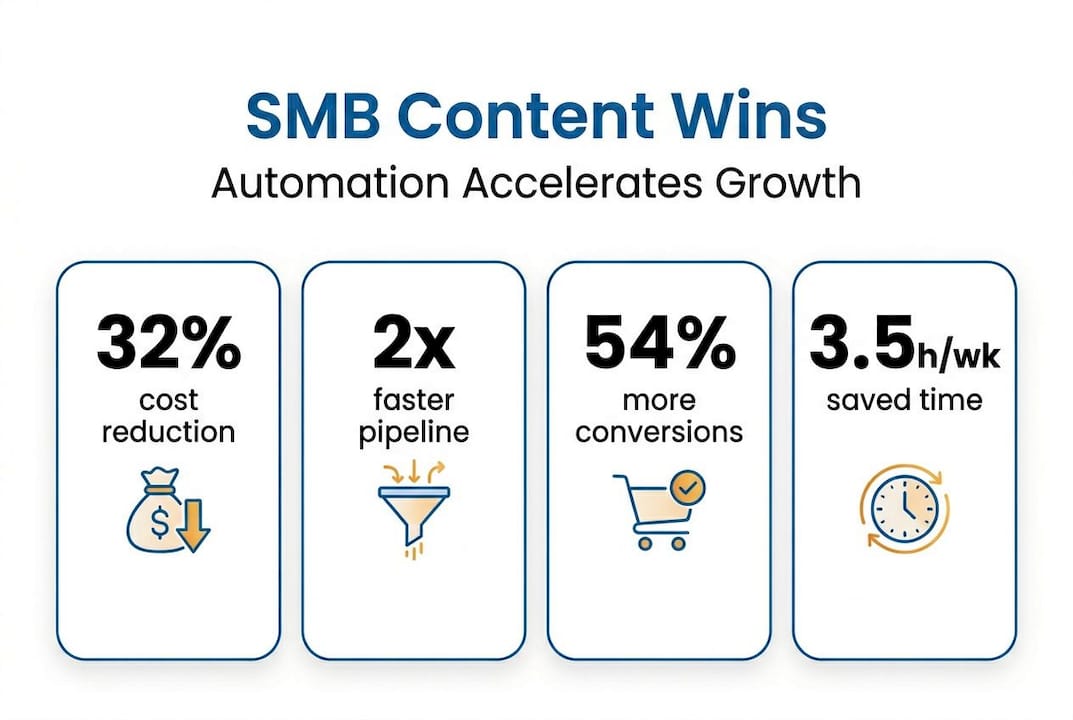
Pro Tip: Don’t judge your content performance by likes or impressions alone. Track how many leads entered your pipeline, requested a demo, or made a purchase as a direct result of your content. That is the number that actually matters.
How to automate your content marketing method affordably
Once you know which methods matter, here’s how to implement automation so your efforts scale without breaking your budget. Automation does not have to mean expensive enterprise software. Many affordable tools deliver impressive results for small teams.
Follow this step-by-step process to get started:
-
Audit your current tasks. List every recurring content task you do weekly. Research, writing, formatting, scheduling, emailing, and reporting are the most common. Circle the ones that feel repetitive.
-
Prioritize high-volume, low-decision tasks. Scheduling social posts, sending follow-up emails, and generating performance reports are prime automation targets. Strategic decisions like campaign direction and messaging tone are not.
-
Select affordable tools. Many all-in-one platforms combine email automation, CRM, and scheduling in one subscription. This is far more cost-effective than paying separately for five tools that don’t communicate with each other.
-
Build trigger-based workflows. Automation should be trigger-based, meaning it responds to specific actions such as a page visit, a download, or a form submission. Tie those triggers to your CRM and lead scoring so the right content reaches the right person at exactly the right moment.
-
Assign a human review checkpoint. Before any content goes live or any sequence launches, a real person should check it. Automated output can drift from your brand voice faster than you expect.
-
Track, adjust, and improve monthly. Review your automation performance every 30 days. Open rates, click rates, and pipeline movement will tell you what is working and what needs adjustment.
A budget-conscious automation approach automates repetitive lifecycle tasks, including research support, scheduling, reporting, and content refresh, while keeping humans in charge of strategy and voice. This balance is what separates businesses that grow sustainably from those that automate themselves into irrelevance.
| Task | Manual time per week | Automated time per week | Annual time saved |
|---|---|---|---|
| Email follow-ups | 4 hours | 30 minutes | 182 hours |
| Social scheduling | 3 hours | 45 minutes | 117 hours |
| Performance reporting | 2 hours | 20 minutes | 88 hours |
| Content distribution | 2.5 hours | 30 minutes | 104 hours |
Learning to optimize automating marketing workflows at this level can give small teams the output capacity of a much larger department. It is one of the most significant advantages available to SMBs right now.
Pro Tip: When setting up automation, always layer in a human quality check. Automated content that sounds robotic or off-brand can actively hurt your reputation. One 15-minute review saves hours of cleanup. Read more about scaling efficiently with marketing automation for small teams.
Choosing quality vs. quantity: What works best in 2026?
With strategy and automation covered, let’s tackle how much content you really need, and what is proven to work best right now. This debate has been going on for years, but 2026 data gives us a clearer picture.
The case for quality over quantity:
- Fewer, deeply researched pieces build more authority than dozens of thin posts
- High-quality content earns backlinks, which drive long-term SEO value
- Detailed guides and case studies align more closely with buyer decision stages
- Raising content standards and prioritizing proprietary, data-backed pieces is increasingly seen as the winning edge
The case for consistency over perfection:
- Companies publishing 2+ times weekly generate significantly more leads than monthly publishers
- Regular publishing builds algorithmic trust on search engines and social platforms
- Multi-channel amplification increases conversions and keeps your brand visible
- Consistency signals reliability to your audience, which builds trust over time
The data suggests neither extreme wins. The blended model is the most effective approach for SMBs in 2026. Publish at a steady cadence, but prioritize quality at each publishing moment. Avoid volume for its own sake. Every piece should serve a clear purpose in your buyer’s journey.
“Quality is the ticket in, but consistency is the engine that actually drives the vehicle. Without both, you stall.”
The benefits of marketing automation become most visible when you apply them to a blended approach. Automation handles the logistics of consistency, while your team focuses on the quality of each piece.

Avoiding common pitfalls in your content marketing method
Even a great method can fail if you fall into common traps. Here is what to watch out for and how to sidestep expensive missteps before they cost you time and pipeline momentum.
The most common mistakes SMBs make:
-
Only creating awareness content. Blogs and social posts are valuable, but funding only awareness formats without investing in mid-funnel and bottom-of-funnel content means your pipeline stalls before leads ever reach a decision. Case studies, comparison pages, and FAQ content serve buyers who are close to choosing.
-
Over-automating tone and personalization. Automation is powerful, but the moment your emails start sounding like they were written by a machine, engagement drops. Always keep a human voice in your messaging, especially in direct communications.
-
Neglecting content refresh. Content decays. A blog post that ranked well 18 months ago may now be losing traffic because search intent shifted or competitors published stronger versions. Build a monthly review into your process to update, expand, or redirect older pieces.
-
Measuring the wrong metrics. Vanity metrics like follower counts and impressions feel good but rarely connect to revenue. Track lead quality, pipeline influence, and conversion rates instead.
Pro Tip: Map every piece of content to a specific stage in your buyer’s journey: awareness, consideration, or decision. If you look at your content library and everything sits in the awareness column, that is a signal to shift resources toward mid-funnel and bottom-of-funnel formats. Learn how to start optimizing your automation process to support all stages of your funnel effectively.
A practical perspective: What most content marketing advice misses for SMBs
Most content marketing guides are written for marketing teams with dedicated strategists, designers, and budget approval cycles. They assume you have time to A/B test subject lines for two weeks before sending an email. That is not the reality for most small business owners, and that gap is where most advice breaks down.
Here is what we have seen consistently across SMB growth cases:
-
Bandwidth is the real bottleneck, not budget. Most SMBs can afford the tools. What they cannot afford is the time to learn, configure, and manage them while running a business. This is exactly why done-for-you setup and real human support matter more than feature lists.
-
Consistency beats brilliance every single time. We have watched businesses publish imperfect content on a reliable schedule and outperform competitors who spent months perfecting one campaign that launched late. Momentum compounds. Perfectionism stalls it.
-
The businesses that grow predictably are the ones that automate the grunt work and protect their human voice. They use automation to handle scheduling, reporting, and follow-ups. They use their own expertise to shape strategy, tell their story, and connect with customers authentically.
“The most effective content marketing for SMBs is not the most sophisticated. It is the most consistent, the most human, and the most deliberately connected to real buyer decisions.”
Reviewing a solid digital marketing workflow guide can help you build a structure that works within your real constraints, not an idealized version of your business.
How all-in-one platforms help SMBs win with content marketing methods
Ready to put these lessons to use? Innovative all-in-one platforms now make the best methods and automation accessible to businesses of any size.
At Go Online Now-Connect, we built our platform specifically for small and mid-sized businesses that are done with overpriced, overcomplicated tools. Our system combines email and SMS automation, a full CRM, pipeline tracking, and content distribution in one place, with done-for-you setup included. No scattered subscriptions. No steep learning curves. You get marketing automation for SMBs that is ready to launch from day one. Our clients regularly report faster time savings and stronger lead conversion within the first 90 days. Check out the proven marketing ROI our platform delivers, and explore integrated marketing tools built for real business growth without the enterprise price tag.
Frequently asked questions
What is the best content marketing method for SMBs in 2026?
A blended approach combining consistent publishing, multi-channel distribution, and smart automation delivers the best results for most SMBs, with median B2B content ROI reaching 287% when both consistency and quality are prioritized.
Does automation replace the need for a content strategist?
No. Automation handles repetitive tasks like scheduling and reporting, but human oversight is essential for brand voice, campaign strategy, and ensuring content remains relevant and authentic.
How do I measure content marketing ROI effectively?
Track conversions and pipeline influence rather than surface metrics like clicks, since focusing on distribution and conversions is consistently associated with better business outcomes than measuring awareness alone.
What is the risk of only creating awareness content?
Funding only awareness formats without investing in mid-funnel and decision-stage content causes pipeline attribution to stall, meaning leads don’t progress toward a purchase even when your brand visibility is high.