

TL;DR:
- Effective small business advertising relies on building a strong organic foundation before investing in paid campaigns to maximize return on investment. Success depends on selecting the right channels, setting a proper budget, and testing campaigns over a 60 to 90-day period. Consistency, patience, and focusing on one or two platforms enable better engagement and measurable growth.
Advertising your small business is the combination of organic marketing and targeted paid campaigns that turns strangers into paying customers. The most effective approach builds a credible organic foundation first, then uses paid channels to accelerate what already converts. Skip that order, and you burn budget on ads that land on a weak website with no social proof. Get it right, and every dollar you spend works harder.
Google Business Profile, Facebook Ads, Instagram, and email marketing are the core tools most small businesses need. Success depends on choosing the right channels for your audience, committing enough budget to gather real data, and testing one platform at a time before scaling.
What must small businesses do before advertising?
Paid ads amplify what already converts. That single principle separates businesses that profit from ads and those that waste money on them. Before you spend a dollar on paid promotion, these foundations must be in place.
- Google Business Profile: A fully optimized Google Business Profile is the most effective free local advertising channel available. First customers typically arrive through organic sources like personal networking and community outreach, not paid ads. Claim your profile, add photos, collect reviews, and keep your hours current. Get a free GBP audit to see exactly where your profile falls short.
- Social proof: Testimonials, Google reviews, and case studies are proof assets. Ads without proof assets produce “spend leakage,” meaning clicks that never convert. Collect at least five to ten reviews before running your first paid campaign.
- A converting website: Your website must load fast, display clearly on mobile, and have one obvious call to action per page. A beautiful site that confuses visitors is a liability, not an asset.
- A clear offer: Vague messaging kills conversions. “We help local businesses grow” is not an offer. “We install residential solar panels in Phoenix with a 10-year warranty” is.
- An email list: Even a small list of 200 subscribers gives you a free channel to test messaging before paying for traffic. Pair this with a step-by-step email strategy to build it consistently.
Pro Tip: Before launching any paid campaign, ask yourself: if 100 people visited my website right now, how many would contact me? If the honest answer is fewer than five, fix the website first.
How do you set an advertising budget that works?
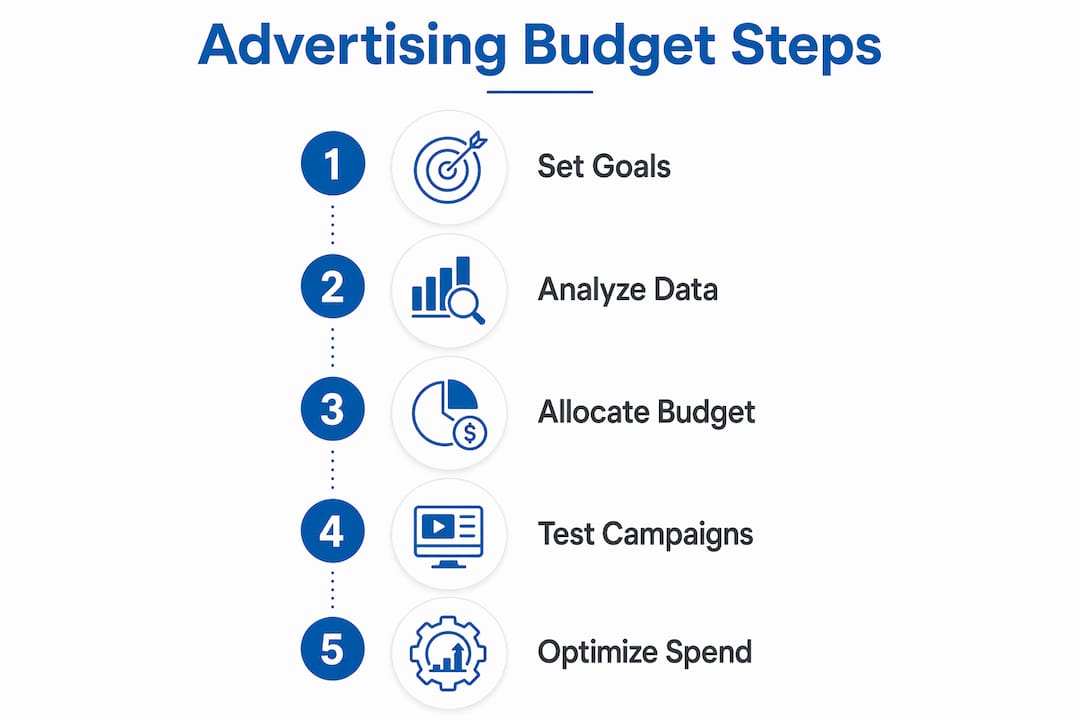
Budget discipline is the difference between a productive test and a wasted month. Small businesses should allocate about 10% of monthly revenue to an advertising reserve. That means a business generating $5,000 per month should set aside $500 per month for advertising. That figure is not arbitrary. It gives you enough to run a real test without threatening your operating costs.
Here is a practical approach to building your advertising budget:
- Calculate your baseline. Take your average monthly revenue and multiply by 0.10. That is your monthly advertising reserve.
- Save for a 90-day test. Before launching a paid channel, accumulate three months of budget. This prevents you from pulling the plug too early when results are still developing.
- Scale proportionally. When revenue grows, your advertising reserve grows with it. A business at $15,000 per month can now invest $1,500 per month, which opens more channels and larger audiences.
- Track cost-per-lead. Divide your monthly ad spend by the number of leads generated. If you spent $500 and got 10 leads, your cost-per-lead is $50. Compare that to your average customer value to decide if the channel is profitable.
- Avoid channel hopping. Switching platforms every two to three weeks means you never gather enough data to optimize. Commit to one channel for a full cycle before judging it.
Pro Tip: Set a hard rule: never increase ad spend on a channel until you have 30 days of consistent data showing a positive cost-per-lead trend.
Which advertising channels work best for small businesses?
Channel selection is where most small business owners make their biggest mistake. They spread budget across Google, Facebook, Instagram, TikTok, and LinkedIn simultaneously and get mediocre results everywhere. Focusing on one or two relevant platforms produces far better engagement quality than a thin presence across many.

Use this table to match your business type to the right channel:
| Business Type | Best Primary Channel | Best Secondary Channel |
|---|---|---|
| Local service (plumber, salon, cleaner) | Google Business Profile + Google Search Ads | Facebook Ads (local targeting) |
| E-commerce or visual product | Instagram Ads | Facebook Ads |
| B2B or professional services | LinkedIn Ads | Google Search Ads |
| Restaurant or retail | Google Business Profile | |
| Coaching or education | Facebook Ads | Email marketing |
A few channel-specific facts worth knowing:
- Google Search Ads capture high-intent buyers. Someone searching “emergency plumber near me” is ready to spend. This channel suits any business where customers search before buying.
- Facebook and Instagram Ads work best for visual products and impulse-driven purchases. They also excel at retargeting people who visited your website but did not convert.
- Referral programs are underused by most small businesses. Referral and partnership strategies can fill the first 6–12 months of customer acquisition without any paid spend, particularly for service businesses and B2B companies.
- Local print and direct mail still deliver results in tight geographic markets. A well-designed postcard to a specific zip code can outperform a digital campaign for businesses like dentists, landscapers, or real estate agents.
For a deeper breakdown of platform options, the social media advertising guide from Goonlinenow covers 2026-specific platform changes in detail.
How do you execute and optimize an advertising campaign?
Execution separates businesses that learn from their ad spend and those that repeat the same mistakes. The process below applies whether you are running Google Search Ads, Facebook Ads, or a local print campaign.
| Phase | Action | Success Metric |
|---|---|---|
| Launch | Set up one campaign on one channel | Campaign live, tracking installed |
| Week 1–2 | Monitor impressions and click-through rate | CTR above 1% for search, 0.5% for display |
| Week 3–4 | Review cost-per-lead | CPL below 30% of average customer value |
| Day 30–60 | Adjust targeting or ad creative | CPL improving week over week |
| Day 60–90 | Evaluate channel ROI | Decide to scale, pause, or shift budget |
- Commit to one channel for 60–90 days. Paid channels require a 60–90 day ramp-up to generate enough data for meaningful optimization. Pulling out at day 20 because results look slow is the most common reason small businesses conclude that “ads don’t work.”
- Install conversion tracking before day one. Google Tag Manager and Meta Pixel both take under an hour to set up. Without them, you are flying blind.
- Test one variable at a time. Change the headline or the image, not both simultaneously. Otherwise, you cannot identify what drove the improvement.
- Integrate paid ads with organic marketing. Paid ads drive traffic. Organic SEO, email marketing, and content capture and retain that traffic at a lower long-term cost.
- Audit your proof assets monthly. New reviews, updated testimonials, and fresh case studies keep your ads credible and your conversion rate healthy.
Common mistakes include changing channels too frequently, underfunding campaigns, and running ads without proof of offer value. Each mistake compounds the others. A small budget spread across three channels with no testimonials is almost guaranteed to fail.
What i’ve learned about small business advertising after working with hundreds of smbs
Most small business owners come to us after wasting money on ads. The pattern is almost always the same: they launched paid campaigns before their website converted, before they had reviews, and before they had a clear offer. The ads were not the problem. The foundation was.
The businesses that succeed with advertising share one habit: patience. They build the organic layer first, whether that is investing in organic SEO, collecting reviews, or growing an email list. Then they treat paid ads as an accelerator, not a rescue plan.
The other thing I have seen consistently is that one strong channel beats three mediocre ones every time. A salon owner who masters Google Business Profile and runs a tight Google Search Ads campaign in her city will outperform a competitor spending the same budget across Google, Instagram, TikTok, and Facebook simultaneously.
My honest advice: resist the pressure to be everywhere. Pick the channel where your customers already search or scroll. Commit to it for 90 days. Measure cost-per-lead religiously. Then, and only then, consider adding a second channel. Advertising is not about volume. It is about precision.
— Go
Ready to make your advertising work harder?
Running ads without the right system behind them means leads fall through the cracks. Goonlinenow combines marketing automation, CRM, and done-for-you campaign support into one affordable platform built specifically for small businesses. You get email and SMS follow-up, lead tracking, and reputation management, all configured by a real team at no extra cost.
If you are ready to turn your advertising spend into measurable growth, the marketing automation platform from Goonlinenow gives you every tool you need in one place. No contracts, no hidden fees, and real human support from day one. See how Goonlinenow clients achieve proven ROI gains from their advertising investment.
FAQ
What is the best way to advertise a small business on a tight budget?
Start with a fully optimized Google Business Profile, which is free, and collect at least five to ten customer reviews before spending on paid ads. Allocate roughly 10% of monthly revenue to advertising and commit that budget to one channel for 60–90 days before evaluating results.
How long before small business ads start producing results?
Paid advertising channels require a 60–90 day ramp-up period to gather enough data for optimization. Businesses that pull campaigns before that window closes rarely see a return on their initial spend.
Should i use social media or google ads for my small business?
The right choice depends on your business type. Google Search Ads work best when customers actively search for your service, while Facebook and Instagram Ads suit visual products and impulse purchases. LinkedIn is the strongest channel for B2B and professional services.
Do i need a website before running ads?
Yes. Paid ads send traffic to your website, and if that site does not convert visitors into leads or customers, the ad spend is wasted. Fix your website’s load speed, mobile display, and call to action before launching any paid campaign.
What is the biggest mistake small businesses make with advertising?
Changing advertising channels too frequently and underfunding campaigns are the two most common errors. Both prevent you from gathering enough data to optimize, which means the entire budget goes toward a testing phase that never produces usable results.