

Most small and mid-sized business owners pour energy into ads, social media, and pricing, yet overlook the one factor that quietly controls whether a new customer chooses them or a competitor. Your online reputation shapes buying decisions before a prospect ever contacts you. ORM directly boosts SMB performance through stronger customer orientation and self-efficacy. This guide breaks down exactly what reputation management means for SMBs, which pillars matter most, affordable tactics you can act on today, and how to measure progress so your efforts compound over time.
Key Takeaways
| Point | Details |
|---|---|
| ORM fuels SMB growth | Managing your online reputation directly improves sales, trust, and competitiveness for small and mid-sized businesses. |
| Focus on core pillars | Soliciting positive reviews, managing your social presence, and responding fast are the pillars of effective reputation management. |
| Affordable strategies work | You don’t need a massive budget—simple, consistent tactics can strengthen your reputation and drive more business. |
| Measure to improve | Track key ORM metrics to identify gaps and keep advancing your reputation performance. |
Why reputation management matters for SMBs
Reputation management, often called online reputation management or ORM, is the practice of monitoring, influencing, and improving how your business appears across review platforms, search results, and social channels. For SMBs, it covers everything from Google reviews and Facebook ratings to how quickly you respond to complaints and how consistently your brand voice shows up online.
Many owners assume ORM is a luxury reserved for large corporations with dedicated PR teams. That assumption is costly. The importance of reputation management for small businesses is arguably greater than for big brands, because SMBs rely more heavily on trust, word-of-mouth, and local search to attract customers. A single string of unanswered negative reviews can stall growth for months.
“Reputation is one of the most powerful competitive tools an SMB has. It costs far less to earn than paid advertising, and it compounds in value over time.”
Research confirms this. SME reputation drives competitive advantage, financial performance, and stronger stakeholder engagement, making it a core business asset rather than a nice-to-have. When you invest in building trust and growth through consistent ORM, the returns show up in repeat business, the ability to charge a fair price premium, and even your ability to attract quality staff.
Here is a quick summary of the key areas reputation management directly affects for SMBs:
- Customer trust and purchase decisions: Most buyers read reviews before making a choice.
- Local search visibility: Google favors businesses with active, positive review profiles.
- Social proof: Ratings and testimonials reduce friction for new customers.
- Talent attraction: Job seekers research employer reputation before applying.
- Price premium: A strong reputation supports higher pricing without losing customers.
Core pillars of reputation management for SMBs
Understanding why reputation matters, the next question is: what should you actually do to manage it? Let’s review the essential reputation pillars for SMBs.
Effective ORM for small businesses rests on three core pillars: soliciting reviews, managing your social presence, and responding to feedback in a timely way. Each one reinforces the others. Ignore any single pillar and the whole structure weakens.
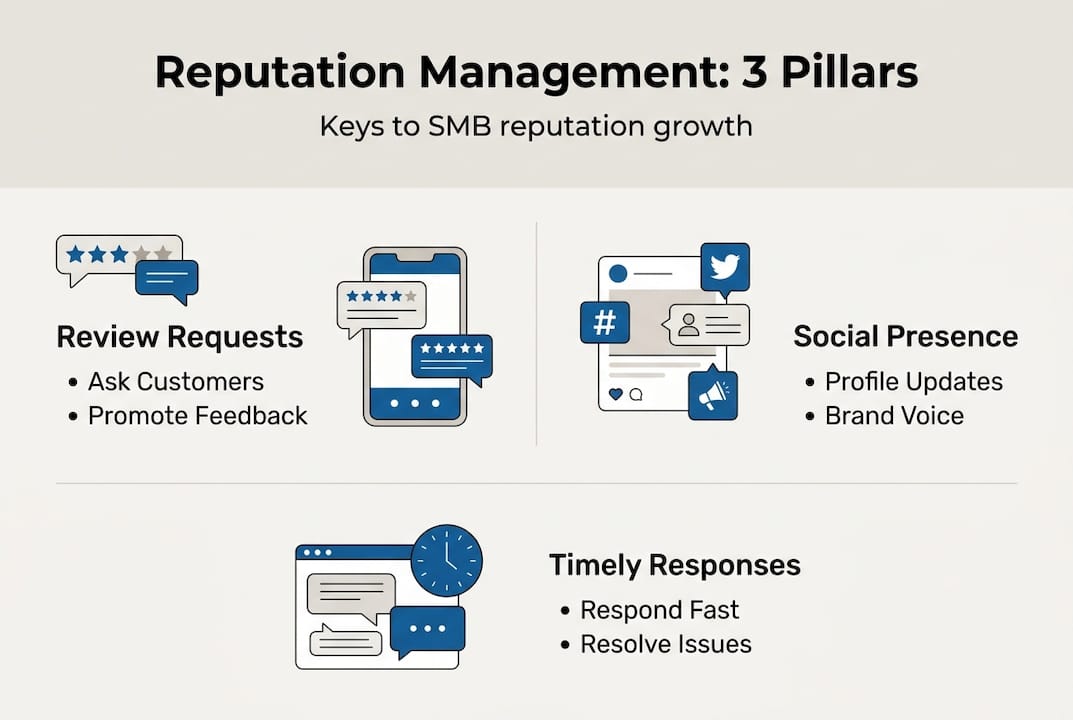
Soliciting reviews means actively asking satisfied customers to share their experience. Most happy customers simply forget to leave a review unless prompted. A simple follow-up text or email after a transaction can double your review volume. ORM consistently boosts SMB performance when businesses take a proactive approach rather than waiting passively.
Managing your social presence means keeping your profiles accurate, active, and on-brand. Inconsistent information across platforms confuses both customers and search engines. Your small business reputation guide should include a monthly audit of your listings.

Timely response is where many SMBs fall short. Responding to every review, positive or negative, signals that you care. Speed matters. A reply within 24 hours shows professionalism and builds confidence.
Here is how manual ORM compares to automated ORM for SMBs:
| Factor | Manual ORM | Automated ORM |
|---|---|---|
| Cost | Low upfront, high in time | Low monthly, scales easily |
| Speed | Slow, reactive | Fast, proactive |
| Consistency | Variable | High |
| Coverage | Limited platforms | Multi-platform |
| Effectiveness | Moderate | High |
Brand voice consistency ties all three pillars together. When your tone is warm and professional across every response and post, customers recognize you and trust you faster. Follow the reputation improvement process to standardize your voice across channels.
Pro Tip: When a negative review arrives, respond calmly, acknowledge the issue, and offer a resolution offline. Never argue publicly. A well-handled complaint often impresses potential customers more than a perfect score does.
Affordable and effective reputation management strategies
With the foundational pillars clear, it’s time for the practical. Let’s break down actionable, affordable reputation management tactics you can use immediately.
The good news is that reputation management research shows ORM is especially powerful in competitive markets, meaning the effort you invest now pays off most when your rivals are also fighting for the same customers. Here are five strategies ranked from easiest to most involved:
-
Set up free monitoring alerts. Use Google Alerts and your review platform dashboards to get notified the moment someone mentions your business. This keeps you reactive without requiring daily manual checks. It costs nothing and saves hours.
-
Create a review request sequence. After every completed sale or service, send a short, friendly message asking for a review. Automate this with a simple email or SMS tool. The why reputation matters page explains how automation makes this effortless at scale.
-
Leverage user-generated content (UGC). Ask customers to share photos or short testimonials you can repost. UGC acts as social proof that feels more authentic than polished brand content, and it costs you nothing to collect.
-
Build a feedback loop. Send a brief satisfaction survey after each interaction. Use the responses to catch unhappy customers before they post publicly. This gives you a chance to resolve issues privately and turn a potential detractor into a loyal advocate.
-
Protect and grow with automation. Platforms that combine review management with CRM tools let you track every customer touchpoint. Protecting SMB growth through automation means fewer missed reviews and faster responses across every channel.
Pro Tip: Build a library of 5 to 10 response templates for common review types, both positive and negative. Personalize one or two lines for each reply. This cuts response time dramatically while keeping your tone consistent and professional.
Measuring and improving your online reputation
Implementing strategies is just the start. To keep improving, you need to measure and track your reputation. Here is how SMBs should approach reputation measurement.
Without clear metrics, you are guessing. Tracking the right numbers turns ORM from a vague effort into a focused, improvable system. Note that gaps in ORM metrics and longitudinal studies still exist in the research, which means many SMBs are ahead of the curve simply by starting to measure at all.
Here are the key metrics every SMB should monitor:
- Average star rating: Your overall score across Google, Yelp, Facebook, and industry platforms.
- Review volume: Total number of reviews and the rate at which new ones arrive.
- Response rate and speed: What percentage of reviews you respond to and how quickly.
- Sentiment trends: Whether the tone of reviews is shifting positive, neutral, or negative over time.
- Local search ranking: How your business ranks in local map results, which is influenced by review activity.
Here is a sample metrics table with benchmarks to aim for:
| Metric | Current average | Target benchmark |
|---|---|---|
| Average star rating | 3.8 | 4.5 or above |
| Monthly new reviews | 4 | 10 or more |
| Response rate | 40% | 90% or above |
| Avg. response time | 72 hours | Under 24 hours |
| Negative review rate | 20% | Under 10% |
To audit your online presence, search your business name in incognito mode and note what appears on the first page. Check every major review platform for outdated information or unanswered reviews. The value of ORM for business owners becomes clearest when you see the gap between where you are and where you could be.
When you spot a negative or neutral trend, act quickly. Identify the root cause, whether it is a service gap, a staff issue, or a communication problem, and fix it at the source. Then follow the online reputation process to rebuild momentum with a fresh wave of authentic positive reviews.
Our take: The truth about reputation management for SMBs most experts won’t tell you
Most reputation guides push one message: get more reviews. Volume matters, but it is not the whole story. We have seen SMBs with 200 reviews lose customers to competitors with 40, simply because those 40 reviews were recent, specific, and genuine, while the larger pool was outdated and generic.
Recency and authenticity beat raw numbers every time. A review from three years ago carries far less weight than one posted last week. Customers and search algorithms both prioritize freshness.
The harder truth is this: your reputation is built as much on how you handle mistakes as on what your average score says. One thoughtful, empathetic response to a one-star review can do more for your credibility than ten five-star ratings. Prospects read those exchanges closely.
Another overlooked strategy is empowering your team. When staff understand that every customer interaction shapes the business reputation, they become active participants in ORM rather than passive bystanders. Train them, involve them, and recognize their contribution.
Finally, reputation cannot be set and forgotten. The businesses that win long-term treat it as a living system, not a one-time fix. Explore how tech, trust, and growth connect when you treat ORM as an ongoing practice rather than a campaign.
Bring your SMB reputation to the next level with expert tools
Reputation management does not have to be time-consuming or expensive when you have the right system behind you. Go Online Now-Connect gives SMBs everything they need in one place: automated review requests, a unified inbox for responses, CRM tracking, and done-for-you setup at a price that makes sense for growing businesses.
If you want to boost SMB conversions without adding complexity to your day, our platform is built for exactly that. See how we are transforming SMB growth through smart automation and real human support. Ready to get started? Explore our automation software guide and take the first step toward a stronger, more trusted online presence today.
Frequently asked questions
What is the most effective reputation management strategy for SMBs?
Combining proactive review solicitation with fast, authentic responses delivers the highest impact at low cost. Research confirms that ORM boosts SMB performance most when businesses take a customer-oriented, self-directed approach.
How can I manage my online reputation affordably as an SMB?
Use free monitoring tools like Google Alerts, build response templates to save time, and encourage satisfied customers to leave authentic feedback after each interaction. Affordable, proactive habits drive strong reputation outcomes even for resource-constrained businesses.
Why does reputation matter more for SMBs than large brands?
SMBs depend more heavily on trust, reviews, and word-of-mouth to win new customers, making reputation a core growth driver rather than a supporting factor. SMB reputation directly drives customer acquisition and long-term retention.
What should I measure to track my SMB’s reputation?
Monitor your average review score, total review volume, response rate, response speed, and sentiment trends for an accurate and actionable overall picture. Tracking these key ORM indicators helps you spot problems early and measure the real impact of your efforts.
Recommended
- Reputation Management Explained: Protecting SMB Growth – Go Online Now
- Reputation Management—Why It Matters for SMB Success – Go Online Now
- Reputation Management for SMEs: Building Trust and Growth – Go Online Now
- Importance of Reputation Management for SMB Success – Go Online Now
- Les meilleures stratégies de marketing digital pour les petites entreprises à Rouen – Agence SEO Branderizing