

TL;DR:
- A content marketing strategy is a documented plan aligned with specific business goals, audience needs, and measurable outcomes.
- Most SMBs fail to connect content efforts to revenue and often focus on vanity metrics instead of meaningful KPIs.
A content marketing strategy is defined as a documented plan that aligns your content creation and distribution with specific business goals, audience needs, and measurable outcomes. Without that alignment, you produce content that fills a calendar but moves no revenue. Developing a content marketing strategy is the single most important step a small or mid-sized business can take before publishing a single blog post, video, or email. Tools like Asana, Google Analytics, and Semrush support execution, but the strategy itself must come first. This guide walks you through every step, from goal setting to performance measurement, with frameworks built specifically for SMBs.
What are the essential goals and KPIs to establish when developing a content marketing strategy?
Goals are the foundation of any content marketing plan. Without them, you cannot distinguish between content that builds your business and content that simply keeps you busy. Tying content efforts to specific business goals is the fundamental key to achieving measurable impact, and that process starts before you write a single word.
The most common mistake SMBs make is chasing vanity metrics: page views, social media likes, and follower counts. These numbers feel good but rarely connect to revenue, retention, or lead quality. Meaningful KPIs include conversion rate from organic traffic, cost per lead by content channel, customer retention rate influenced by nurture content, and pipeline value attributed to content-driven leads.
Here is how to set goals that actually work:
- Connect content goals to business priorities. If your business goal is to grow revenue by 20% this quarter, your content goal might be to generate 50 qualified leads per month through organic search.
- Set time-bound targets. “Increase email subscribers” is not a goal. “Grow the email list by 300 subscribers in 90 days through gated content” is a goal you can track and act on.
- Separate leading from lagging indicators. Email open rates and time-on-page are leading indicators. Closed deals and revenue are lagging indicators. You need both to understand what is working and why.
- Review goals quarterly. Markets shift, products change, and audience behavior evolves. A goal set in January may need recalibration by April.
Pro Tip: Write your top three content KPIs on a single page and share them with every person involved in content production. When writers, designers, and marketers all know the target, every piece of content gets created with purpose.
How to identify and understand your audience for your content plan
Audience research is where most SMB content strategies fall apart. Business owners assume they know their customers, but assumptions produce generic content that no one shares and few people read. A solid SMB content strategy clarifies who your audience is, what problems they face, and where they spend time online before any content is planned.

The most reliable audience research methods combine qualitative and quantitative data. Customer interviews reveal the exact language your buyers use to describe their problems. That language belongs in your headlines, email subject lines, and calls to action. Surveys through tools like Typeform or Google Forms surface patterns across a larger sample. Google Analytics and Meta Audience Insights show you which demographics engage most with your existing content and where they drop off.
From that research, you build buyer personas. A buyer persona is a semi-fictional profile of your ideal customer, built from real data. For a coaching business, that persona might be “Maria, a 38-year-old HR manager who consumes LinkedIn content during her commute and searches Google for leadership development frameworks on Tuesday mornings.” That level of specificity changes how you write, what formats you choose, and which platforms you prioritize.
- Identify pain points, not just demographics. Age and job title tell you who someone is. Pain points tell you why they would read your content and buy your product.
- Map digital behavior. Does your audience watch YouTube tutorials, read long-form blog posts, or scroll Instagram Reels? Format your content where attention already lives.
- Segment your audience. A real estate agency serves both first-time buyers and seasoned investors. Each segment needs different content, different language, and different calls to action.
Pro Tip: Pull your last 10 customer support emails or sales call notes. The questions your customers ask repeatedly are your best content ideas. They reveal exactly what your audience needs to know before they buy.
You can also explore local brand content strategies for additional frameworks on reaching specific audience segments with precision.
How to audit existing content and plan new content types
Before you create anything new, you need to know what you already have. A content audit is a structured inventory of every piece of content your business has published, including blog posts, videos, social media posts, email sequences, and downloadable resources. Following a stepwise process that includes auditing existing content reduces overwhelm and eliminates duplication before it starts.
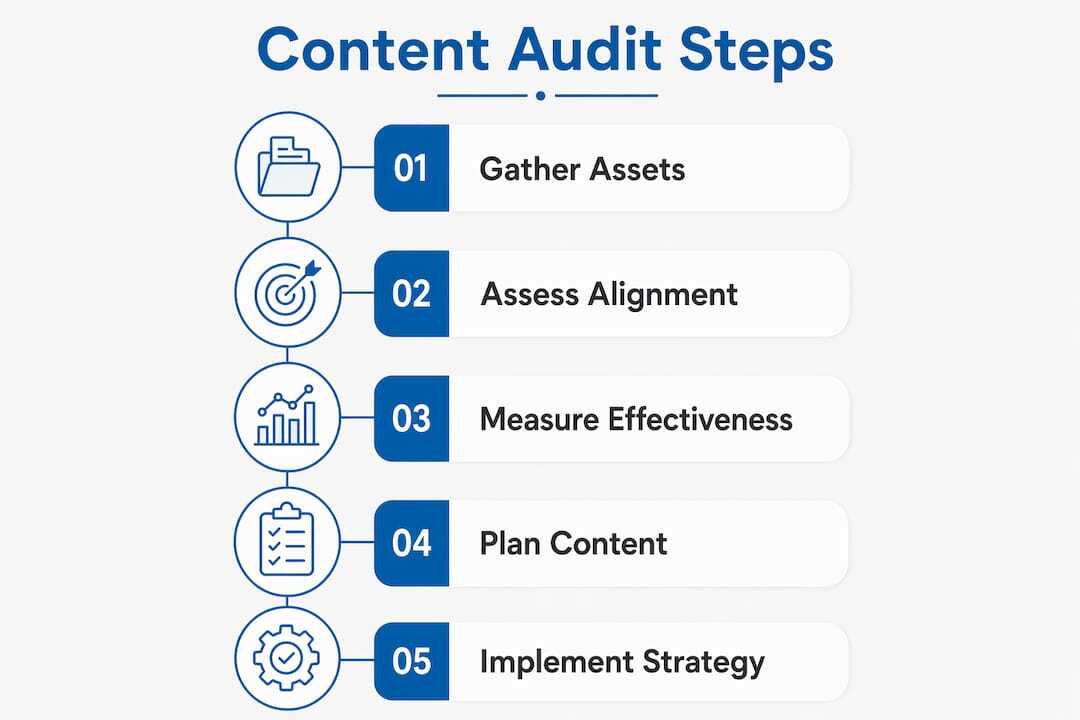
The audit answers three questions for each asset: Does this content align with a current business goal? Does it serve a defined audience segment? Is it performing against engagement or conversion benchmarks? Content that fails all three criteria gets archived or repurposed. Content that partially meets the criteria gets updated. Content that scores well gets amplified.
| Content type | Best use case | Performance metric |
|---|---|---|
| Long-form blog posts | SEO and lead generation | Organic traffic, time on page |
| Email newsletters | Retention and nurture | Open rate, click-through rate |
| Short-form video | Awareness and social reach | Views, shares, saves |
| Case studies | Sales enablement | Downloads, sales cycle influence |
| Webinars | Lead generation and authority | Registrations, attendee conversion |
After the audit, plan your content mix across two categories. Evergreen content addresses topics that stay relevant for years, such as “how to choose a business accountant” or “what to look for in a CRM.” Timely content responds to trends, seasons, or news events. Evergreen content builds long-term organic traffic. Timely content drives short-term spikes. A balanced content strategy marketing plan uses both deliberately, not randomly.
How to build an editorial calendar and content marketing playbook
An editorial calendar is the operational backbone of your content strategy. It maps every piece of content to a topic, format, publishing date, distribution channel, and responsible team member. Without it, content production becomes reactive and inconsistent. Execution-ready strategies include editorial calendars and promotion workflows to manage what gets published, when, by whom, and through which channels.
Here is a practical process for building yours:
- List your content themes for the quarter. Based on your audience research and business goals, identify four to six core themes. For a salon, those might be hair care education, seasonal styling trends, client transformation stories, product reviews, and team spotlights.
- Assign formats to themes. Not every theme suits every format. Education content works well as blog posts and YouTube videos. Transformation stories perform on Instagram and Facebook. Match format to theme and platform.
- Set a publishing cadence you can sustain. Two high-quality posts per week beats five rushed ones. Consistency matters more than volume, especially for SEO and audience trust.
- Build a content marketing playbook. A playbook documents repeatable workflows detailing plays, audience, assets, messaging, steps, and roles. Each “play” is a reusable template for a content type, such as a blog post play that includes a brief template, SEO checklist, internal review step, and social promotion sequence.
- Integrate promotion workflows. Publishing is not the finish line. Each piece of content needs a distribution plan covering owned channels like email and social, earned channels like PR and partnerships, and paid channels like boosted posts or search ads.
Pro Tip: Use a project management tool like Asana, Trello, or Monday.com to house your editorial calendar. Assign due dates, tag team members, and attach briefs directly to each content card. This keeps production on track without requiring daily check-in meetings.
| Calendar column | What to include |
|---|---|
| Publish date | Specific day and time |
| Content title | Working headline |
| Format | Blog, video, email, social |
| Owner | Writer, designer, or agency |
| Status | Draft, review, scheduled, live |
| Distribution | Email, LinkedIn, Instagram, paid |
What measurement frameworks ensure your content strategy drives results?
Measurement is where strategy connects to growth. A connected system from goals through KPIs, channels, and analytics converts content activity into business intelligence. Without that system, you are producing content in the dark.
Set up tracking before you publish anything. Google Analytics 4 tracks traffic sources, user behavior, and goal completions. A CRM like the one inside Goonlinenow connects content-driven leads to actual sales outcomes, so you can see which blog post or email sequence influenced a closed deal. UTM parameters on every link let you attribute traffic accurately across channels.
- Use attribution models deliberately. First-touch attribution credits the content that first brought a lead to your site. Last-touch credits the content that converted them. Multi-touch attribution distributes credit across the full journey. For SMBs, a simple first-touch and last-touch comparison reveals which content attracts and which content closes.
- Schedule monthly performance reviews. Pull data on your top five and bottom five performing pieces. Identify patterns. High performers often share a topic cluster, format, or distribution channel. Replicate what works.
- Avoid reporting on metrics that do not connect to outcomes. Social media impressions and raw page views are context, not conclusions. Report on leads generated, email subscribers added, and revenue influenced by content.
- Iterate based on data, not opinion. If a video series consistently outperforms blog posts for lead generation, shift resources toward video. Let performance data drive format decisions, not personal preference.
Pro Tip: Build a simple monthly content scorecard in Google Sheets. Track five KPIs per channel, compare month over month, and flag any metric that moves more than 15% in either direction. That discipline catches problems early and surfaces wins worth scaling.
What I have learned from building content strategies for SMBs
The most common failure I see is not a lack of content. It is a lack of connection between content and business outcomes. SMBs publish consistently for three months, see no obvious revenue spike, and abandon the strategy entirely. That is the wrong conclusion. Content marketing compounds over time, and the businesses that win are the ones that measure correctly from the start.
The second pattern I see is perfectionism killing momentum. Owners spend weeks refining a single blog post instead of publishing four solid ones. A stepwise, simplified process reduces that paralysis. Start with a documented plan, publish at a sustainable pace, and improve based on real data rather than imagined standards.
I also believe most SMBs underuse their existing content. A single well-researched blog post can become a LinkedIn article, an email newsletter, three social posts, and a short video script. That is five pieces of content from one idea. The businesses I see grow fastest are the ones that repurpose deliberately rather than constantly chasing new topics.
AI writing tools like ChatGPT and Jasper can accelerate drafting, but they cannot replace your brand voice or your customer relationships. Use them to speed up production. Keep the human story at the center. That combination, speed plus authenticity, is what separates content that ranks from content that resonates.
— Go
Put your content strategy to work with Goonlinenow
Developing a strategy is only half the work. Executing it consistently, tracking results, and adjusting in real time requires the right infrastructure.

Goonlinenow’s marketing automation software for SMBs brings your content strategy to life with email automation, lead nurturing sequences, CRM pipeline tracking, and performance dashboards built into one affordable system. You get done-for-you setup, real human support, and tools that connect your content directly to conversions. No scattered subscriptions. No complex tech. Just a system that works from day one. Explore how Goonlinenow helps SMBs measure content ROI and grow smarter.
FAQ
What is a content marketing strategy?
A content marketing strategy is a documented plan that connects your content creation and distribution to specific business goals, audience needs, and measurable KPIs. Without documentation, content production becomes inconsistent and disconnected from revenue.
How long does it take to develop a content marketing strategy?
Most SMBs can build a functional content strategy in two to four weeks by completing audience research, a content audit, goal setting, and editorial calendar planning in sequence. The strategy improves continuously as performance data accumulates.
What KPIs should SMBs track for content marketing?
The most meaningful KPIs for SMBs are lead quality and volume by channel, email subscriber growth, organic traffic conversion rate, and revenue influenced by content. Avoid reporting on page views or social likes as standalone success metrics.
How often should I publish content as an SMB?
Consistency matters more than frequency. Publishing two well-researched pieces per week outperforms five rushed ones in both SEO performance and audience trust. Set a cadence your team can sustain for at least six months.
What is a content marketing playbook?
A content marketing playbook is a document that defines repeatable content workflows including roles, messaging, assets, and timelines for each content type your business produces. It turns strategy into repeatable, scalable execution.
Recommended
- Digital content strategy: Build an effective plan for SMB growth – Go Online Now
- How to Create a Content Marketing Strategy for SMBs – Go Online Now
- Content Marketing Methods: Affordable Strategies for SMB Growth – Go Online Now
- Digital marketing strategy: A complete guide for SMB growth – Go Online Now