

Over 80 percent of American small businesses report feeling overwhelmed by juggling multiple tools just to manage customer relationships. The pressure to keep up with modern sales, marketing, and service demands makes streamlined solutions more important than ever. By understanding how an all-in-one CRM can centralize tasks, cut manual work, and drive smarter business decisions, American entrepreneurs can unlock real efficiency and growth.
All-in-one CRM for small business explained
Small businesses today need powerful yet streamlined customer relationship management solutions that grow with their operations. An all-in-one CRM represents more than just software – it’s a strategic business tool designed to centralize customer interactions, sales tracking, and communication management in one integrated platform.
Modern small businesses require systems that eliminate manual data entry and reduce operational complexity. Integration research confirms significant efficiency gains for small and medium enterprises through unified management of sales, marketing, customer service, and operational processes. By consolidating multiple business functions into a single platform, companies can dramatically reduce administrative overhead and focus more energy on strategic growth.
Key advantages of an all-in-one CRM for small businesses include:
- Centralized customer data management
- Automated communication tracking
- Seamless sales pipeline visualization
- Real-time performance reporting
- Integrated marketing and communication tools
Pro Tip for CRM Success: Select a CRM platform that offers scalable features and intuitive design, ensuring your system can adapt as your business grows without requiring complicated technical expertise.
Core features unified for SMB growth
Successful small and medium-sized businesses require comprehensive technological solutions that streamline complex operational processes. Modern all-in-one CRM systems provide a critical technological backbone that integrates multiple business functions into a single, powerful platform.
Integration research from leading technology studies reveals how CRM systems can unify core business functions like sales automation, marketing tools, customer service modules, and advanced analytics. By consolidating these essential features, small businesses can eliminate fragmented software ecosystems and create a more cohesive, efficient operational strategy.
The core unified features typically include:
- Sales pipeline management
- Customer interaction tracking
- Automated marketing campaign tools
- Performance analytics and reporting
- Contact and lead management
- Task and workflow automation
- Communication history tracking
Small businesses benefit from these integrated systems by reducing manual data entry, minimizing communication gaps, and providing real-time insights into business performance. The ability to see comprehensive customer interactions across multiple channels allows for more strategic decision-making and personalized customer experiences.
Here’s a summary of how core CRM features translate into business benefits for small companies:
| CRM Feature | What It Does | Business Benefit |
|---|---|---|
| Sales Pipeline Management | Tracks deals and progress | Improves forecasting and closing rates |
| Automated Marketing Tools | Schedules and sends campaigns | Boosts lead engagement and conversion |
| Performance Analytics | Analyzes key metrics | Enables faster, data-driven decisions |
| Workflow Automation | Automates routine business tasks | Saves employee time and reduces errors |
| Customer Interaction Tracking | Logs all communication | Delivers personalized and timely responses |
Pro Tip for Feature Integration: Conduct a thorough audit of your current business processes before selecting an all-in-one CRM, ensuring the platform you choose matches your specific operational needs and growth trajectory.
Comparing all-in-one CRM vs. separate tools
Small businesses face a critical decision when managing customer relationships: choosing between comprehensive all-in-one CRM solutions and multiple specialized tools. Each approach offers distinct advantages and challenges that can significantly impact operational efficiency and business growth.
Research examining enterprise technology strategies reveals the complex trade-offs between consolidated and fragmented software ecosystems. Separate tools might seem attractive initially, offering specialized features for specific tasks, but they often create significant hidden costs through integration complexity and data management challenges.
Key differences between all-in-one CRM and separate tools include:
- Integration Complexity
- All-in-one: Seamless data flow
- Separate tools: Requires manual synchronization
- Cost Structure
- All-in-one: Predictable, bundled pricing
- Separate tools: Multiple subscription fees
- Reporting Capabilities
- All-in-one: Comprehensive, unified insights
- Separate tools: Fragmented, difficult to consolidate
- Scalability
- All-in-one: Easier to expand
- Separate tools: Requires additional configuration
For small businesses seeking streamlined operations, an integrated CRM solution eliminates the overhead of managing multiple platforms. By consolidating customer data, communication channels, and operational insights into a single system, companies can reduce administrative complexity and focus more energy on strategic growth and customer relationships.
Pro Tip for Tool Selection: Conduct a detailed workflow analysis of your current processes before selecting a CRM solution, identifying specific integration requirements and potential bottlenecks in your existing systems.
Real-world impact on efficiency and sales
Small businesses operate in a challenging environment where every minute and dollar counts. Integrated CRM systems represent more than just technological solutions – they are strategic accelerators that transform operational performance and sales potential.

Comprehensive research examining enterprise technology implementations reveals compelling evidence of how unified CRM platforms can dramatically enhance business efficiency. Case studies demonstrate significant improvements in key performance metrics, including reduced administrative overhead, faster sales cycles, and more accurate customer engagement strategies.
Specific real-world efficiency impacts include:
- 40-60% reduction in manual data entry time
- 25-35% faster sales pipeline progression
- Improved lead conversion rates by up to 27%
- Enhanced customer communication accuracy
- Streamlined reporting and performance tracking
The tangible benefits extend beyond mere numbers. By consolidating customer interactions, communication channels, and sales data into a single integrated platform, businesses can create a more responsive and intelligent operational ecosystem. This holistic approach enables teams to make faster, more informed decisions, ultimately driving revenue growth and competitive advantage.
Pro Tip for Performance Optimization: Regularly audit your CRM data and workflows, identifying bottlenecks and opportunities for automation to continuously improve your business’s operational efficiency.
Cost savings and scalability for SMEs
Small and medium enterprises face unique financial challenges that demand strategic technological solutions. Cloud-based CRM systems offer a revolutionary approach to managing business operations without the traditional high costs associated with enterprise software implementations.
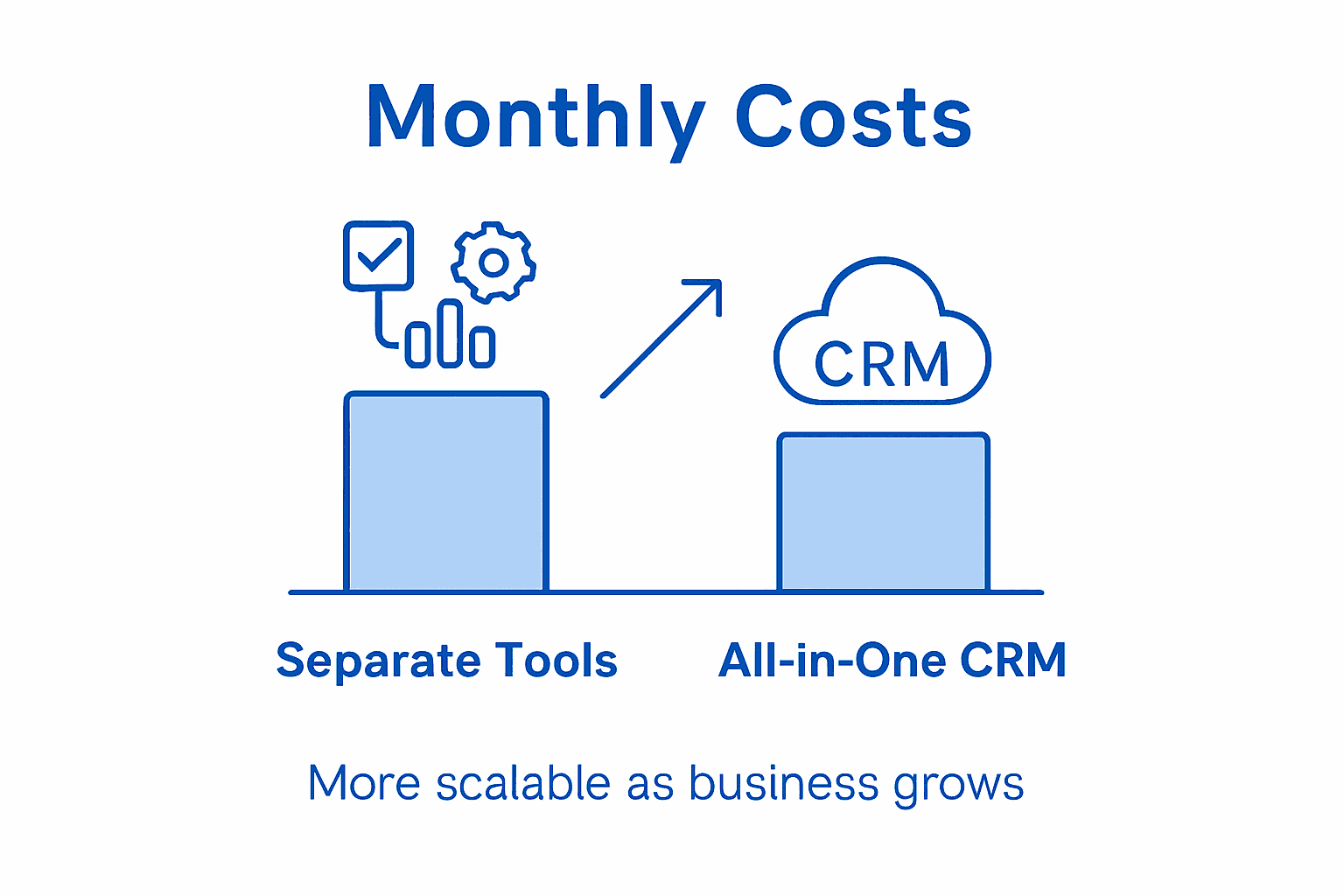
Comprehensive cloud technology research demonstrates how modern CRM platforms provide unprecedented scalability and cost-effectiveness for growing businesses. These systems eliminate the need for expensive hardware investments, allowing companies to adapt their technological infrastructure dynamically as their business evolves.
Key financial advantages of scalable CRM solutions include:
- Reduced upfront infrastructure costs
- Pay-as-you-grow pricing models
- Elimination of expensive hardware maintenance
- Automatic software updates at no additional charge
- Flexible user licensing options
- Minimal IT support requirements
The true economic benefit lies in the platform’s ability to grow alongside the business. Small enterprises can start with basic features and incrementally add sophisticated tools without massive financial commitments. This approach transforms technology from a cost center into a strategic investment, enabling businesses to allocate resources more efficiently and invest in core growth initiatives.
This table highlights how a cloud-based all-in-one CRM changes cost and scaling dynamics for SMEs:
| Area | Without CRM Platform | With Cloud CRM Platform |
|---|---|---|
| Upfront IT Investment | High hardware/software costs | Minimal startup costs |
| Ongoing Maintenance | Regular, expensive updates | Automatic, vendor-managed updates |
| Adjusting to Growth | Requires manual IT upgrades | Instantly adds users and features |
| Financial Flexibility | Fixed, annual contracts | Pay-as-you-grow, flexible billing |
Pro Tip for Cost Management: Conduct a thorough cost-benefit analysis before selecting a CRM platform, considering not just monthly subscription fees but also potential productivity gains and operational efficiency improvements.
Unlock Growth with an All-In-One CRM Designed for SMBs
Growing small businesses face the challenge of managing customer data, sales pipelines, and marketing efforts without wasting time on complicated, expensive, or scattered tools. This article highlights the key hurdles such as integration complexity and inefficient workflows that slow down SMB success. At Go Online Now-Connect, we understand these pain points and offer a simple, affordable all-in-one CRM solution built to unify your communications, automate lead management, and streamline marketing automation — all in one place.
Experience the power of a platform designed with small businesses in mind: from unified inbox and appointment scheduling to marketing automation tools that boost lead engagement. Our system helps you cut down the manual work and make faster, data-driven decisions so you can focus on growing smarter, not harder.
Explore how easy it is to transform your business by visiting Automation Archives – Go Online Now and Digital Marketing Archives – Go Online Now.
Ready to stop juggling multiple tools and start focusing on growth? Visit Go Online Now today and discover how our all-in-one CRM and marketing automation software can save you time, lower costs, and boost your sales with real human support and done-for-you setup. Take the first step to grow your SMB smarter and faster now.
Frequently Asked Questions
What are the key benefits of using an all-in-one CRM for small businesses?
An all-in-one CRM centralizes customer data management, automates communication tracking, visualizes sales pipelines, provides real-time performance reporting, and integrates marketing tools to streamline operations and enhance strategic growth.
How does an all-in-one CRM improve operational efficiency for SMBs?
By consolidating multiple business functions into a single platform, an all-in-one CRM reduces manual data entry and communication gaps, allowing businesses to focus on strategic decision-making and providing personalized customer experiences.
What should small businesses consider when choosing an all-in-one CRM?
Small businesses should evaluate the platform’s scalability, user-friendliness, and integration capabilities with existing processes to ensure it meets their growth trajectory and operational needs effectively.
How can an integrated CRM impact sales performance for growing SMBs?
An integrated CRM can lead to significant improvements such as faster sales cycle progression, reduced manual data entry time, better lead conversion rates, and enhanced customer communication accuracy, ultimately driving revenue growth.
Recommended
- 7 Essential Examples of Digital Marketing Tools for SMBs – Go Online Now
- Marketing Automation Software: Smarter Growth for SMBs – Go Online Now
- SMB Digital Marketing Essentials for Smarter Growth – Go Online Now
- Marketing Automation Software: Complete Guide for SMBs – Go Online Now
- Best 7 Cannabis Business Tax Software 2025 – Expert Comparison – Cannabis Business Minds