

TL;DR:
- Most small business owners mistakenly believe that creating quality content requires a large agency budget and a full marketing team. A focused, strategic approach utilizing AI and automation can generate consistent leads without significant expense or time commitment. Regular, high-quality content, guided by clear strategy and measurement, leads to better search visibility, trust, and long-term growth.
Most small business owners assume that serious creation of content requires a big agency budget and a full marketing team. That assumption is costing them customers every day. The reality is that a focused, well-structured approach to content development can generate consistent leads without breaking your budget. This guide walks you through practical content creation steps, how AI fits into the process, and how marketing automation tools can help you manage it all without adding hours to your week.
Key Takeaways
| Point | Details |
|---|---|
| Content creation budgets | Small and mid-sized businesses typically spend $5,000 to $10,000 monthly, with nearly half allocated to creating high-quality content. |
| Structured content process | A well-defined 7-step content marketing process ensures research, creation, promotion, and measurement are effective and manageable. |
| AI as a productivity tool | AI accelerates drafting and routine tasks but requires human editing to maintain quality, trust, and SEO compliance. |
| Focus on consistency | Regular, scheduled content creation sessions build sustainable growth better than sporadic burst efforts. |
| Marketing automation benefits | Automation software streamlines workflows, improves ROI, and supports SMBs in scaling content marketing affordably. |
Understanding the costs and benefits of creating content for SMBs
Before you spend a dollar on content production, it helps to understand what the market actually looks like. SMB content marketing budgets typically fall between $5,001 and $10,000 per month, with 45 to 55% of that going directly toward creation activities like blog posts, videos, and graphics.
That might sound like a lot. But when you break it down, a well-written SEO blog post costs $400 to $800 and can generate organic traffic for years. Video content sits at the higher end of the budget but tends to deliver strong engagement and conversion rates. The key is knowing where your money works hardest.
Here is how a balanced SMB content budget typically breaks down:
| Budget category | Percentage of total | What it covers |
|---|---|---|
| Content creation | 45–55% | Blog posts, videos, graphics, copy |
| Promotion and distribution | 20–25% | Paid social, email, ad spend |
| Tools and software | 10–15% | CMS, analytics, scheduling platforms |
| Team and freelancers | 15–20% | Writers, editors, designers |
To keep costs manageable, focus on cost-effective content marketing approaches that prioritize formats with the longest shelf life. Blog posts optimized for search, how-to videos, and email sequences are all formats that keep working after you publish them.
A few principles to guide your budget decisions:
- Prioritize evergreen content over trending topics that expire quickly
- Repurpose everything — a single blog post can become a social post, an email, and a short video script
- Track ROI by format so you know which content types justify higher investment
- Use AI in content strategy to reduce production costs on first drafts without dropping quality
With a clear picture of what content creation costs, let’s explore the detailed process that turns investment into results.
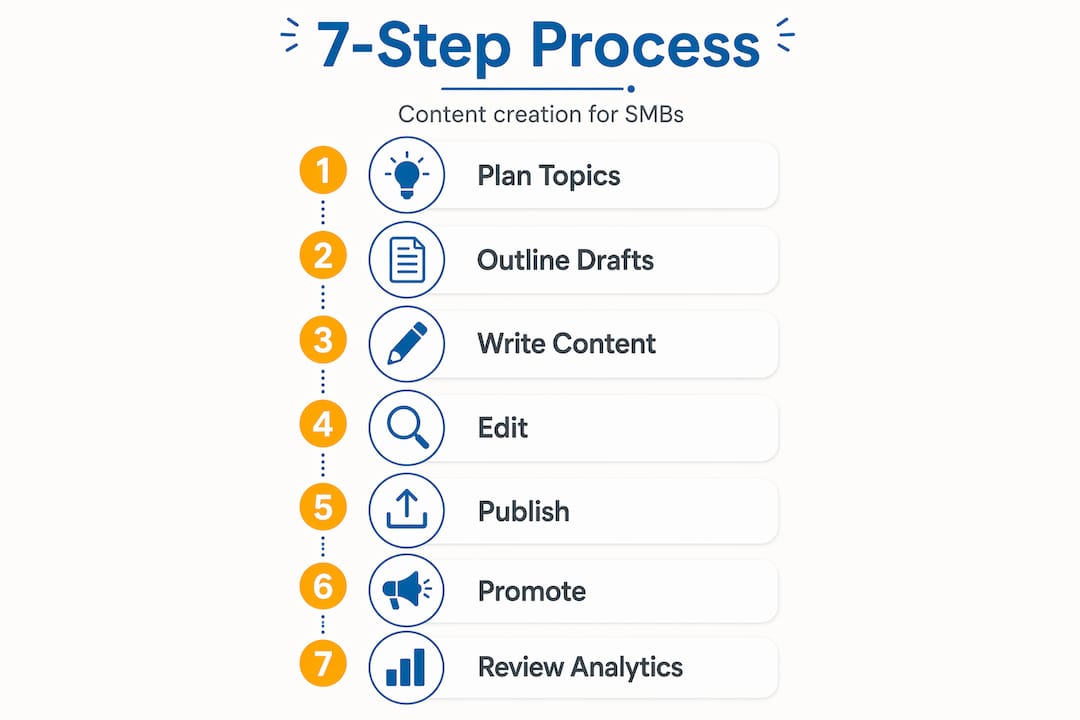
The 7-step content creation process simplified for busy SMB owners
The content creation process in digital marketing is not a single task. It is a workflow. And when you treat it that way, it becomes repeatable and manageable. A 7-step content process that covers research through measurement takes 8 to 20 hours per blog post from start to finish, depending on your topic complexity and team size.
Here is what each step looks like in practice:
-
Research and audience analysis — Identify what your ideal customer is searching for. Tools like Google Search Console or Answer the Public show real questions people ask. This is the most important step. Skip it and everything else suffers.
-
Strategy and goal setting — Decide what each piece of content is supposed to do. Drive traffic? Capture email leads? Educate a prospect before a sales call? Every piece needs a clear job.
-
Content planning and editorial calendar — Map your topics to a publishing schedule. Even one post per week, published consistently, outperforms three posts in January and silence for two months.
-
Drafting and production — This is where writing, designing, or filming happens. Use AI tools to speed up the first draft, but always add your business’s real perspective and experience.
-
Editing and SEO polishing — Review for accuracy, brand voice, and search visibility. Adjust headers, add internal links, and verify that your target keyword appears naturally throughout.
-
Publishing and promotion — Publish on your website, then distribute through email, social media, and any relevant community groups or forums. The content does not promote itself.
-
Measurement and iteration — Check performance at 7, 30, and 90 days. What drove traffic? What converted? Use those answers to plan your next round.
Pro Tip: Batch your content tasks. Write three outlines on Monday, draft two articles on Tuesday, edit on Thursday. Working in focused blocks is far more efficient than trying to do every step in one sitting.
Understanding these steps helps you see how to manage your content workflow efficiently.

How AI accelerates content creation without sacrificing quality
AI has changed what is possible for small teams. The honest truth is that AI drafting tools can save up to 80% of drafting time, but that time savings only holds if you edit the output properly. Raw AI content lacks the personal anecdotes, brand-specific examples, and nuanced judgment that make content actually useful to readers.
Google has been clear on this. AI-generated content is allowed if it is helpful and serves users first. Google only penalizes AI content that was created primarily to manipulate search rankings. That means the bar is quality and intent, not the tool used.
“The goal is not to fool Google. The goal is to genuinely help your reader. AI gets you to a first draft faster. Your expertise makes that draft worth reading.”
A practical AI-human workflow for content creation with AI looks like this:
- Use AI to generate a first draft based on a detailed prompt that includes your target keyword, audience, and key points
- Add human specifics — client stories, real data from your business, opinions grounded in your experience
- Edit for tone so it sounds like your brand, not a generic assistant
- Run an E-E-A-T check — Google’s standard for Experience, Expertise, Authoritativeness, and Trustworthiness. Ask: does this content show real knowledge? Can a reader trust it?
- Fact-check everything, especially statistics, dates, and any claims about third-party products or services
The businesses getting the best results with AI are not replacing their content teams. They are using AI to remove the blank page problem and then investing human time where it matters most: judgment, voice, and accuracy.
Now that AI can speed up creation, let’s examine how to structure your content strategy for maximum impact.
Building a lean content strategy that fits your SMB resources
Here is a fact that most business owners miss: a documented content strategy generates 3x more leads per dollar compared to undocumented efforts. Writing down your strategy is not busywork. It is one of the highest-ROI activities you can do in an afternoon.
Your lean content strategy does not need to be a 40-page document. It needs to answer five questions:
- Who are you writing for?
- What problems do they have that you can address?
- What formats work best for your audience and your team’s capacity?
- How often can you realistically publish?
- How will you measure success?
Content structure matters too. The highest-ROI format for most SMBs is bottom-of-funnel content — FAQ pages, product comparisons, how-to guides, and case studies. These pieces target buyers who are already close to a purchasing decision. They convert faster than broad awareness content.
Here is a comparison of content approaches for lean SMB teams:
| Approach | Resource requirement | Lead generation speed | Long-term growth |
|---|---|---|---|
| Bottom-of-funnel blog posts | Low to moderate | Fast (30–90 days) | High |
| Social media only | Low | Slow | Low |
| Video series | High | Moderate | High |
| Repurposed content across channels | Low | Moderate | High |
One more content creation tip: prune regularly. Review your published content every six months and either update articles that have dropped in performance or remove thin pages that add no value. Google rewards sites where the average quality is high. Every weak page lowers that average.
With strategy in place, let’s explore how to track your content’s performance to sharpen your approach.
Measuring and optimizing content creation to maximize ROI
Publishing content without measuring it is like running ads with no tracking. You feel busy, but you have no idea what is working. The content marketing process requires tracking traffic, leads, conversions, and revenue tied to specific pieces so you can improve continuously.
Here is a simple measurement timeline you can follow:
- Day 7 post-publish — Check indexing status and initial traffic. Is Google crawling the page? Are there any technical issues?
- Day 30 — Review organic traffic, average time on page, and bounce rate. Are people engaging or leaving immediately?
- Day 90 — Measure leads generated, email sign-ups, or product inquiries tied to that content. This is the revenue-relevance check.
Use this tracking table to organize your content marketing measurement across your key pieces:
| Content piece | Traffic (30 days) | Leads generated | Conversion rate | Next action |
|---|---|---|---|---|
| “How to choose a salon software” | 420 | 18 | 4.3% | Update and add FAQ section |
| “Real estate lead generation tips” | 210 | 6 | 2.9% | Add case study section |
| “Coaching business pricing guide” | 580 | 34 | 5.9% | Promote via email sequence |
The goal is not just to track numbers. It is to identify what your audience actually responds to and then do more of it. If how-to guides consistently outperform opinion posts, that tells you something actionable about your audience. Trust the data over your preferences.
Pro Tip: Connect your content analytics to your CRM. When you can see that a specific blog post influenced a contact before they booked a call, you have proof of ROI. That proof makes your next content budget conversation a lot easier.
Finally, we share a unique perspective on making content creation manageable and impactful for your SMB.
Why creating content should be a consistent habit — not a heroic sprint
Here is an observation that runs counter to how most business owners approach this: a repeatable 2-hour weekly workflow beats sporadic 8-hour content marathons in both consistency and output quality. That means showing up every Tuesday for two hours outperforms one exhausting Saturday spent trying to create a month’s worth of content.
The reason comes down to cognitive load and editorial quality. When you are not under pressure to produce everything at once, your writing is clearer, your editing is sharper, and your ideas are better. Consistency also builds something that irregular bursts cannot: audience trust. Readers notice when a brand publishes regularly and when it goes quiet for two months.
There is a deeper issue worth naming. Google’s 2024 core update specifically targeted low-quality, high-volume content built to manipulate rankings. This means the “publish as much as possible” strategy is not only exhausting — it actively works against you if quality suffers. The algorithm has shifted toward rewarding sustained quality and genuine expertise.
Our experience working with SMBs across coaching, real estate, and professional services is clear: the businesses that win at content are not the ones that publish the most. They are the ones that publish consistently, with real perspective, around topics their customers are already searching for. Build that content creation consistency into your week like a standing meeting, and results compound over time.
The businesses that treat content as a campaign — intense for a month, then dormant — rarely build lasting search visibility. Those that treat it as a habit almost always do.
Simplify your content creation with marketing automation software for SMBs
Managing the full creation of content cycle — planning, drafting, editing, publishing, distributing, and measuring — is a real operational challenge for small teams. That is exactly where marketing automation software for SMB conversions changes the picture entirely.
At Go Online Now-Connect, we built an all-in-one platform that brings your email marketing, social distribution, CRM, and analytics under one roof. You do not need five different tools. You need one that works. Our done-for-you setup means your automations, funnels, and content workflows are configured from day one — no tech headaches, no guessing. We have seen clients achieve up to 85% more conversions and 75% time savings in their first 90 days. If you want to understand the marketing automation software ROI before committing, our marketing automation guide for SMBs walks you through exactly what to expect. No contracts, no hidden fees, and real human support at every step.
Frequently asked questions
What is the typical monthly budget for content creation in small businesses?
Most small and mid-sized businesses allocate between $5,000 and $10,000 monthly for content marketing, with 45–55% dedicated to creation activities like blog posts and videos. Starting at the lower end with high-quality evergreen content gives the best return for most SMBs.
How can AI tools help with creating marketing content?
AI tools can dramatically speed up early-stage drafting, with up to 80% time saved on initial copy. Human editing remains essential to maintain accuracy, add brand voice, and meet Google’s quality standards.
What content types should small businesses prioritize first?
Small businesses should focus first on bottom-of-funnel content like FAQ pages, how-to guides, and comparison posts. These formats generate faster ROI because they reach buyers who are already close to a decision.
Why is consistency important in content creation for SMBs?
Consistent publishing builds audience trust and compounds search visibility over time. A repeatable weekly workflow consistently outperforms occasional content bursts in both quality and long-term results.
Does Google penalize AI-generated content?
Google does not penalize AI content itself. It targets content that is low-quality or created primarily to manipulate rankings rather than genuinely help users. Focus on people-first content and you are fine.