

TL;DR:
- A digital marketing executive executes and optimizes multi-channel campaigns to drive measurable business growth. They serve as the operational link between strategy and results, ensuring accurate tracking, reporting, and alignment across paid search, social, email, and organic channels. Success in this role depends on strong analytical skills, platform mastery, precise measurement, and continuous learning to enhance campaign performance and profitability.
A digital marketing executive is the operational specialist who executes, optimizes, and reports on multi-channel digital campaigns to drive measurable business growth. This role sits between strategy and results. The executive turns a marketing manager’s plan into live campaigns across paid search, paid social, email, and organic channels, then tracks every outcome against KPIs like CAC (customer acquisition cost), ROAS (return on ad spend), and CPA (cost per acquisition). Tools like Google Analytics GA4, Meta Ads Manager, Google Ads, and email platforms like Brevo are the daily instruments of this work. For business owners and marketing teams, understanding what this role actually does, and what separates a good one from a great one, is the difference between campaigns that spend and campaigns that perform.
What does a digital marketing executive do?
A digital marketing executive executes multi-channel campaigns including paid search, paid social, email, and organic social, and produces performance reports using analytics tools like GA4 and ad platform dashboards. That scope is broader than most job titles suggest. This is not a content creator role or a strategy role. It is the operational layer that makes both of those things produce real results.
The day-to-day work breaks down into four core areas:
- Campaign execution: Setting up, scheduling, and publishing ads across Google Ads Manager, Meta Ads, and TikTok. This includes audience targeting, creative uploads, bid strategy configuration, and go-live QA checks.
- Performance reporting: Pulling data from GA4, Meta Ads, and Google Ads into structured reports. The goal is not just to show numbers but to interpret what they mean for the business.
- Email and CRM lifecycle marketing: Building campaigns, defining success metrics, and optimizing automation journeys using platforms like Brevo or Klaviyo. This includes segmentation, behavioral triggers, and A/B testing subject lines and send times.
- Cross-functional collaboration: Working with marketing managers, designers, and content teams to align execution with the broader strategy and marketing calendar.
Pro Tip: Before any campaign goes live, run a full QA pass on tracking links, UTM parameters, and audience segments. One broken UTM tag can corrupt weeks of attribution data in GA4.
The digital marketing executive role is the operational linchpin between strategy and results. Without strong execution at this level, even the best marketing strategy produces unreliable data and wasted spend.

Which skills separate effective digital marketing executives?
The most effective digital marketing specialists combine analytical ability with platform fluency. Knowing how to read a dashboard is not enough. You need to know why a metric moved and what to do about it.
Here are the core competencies that distinguish high-performing professionals in this role:
- Analytical skills: Interpreting performance data, identifying anomalies, and diagnosing campaign issues before they compound. This means understanding statistical significance in A/B tests, not just reading which variant won.
- Platform mastery: Hands-on proficiency with Google Analytics GA4, Google Ads Manager, Meta Ads, and at least one email platform like Brevo or Klaviyo. Employers consistently list these as non-negotiable in marketing executive job descriptions.
- Segmentation and testing: Understanding how to build audience segments, write behavioral trigger logic, and run structured tests. Segmentation and journey logic in email and CRM marketing involve behavioral triggers, dynamic content, and ongoing testing, not just sending newsletters.
- QA and tracking accuracy: Pre-launch checks on tagging, link personalization, and audience lists. Pre-launch QA of tracking and tagging is critical to prevent flawed performance analysis from corrupting optimization decisions.
- Communication and project coordination: Briefing designers, updating managers, and flagging blockers clearly. Execution breaks down when communication does.
The digital marketing career path rewards specialists who go deep on one or two channels before going broad. A paid social specialist who also understands email attribution is far more valuable than a generalist who knows a little about everything. If you want to see how digital content creation fits into this skill set, it is worth understanding how content and distribution work together at the execution level.
How do digital marketing executives measure campaign performance?
Performance measurement is where the digital marketing executive role directly connects to business outcomes. Platform metrics like CPC (cost per click) and CTR (click-through rate) tell you how an ad is performing inside a platform. Business metrics tell you whether that performance is actually making money.
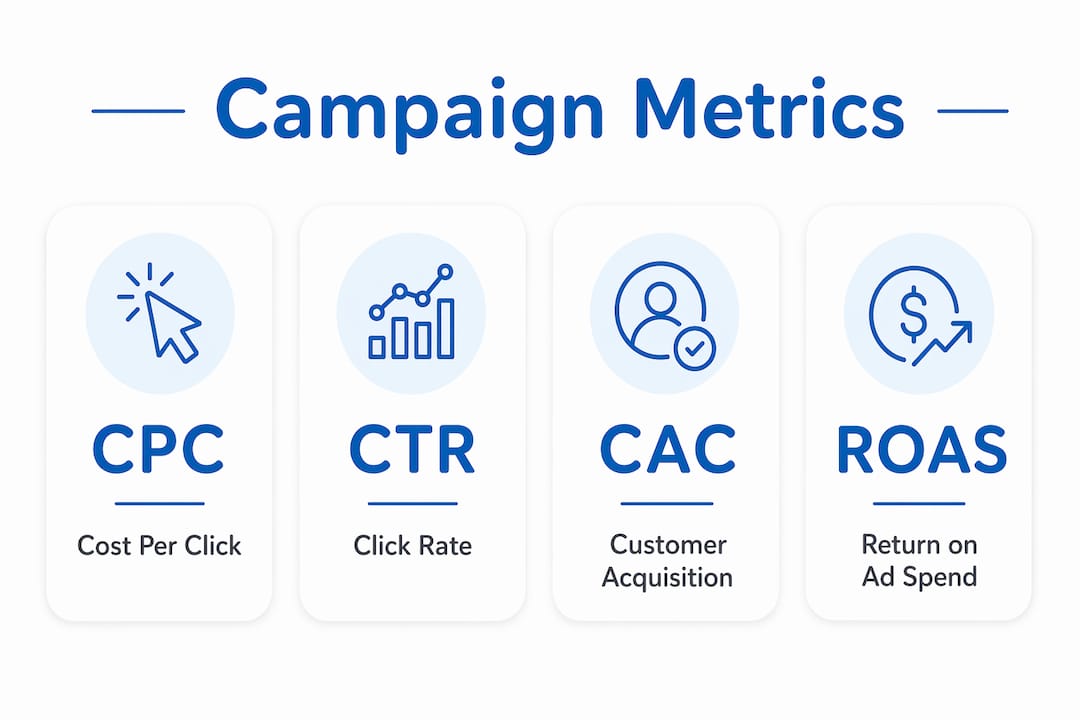
The table below shows the distinction clearly:
| Metric Type | Examples | What It Tells You |
|---|---|---|
| Platform metrics | CPC, CTR, impressions | How an ad performs within a channel |
| Business KPIs | CAC, ROAS, CPA, LTV | Whether marketing spend drives profit |
| Health indicators | Churn rate, payback period | Long-term sustainability of acquisition |
Business performance metrics like CAC, LTV, ROAS, and payback period link marketing investment to profitability in ways that platform metrics alone cannot. A campaign with a strong CTR but a CAC that exceeds LTV is losing money, even if the dashboard looks green.
Effective measurement follows a clear workflow. First, confirm that all tracking is accurate before the campaign launches. Second, set benchmark targets for each KPI based on historical data or industry norms. Third, review performance at regular intervals, weekly for paid channels and monthly for email, and adjust bids, audiences, or creative based on what the data shows. Fourth, translate those findings into a report that connects channel activity to business outcomes.
Accurate tracking, QA, and tagging are the foundation of this entire process. If your data is wrong at the source, every optimization decision built on it is also wrong.
Pro Tip: Always reconcile GA4 conversion data against your CRM or sales records monthly. Discrepancies between platform-reported conversions and actual revenue are common and will mislead budget decisions if left unchecked.
For finance-focused teams, understanding how CPA and ROAS apply to lead generation in specific sectors like financial services adds another layer of precision to campaign measurement.
What impact does this role have on business growth?
The digital marketing executive role drives growth through two mechanisms: customer acquisition and customer retention. Both require consistent, well-executed campaigns backed by accurate data.
On the acquisition side, the executive manages paid campaigns that bring new leads into the funnel. On the retention side, lifecycle marketing responsibilities involve rigorous QA, segmentation, and optimization rather than merely content creation. A well-built email automation journey can re-engage dormant customers, upsell existing ones, and reduce churn, all without additional ad spend.
The practical business impact includes:
- Lower CAC over time: Optimized campaigns reduce wasted spend and improve conversion rates, bringing down the cost of acquiring each new customer.
- Higher LTV: Lifecycle automation keeps customers engaged longer, increasing the revenue each customer generates before they churn.
- Better decision-making: When executives translate platform metrics into business-level insights, leadership can allocate budget with confidence rather than guesswork.
- Cross-channel alignment: Managing a shared marketing calendar across paid, email, and organic channels prevents conflicting messages and maximizes the impact of each campaign.
For SMBs specifically, a skilled online marketing executive can produce outsized results because they are often managing the full execution stack. A single well-optimized email automation sequence, built using SMB-focused email strategies, can generate consistent revenue without ongoing manual effort. That is the compounding value of execution done right.
Understanding how to build a digital marketing plan that the executive can actually execute is equally important. Strategy without execution infrastructure is just a document.
What i have learned about making this role actually work
After working with dozens of SMBs on their digital marketing execution, the pattern I see most often is this: businesses hire a digital marketing specialist, hand them a strategy document, and expect results. What they get instead is a talented person spending 40% of their time fixing tracking issues, reconciling data discrepancies, and waiting on approvals.
The role works when three things are in place. First, the tracking infrastructure must be correct before any campaign launches. GA4 configuration, UTM conventions, and CRM integration are not setup tasks you do once and forget. They require regular audits. Second, the executive needs a clear brief that connects channel goals to business KPIs. Telling someone to “grow the email list” is not a brief. Telling them to reduce CAC by 15% through email-driven reactivation campaigns is a brief they can execute against.
Third, and this is the part most businesses skip: the executive must be able to report on unit economics, not just engagement metrics. Executives must report on profit metrics, not just superficial channel engagement numbers, for leadership buy-in. When a marketing executive walks into a leadership meeting with CAC, LTV, and payback period data, they get budget. When they walk in with impressions and open rates, they get skepticism.
The digital marketing career path also rewards continuous learning. Meta Ads, Google Ads, and GA4 all update their interfaces, attribution models, and policies regularly. An executive who stopped learning 18 months ago is already working with outdated assumptions. The best ones I have seen treat platform update logs the way a lawyer reads case law: systematically and without skipping.
— Go
How Goonlinenow helps digital marketing executives deliver more
If you are building out your digital marketing execution capability, the right tools make a measurable difference in how fast you can move and how clearly you can report results.

Goonlinenow’s marketing automation software for SMBs combines email automation, CRM, lead nurturing, and campaign analytics in one system. There is no need to stitch together five separate platforms or spend hours reconciling data across tools. The done-for-you setup means your automations, funnels, and segmentation logic are configured by real people, not left to you to figure out. For marketing executives who want to spend less time on setup and more time on optimization, Goonlinenow is built for exactly that. Explore how automation drives SMB growth and see what your campaigns could look like with the right infrastructure behind them.
FAQ
What is a digital marketing executive’s core responsibility?
A digital marketing executive is responsible for executing and optimizing multi-channel campaigns across paid search, paid social, email, and organic channels, then reporting results against business KPIs like CAC, ROAS, and CPA.
How does a digital marketing executive differ from a manager?
A digital marketing manager sets strategy and oversees budgets, while the executive focuses on hands-on campaign setup, optimization, and reporting. The executive is the operational specialist; the manager is the strategic decision-maker.
Which tools does a digital marketing executive use daily?
The most common tools include Google Analytics GA4, Google Ads Manager, Meta Ads, and email platforms like Brevo or Klaviyo, along with CRM systems for segmentation and lifecycle campaign management.
What kpis should a digital marketing executive track?
Beyond platform metrics like CPC and CTR, an effective executive tracks business KPIs including CAC, LTV, ROAS, CPA, churn rate, and payback period to connect campaign activity to actual profitability.
How do you become a digital marketing executive?
The most direct path combines hands-on experience with at least one paid channel and one email or CRM platform, supported by proficiency in GA4 for performance analysis. Certifications from Google and Meta provide a credible foundation for the digital marketing career path.