

TL;DR:
- A digital marketing description sample clearly defines responsibilities, required skills, tools, and measurable KPIs for hiring and performance. It structures duties around strategy, content, technical implementation, and analysis, with emphasis on campaign optimization and lead generation. Seniority levels necessitate different focuses, highlighting soft skills and strategic accountability for higher roles to attract qualified candidates.
A digital marketing description sample is a structured document that defines the responsibilities, required skills, and measurable outcomes expected from a digital marketing role. Business owners and marketers use these descriptions to attract qualified candidates, align internal teams, and communicate the scope of digital marketing duties with precision. The industry term for this document is a “job description” or “role profile,” and when done well, it functions as both a recruitment tool and an operational blueprint. Tools like Google Analytics, CRM software, and performance metrics such as ROI, CPA, and CLV are standard components in any credible marketing service description. Getting this document right is the difference between hiring a generalist and building a focused marketing function.
What does a digital marketing description sample include?
A well-structured digital marketing description sample organizes responsibilities into four core areas: strategy and planning, content creation, technical implementation (SEO, SEM, and paid ads), and data analysis with reporting. According to research, 60 to 70% of focus in most digital marketing roles sits on campaign optimization and lead generation. That concentration tells you where to weight your descriptions and where to set performance expectations.
Each of the four areas carries distinct duties that should appear explicitly in any sample digital marketing outline:
- Strategy and planning: Setting campaign goals, defining audience segments, allocating budgets, and mapping content calendars
- Content creation: Writing copy, producing social media assets, developing email sequences, and managing brand voice
- Technical implementation: Running SEO audits, managing Google Ads or Meta campaigns, executing A/B tests, and handling landing page optimization
- Data analysis and reporting: Tracking KPIs like ROI, CPA, and CLV, building dashboards in Google Analytics, and presenting performance summaries to stakeholders
The duties of a digital marketer span all four areas, but the weight shifts depending on the role level and company size. A solo marketer at an SMB will touch all four. A specialist at a larger firm may own just one.
Pro Tip: When writing a description, list duties in order of time investment, not alphabetical order. Candidates read the first three bullet points most carefully, so lead with the responsibilities that define 70% of the actual workday.

How do digital marketing descriptions vary by seniority and specialization?
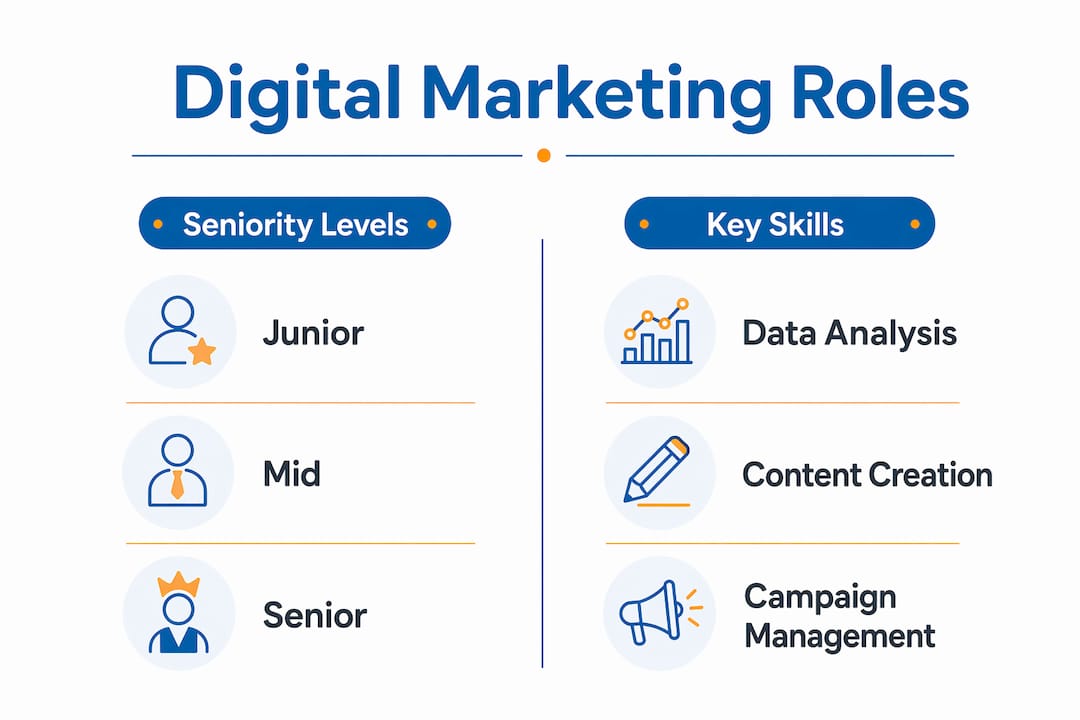
The most common mistake in writing a digital marketing description is applying the same template to every level of the role. Junior and senior positions require fundamentally different documents, and junior roles focus on execution while senior roles carry full accountability for KPIs and strategy alignment.
Here is how responsibilities and required skills shift across common role types:
| Role | Primary focus | Core responsibilities | Key skills required |
|---|---|---|---|
| Digital Marketing Coordinator | Execution | Content scheduling, basic reporting, ad setup | Canva, Hootsuite, Google Analytics basics |
| SEO Specialist | Technical growth | Keyword research, on-page optimization, link building | Ahrefs, SEMrush, Google Search Console |
| PPC Specialist | Paid performance | Campaign management, bid strategy, conversion tracking | Google Ads, Meta Ads Manager, Excel |
| Social Media Manager | Brand engagement | Content creation, community management, trend analysis | Instagram, LinkedIn, TikTok, scheduling tools |
| Content Marketing Manager | Audience growth | Editorial planning, SEO writing, content distribution | CMS platforms, SEO tools, email platforms |
| Digital Marketing Manager | Strategy and leadership | Budget ownership, team management, cross-channel strategy | Full-stack digital tools, stakeholder reporting |
| Head of Digital / CMO | Business alignment | P&L accountability, growth strategy, executive reporting | Analytics platforms, CRM, business intelligence tools |
Soft skills become increasingly critical as seniority rises. Stakeholder management and cross-functional collaboration are as important as technical skills at the manager level and above, because digital marketing intersects daily with design, product, and sales teams. A senior marketer who cannot explain a drop in click-through rates to a non-technical CFO is a liability, regardless of their technical ability.
Pro Tip: For senior roles, include one line in the description that explicitly names the internal stakeholders the person will report to and collaborate with. Candidates self-select more accurately when they understand the organizational context upfront.
What competencies and tools should digital marketing descriptions emphasize?
Effective descriptions define 5 to 7 core competencies, covering analytics tools like Google Analytics and CRM software alongside a working understanding of social media algorithms. This is the technical floor. Any description that lists fewer competencies risks attracting candidates who are underqualified for the actual workload.
The competencies that consistently appear in high-performing digital marketing role profiles include:
- SEO and SEM: Keyword strategy, on-page and technical SEO, paid search campaign management
- Email marketing: Segmentation, automation sequences, deliverability management, and A/B testing subject lines
- Content marketing: Long-form writing, editorial calendars, repurposing content across channels
- Paid advertising: Google Ads, Meta Ads, LinkedIn Ads, retargeting, and budget pacing
- Performance analytics: Google Analytics 4, CRM reporting, attribution modeling, and KPI dashboards
- CRM proficiency: Contact management, pipeline tracking, lead scoring, and integration with marketing tools
- Social media strategy: Platform-specific content, algorithm awareness, and community engagement
Beyond the technical list, a data-first mindset and the ability to translate insights into concrete improvements separate effective marketers from average ones. Listing “proficiency in Google Analytics” is not enough. Your description should specify what the person will do with that data, such as building weekly performance reports or identifying underperforming ad sets and reallocating budget in real time.
The ability to connect granular metrics like click-through rates to broader business goals such as CLV and lead conversion rates is what distinguishes high performers. Your description should reflect that expectation explicitly, not leave it implied. A digital marketing checklist can help you verify that your role profiles cover all the competency areas that matter in 2026.
How to craft an effective digital marketing description sample
The structure of a well-written description matters as much as the content. Descriptions that use structured numerical listings of duties and measurable KPIs attract higher-quality candidates and reduce misalignment after hiring. Vague language like “manage social media” produces vague applications. Specific language like “manage a monthly paid social budget of $5,000 across Meta and LinkedIn, reporting weekly on CPA and ROAS” produces qualified ones.
Here is a short sample excerpt for a mid-level Digital Marketing Manager role:
“Manage and optimize multi-channel campaigns across Google Ads, Meta, and email, with direct accountability for monthly lead generation targets and a quarterly ROI report to the executive team. Conduct A/B testing on landing pages and ad creative, using Google Analytics 4 and CRM data to identify performance gaps and adjust strategy within a two-week cycle.”
That excerpt names the platforms, defines the accountability, sets a reporting cadence, and specifies the tools. It leaves no ambiguity about what the role requires. You can see more examples of how these duties translate into live campaigns in this digital marketing campaign guide.
Follow this checklist when writing or reviewing any digital marketing description:
- Open with a two-sentence role summary that states the business purpose of the position
- List 6 to 10 specific responsibilities, ordered by time investment
- Separate “required” qualifications from “preferred” qualifications clearly
- Name every tool the person will use daily (Google Analytics, CRM, ad platforms)
- Include at least three measurable KPIs the role owns (ROI, CPA, CLV, lead volume)
- Add a soft skills section that names communication and collaboration expectations
- State reporting lines and team structure so candidates understand the organizational context
Balancing creative and analytical skills in the description is vital. Copywriting and asset design attract creative candidates, while ROI and CPA accountability signals to analytical ones. The best descriptions make clear that both are required, not optional. For a broader framework on building your hiring process around these descriptions, the digital recruitment guide from Goonlinenow covers the full hiring workflow for SMBs.
What I’ve learned about digital marketing descriptions after years of working with SMBs
Most digital marketing descriptions I review have the same problem. They are written for the company, not for the candidate. They list what the business needs without explaining why the role matters or what success looks like in the first 90 days. That gap costs businesses qualified applicants who move on to clearer opportunities.
The shift toward data-driven marketing skills is real and accelerating. Hiring managers who still prioritize creative portfolios over analytical track records are going to struggle to fill roles with people who can actually move revenue. That does not mean creativity is irrelevant. It means the description needs to show that both matter, and it needs to weight them honestly.
The other pattern I see constantly is the omission of soft skills. Omitting soft skills from digital marketing descriptions is one of the most common pitfalls in recruitment. A marketer who cannot communicate campaign performance to a non-technical founder, or who cannot collaborate with a sales team on lead quality, will underperform regardless of their technical credentials. Put communication expectations in the description. Be specific about who they will present to and how often.
My practical advice: write the description as if you are briefing the person on their first day. If you would not hand the document to a new hire as a performance guide, it is not specific enough to be a recruitment tool either.
— Go
Take your digital marketing further with the right tools

A strong digital marketing description sample sets the foundation for hiring the right people. But even the best team needs the right tools to execute effectively. Goonlinenow combines marketing automation, CRM, email, SMS, and lead nurturing into one affordable platform built specifically for SMBs. You get real human support, done-for-you setup, and proven results without the complexity or cost of enterprise software. If you want to see how automation can support your marketing team’s performance and give you the ROI visibility your descriptions promise, explore the marketing automation software built for growing businesses. No contracts, no hidden fees, and no tech headaches.
FAQ
What is a digital marketing description sample?
A digital marketing description sample is a structured role profile that outlines the responsibilities, required skills, tools, and measurable KPIs for a digital marketing position. It serves as both a recruitment document and an internal performance reference.
What are the core duties of a digital marketer?
The core digital marketing duties cover four areas: strategy and planning, content creation, technical implementation (SEO, SEM, paid ads), and data analysis with reporting. Most roles allocate 60 to 70% of workload to campaign optimization and lead generation.
How should descriptions differ for junior vs. senior digital marketing roles?
Junior roles focus on execution tasks like content scheduling and basic reporting, while senior roles carry full accountability for KPIs, budget allocation, and strategic direction. Senior descriptions should also include soft skills like stakeholder management and cross-team communication.
Which tools should appear in a digital marketing description?
Every description should name the specific tools the role requires daily, including Google Analytics 4, CRM software, Google Ads, Meta Ads Manager, and email marketing platforms. Naming tools attracts candidates with verified proficiency and reduces onboarding time.
How many competencies should a digital marketing description list?
Effective descriptions define 5 to 7 core competencies, covering SEO, SEM, email marketing, paid advertising, content creation, analytics, and CRM proficiency. Fewer than five competencies typically signals an underspecified role that will attract misaligned candidates.