

Hiring qualified digital professionals globally has never been more challenging for small and mid-sized businesses. You’re competing with enterprises that have massive HR budgets, yet you need the same specialized skills to grow. The good news? By 2026, 87% of companies globally use AI in at least one hiring aspect, leveling the playing field. This guide shows you how to leverage AI-powered recruitment tools, applicant tracking systems, and global talent strategies to find, qualify, and hire the right people faster and more affordably than ever before.
Key takeaways
| Point | Details |
|---|---|
| AI adoption transforms hiring | 87% of companies use AI in recruitment, enabling SMBs to compete with larger enterprises through automation and efficiency gains. |
| ATS streamlines workflows | Applicant tracking systems centralize job posting, resume parsing, screening, and communication, ideal for resource-constrained SMBs. |
| Global talent unlocks growth | Accessing specialized skills worldwide reduces costs, enables remote teams, and fills critical digital roles faster. |
| Time-to-hire drops dramatically | AI can reduce hiring cycles from 62 to 34 days while improving candidate quality and reducing manual workload. |
| Real ROI proven | SMBs using digital recruitment tools achieve 41% lower cost per hire, 20% better retention, and 300% hiring volume growth. |
Understanding the digital recruitment landscape in 2026
Digital recruitment today goes far beyond posting jobs online. It’s about using AI-driven tools, applicant tracking systems, and data analytics to identify, engage, and hire digital professionals across borders. For SMBs, this shift is critical because you’re competing for the same talent pool as Fortune 500 companies, but with a fraction of their resources.

The challenges are real. You likely don’t have a dedicated HR team to screen hundreds of resumes. You need specialized skills like SEO experts, developers, or digital marketers, but finding qualified candidates takes weeks or months. High competition means top talent gets snapped up quickly, leaving you with second-tier options or expensive external recruiters.
Here’s where the landscape has shifted dramatically. By 2026, 87% of companies globally use AI in at least one hiring aspect, from resume screening to candidate communication. This isn’t just enterprise adoption anymore. SMBs are embracing smb digital recruitment automation because it solves their biggest pain points: limited time, small teams, and tight budgets.
Applicant tracking systems and AI work together to automate the most time-consuming tasks. Instead of manually reading every resume, AI algorithms parse applications, score candidates against job requirements, and surface the best matches in minutes. Instead of scheduling interviews through endless email chains, automated systems let candidates book slots directly.
By 2026, 87% of companies globally use AI in at least one hiring aspect, transforming recruitment from manual processes to intelligent automation.
The main challenges SMBs face include:
- Extended time-to-hire cycles that cost revenue and momentum
- Difficulty assessing specialized digital skills without technical expertise
- Limited resources to compete with enterprise compensation packages
- Processing high application volumes without dedicated HR staff
- Maintaining candidate engagement throughout lengthy hiring processes
Understanding this landscape means recognizing that digital recruitment isn’t optional anymore. It’s how you stay competitive, access global talent, and build teams that drive growth without burning out your existing staff.
The role of AI and applicant tracking systems in smarter hiring
An applicant tracking system is software that centralizes your entire hiring workflow. Think of it as your recruitment command center. ATS centralizes activities like job posting, resume parsing, candidate screening, and communication, eliminating the chaos of spreadsheets, email threads, and lost applications.
For SMBs, this matters because you can’t afford to lose great candidates to disorganization. An ATS ensures every applicant gets tracked, evaluated, and responded to consistently. No more wondering which candidate you interviewed last week or where you saved that impressive resume.
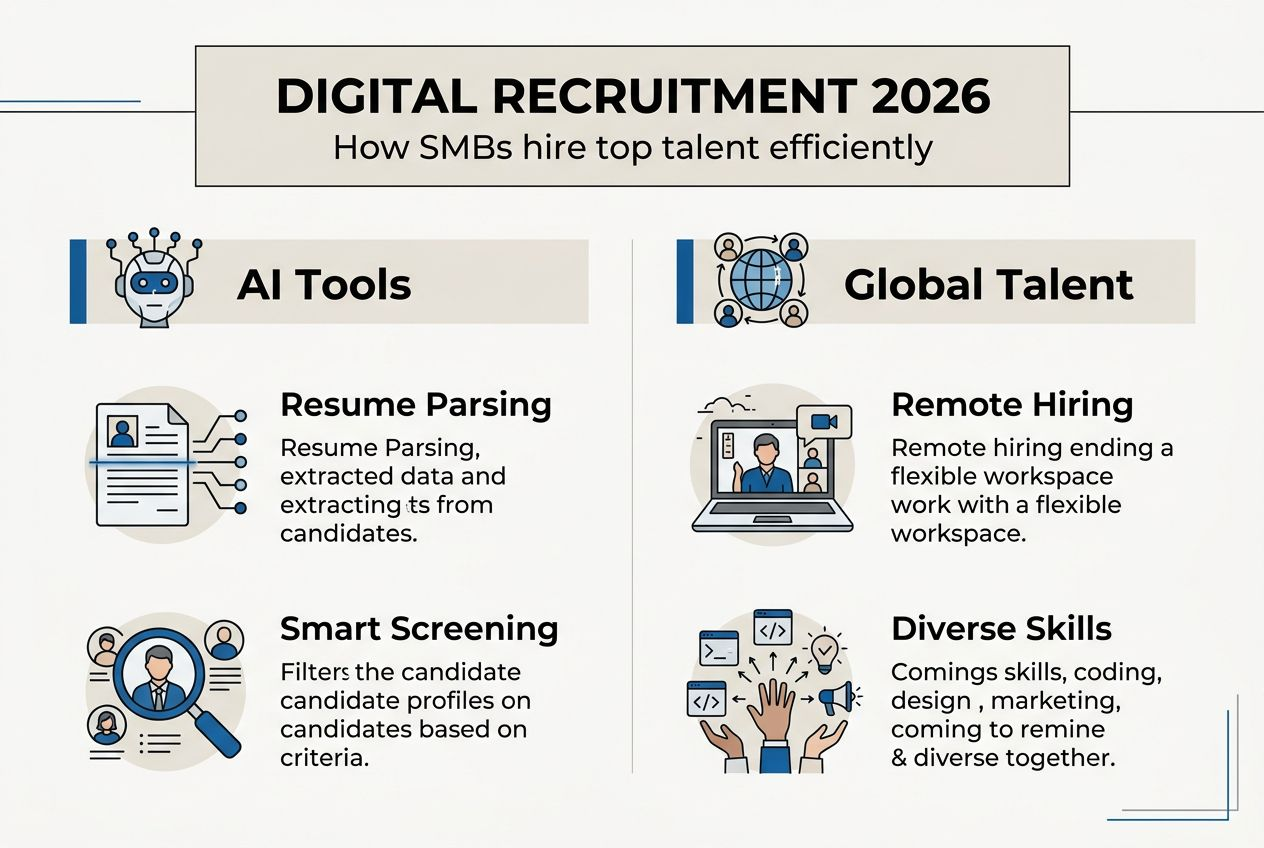
AI takes this further by actually evaluating candidates for you. Instead of spending hours reading resumes, AI-powered screening analyzes skills, experience, and qualifications against your job requirements. It ranks candidates, flags top matches, and even predicts which applicants are most likely to succeed in the role based on historical data.
The impact is measurable. AI can reduce time-to-hire from 62 to 34 days for medium-sized businesses. That’s nearly cutting your hiring cycle in half, which means faster project starts, quicker revenue generation, and less strain on your existing team covering vacant roles.
Here are the key features that make ATS and AI recruitment tools essential:
- Job posting distribution that broadcasts openings across multiple platforms simultaneously
- Resume parsing that extracts candidate information into structured, searchable databases
- Automated candidate screening using AI algorithms to score and rank applicants
- Communication automation including acknowledgment emails, status updates, and interview reminders
- Interview scheduling tools that sync with calendars and let candidates self-book available slots
- Analytics dashboards showing metrics like time-to-hire, source effectiveness, and candidate pipeline health
The data speaks clearly about adoption impact:
| Metric | Before AI/ATS | After AI/ATS | Improvement |
|---|---|---|---|
| Average time-to-hire | 62 days | 34 days | 45% faster |
| Candidate quality score | 6.2/10 | 8.1/10 | 31% better |
| Manual screening hours | 24 hrs/role | 4 hrs/role | 83% reduction |
| Cost per hire | $4,200 | $2,478 | 41% lower |
Pro Tip: Before implementing any ATS, map out your current hiring process step by step. Identify your biggest bottlenecks, whether that’s resume screening, interview scheduling, or candidate communication. Choose a system that specifically addresses those pain points rather than paying for features you won’t use. Many SMBs waste money on over-engineered platforms when a focused solution would deliver better results.
The real power comes from integration. When your ATS connects with your digital recruitment solutions explained, you create a seamless pipeline from job posting to offer acceptance. Candidates get a professional experience, your team saves countless hours, and you make better hiring decisions backed by data instead of gut feeling.
Leveraging global talent acquisition for digital recruitment success
Global talent acquisition means strategically sourcing and hiring professionals regardless of geographic location. For SMBs hiring digital specialists, this approach opens doors that local-only recruiting keeps locked. You’re no longer limited to your city or region. You can hire the best SEO expert in Manila, the perfect developer in Bangalore, or the ideal content strategist in Buenos Aires.
This matters because digital skills are globally distributed and increasingly remote-friendly. The pandemic proved that location doesn’t determine productivity for digital roles. Global talent acquisition is driven by intense competition and employees’ expectation for location flexibility, fundamentally changing how SMBs build teams.
The benefits extend beyond just access. Global hiring often reduces costs since you can offer competitive salaries based on local markets rather than expensive tech hubs. You build diverse teams with varied perspectives that strengthen problem-solving and creativity. You can maintain 24/7 operations by leveraging time zones strategically.
But global talent acquisition requires careful planning. Here are the key considerations:
- Compliance with local labor laws, tax requirements, and employment regulations in each country
- Cultural fit assessment to ensure remote team members align with your company values and communication style
- Time zone management for meetings, collaboration, and real-time communication needs
- Cost structure including salary, benefits, equipment, and potential employer of record services
- Skills-based hiring that prioritizes demonstrated abilities over traditional credentials or degrees
The strategic shift here is important. Traditional recruitment focuses on filling vacancies reactively. Global talent acquisition positions hiring as a proactive growth strategy. You’re not just plugging holes. You’re building a competitive advantage by accessing skills and perspectives unavailable in your local market.
This approach also mitigates risk. When you’re not dependent on one geographic talent pool, you have more options during hiring crunches. If your local market is saturated or too expensive, you pivot globally. If you need specialized expertise that’s rare in your region, you find it elsewhere.
The digital recruitment smes impact becomes clear when you realize that location constraints are self-imposed limitations. Digital professionals can work from anywhere. Your job is creating systems and processes that make remote collaboration seamless, from onboarding to daily operations to performance management.
For SMBs, this levels the playing field against larger competitors. You can’t outspend enterprises on compensation, but you can offer flexibility, autonomy, and direct impact that corporate bureaucracies can’t match. Global talent acquisition lets you compete on values and culture rather than just salary.
Proven benefits: real SMB success stories with digital recruitment tools
Theory is helpful, but results convince. Let’s look at actual SMBs that transformed their hiring through digital recruitment platforms. These aren’t cherry-picked outliers. They’re representative examples of what happens when you implement the right tools strategically.
Elite Construction Solutions reduced cost per hire by 41% and improved retention by 20% using Workable ATS. They were struggling with high turnover and expensive external recruiters. By centralizing their recruitment process and using AI screening, they identified better-fit candidates faster and built a more stable workforce.
Even more dramatic, Hugging Face scaled global hiring by 300% eliminating external recruiter costs with Workable’s AI ATS. As a fast-growing tech company, they needed to hire across multiple countries simultaneously. The ATS handled the complexity while AI screening ensured quality didn’t suffer despite the volume.
Here’s how these companies compared before and after implementation:
| Company | Metric | Before Digital Tools | After Digital Tools | Impact |
|---|---|---|---|---|
| Elite Construction | Cost per hire | $4,200 | $2,478 | 41% reduction |
| Elite Construction | 1-year retention | 68% | 88% | 20% improvement |
| Hugging Face | Hiring volume | 30 roles/year | 120 roles/year | 300% increase |
| Hugging Face | External recruiter cost | $180,000/year | $0 | 100% eliminated |
The additional benefits extended beyond these headline metrics:
- Automated resume screening eliminated 80% of manual review time
- Reduced dependency on external recruiters saving tens of thousands annually
- Improved candidate experience through faster response times and clear communication
- Better hiring decisions backed by data and AI insights rather than subjective impressions
- Scalable processes that grew with the business without proportional increases in HR staff
Pro Tip: When evaluating digital recruitment tools, look for case studies from companies similar to your size and industry. A platform that works brilliantly for a 500-person tech company might be overkill for a 20-person service business. Match the tool’s capabilities to your actual needs and growth trajectory, not aspirational goals that may never materialize.
These success stories share common elements. First, they committed to the technology fully rather than half-implementing it. Second, they trained their teams properly so everyone used the system consistently. Third, they measured results rigorously, tracking metrics like time-to-hire, cost per hire, and candidate quality to validate ROI.
The strategic impact goes beyond cost savings. Better hiring means better teams, which means better products, happier clients, and faster growth. When you recruitment solutions smbs cut hiring time and improve quality simultaneously, you create a competitive advantage that compounds over time.
Explore tailored digital recruitment solutions for your SMB
Now that you understand the landscape, tools, and proven results, it’s time to take action. Go Online Now offers recruitment solutions smbs cut hiring time specifically designed for businesses like yours. Our platform combines recruitment automation with marketing tools, creating an integrated system that attracts, engages, and converts top talent efficiently.
We know you don’t have time for complex implementations or learning curves. That’s why our digital recruitment solutions explained approach focuses on simplicity and results. You get done-for-you setup, real human support, and tools that actually work together instead of requiring constant integration fixes. Whether you’re hiring your first remote team member or scaling to dozens of digital professionals globally, we provide the automation and guidance you need. Explore how our marketing automation software smb conversions approach applies to recruitment, turning your hiring process into a competitive advantage rather than a constant struggle.
FAQ
What is an applicant tracking system (ATS)?
An ATS is software that centralizes and automates recruitment tasks including job posting, resume parsing, candidate screening, and communication. It helps SMBs manage applicants efficiently, reducing time-to-hire and improving candidate experience. Think of it as a CRM specifically designed for hiring, keeping every candidate interaction organized and trackable.
How can AI improve my SMB’s hiring process?
AI automates the most time-consuming parts of recruitment like sorting resumes and evaluating candidates against job requirements. It can reduce your hiring cycle from over 60 days to around 34 days while improving candidate quality. AI also enhances candidate experience through timely automated communication, ensuring no applicant falls through the cracks during your process.
What challenges do SMBs face in digital recruitment?
SMBs typically lack dedicated HR teams, causing longer hiring cycles and difficulty assessing specialized digital skills. You face intense competition from larger companies with bigger budgets for the same talent pool. Limited resources mean you can’t afford expensive external recruiters or lengthy hiring processes that drain productivity from your existing team.
How do I avoid common mistakes when implementing AI recruiting tools?
Start by defining clear recruitment goals and choosing tools that specifically address your biggest bottlenecks. Engage your team early in the selection process to ensure buy-in and smooth adoption. Focus on platforms designed for SMBs rather than enterprise solutions that require heavy IT support. Learn from others by exploring digital recruitment strategies smbs that have proven successful for businesses your size.