

TL;DR:
- Most entrepreneurs mistake digital marketing as solely running ads, but it is an interconnected system of demand, conversion, measurement, and compliance that drives growth. Key trends in 2026 include agentic AI, privacy regulations, fragmented attention, and immersive content, all emphasizing trust and authenticity. SMB success depends on auditing their ecosystem, choosing targeted channels, and mastering measurement prior to increasing ad spend.
Most entrepreneurs think the digital market is just about running ads. It is not. The digital market, more precisely called the digital marketing ecosystem, is an interconnected system of demand discovery, conversion, measurement, and compliance that determines whether your business grows or stalls online. Every channel you use, every piece of content you publish, and every data point you collect is part of this system. This guide breaks down the ecosystem, the trends reshaping it in 2026, the regulatory pressures you cannot ignore, and a practical framework to help you compete and win.
Understanding the digital market ecosystem
Think of the digital market not as a single channel but as a machine with interdependent parts. When one part fails, the whole system underperforms. According to SBA guidance on market systems, practitioners treat this ecosystem as three aligned layers: demand discovery, conversion assets, and measurement plus compliance.
Demand discovery covers every channel where potential customers find you. That includes:
- Organic search (Google, Bing, AI-generated search results)
- Social media platforms (Instagram, LinkedIn, TikTok, YouTube)
- Marketplaces (Amazon, Etsy, Google Shopping)
- Video content and podcasts
Conversion assets are what turn that awareness into revenue. Your website, landing pages, lead magnets, pricing pages, and offers all belong here. A business can invest heavily in discovery and still lose because the conversion layer is weak.
Measurement and compliance is the part most SMBs underestimate. This includes your analytics setup, attribution models, consent management, and legal obligations under regulations like GDPR. Without clean measurement, you cannot tell what is working. Without compliance, you risk fines and broken customer trust.
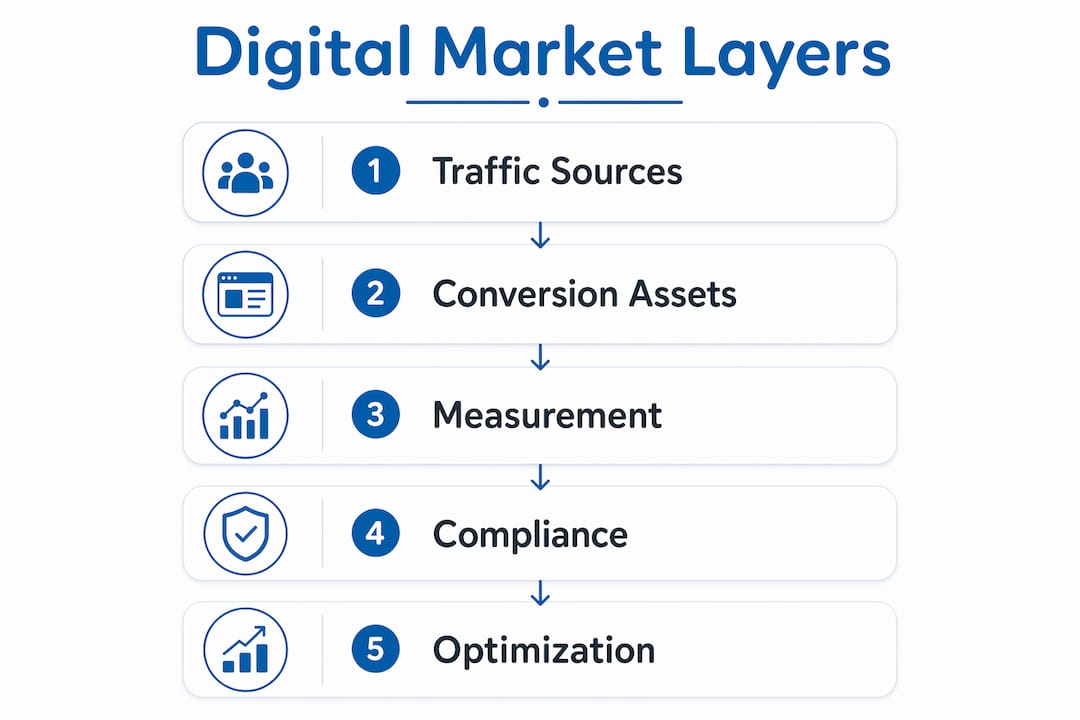

These three layers must work together. If you drive traffic from social media but your landing page loads slowly on mobile, the discovery effort is wasted. If your analytics are misconfigured because of a poor consent setup, your data is unreliable and every decision built on it is flawed.
Pro Tip: Before increasing your ad spend, audit all three layers of your ecosystem. Many SMBs spend more on traffic before fixing the conversion and measurement problems that are already costing them money.
Key digital marketing trends in 2026
The forces reshaping online commerce right now are not gradual shifts. Several of them are structural changes that require you to rethink your approach from the ground up.
Agentic AI is the biggest technology shift this year. These are autonomous systems that handle campaign segmentation, ad execution, and performance optimization without manual input at every step. They do not just automate tasks; they make decisions. For SMBs, this means you can run more sophisticated campaigns with smaller teams, but you still need a human setting strategy and reviewing outputs.
- E-E-A-T and content quality: Google’s ranking systems now heavily favor expertise and trustworthiness signals. Content that demonstrates real experience, specific expertise, and verifiable authorship outperforms generic, AI-generated filler. If your blog posts could have been written by anyone, they will rank accordingly.
- Privacy and the death of third-party cookies: Ethical data practices are no longer optional. GDPR enforcement has grown sharper, and major browsers have eliminated or restricted third-party cookies. Brands that built their retargeting on those cookies are rebuilding their data strategies from scratch.
- Fragmented attention: Your customers are not on one platform. They move between short-form video, email, search, and messaging apps in a single hour. A multi-channel presence is not ambitious marketing. It is a basic requirement.
- Immersive and interactive content: Augmented reality product previews, interactive calculators, and shoppable video are gaining real traction. These formats generate higher engagement and longer time-on-page, which feeds both conversion and SEO.
The common thread across all these trends is trust. AI can generate content at scale, but human oversight for brand voice and compliance language remains critical. Customers in 2026 can spot inauthenticity faster than ever. Your competitive edge is not just technology. It is the combination of smart automation and genuine human credibility.
For a deeper look at how these shifts affect your search visibility, the SEO trends for small business breakdown from Goonlinenow is worth your time.
Navigating Digital Markets Act enforcement
The Digital Markets Act (DMA) is European Union legislation designed to prevent large platform operators from using their market dominance unfairly. If you run ads on or sell through platforms like Google, Apple, Meta, or Amazon, their behavior toward you is directly shaped by DMA enforcement. Understanding this is part of how to succeed in digital commerce in 2026.
In May 2026, two non-compliance decisions with fines were published, covering violations related to anti-steering practices and personal data use. Anti-steering rules prevent platforms from stopping businesses from directing customers to their own websites or better offers elsewhere. These fines signal that enforcement is accelerating, not slowing down.
The DMA also has ongoing investigations into cloud services and gatekeeper designation for additional platforms. The practical implication: the platforms you depend on for visibility are operating under increasing scrutiny and are changing their policies accordingly.
Here is what SMBs should do to stay compliant and protect their channel strategies:
- Audit your consent flows. Tighter consent UX is now a legal and strategic requirement. Users must have clear, easy choices about their data. Build consent management into your website, not around it.
- Diversify your platform reliance. Do not build your entire customer acquisition strategy on a single gatekeeper platform. If that platform changes its terms or faces enforcement action, your business should not collapse.
- Review your data collection practices. Only collect what you need, store it securely, and document why you collect it. This protects you legally and builds customer trust.
- Work with legal or compliance counsel on key markets. If you sell into the EU, you need someone who understands both DMA and GDPR implications for your specific business model.
Pro Tip: Treat your consent management platform (CMP) as a revenue protection tool, not just a legal checkbox. Poorly designed consent flows suppress the analytics data you need to make good decisions, which costs you more than the fine risk.
Building your digital market strategy
A strategy that actually works in 2026 combines three things: market research, competitive analysis, and the right technology stack. Most SMBs have one or two of these. Very few have all three working together.
The SBA recommends combining market research with competitive analysis because each one answers a different question. Market research tells you who your customers are and what they want. Competitive analysis tells you what your competitors are doing and where the gaps are. Together, they give you a basis for differentiation that is grounded in real demand.
Strategy comparison: common SMB approaches
| Approach | What it does well | Where it falls short |
|---|---|---|
| Ad spend only | Fast visibility | No owned audience, stops when budget stops |
| SEO only | Long-term organic growth | Slow to start, affected by algorithm changes |
| Social media only | Community building | Algorithm-dependent reach, low conversion |
| Integrated multi-channel | Discovery, nurture, convert | Requires coordination and measurement |
The integrated approach wins over time, but it requires discipline. Here is how to build it:
- Start with customer research. Interview ten current customers. Ask how they found you, what they almost bought instead, and what made them choose you. This is your strategic brief.
- Map your competitive position. Identify three direct competitors. Study their content, ads, and offers. Find what they are ignoring. That gap is often your opening.
- Pick your core channels. Choose three channels where your customers actually spend time. Do those three well before adding more.
- Use AI tools for execution, not strategy. Let automation handle email sequences, ad pacing, and reporting. Keep humans in charge of messaging, positioning, and creative direction.
- Measure attribution, not just traffic. Know which channels contribute to revenue, not just clicks. Multi-channel digital strategies perform best when you can see the full conversion path.
Practical tips for SMBs in the evolving market
You can read about digital advertising strategies all day. What separates businesses that grow from those that stay stuck is disciplined execution on a small number of things that actually matter.
- Own your audience. Build your email list. Your followers on any platform are rented. Your email list is owned. When platforms change their algorithm or raise ad prices, your list still works.
- Focus, not breadth. Three channels done well outperform seven channels done poorly. Pick the platforms where your specific customers are, not where marketing articles say you should be.
- Tell real stories. Authentic case studies, behind-the-scenes content, and honest customer testimonials outperform polished corporate ads for SMBs. You have an advantage over large brands here. Use it.
- Be transparent about data. Tell customers exactly what you collect and why. This is legally smart and genuinely differentiating. Most businesses still treat privacy policy pages as legal boilerplate nobody reads.
- Prepare your team for ongoing change. AI tools, platform updates, and regulatory changes will keep coming. Build a culture where your team tests small, learns fast, and adapts without panic.
Pro Tip: The SMB digital marketing checklist from Goonlinenow is a practical tool for auditing your current setup against these fundamentals. Use it quarterly, not just when something breaks.
My take on mastering the digital market today
I have watched hundreds of SMBs enter the digital market with ambition and exit with frustration. The pattern is almost always the same: they invest in tactics before they have a strategy, and they invest in traffic before they have a functioning conversion and measurement system.
Here is the uncomfortable truth I have learned. Most businesses do not have a marketing problem. They have a measurement problem. They cannot see what is working because their consent flows are broken, their analytics are misconfigured, or they are attributing revenue to the wrong channel. Fixing measurement is unglamorous work, but it pays better than any new ad campaign.
I am also skeptical of the idea that AI will solve everything for smaller businesses. The agentic AI tools are genuinely powerful, but they need clean inputs: a clear brand voice, a defined customer persona, and reliable data. If you feed AI a confused strategy, it executes that confusion at scale. Faster failure is not progress.
What actually works is boring but effective: know your customer deeply, pick a small number of channels, produce content that demonstrates real expertise, and measure rigorously. The businesses I have seen grow consistently in this environment are not the ones chasing every new platform. They are the ones that get the fundamentals right and stay patient while the results compound.
— Go
How Goonlinenow helps SMBs compete online
Growing in the digital market takes more than reading the right articles. It takes a system that ties your marketing, automation, and customer management together without requiring you to become a full-time technologist.
Goonlinenow is built for exactly this. The platform delivers marketing automation built for SMB conversions, combining email, SMS, lead nurturing, CRM, and reputation management in one place. Clients have seen up to 85% more conversions and 75% time saved in 90 days. There are no contracts, no hidden fees, and the setup is done for you. If you are ready to put the strategy from this article into practice with tools that actually fit your budget, Goonlinenow is worth a look. Explore the proven ROI gains other SMBs are achieving right now.
FAQ
What is the digital market for SMBs?
The digital market refers to the full online ecosystem where businesses discover customers, convert them, and measure results. For SMBs, it includes search, social media, email, marketplaces, and the technology and compliance systems that support them.
How do digital marketing trends affect small businesses?
Trends like agentic AI, E-E-A-T-focused SEO, and the decline of third-party cookies directly change how SMBs attract and retain customers online. Staying current with these shifts determines whether your existing strategies continue to perform or quietly lose effectiveness.
What is the Digital Markets Act and why should SMBs care?
The DMA is EU legislation that regulates how large platform operators like Google and Meta can treat businesses that depend on their platforms. SMBs should care because DMA enforcement actions affect platform behavior, advertising rules, and data usage policies that directly impact your campaigns.
How do you build a digital market strategy that works?
Combine market research with competitive analysis to understand your customers and your differentiation, then select three core channels aligned with your customer journey. Measure attribution properly and adapt based on what the data shows.
What is the biggest mistake SMBs make in digital commerce?
The most common mistake is investing in traffic before fixing conversion and measurement. More visitors do not fix a broken funnel or misconfigured analytics. Audit your ecosystem first, then scale what works.