

TL;DR:
- Digital recruitment streamlines the full hiring process, reducing costs and increasing speed.
- Combining automation with human judgment ensures fair and effective hiring outcomes.
- Regular audits and strategic adjustments are essential to mitigate bias and edge-case risks.
Optimize your digital recruitment process for faster, smarter hiring
Most small and mid-sized businesses have already adopted some form of digital recruitment, yet 69% of SMBs still struggle to fill key roles. That gap tells a clear story: having the tools is not the same as using them well. Digital recruitment done right means combining the speed of automation with the judgment of experienced people. Done wrong, it means rejected qualified candidates, fraud exposure, and wasted time. This article walks you through how the process actually works, where it breaks down, and what practical strategies will help your business hire faster and smarter in 2026.
Key Takeaways
| Point | Details |
|---|---|
| Automation saves time | Digital recruitment tools can cut hiring costs and process time by over half when properly implemented. |
| Hybrid approach wins | Combining human judgment with AI screening produces better talent matches than automation alone. |
| Audit for bias | Regular audits of digital tools are critical to avoid unfair hiring and maximize fit. |
| Edge cases matter | SMBs must watch for fraud, ghosting, and AI-driven bias to maintain candidate quality. |
| Skills-first strategy | Prioritizing skills and candidate-first processes attracts higher-quality applicants and supports global hiring. |
Understanding digital recruitment: From manual to automated
Digital recruitment is not just posting a job online. It covers the full hiring journey, from writing and distributing job listings to screening resumes, scheduling interviews, running assessments, and onboarding new hires. Understanding what this process actually includes is the first step to making it work for your business.
Not long ago, a small business owner would manually sort through paper resumes, call candidates one by one, and schedule interviews via email chains that dragged on for weeks. Today, software handles most of those tasks in hours. That shift has been dramatic. A solid digital recruitment guide will show you how the landscape has changed and what tools now exist for businesses of every size.
Here is what modern digital recruitment actually covers:
- Job posting automation: Distributing listings across multiple job boards simultaneously
- AI-powered resume screening: Filtering applications by skills, experience, and keywords
- Automated scheduling: Booking interviews without back-and-forth emails
- Video interviewing platforms: Pre-recorded or live interviews with built-in scoring
- Digital onboarding: E-signatures, document collection, and training delivery
- Talent analytics: Tracking source quality, time-to-fill, and drop-off rates
The efficiency gains are real. Digital tools cut recruitment costs by 50 to 60 percent compared to traditional methods. That is a meaningful saving for any SMB operating with a lean HR function. And it is not just about cost. Speed matters too. Faster hiring means fewer lost candidates who accept offers elsewhere while you are still deliberating.
But here is where many business owners get tripped up: they assume automation means hands-off. It does not. 99% of hiring managers now use AI in their process, mainly for scheduling and talent strategy, but the best results come when humans stay involved in the decisions that matter most. Learning how digital recruitment works at each stage helps you know exactly where to apply technology and where to apply judgment.
Another common misconception is that AI produces unbiased results by default. It does not. Algorithms trained on historical hiring data can inherit the same biases that existed in past decisions. Recognizing this from the start puts you in a much stronger position to build a fair and effective process.

Key stages of the digital recruitment process
Now that you have seen what digital tools offer, here is how the recruitment process looks when applied step by step. Breaking it into clear stages makes it easier to spot where automation helps and where human judgment is irreplaceable.
- Planning: Define the role, required skills, compensation range, and target start date. Involve your team leads early. Misaligned expectations at this stage cause delays later.
- Sourcing: Use job boards, LinkedIn, social media, niche platforms, and employee referrals. Automated tools can push your listing to dozens of channels at once.
- Screening: AI filters resumes by keywords and qualifications. This saves hours but requires careful setup to avoid filtering out strong candidates who phrase their experience differently.
- Interviewing: Combine automated video screening for early rounds with live structured interviews for shortlisted candidates. Human interviewers assess cultural fit, communication, and nuanced judgment.
- Assessment: Skills tests, work samples, or reference checks happen here. Automation can deliver and score tests, but humans interpret the results.
- Offer and onboarding: Automated systems handle offer letters, e-signatures, compliance documents, and initial training schedules. Human touchpoints ensure new hires feel welcomed.
The hybrid human-AI approach is widely recognized as ideal: use automation for volume tasks and human review for fit and culture decisions. That balance is what separates businesses that hire well from those that hire fast and regret it.
| Stage | Automated | Human-led |
|---|---|---|
| Job posting | Yes, multi-board distribution | Role definition and copywriting |
| Resume screening | Yes, keyword and skills filter | Final shortlist review |
| Interview scheduling | Yes, calendar sync | Decision on interview format |
| Video interviews | Partial, pre-recorded screens | Live structured interviews |
| Assessments | Yes, delivery and scoring | Interpretation and weighting |
| Onboarding | Yes, documents and training | Culture integration and mentoring |
Applying SMB hiring strategies that match each stage to the right tools makes the whole process faster and more reliable. One critical point: edge cases are rising, including fake applications, AI-generated resumes, ghosting, and data overload. Building human checkpoints into your process is your best defense.
Pro Tip: Conduct quarterly bias audits of your screening filters and interview scoring rubrics. Small calibration errors compound over time and can quietly skew your hiring pool in ways that are hard to reverse.
Pitfalls and edge cases: What can go wrong?
As powerful as digital recruitment is, SMBs must be aware of what can go wrong and how to mitigate these risks. The efficiency gains are real, but so are the failure modes.
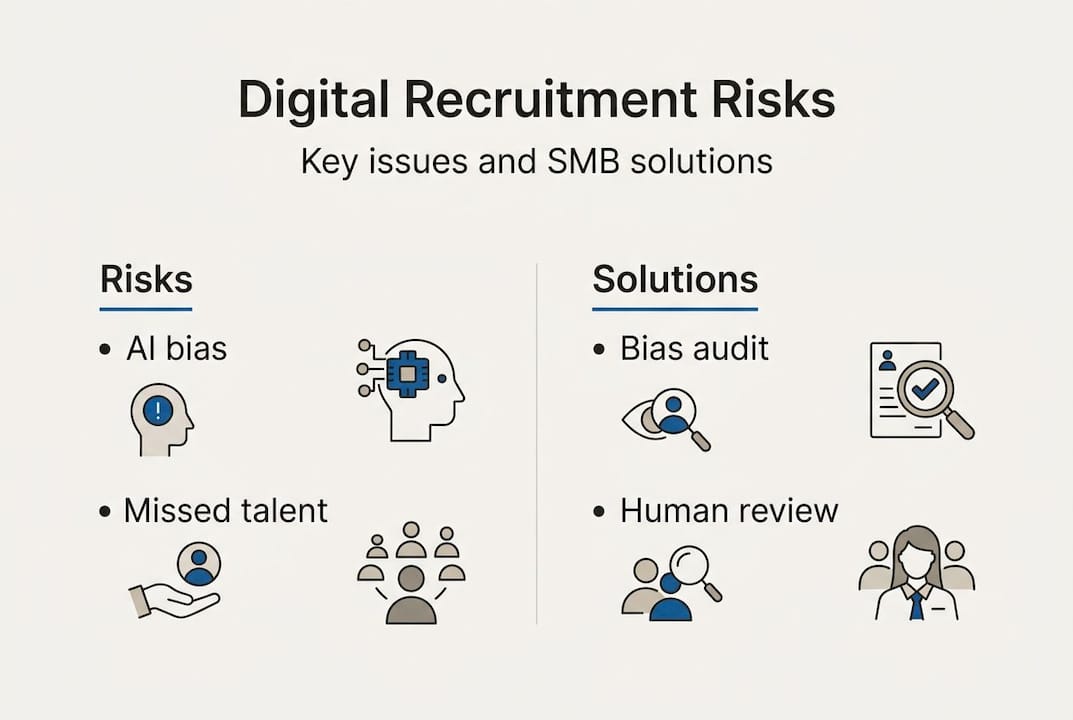
The most talked-about risk is bias. AI amplifies historical biases if the underlying data is skewed, and bias in video analysis and facial recognition tools has been well documented. A system trained on past hires from a narrow demographic will tend to favor more of the same, even when better candidates exist outside that group.
Fraud is a growing concern that catches many SMBs off guard. Fake applications, LLM-generated resumes, and ghosting are all rising trends. Some estimates suggest that by 2028, up to 25% of applications will not originate from real human candidates in the traditional sense. That means your screening tools need to be configured to detect anomalies, not just match keywords.
Here are the top pitfalls SMBs encounter in digital recruitment:
- False negatives: Qualified candidates rejected because their resume lacks specific keywords your filter expects
- AI-generated applications: Bots or LLMs submitting polished but hollow applications at scale
- Ghosting: Candidates dropping out mid-process due to slow communication or unclear next steps
- Bias in video tools: Automated facial analysis scoring candidates unfairly based on appearance or accent
- Data overload: Too many applications creating analysis paralysis instead of clarity
- Compliance gaps: Failing to meet data privacy regulations when storing candidate information
“The real risk in digital recruitment is not that technology will make a bad hire. It is that technology will quietly reinforce the same patterns that made your past hires less diverse and less effective than they could have been.”
Here is a summary of common edge-case risks and practical mitigation steps:
| Risk | Impact | Mitigation |
|---|---|---|
| AI false negatives | Lose qualified candidates | Broaden keyword lists; add manual spot-checks |
| LLM-generated resumes | Waste screening time | Add opinion-based questions; verify manually |
| Ghosting | Damaged employer brand | Automate timely status updates |
| Bias in video analysis | Discriminatory shortlists | Disable facial scoring; use structured rubrics |
| Data overload | Slower decisions | Set scoring thresholds; limit screening rounds |
Using streamlining tips to structure your process and reviewing SME recruitment impact data will help you build safeguards before problems arise, not after. Prevention is far cheaper than damage control.
Best practices for SMB digital recruitment success
Having addressed what can go wrong, let’s turn to proven strategies and best practices for SMB digital recruitment success. These are not theoretical ideals. They are practical actions you can apply right now.
Start with skills, not degrees. Skills-first hiring consistently outperforms credential-based filtering for most SMB roles. A degree tells you someone sat through a program. A skills assessment tells you what they can actually do. Rewriting your job listings to focus on outcomes and competencies rather than educational requirements immediately broadens your talent pool.
Design for mobile. A large share of global candidates, especially younger professionals and those in emerging markets, apply entirely from their phones. If your application process requires desktop uploads, long forms, or browser-specific tools, you are losing candidates before they even begin. Keep the mobile experience fast, simple, and respectful of the applicant’s time.
Communicate at every stage. Ghosting is a two-way street. Candidates ghost employers partly because employers ghost them first. Automating status updates at each stage of the process costs almost nothing and dramatically improves your candidate experience and employer brand. A simple “we received your application” message followed by a clear timeline reduces anxiety and drop-off.
Offer flexible work options. If you want to access global talent, flexibility is not optional. Flexible work arrangements are among the top factors that attract high-quality candidates outside your immediate geography. Remote or hybrid options, flexible hours, and asynchronous communication tools open your candidate pool significantly.
Audit regularly. Your process today will drift from your goals within months if left unreviewed. Schedule quarterly reviews of your screening criteria, scoring rubrics, and sourcing channels. Look at drop-off rates by stage, time-to-fill by role, and offer acceptance rates. Each metric tells you where friction lives.
Here are additional best practices that make a measurable difference:
- Include your recruiters in business planning sessions so hiring aligns with growth timelines
- Use structured interview scorecards to reduce interviewer subjectivity
- Test your own application process regularly from a candidate’s perspective
- Build a talent pipeline before you have open roles, not after
- Track source quality, not just source volume
Pro Tip: At the final interview stage, include at least one open-ended opinion question that requires a genuinely personal answer. This step is simple, costs nothing, and is highly effective at identifying AI-generated or bot-driven responses, which are a growing risk in candidate-first hiring design.
Reviewing a streamlining recruitment guide for SMBs and applying an efficient hiring guide framework will help you build a process that is both scalable and human-centered.
The uncomfortable truth most experts won’t tell you about digital recruitment
Most expert guides focus on what tools to buy and what metrics to track. What they often skip is this: technology amplifies what already works in your hiring process. It does not fix what is broken.
If your job descriptions attract the wrong candidates, automation will screen the wrong people faster. If your interview process is inconsistent, AI scoring will lock in that inconsistency at scale. Even advanced digital tools cannot fill all key roles when the underlying strategy is misaligned with what candidates actually want.
The businesses that hire best in 2026 are not the ones with the most sophisticated tech stacks. They are the ones that combine digital agility with creative candidate sourcing and honest self-assessment. That might mean sourcing from non-traditional platforms, building relationships with local training programs, or simply writing better job listings. Explore digital recruitment solutions explained to understand what a balanced approach actually looks like in practice.
Expect that some hires will always require manual intervention. Build that into your process deliberately, not as an afterthought.
Streamline your digital recruitment with expert solutions
If you are ready to apply what you have learned and build a smarter hiring process, Go Online Now offers SMB recruitment solutions designed specifically for growing businesses like yours.
Our digital recruitment solutions guide walks you through the exact tools and frameworks that reduce hiring time and help you connect with qualified professionals worldwide. From process design to sourcing strategy, we bring together automation and real human expertise in one place. Ready to move from reactive hiring to a proactive talent strategy? Our streamline recruitment tips will show you exactly where to start.
Frequently asked questions
How can SMBs avoid bias in digital recruitment?
SMBs should run quarterly audits of their AI screening tools and scoring criteria to identify and correct bias before it shapes hiring outcomes. Disabling facial analysis features in video tools is also a practical first step.
Are traditional interviews still effective in digital recruitment?
Standard interview formats are losing ground to more practical assessments. Pair programming and project-based interviews are increasingly preferred because they reveal real skills and team fit far better than scripted Q&A.
What’s the biggest risk in automated candidate screening?
The most common risk is AI-driven false negatives, where qualified candidates are rejected because their resumes do not use the exact keywords the filter expects, causing real talent to slip through unnoticed.
How can SMBs find global talent with digital recruitment?
Making your process mobile-friendly and flexible expands your reach significantly. Offering remote or hybrid roles and using digital tools designed for international sourcing gives you access to a far broader and more diverse global talent pool.