

TL;DR:
- Digital recruitment democratizes access, reduces costs, and speeds up hiring for SMBs.
- Over-reliance on AI can amplify bias and increase fake applications; human oversight is essential.
- Successful SMB hiring combines automation with human review and candidate experience focus.
Digital recruitment is reshaping how small and mid-sized businesses find and hire talent, but it comes with a risk most owners overlook. By 2028, 25% of applications are expected to be fake, driven by the very tools designed to make hiring easier. That reality changes everything about how you should approach your hiring strategy. This article breaks down what digital recruitment actually means for SMBs, where the real advantages lie, what pitfalls to avoid, and how to build a smarter, more reliable hiring process that delivers quality hires without losing the human judgment that no algorithm can replace.
Key Takeaways
| Point | Details |
|---|---|
| Digital recruitment levels the field | Small and mid-sized businesses can now compete for talent and grow thanks to affordable digital hiring tools. |
| Speed and efficiency drive success | Using digital recruitment cuts hiring time and costs, letting SMBs build their teams faster. |
| Hybrid approach avoids tech pitfalls | Combining human judgment with digital tools prevents bias and fake applications while preserving candidate experience. |
| Practical frameworks improve results | Following best practice checklists helps SMBs hire smarter and scale sustainably. |
Digital recruitment: Changing the hiring game for SMBs
Digital recruitment is the use of online platforms, software, and automation to attract, screen, and hire candidates. Think job boards, applicant tracking systems (ATS), video interviews, and AI-powered screening tools. For SMBs, these tools were once reserved for large corporations with dedicated HR departments and big budgets. That is no longer the case.
Today, digital recruitment democratizes access to professional hiring tools, reduces costs significantly, and allows smaller businesses to compete for the same talent as enterprise companies. You no longer need a full recruiting team to post jobs globally, screen applicants efficiently, or schedule interviews automatically.
Here is what modern digital recruitment platforms typically offer:
- Job distribution: Post to multiple job boards simultaneously with one click
- ATS software: Track every applicant from application to offer in one dashboard
- AI screening: Filter resumes based on skills, experience, and keywords
- Video interviews: Conduct asynchronous or live interviews without scheduling headaches
- Analytics: Measure time-to-hire, cost-per-hire, and source effectiveness
- Candidate communication: Automate follow-ups, rejections, and interview scheduling
The impact on cost and time is measurable. Consider the following comparison:
| Metric | Traditional hiring | Digital recruitment |
|---|---|---|
| Average time to hire | 36 to 42 days | 14 to 21 days |
| Cost per hire | $4,000 or more | $1,500 or less |
| Job posting reach | Local or regional | Global |
| Resume screening time | Hours per role | Minutes per role |
| Candidate tracking | Manual spreadsheets | Automated ATS |
For a growing SMB, cutting time-to-hire in half and reducing cost-per-hire by 60% is not just a convenience. It is a competitive advantage. Explore the full range of digital recruitment benefits to understand how these tools can fit your specific business context.

Core advantages: Why digital recruitment fuels growth
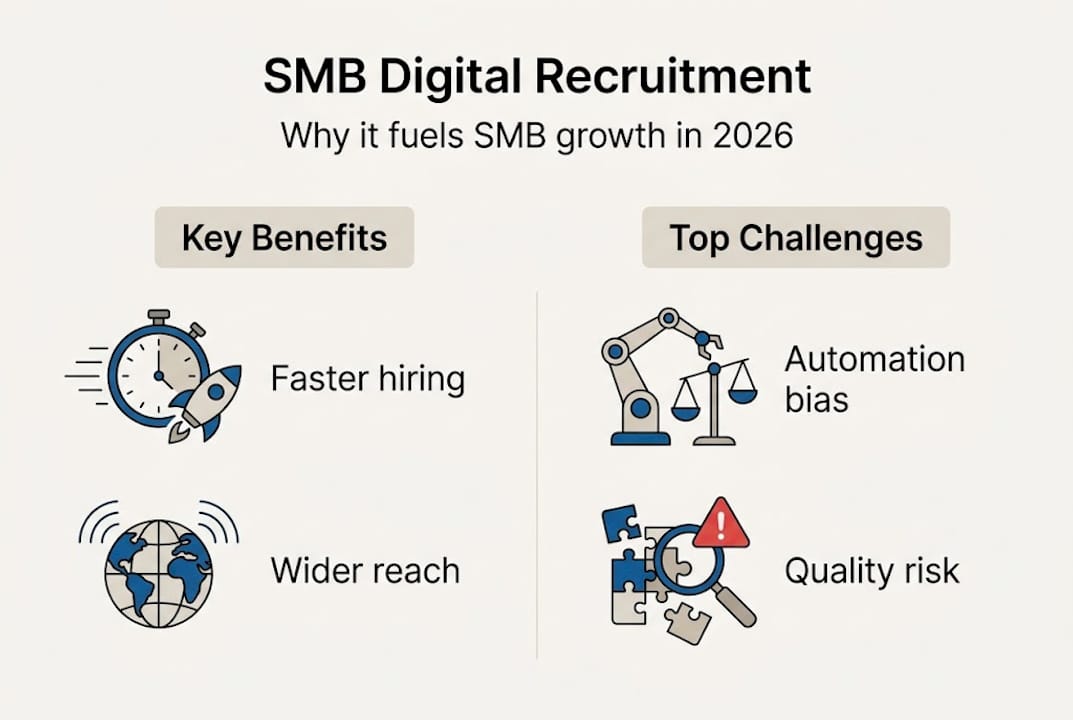
Speed, reach, and candidate quality are the three pillars where digital recruitment consistently outperforms traditional methods. Let’s look at each one and why it matters to you as an SMB owner.
Speed is the most immediate win. Digital recruitment enables faster and more efficient hiring at a lower cost, which means you spend less time with a vacant role pulling productivity from your team. Every day a critical position stays open, your business loses output.
Reach is where digital tools genuinely level the playing field. You can now attract candidates from across the country or around the world without a recruiter or agency. This is especially valuable for remote roles or specialized positions that are hard to fill locally.
Candidate quality improves when your screening process is structured and consistent. Automated tools apply the same criteria to every applicant, reducing the inconsistency that often comes with manual review.
| Factor | Traditional method | Digital method |
|---|---|---|
| Applicant volume | Limited by reach | High, global pool |
| Screening consistency | Varies by reviewer | Standardized criteria |
| Time to shortlist | Days to weeks | Hours to days |
| Candidate experience | Often slow and opaque | Faster, more communicative |
Additional advantages SMBs regularly report include:
- Reduced dependency on expensive recruitment agencies
- Easier compliance tracking and documentation
- Better data for improving future hiring decisions
- Stronger employer branding through professional candidate communications
Pro Tip: Even when automating your recruitment workflow, always personalize the candidate experience. A simple branded confirmation email or a short video message from the hiring manager can dramatically improve your offer acceptance rate.
For a deeper look at building efficient workflows, review proven digital recruitment strategies and use the efficient hiring guide to map your process from job posting to signed contract.
Pitfalls and challenges: Technology isn’t a silver bullet
Here is the part that most articles skip. Digital recruitment tools are powerful, but using them without the right guardrails creates serious problems. Understanding these risks is not optional. It is essential.
The most common pitfalls SMBs face with digital recruitment include:
- Over-reliance on AI screening: Letting algorithms make all the decisions removes human context and can eliminate strong candidates for arbitrary reasons.
- Amplified bias: AI systems trained on biased historical data will repeat and reinforce those biases at scale.
- Fake and fraudulent applications: Automated tools make it easy for bad actors to submit fabricated credentials in bulk.
- Candidate ghosting: Poor automated communication leaves candidates feeling ignored, damaging your employer reputation.
- Data overload: Too many metrics without clear goals leads to analysis paralysis instead of better decisions.
“By 2028, one in four job applications is projected to be fake, driven by the same AI-powered tools that make digital recruitment efficient.”
This is not a reason to avoid digital recruitment. It is a reason to build a smarter process around it. Over-reliance on AI can worsen bias, increase the volume of fake applications, and undermine the human judgment that still defines a great hire. The solution is a hybrid approach, where technology handles volume and logistics while humans make the final calls on cultural fit and character.
Learn how streamlining talent acquisition with the right balance of automation and oversight can protect your hiring quality. For a broader understanding of how these systems work together, the digital recruitment guide offers a clear breakdown of each stage and where human review matters most.
Pro Tip: Conduct a bias audit of your ATS settings every quarter. Review which candidate profiles are being filtered out and ask whether the criteria reflect genuine job requirements or legacy assumptions.
Best practices: Human and digital, not just digital
The SMBs that get the most out of digital recruitment are not the ones with the most advanced tools. They are the ones who combine technology with clear human checkpoints at every critical stage of the hiring process.
Success requires hybrid approaches that include consistent bias mitigation and a strong focus on maintaining candidate experience throughout. Here is a practical checklist to guide your approach:
- Define role requirements clearly before activating any automated screening to prevent the wrong filters from eliminating good candidates.
- Use structured interviews with standardized questions so every candidate is evaluated on the same criteria.
- Set human review checkpoints at the resume shortlist, interview, and offer stages to catch what automation misses.
- Collect candidate feedback after every hire to identify where your process created confusion or friction.
- Audit your job postings for exclusionary language that could discourage qualified applicants from applying.
- Monitor application-to-interview ratios regularly to detect sudden drops that may signal a filtering problem.
- Verify credentials manually for finalists, especially when AI screening identified the candidate, to guard against fraudulent applications.
Additional behaviors that separate effective SMB recruiters from the rest:
- They treat every applicant like a potential customer
- They use data to improve process, not just report on it
- They review and update their screening criteria every six months
- They keep communication warm and human even when it is automated
For a globally focused approach, explore resources on streamlining global SMB hiring and apply the tactical steps outlined in the streamlining recruitment process guide to build a process that scales with your growth.
Our insight: What most SMBs miss about digital recruitment
Most SMBs approach digital recruitment like a vending machine. Put in a job posting, get out a qualified hire. That is not how it works, and the businesses that believe it usually end up with a revolving door of mismatched candidates.
The best-performing SMBs we work with treat digital recruitment as a relationship channel, not a filter system. They use automation to scale their reach and reduce administrative burden, but they invest real time in the candidate experience at every human touchpoint. That means thoughtful job descriptions, timely communication, and structured conversations that help both sides assess fit.
The uncomfortable truth is that technology does not fix a broken hiring culture. It amplifies it. If your process was inconsistent before, automation will make it inconsistently faster. If your criteria were vague, AI will apply those vague criteria to thousands of applications at once.
Review our smart recruitment strategies to see what balanced, high-performance digital hiring actually looks like in practice. The businesses that grow their teams well are the ones that use digital tools to serve their hiring goals, not replace their hiring judgment.
Upgrade your hiring: SMB digital recruitment solutions
You now have a clear picture of what digital recruitment can do for your business and where to apply caution. The next step is putting that knowledge into action with the right support.
At Go Online Now-Connect, we specialize in helping SMBs find, qualify, and hire the right digital professionals worldwide, without the overhead of a traditional recruiting agency. Our SMB recruitment solutions are built around your growth goals, not a one-size-fits-all process. Explore the full digital recruitment solutions guide to understand exactly how we help businesses like yours hire faster and smarter. When you are ready to take action, start with our practical streamlining recruitment tips and see the difference a structured, supported approach makes.
Frequently asked questions
What is digital recruitment?
Digital recruitment uses technology like job boards, ATS, and AI to streamline hiring, boost reach, and reduce costs. It democratizes access to professional hiring tools that were once only available to large enterprises.
How can SMBs avoid bias and fake applications with digital recruitment?
Combine digital tools with regular human review, structured screening criteria, and quarterly bias audits of your ATS. Over-reliance on AI amplifies existing bias and increases exposure to fraudulent applications.
Does digital recruitment work globally for small businesses?
Yes, digital recruitment platforms give SMBs access to global talent pools and allow them to compete for qualified professionals regardless of geography. Digital recruitment enables a wider reach than any traditional or local method.
What is the most important factor in digital recruitment success?
Balancing technology with human judgment is the most critical factor. Success requires hybrid human-digital approaches that protect candidate quality and deliver a consistent, positive experience.