

TL;DR:
- Most SMBs experience low conversion rates across sales funnel stages, leading to missed revenue.
- Regularly auditing and simplifying the funnel boosts efficiency without complex overhauls.
- Marketing automation enhances follow-up speed, scalability, and overall conversion, driving growth.
Most small and mid-sized businesses lose far more potential customers than they realize, often at every single stage of their sales funnel. Studies show that average conversion rates across funnel stages are surprisingly low, meaning a large portion of your marketing investment quietly walks out the door. The good news is that targeted, practical improvements at each stage can produce outsized results without requiring a massive budget or a complete overhaul. This guide walks you through understanding your funnel, auditing what is broken, applying proven tactics, and measuring ongoing progress so you can build a sales engine that consistently converts.
Key Takeaways
| Point | Details |
|---|---|
| Map and benchmark your funnel | Start by clearly mapping your sales funnel stages and comparing each to current industry benchmarks to find your biggest leaks. |
| Audit and prioritize improvements | A focused audit of recent deals and conversion bottlenecks often reveals quick wins with high impact. |
| Optimize each stage methodically | Apply targeted tactics like lead scoring, A/B testing, automation, and ICP refinement for each funnel step. |
| Measure and repeat for compounding gains | Continuous testing and adjustment sustain growth and transform your sales funnel into a high-performing engine. |
Understand the sales funnel stages and benchmarks
To improve your outcomes, you must first know what each stage should deliver and where most businesses falter. The modern SMB sales funnel follows a well-established model: TOFU, MOFU, BOFU, and Retention, each representing a distinct phase of the buyer journey.
TOFU (Top of Funnel) is the awareness stage. This is where prospects first encounter your brand through ads, content, social media, or search. Your goal here is volume and relevance, attracting the right people into your world.
MOFU (Middle of Funnel) is the consideration stage. Prospects are evaluating their options. They are reading your emails, downloading your resources, or attending your webinars. Your job is to build trust and demonstrate value.
BOFU (Bottom of Funnel) is the decision stage. The prospect is ready to buy or is very close. This is where demos, proposals, and direct sales conversations happen.
Retention is often overlooked but critically important. Keeping an existing customer is far less expensive than acquiring a new one, and loyal customers generate referrals.
Here is how 2026 benchmarks break down across stages:
| Funnel stage | Benchmark conversion rate |
|---|---|
| Visitor to lead | 1% to 3% |
| Lead to MQL | 25% to 45% |
| MQL to SQL | 13% to 42% |
| SQL to opportunity | 38% to 62% |
| Opportunity to close | 15% to 40% |
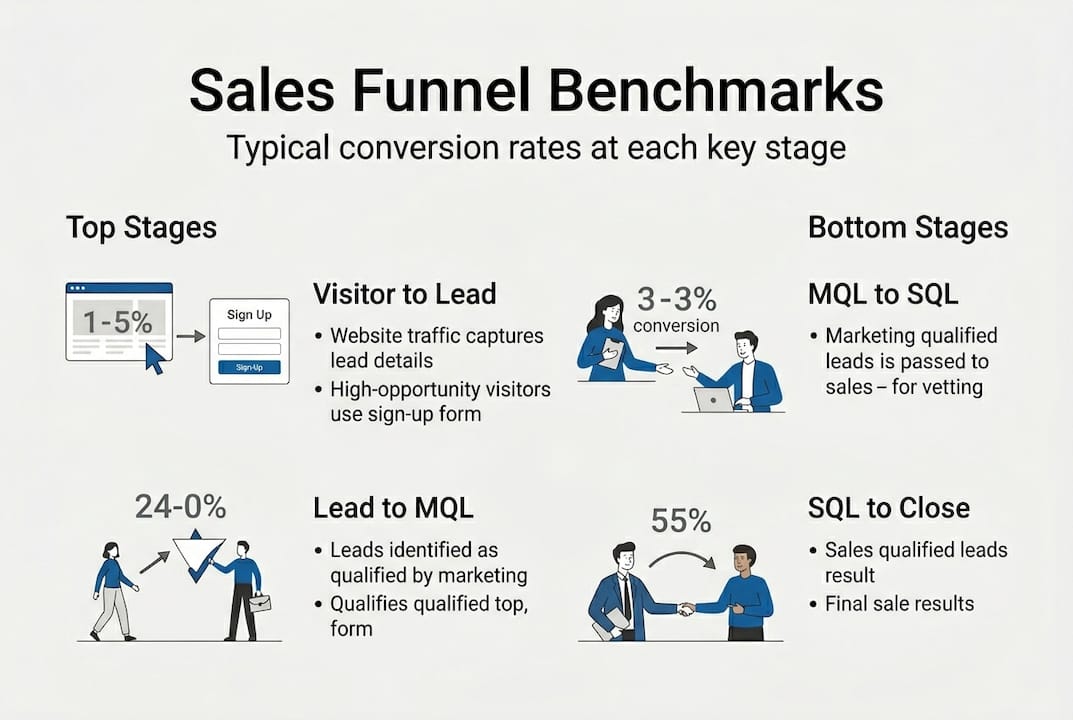
According to 2026 conversion benchmarks, only 1 to 5% of total website visitors ever become paying customers. That number is both sobering and motivating. It means even a small improvement at any stage compounds into meaningful revenue.
Most SMBs struggle most at MOFU. Leads come in but stall because there is no structured nurturing, inconsistent follow-up, or unclear messaging. Understanding driving growth with sales funnels can help you see where the biggest opportunities lie before you start making changes.
Key warning signs your funnel has leaks:
- Leads go quiet after the first contact
- Proposals are sent but rarely followed up
- Your close rate has not improved in 6 months
- You have no clear handoff between marketing and sales
Audit your current funnel: identify leaks and quick wins
Once you understand the standard stages and expected conversion points, it is time to evaluate your own process. A focused self-audit does not need to take weeks. In fact, a sales process review can be completed in under 10 hours and still deliver significant clarity.
Follow these steps to audit your funnel effectively:
- Map your current funnel. Write down every touchpoint from first contact to closed deal. Include emails, calls, ads, landing pages, and proposals. Most SMBs discover gaps they did not know existed.
- Gather your conversion data. Pull numbers from your CRM or analytics tool. How many leads entered each stage last month? How many moved forward? Where did the majority stop?
- Review your last 10 deals. Look at both wins and losses. What was the average time to close? Where did deals stall most often? What objections came up repeatedly?
- Identify your biggest drop-off point. Focus on the one stage where you lose the most leads. That is your highest-leverage area for improvement.
- List your quick wins. These are low-effort, high-impact fixes. Common examples include faster follow-up timing, clearer offer language on your website, or adding a simple email sequence after a lead opts in.
“The businesses that improve fastest are not those who redesign everything at once. They are the ones who find one leak, fix it, measure the result, and move to the next.”
Pro Tip: When optimizing your sales funnel, focus on your follow-up speed first. Research consistently shows that responding to a new lead within five minutes dramatically increases your chances of conversion compared to waiting even an hour.

After your audit, use win/loss reviews to refine your targeting. Ask lost prospects why they chose a competitor. Ask new customers what made them say yes. These conversations reveal messaging gaps that no analytics tool can show you. If you want a structured framework for creating high-converting funnels, start with the data you already have before adding new tools.
Implement proven optimization tactics for every funnel stage
With problems identified, it is time to select the right improvements for each funnel stage. The key is matching your tactic to the specific challenge at that stage rather than applying generic fixes everywhere.
Here is a practical breakdown:
| Funnel stage | Recommended tactic | Goal |
|---|---|---|
| TOFU | A/B test landing pages and ad copy | Increase visitor-to-lead rate |
| MOFU | Automated email nurture sequences | Build trust, move leads forward |
| BOFU | Personalized follow-up and case studies | Overcome objections, close faster |
| Retention | Post-sale check-ins and loyalty offers | Reduce churn, generate referrals |
The tactics that consistently deliver results include follow-ups, A/B testing, and personalization. These are not complicated. They are disciplined.
- Define your Ideal Customer Profile (ICP). An ICP is a detailed description of the type of customer who gets the most value from your product and is most likely to buy. When your messaging speaks directly to this person, conversion rates at every stage improve.
- A/B test your top-of-funnel assets. Change one element at a time on your landing pages or ads. Test headlines, button colors, form length, and images. Small changes can lift conversion rates by 10 to 30%.
- Build a MOFU nurture sequence. A series of 4 to 6 emails sent over two to three weeks after a lead opts in keeps your brand visible and builds credibility. Include case studies, testimonials, and useful tips.
- Automate your follow-up. Automation scales better for SMBs than manual outreach, dramatically increasing the number of qualified leads that reach the decision stage without adding headcount.
Pro Tip: Explore email strategies for higher ROI to sharpen your MOFU nurture sequences. Personalized subject lines alone can increase open rates by over 26%.
For teams with limited time, automation for small teams removes the manual burden of follow-up and lead tracking. When you pair automation with a solid ICP, you stop wasting effort on prospects who were never going to convert and focus energy where it matters. The results of boosting SMB conversions with automation speak for themselves: faster response times, more consistent nurturing, and higher close rates.
Measure, test, and refine: creating a data-driven sales engine
Implementing tactics is just the beginning. Here is how to ensure ongoing gains and future-proof your funnel.
The most important habit you can build is consistent measurement. Without data, you are guessing. With data, every decision becomes faster and more confident.
Metrics to track every month:
- Visitor-to-lead rate: Are your top-of-funnel efforts attracting the right people?
- Lead-to-opportunity rate: Are your nurture sequences doing their job?
- Opportunity-to-close rate: Is your sales process competitive and persuasive?
- Average deal cycle length: Are deals moving faster or slower over time?
- Customer retention rate: Are you keeping the customers you worked hard to win?
Continuous testing and post-sale retention yield compounding gains. A 5% improvement in retention can increase profits by 25 to 95% over time, making it one of the highest-return activities in your entire business.
Simple tests to run every quarter:
- Test two versions of your primary call-to-action button
- Test two subject lines on your most-opened nurture email
- Test two different landing page headlines for your main lead magnet
Customer feedback is equally valuable. Send a short survey to new customers asking what almost stopped them from buying. Their answers will reveal friction points your analytics cannot capture.
Keep in mind that only 1 to 5% of visitors close in B2B SaaS environments, which means even a modest improvement in mid-funnel conversion can double your revenue without increasing your ad spend. Tracking key funnel metrics consistently is what separates businesses that grow steadily from those that plateau. For a broader view of how all these pieces connect, the complete automation guide is a useful resource to keep handy.
Why overcomplicating your funnel slows SMB growth
Here is an uncomfortable truth we see repeatedly: most SMBs do not have a strategy problem. They have a focus problem. Business owners get excited about new tools, new platforms, and new tactics, and they layer complexity onto a funnel that has not even been properly audited yet.
The most successful SMBs we work with are not the ones with the most sophisticated tech stacks. They are the ones who picked two or three high-leverage actions, executed them consistently, and measured results every month. That is it.
Simple audits and steady improvements outperform massive overhauls almost every time. Feature bloat and data overload are real risks. When you are tracking 20 metrics, you are effectively tracking none of them.
Our honest advice: audit first, act on your biggest leak, measure for 30 days, then move to the next issue. Businesses that build growth-driven sales funnels this way build durable momentum instead of chasing trends that fade.
Accelerate results with the right marketing automation
If you are ready to accelerate your funnel improvements, purpose-built tools make all the difference. The right software removes the manual burden, keeps your pipeline visible, and ensures no lead falls through the cracks.
Go Online Now-Connect is built specifically for SMBs who want faster results without the complexity of enterprise platforms. Our SMB conversion automation tools handle email sequences, follow-ups, and lead tracking in one place. Whether you are just starting to optimize or ready to scale, our automation for SMB growth platform and all-in-one CRM for SMBs give you everything you need to convert more leads, retain more customers, and grow smarter. Done-for-you setup included, no contracts, no hidden fees.
Frequently asked questions
What is the most common sales funnel mistake for SMBs?
Selling too early and neglecting follow-up are the most common mistakes, causing leads to disengage before they are ready to buy. Building structured nurture steps between stages keeps prospects moving forward.
How often should I audit my sales funnel process?
Perform a basic audit at least quarterly and after any major campaign, using your conversion data and deal review notes. Even short audits provide enough clarity to identify your next highest-priority improvement.
What conversion rates should SMB owners expect at each funnel stage?
2026 benchmarks show visitor-to-lead at 1 to 3%, lead-to-MQL at 25 to 45%, MQL-to-SQL at 13 to 42%, SQL-to-opportunity at 38 to 62%, and opportunity-to-close at 15 to 40%.
Does sales funnel automation work for small businesses?
Yes, automation increases qualified leads by up to 451% and scales far more efficiently than manual processes, making it one of the best investments an SMB can make.
Recommended
- How to optimize your sales funnel for better conversions – Go Online Now
- How to build sales funnels that drive growth fast – Go Online Now
- How to Create Sales Funnels That Convert Customers – Go Online Now
- How to qualify digital leads for higher SMB sales conversion – Go Online Now
- A No-BS Guide to a High Converting Landing Page