

Selecting the right Customer Relationship Management solution often feels daunting for small businesses trying to balance growth and cost. Many American and British entrepreneurs mistakenly believe CRM is designed only for large corporations or see it as just another complex software purchase. Understanding that CRM integrates technologies, processes, and people helps businesses make smarter choices and unlock sales efficiency. This guide clears up common misconceptions and explains how CRM can become a powerful, strategic asset for small and medium companies aiming for sharper growth.
Defining CRM and Common Misconceptions
Customer Relationship Management (CRM) represents a strategic approach that enables businesses to manage interactions with current and potential customers. Far more than just software, CRM integrates technologies, processes, and people to create comprehensive customer engagement strategies. Common misconceptions about CRM strategies often prevent small and medium businesses from leveraging its full potential.
At its core, CRM is about understanding and improving customer relationships through data-driven insights. Many small business owners mistakenly believe CRM is:
- Only for large enterprises
- Exclusively a technology tool
- Too complex and expensive
- Unnecessary for their business model
- A one-time implementation rather than an ongoing process
In reality, CRM provides small businesses with powerful capabilities to track customer interactions, analyze sales pipelines, and personalize communication strategies. Strategic approach to customer management allows companies to transform raw customer data into actionable business intelligence.
The most successful CRM implementations view the system as a holistic strategy, not just a software solution. It requires commitment from leadership, ongoing training, and a cultural shift towards customer-centric thinking. By understanding CRM as a comprehensive approach, small businesses can unlock significant growth potential and create more meaningful customer connections.
Pro tip: Start with a simple CRM system that matches your specific business needs and gradually expand its usage as you become more comfortable with the technology.
CRM Types and Core Functionalities
Customer Relationship Management (CRM) systems are not one-size-fits-all solutions. CRM system classifications reveal three primary types that serve different business needs: operational, analytical, and collaborative CRM. Each type focuses on unique aspects of customer interaction and data management, providing small businesses with targeted strategies for growth.
The three main CRM types include:
- Operational CRM: Automates customer-facing processes
- Sales force automation
- Marketing campaign management
- Customer service support
- Analytical CRM: Transforms customer data into strategic insights
- Performance tracking
- Predictive analytics
- Customer behavior analysis
- Collaborative CRM: Enhances communication across stakeholders
- Multi-channel interaction management
- Interdepartmental information sharing
- External partner communication
Core functional components of CRM encompass several critical capabilities that enable businesses to streamline customer relationship management. These functionalities typically include contact management, lead tracking, customer data analytics, and integrated communication channels. Small businesses can leverage these features to create personalized customer experiences, improve sales processes, and make data-driven decisions.
Successful CRM implementation requires understanding how these types and functionalities align with specific business objectives. By selecting the right CRM approach, small businesses can transform customer data into a strategic asset that drives growth and enhances customer satisfaction.
Here’s a summary that distinguishes the three main CRM types and highlights their strategic business impact:
| CRM Type | Main Focus | Typical Tools/Inclusions | Business Impact |
|---|---|---|---|
| Operational | Process automation | Sales automation, support tools | Increases productivity |
| Analytical | Data-driven insights | Advanced analytics, reporting | Enhances strategic decisions |
| Collaborative | Stakeholder communication | Interdepartmental platforms | Improves teamwork, alignment |
Pro tip: Evaluate your business needs carefully and choose a CRM type that matches your specific customer interaction and data management requirements.
How CRM Streamlines Sales Operations
Sales process automation transforms how small businesses manage customer interactions and drive revenue. CRM systems eliminate manual administrative tasks, allowing sales teams to focus on building relationships and closing deals. By centralizing customer data and automating repetitive workflows, these platforms create significant operational efficiencies for growing businesses.
Key ways CRM streamlines sales operations include:
- Automated Lead Tracking
- Capture leads from multiple channels
- Automatically score and prioritize prospects
- Route leads to appropriate sales representatives
- Sales Pipeline Management
- Real-time opportunity tracking
- Predictive sales forecasting
- Visual pipeline visualization
- Communication Optimization
- Integrated communication logs
- Automated follow-up reminders
- Personalized communication templates
Real-time customer information integration enables faster decision-making and more responsive sales strategies. Small businesses can leverage CRM to create comprehensive customer profiles, track interaction histories, and develop targeted sales approaches that significantly improve conversion rates. The system transforms raw customer data into actionable insights that drive strategic sales planning.
By reducing administrative overhead and providing intelligent sales tools, CRM systems help small businesses compete more effectively in complex market environments. The technology empowers sales teams to work smarter, not harder, by providing instant access to critical customer information and automating time-consuming processes.

Pro tip: Integrate your CRM with existing communication tools to maximize automation and reduce manual data entry.
Lead Management, Automation, and Nurturing
Lead management automation transforms how small businesses approach customer acquisition and conversion. CRM systems provide powerful tools that streamline the entire lead lifecycle, from initial capture to final sale. By automating repetitive tasks and creating intelligent workflows, businesses can focus on building meaningful customer relationships instead of getting bogged down in manual processes.
Key components of effective lead management include:
- Lead Capture
- Multi-channel lead collection
- Automatic contact information extraction
- Instant lead qualification
- Lead Scoring
- Behavioral tracking
- Engagement level assessment
- Predictive priority ranking
- Lead Nurturing
- Personalized communication sequences
- Targeted content delivery
- Automated follow-up scheduling
Automated nurturing workflows enable businesses to create sophisticated, personalized engagement strategies. These systems track prospect interactions across multiple touchpoints, delivering timely and relevant content that moves leads through the sales funnel more efficiently. Small businesses can leverage advanced algorithms to prioritize high-potential prospects and optimize their limited sales resources.
By integrating intelligent automation, CRM systems help small businesses compete with larger competitors. The technology enables precise lead tracking, personalized communication, and data-driven decision-making, transforming how companies approach customer relationship development.
Pro tip: Develop a clear lead scoring system that aligns with your specific business goals and continuously refine your scoring criteria based on actual conversion data.
Real-World CRM Benefits for SMBs
Empirical benefits for small businesses demonstrate how Customer Relationship Management systems transform operational capabilities for growing companies. CRM technology offers small and medium businesses a strategic advantage by providing comprehensive tools that were previously accessible only to large corporations. These systems enable businesses to compete more effectively by centralizing customer information and streamlining critical business processes.
Key real-world benefits of CRM for SMBs include:
- Enhanced Customer Insights
- 360-degree customer view
- Detailed interaction tracking
- Behavioral pattern recognition
- Improved Sales Performance
- Accurate sales forecasting
- Faster lead conversion
- Targeted sales strategies
- Operational Efficiency
- Reduced administrative tasks
- Automated reporting
- Streamlined communication workflows
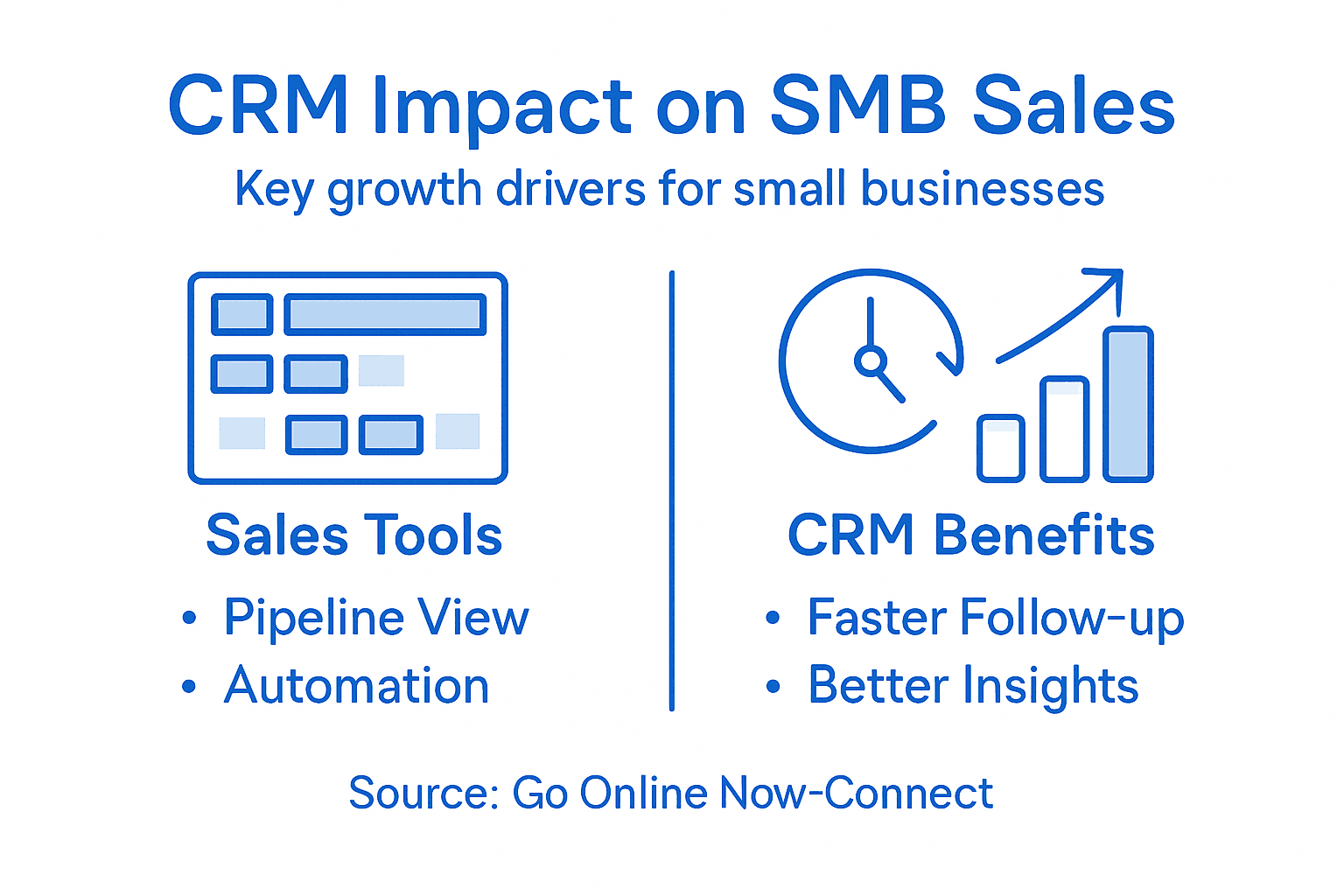
Case studies reveal significant performance improvements when small businesses implement strategic CRM solutions. These systems enable more personalized marketing approaches, shorter sales cycles, and more meaningful customer relationships. By leveraging data-driven insights, SMBs can make more informed decisions and adapt quickly to changing market conditions.
The most transformative aspect of CRM for small businesses is its ability to level the competitive playing field. Technology that was once prohibitively expensive is now accessible, allowing smaller companies to build sophisticated customer engagement strategies that rival those of larger organizations.
Pro tip: Start with a CRM solution that offers scalability, ensuring the platform can grow alongside your business’s evolving needs.
Pitfalls to Avoid When Choosing a CRM
Common CRM selection mistakes can significantly undermine a small business’s growth potential. Many entrepreneurs rush into CRM implementation without thoroughly understanding their specific operational needs, leading to costly and ineffective technology investments. Selecting the right CRM requires a strategic approach that goes beyond surface-level feature comparisons.
Key pitfalls small businesses must avoid include:
- Inadequate Needs Assessment
- Choosing features without understanding workflow
- Ignoring specific business process requirements
- Failing to map CRM to existing operational models
- User Adoption Challenges
- Selecting overly complex systems
- Neglecting team training
- Overlooking user interface intuitiveness
- Financial and Technical Missteps
- Prioritizing lowest cost over long-term value
- Ignoring scalability requirements
- Overlooking integration capabilities
CRM implementation challenges reveal that successful adoption depends on more than just technological features. Small businesses must consider vendor reliability, ongoing support, and the platform’s ability to evolve with their growing needs. Understanding these nuanced factors can prevent expensive mistakes and ensure a CRM solution that genuinely drives business growth.
The most critical aspect of CRM selection is recognizing that it’s not just a technology purchase, but a strategic investment in your business’s customer relationship management capabilities. Careful evaluation, thorough testing, and a focus on long-term scalability are essential for finding the right CRM solution.
The table below summarizes common CRM selection mistakes and their long-term consequences for small businesses:
| Selection Mistake | Short-Term Effect | Long-Term Consequence |
|---|---|---|
| Feature-over-function focus | Slow adoption | Reduced system usage |
| Poor training | Low staff engagement | Persisting process gaps |
| Ignoring scalability | Fast initial setup | Expensive future migrations |
| Overlooking integration | Quick standalone launch | Data silos, missed insights |
Pro tip: Conduct a comprehensive internal audit of your current sales and customer management processes before evaluating any CRM solution.
Unlock Sales Growth with the Right CRM and Automation Tools
If you want your SMB to grow smarter and faster, you need more than just a CRM system. The article highlights how crucial it is to streamline sales operations and automate lead nurturing to boost conversion rates and save valuable time. Many small businesses struggle with complex, overpriced platforms that do not fit their unique needs or workflows. That is where Go Online Now-Connect steps in by offering an all-in-one CRM integrated with marketing automation software designed specifically for SMBs who want simple, affordable, and effective solutions.
Explore how Go Online Now-Connect can empower your sales teams by centralizing contact management, automating follow-ups, scoring leads intelligently, and tracking pipelines in one easy-to-use platform. Alongside our digital marketing services, you get a complete growth partner toolset tailored for small businesses. Don’t let operational hurdles or scattered tools slow you down. Visit our Automation Archives – Go Online Now and Digital Marketing Archives – Go Online Now to learn more about how marketing automation and CRM work together to unlock your sales potential. Ready to make the smart choice today Visit Go Online Now and start growing with the proven all-in-one solution that saves you time and increases sales.
Frequently Asked Questions
How can CRM automate lead tracking for small businesses?
CRM systems automate lead tracking by capturing leads from multiple channels, scoring and prioritizing prospects automatically, and routing leads to appropriate sales representatives based on predefined criteria.
What are the key benefits of using CRM for sales performance?
CRM enhances sales performance by providing accurate sales forecasting, speeding up lead conversion, and allowing for targeted sales strategies tailored to customer preferences and behaviors.
How does CRM help in nurturing leads effectively?
CRM nurtures leads by automating personalized communication sequences, delivering targeted content, and scheduling follow-ups that keep prospects engaged throughout the sales funnel.
What should small businesses consider when choosing a CRM system?
Small businesses should assess their specific operational needs, ensure user-friendly interfaces to encourage adoption, and evaluate the system’s scalability and integration capabilities with existing tools.
Recommended
- CRM for SMBs Explained: Smarter Growth Without Stress – Go Online Now
- Why All-In-One CRM Matters for Growing SMBs – Go Online Now
- Why Use an All-in-One CRM for SMB Growth – Go Online Now
- Understanding Digital Growth Strategies for SMBs – Go Online Now
- Enhance Conversions with Superior UX and UI Design