

TL;DR:
- Content creation in marketing involves producing valuable content to attract and retain a target audience, supporting digital channels like SEO and social media. A structured workflow from research to performance analysis ensures consistent, impactful content that builds trust and organic growth. Focusing on audience clarity, regular publishing, and proper distribution maximizes return on investment for small businesses.
Content creation in marketing is the structured process of producing and distributing relevant, valuable content to attract, engage, and retain a clearly defined audience in order to achieve specific business goals. Known formally as content marketing, this practice powers every major digital channel, from SEO and social media to email campaigns and paid advertising. For marketers and small business owners, mastering this process is the difference between a brand that gets noticed and one that gets ignored. Done consistently, it builds trust, drives organic traffic, and turns strangers into loyal customers.
What is content creation in marketing and why does it matter?
Content creation in marketing is not the same as digital marketing, though the two are closely linked. Content creation fuels broader digital marketing efforts like SEO, social media, and paid campaigns, but it is a distinct process with its own workflow and skill set. Think of it as the engine inside the machine. Without quality content, your ads have nothing compelling to say, your social profiles have nothing worth sharing, and your website has no reason to rank.

The formats that make up content marketing are wide-ranging. Blog posts, short-form videos, podcasts, infographics, email newsletters, and social media updates all qualify. Each format serves a different stage of the buyer journey. A blog post builds awareness and SEO authority. An email newsletter nurtures leads who already know you. A product demo video closes the deal. The key insight most small business owners miss is that audience clarity and emotional impact must come before production. If you do not know who you are talking to and what you want them to feel, no amount of polished content will move them.
The business case for content marketing is strong. Brands that publish consistently build algorithmic trust on platforms like Google and Instagram, which translates directly into reach and visibility. For SMBs with limited advertising budgets, this organic compounding effect is one of the highest-return investments available.
What does the content creation process involve?
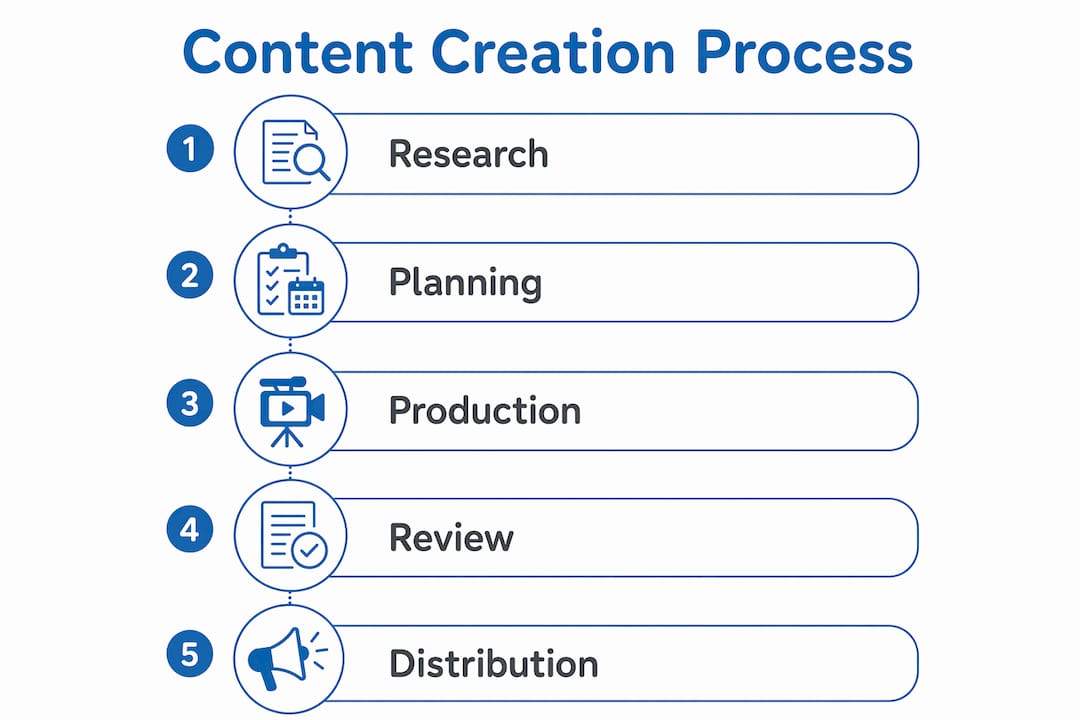
A standardized content workflow has five to seven essential stages that turn raw ideas into published assets. Understanding each stage prevents the chaos of ad hoc creation and protects your team from burnout.
- Research. Start with audience questions, keyword data, and competitor content gaps. Tools like Google Search Console, AnswerThePublic, and SEMrush surface what your audience is actively searching for.
- Planning. Map your ideas to a content calendar. Assign formats, channels, publication dates, and responsible team members before a single word is written.
- Idea validation. Check search volume and competitive difficulty for each topic. A great idea with zero search demand is a passion project, not a marketing asset.
- Production. Write, record, or design the content. This is where a content brief improves collaboration and keeps everyone aligned on tone, audience, and goals. Briefs reduce guesswork and produce on-brand output every time.
- Review and editing. Use tools like Grammarly or Hemingway Editor to tighten copy before it goes live. A second set of eyes, human or AI-assisted, catches errors that damage credibility.
- Distribution. Publish across your chosen channels. Repurpose where possible: a blog post becomes a LinkedIn article, a newsletter section, and three social media captions.
- Performance analysis. Track metrics like organic traffic, time on page, click-through rate, and conversions. Monitoring post-publication data is the step most small businesses skip, and it is exactly where strategy improves.
Pro Tip: Batch your content creation by producing multiple pieces in a single focused session. This approach prevents burnout, keeps your publishing schedule predictable, and frees up mental energy for strategy rather than daily scrambling.
For a deeper look at building this process for your business, the SMB content creation workflow guide from Goonlinenow walks through each stage with practical templates.
Which content formats and channels are most effective?
Choosing the right format is a strategic decision, not a personal preference. The best format is the one your audience already consumes and the one you can produce consistently. Here is a comparison of the most common formats by benefit and best use case.
| Format | Primary benefit | Best use case | Recommended tools |
|---|---|---|---|
| Blog posts | SEO authority and organic traffic | Awareness and education | WordPress, Surfer SEO |
| Short-form video | High engagement and reach | Brand awareness and social growth | CapCut, Canva Video |
| Email newsletters | Direct audience access | Lead nurturing and retention | Mailchimp, Klaviyo |
| Podcasts | Deep trust and loyalty | Thought leadership | Riverside.fm, Audacity |
| Infographics | Visual clarity and shareability | Data-heavy topics and social sharing | Canva, Piktochart |
| Social media updates | Community building and traffic | Daily engagement and promotion | Buffer, Later |
The table above reveals a pattern worth noting: formats that build the deepest trust, like podcasts and long-form blogs, require the most production time. Formats that generate the fastest reach, like short-form video and social posts, have shorter shelf lives. A smart content mix for most SMBs combines one long-form anchor format (blog or podcast) with two to three shorter distribution formats that repurpose that anchor content.
Format choice should also reflect your team’s capacity. A solo marketer cannot realistically produce weekly YouTube videos, daily social posts, and a monthly podcast. Prioritize depth over volume, especially early on.
Common mistakes that kill content marketing results
Most content marketing failures trace back to a small set of repeatable errors. Recognizing them early saves months of wasted effort.
- Confused content. Unclear audience targeting produces content that tries to speak to everyone and resonates with no one. Before writing a single word, define one specific reader: their job, their problem, and the outcome they want.
- Perfection paralysis. Waiting for the perfect idea, the perfect design, or the perfect moment is the single biggest reason content calendars stay empty. Imperfect but consistent content outperforms polished but irregular publishing every time.
- Inconsistent posting cadence. Irregular publishing confuses platform algorithms and erodes audience trust. A weekly blog post beats a monthly masterpiece when it comes to building steady organic growth.
- No distribution plan. Creating content without a plan to get it in front of people is like printing a flyer and leaving it in your desk drawer. Every piece needs a distribution checklist: which channels, which repurposed formats, and which paid amplification if needed.
- Skipping the data review. Publishing without analyzing performance means repeating mistakes indefinitely. Set a monthly review cadence to check what is working and cut what is not.
Pro Tip: Start with one format and one channel. Publish consistently for 90 days before adding complexity. Momentum built on a narrow focus compounds faster than scattered effort across five platforms.
How to create and optimize marketing content for growth
Consistent content growth follows a repeatable four-step cycle: ideate, validate, produce, and optimize. Here is how to execute each step with discipline.
-
Ideate from real sources. Your best content ideas come from your audience, not your imagination. Mine customer support emails, sales call transcripts, and social media comments for the exact questions your buyers are asking. Tools like AnswerThePublic and Reddit surface high-intent topics you would never think to write about on your own.
-
Validate before you produce. Use keyword research tools like Ahrefs or Google Keyword Planner to confirm that a topic has search demand. Check competitor content to identify gaps you can fill with more depth or a different angle. This step prevents you from investing hours in content nobody is searching for. For a structured approach to this, the content creation process guide from Goonlinenow covers validation frameworks built for SMBs.
-
Build and maintain a content calendar. A content calendar is not a luxury for large marketing teams. It is the system that keeps a solo marketer or a two-person team publishing on schedule. Scheduling tools like Buffer, Later, or Zernio let you plan weeks in advance and automate distribution, so publishing does not depend on daily willpower.
-
Measure, learn, and adjust. After each piece goes live, track its performance against a clear goal. A blog post targeting organic traffic should show growth in impressions and clicks within 60 to 90 days. An email newsletter should show open rate trends over time. Regular performance analysis is what separates content that compounds in value from content that flatlines after the first week. Use what you learn to double down on formats and topics that work, and retire those that consistently underperform.
Understanding how audience needs shape content strategy is the foundation of this entire optimization cycle. When you know what your audience wants before you create, every step from ideation to distribution becomes more efficient and more effective.
What working with SMB content creators has taught me
After working with dozens of small business owners on their content marketing, the pattern I see most often is this: people wait too long to start because they are afraid of getting it wrong. They spend weeks planning the perfect content strategy, designing the perfect brand voice guide, and researching the perfect posting frequency. Then they publish nothing.
The businesses that grow through content are not the ones with the best strategy documents. They are the ones that publish something every week, review what worked, and adjust. Muscle memory through consistent creation beats waiting for perfect inspiration every single time. The first ten blog posts will not be your best. That is not a problem. They are the price of admission.
The other thing I have learned is that chasing viral moments is a distraction for most SMBs. One viral post does not build a business. A year of consistent, useful content does. The compounding effect of steady publishing, where each piece builds on the last and earns more trust over time, is what actually moves revenue. Patience is a content strategy.
If you are just starting out, pick one format, commit to a publishing schedule you can realistically maintain, and treat the first 90 days as a learning experiment rather than a performance review.
— Go
How Goonlinenow helps SMBs turn content into conversions
Creating great content is only half the equation. Getting it in front of the right people at the right time is where most small businesses lose momentum.

Goonlinenow’s marketing automation software for SMBs handles the distribution, scheduling, and performance tracking that eats up your time after content is created. Email sequences, SMS follow-ups, and funnel automation run in the background while you focus on producing content worth sharing. The platform also includes a built-in CRM so every lead generated by your content is captured, tracked, and nurtured automatically. For SMBs that want to grow without adding headcount, this combination of content strategy and automation is the most direct path to measurable results.
FAQ
What is content creation in digital marketing?
Content creation in digital marketing is the process of producing written, visual, or audio material designed to attract and engage a specific audience across digital channels like search, social media, and email. It powers strategies including SEO, social media marketing, and paid advertising.
What are the main examples of content in marketing?
The most common examples include blog posts, short-form videos, email newsletters, infographics, podcasts, and social media updates. Each format serves a different stage of the buyer journey, from awareness to conversion.
How many stages does the content creation process have?
A standardized content workflow includes five to seven stages: research, planning, idea validation, production, review, distribution, and performance analysis. Skipping any stage, especially analysis, limits long-term growth.
What is the biggest mistake in content marketing?
Producing content without a clearly defined audience is the most common and costly mistake. Confused content that lacks audience clarity generates poor engagement regardless of production quality.
How often should a small business publish content?
Consistency matters more than frequency. One well-researched blog post per week published on a reliable schedule outperforms sporadic bursts of content, because consistent publishing builds trust with both audiences and search algorithms.