

TL;DR:
- Search engine marketing companies manage paid search, organic SEO, and AI visibility to maximize online revenue.
- Integrating these channels boosts conversions and ensures brands are visible in AI-generated answers and search results.
A search engine marketing company is defined as a specialized agency that manages your paid search, organic SEO, and AI search visibility to capture traffic, leads, and revenue from every part of the search results page. The industry term for this discipline is SEM, short for search engine marketing, and it covers far more than running Google Ads. AI Overviews now appear on approximately 20.5% of all search results pages, and that share is growing. That single shift means a business relying only on paid ads or only on organic SEO is already missing a significant slice of buyer attention. The right SEM partner builds a system that captures all three channels together, turning search into a reliable revenue source rather than a guessing game.
What services does a search engine marketing company provide?
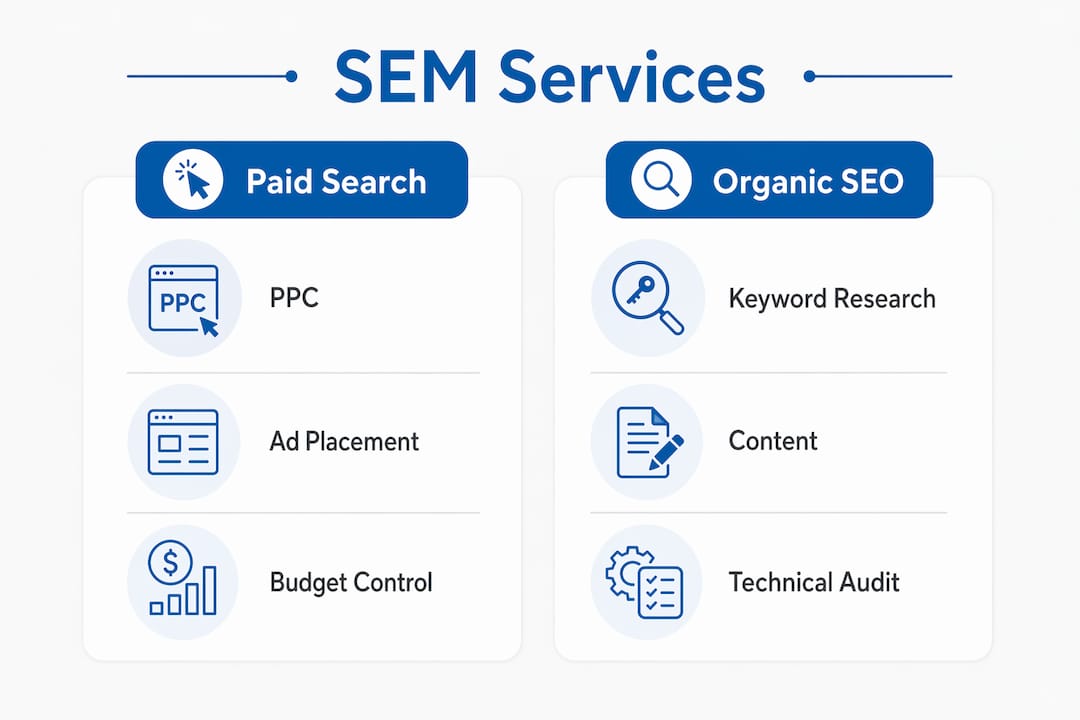
A full-service search engine marketing company delivers three core service categories: paid search management, organic SEO, and AI search visibility optimization. Each category targets a different part of the search results page, and together they cover the entire buyer journey from first query to final purchase.

Paid search management
Paid search, commonly called PPC (pay-per-click), puts your ads at the top of results immediately. A competent SEM company handles keyword bidding, ad copy creation, audience targeting, and continuous campaign optimization. The goal is not just clicks but qualified clicks that convert into leads and sales.
Organic SEO
Organic SEO builds long-term visibility through keyword research, technical site audits, on-page content optimization, and link building. Organic SEO integrated with paid media drives 33% of traffic in growing small businesses. That figure shows organic is not a “nice to have.” It is a primary traffic source that compounds over time.
AI search visibility
AI search visibility is the newest and most misunderstood service category. It involves optimizing your content so that AI-powered answer features, including Google AI Overviews, ChatGPT, and Perplexity, cite your brand in their responses. Modern SEM now includes optimization for platforms like ChatGPT, Perplexity, and Google AI Mode, requiring semantic SEO, authoritative content, and structured data techniques.
Why integration beats siloed channels
- Paid search data reveals which keywords convert, informing SEO content priorities.
- SEO rankings reduce paid search costs by improving Quality Scores on Google Ads.
- AI visibility builds brand authority that reinforces both paid and organic performance.
- A unified SEM approach delivers up to 85% more conversions within 90 days compared to managing channels separately.
- Fragmented vendors create communication gaps that slow results and inflate costs.
Pro Tip: Never treat SEO and PPC as competing budget lines. The data from each channel feeds the other. A keyword that converts well in paid search is your next organic content priority.
How do SEM companies measure effectiveness and ROI?
Effective SEM measurement goes well beyond tracking website traffic. The metrics that matter are the ones tied directly to revenue, and a credible digital marketing agency will report on these from day one.
| KPI | What It Measures | Business Impact |
|---|---|---|
| Cost-per-lead (CPL) | Cost to generate one qualified inquiry | Controls acquisition efficiency |
| Customer acquisition cost (CAC) | Total spend to win one paying customer | Determines profitability per channel |
| Return on ad spend (ROAS) | Revenue generated per dollar of ad spend | Validates paid search investment |
| Conversion rate | Percentage of visitors who take a target action | Reveals landing page and offer quality |
| Pipeline value | Total revenue value of active leads | Connects marketing to sales forecasts |
Revenue readiness assessments map all SEM activities directly to pipeline and ROI before any spend commitment is made. This practice protects your budget by confirming that campaigns are structured to generate revenue, not just activity.
Onboarding timelines matter too. Aggressive optimization of bidding strategies and account structure can reduce CPL by up to 40% within 60 days. That kind of result requires a structured 30–90 day onboarding process, not a quick account setup and a monthly report.
Pro Tip: Ask any prospective SEM partner to show you a sample report before you sign. If the report leads with impressions and clicks rather than CPL, CAC, and pipeline value, find a different partner. Data-backed reporting is the clearest signal of a results-focused agency.
What factors should small businesses consider when choosing an SEM company?
Choosing the right SEM partner is one of the highest-leverage decisions a small business owner makes. The wrong choice wastes budget and time. The right choice builds a compounding growth system.
-
Focus on business outcomes, not vanity metrics. Avoid agencies that sell packages focused on vanity KPIs like traffic. Instead, select partners who build systems prioritizing metrics like CAC and ROAS. Traffic volume means nothing if it does not convert into paying customers.
-
Prefer system builders over package sellers. Many online advertising firms sell fixed monthly packages: a set number of blog posts, a set ad budget, a set number of keywords. That model serves the agency’s workflow, not your revenue goals. A genuine SEM partner audits your current situation and builds a custom system around your specific gaps.
-
Choose unified providers over multiple vendors. Consolidating SEO, PPC, and content under one provider avoids miscommunication and can reduce acquisition costs by 15–20%. Fragmented vendors each optimize for their own deliverables, not your overall growth. One provider owns the full picture and is accountable for the full result.
-
Expect a structured onboarding and audit phase. A credible SEM company starts with a thorough audit of your current search presence, ad accounts, and website performance. This audit phase typically lasts 30–60 minutes of discovery, followed by a 30–90 day onboarding period before you see measurable improvements. Be skeptical of any agency promising results in week one.
-
Ask the right questions before you commit. Before signing with any SEM provider, ask these directly:
- How do you report on CPL and ROAS, and how often?
- Who owns the ad accounts and data if we part ways?
- How do you integrate paid and organic strategies?
- What does your AI search visibility service include?
- Can you show me a case study from a business similar to mine?
A provider who answers these questions clearly and confidently is worth your time. One who deflects or defaults to generic answers is not.
How do AI search trends affect SEM company services?
AI search is not a future trend. It is a current reality that is reshaping how buyers find businesses right now. Understanding it is no longer optional for any business investing in SEM and SEO services.
- AI Overviews appear on approximately 20.5% of all search results pages, and they appear above both paid ads and organic results in many cases.
- AI-generated answers pull from authoritative sources. Brands that publish credible, well-structured content earn citations. Brands that do not are invisible in those results.
- Traditional paid search ads do not appear inside AI Overviews. Winning that placement requires organic authority, not ad spend.
- Semantic SEO, which focuses on topic depth and entity relationships rather than keyword repetition, is the primary technique for earning AI citations.
- Structured data markup, FAQ schema, and clear content hierarchies all improve the likelihood that AI systems select your content as a source.
- Ignoring AI search visibility makes brands invisible to 20.5% of queries featuring AI-generated answers. For a business generating 1,000 monthly search visits, that is potentially 200 buyers who never see your brand.
The cost-effective SEO strategies that earn AI citations are the same ones that improve organic rankings. The two goals reinforce each other, which is why AI visibility should be built into your SEM strategy from the start, not added as an afterthought.
Why integrated SEM is the only strategy worth building
Working with small businesses across industries, I have seen the same mistake repeated constantly. A business owner hires one agency for Google Ads, another for SEO, and sometimes a third for content. Each vendor delivers their piece. Nobody owns the whole picture. The result is three separate reports, three separate strategies, and a marketing budget that underperforms because no one is connecting the dots.
The full-SERP strategies that integrate AI search with paid and organic components are not just the future of SEM. They are the only approach that captures buyer intent at every stage. A buyer who sees your brand in an AI Overview, then in organic results, then in a paid ad is far more likely to convert than a buyer who sees you in only one place.
The businesses I have seen grow fastest are the ones that stopped chasing traffic numbers and started demanding revenue accountability from their marketing partners. They asked hard questions about CPL and ROAS. They pushed for unified reporting. They treated their SEM partner as a business partner, not a vendor. That shift in mindset changes everything.
If you are evaluating SEM companies right now, my strongest advice is this: find a partner who can explain, in plain language, exactly how each channel feeds the others and how they will measure success in dollars, not clicks. That clarity is the best predictor of results.
— Go
How Goonlinenow amplifies your SEM results
A great SEM strategy generates leads. What happens to those leads after they arrive determines whether your investment pays off. Goonlinenow is built to close that gap. The platform combines marketing automation software with an all-in-one CRM, giving SMBs the tools to nurture every lead generated by their paid and organic campaigns. Email sequences, SMS follow-ups, and pipeline tracking work together to convert search traffic into paying customers. Goonlinenow clients report up to 85% more conversions within 90 days. If your SEM company is driving traffic and your leads are going cold, automation built for SMBs is the missing piece.
FAQ
What is a search engine marketing company?
A search engine marketing company is an agency that manages paid search (PPC), organic SEO, and AI search visibility to increase a business’s presence across all parts of the search results page. The goal is to drive qualified traffic, leads, and revenue from search engines.
How long does it take to see results from an SEM company?
Most businesses see measurable improvements in cost-per-lead within 60–90 days of structured onboarding. Aggressive bidding and account optimization can reduce CPL by up to 40% within 60 days, while organic SEO results typically build over 3–6 months.
What is the difference between SEO and SEM?
SEO (search engine optimization) focuses on earning unpaid organic rankings through content and technical improvements. SEM is the broader discipline that includes SEO, paid search advertising, and AI search visibility working together as a unified strategy.
How do I know if an SEM company is delivering real results?
Demand reports that show CPL, CAC, ROAS, and pipeline value, not just traffic and impressions. A results-focused agency ties every campaign metric directly to business outcomes and provides transparent, data-backed reporting on a regular schedule.
Why does AI search visibility matter for my business?
AI Overviews now appear on approximately 20.5% of all search results pages, above both paid ads and organic listings. Businesses that are not optimized for AI-generated answers are invisible to a growing share of buyers, making AI visibility a critical component of any modern SEM strategy.