

TL;DR:
- A digital marketing plan provides a structured roadmap with clear objectives, audience insights, and performance metrics. Focusing on a 90-day sprint with one measurable goal enables small businesses to adapt quickly and achieve better results. Regular updates and selecting two to three aligned channels are key to focused execution and sustained growth.
A digital marketing plan is a structured, written roadmap that defines your objectives, audience, channel tactics, budget, and performance metrics so your business grows with purpose rather than guesswork. For small and mid-sized businesses, the most effective version of this roadmap is not a 40-page annual strategy document. A focused 90-day sprint plan with one measurable primary objective gives you the agility to adapt, the clarity to execute, and the data to improve. This guide walks you through every component of a sample digital marketing plan, from situational analysis to budget timelines, so you can build one that actually drives results.
What does a sample digital marketing plan include?
A digital marketing plan, sometimes called a digital marketing strategy document, is only as good as the structure behind it. Skipping any core component is the fastest way to waste budget and lose momentum. Here are the six building blocks every plan needs.
- A single, measurable primary objective. Effective SMB plans prioritize one primary objective to avoid diluting focus. A strong example: grow monthly email signups by 30% within 90 days. One target keeps your team aligned and your measurement clean.
- Situational analysis and SWOT. Before selecting any channel, you need to know where you stand. Auditing your assets and competitors through a SWOT analysis reveals gaps you can exploit and threats you need to plan around. This step prevents expensive guesswork.
- Audience and customer journey mapping. Define who you are targeting and how they move from awareness to purchase. Frameworks like RACE (Reach, Act, Convert, Engage) give you a structured way to map this journey before you choose a single channel or tactic.
- Channel selection. Limit yourself to 2–3 high-impact channels that match your audience’s journey stages. Simple channel mixes like SEO and email consistently outperform scattered efforts across six or seven platforms. Consistency beats volume every time.
- Budget and resource allocation. Assign specific dollar amounts to each channel and tactic. Account for agency fees, software subscriptions, and ad spend. Vague budgets produce vague results.
- KPIs and measurement strategy. Define what success looks like before the plan launches. Metrics like customer acquisition cost, conversion rate, and organic traffic growth give you the data to optimize monthly.
Pro Tip: Before you finalize your channel mix, complete your audience journey map first. Starting with channels instead of the customer journey is the single most common mistake SMB marketers make, and it leads directly to wasted spend.
For a practical walkthrough of these elements in action, the SMB marketing plan guide at Goonlinenow is a strong starting point.
How does the RACE framework apply to your marketing plan?
The RACE framework, developed by Smart Insights, organizes your marketing tactics around four stages of the customer journey: Reach, Act, Convert, and Engage. Each stage has a distinct goal, a set of matching tactics, and specific metrics that tell you whether those tactics are working.
| RACE Stage | Goal | Example Tactics | Key Metrics |
|---|---|---|---|
| Reach | Build awareness and drive traffic | SEO, paid search, social ads | Organic sessions, impressions, click-through rate |
| Act | Encourage interaction and lead capture | Blog content, landing pages, lead magnets | Time on page, form completions, bounce rate |
| Convert | Turn prospects into paying customers | Email sequences, retargeting, offers | Conversion rate, cost per acquisition |
| Engage | Retain customers and drive referrals | Email newsletters, loyalty programs, reviews | Repeat purchase rate, Net Promoter Score |
The RACE framework helps target specific outcomes at each journey stage, which makes measurement far more precise than a generic “post more content” approach. Each stage feeds the next. Weak Reach numbers mean your Convert tactics never get enough traffic to work. Weak Engage metrics mean you are constantly paying to acquire customers you cannot keep.
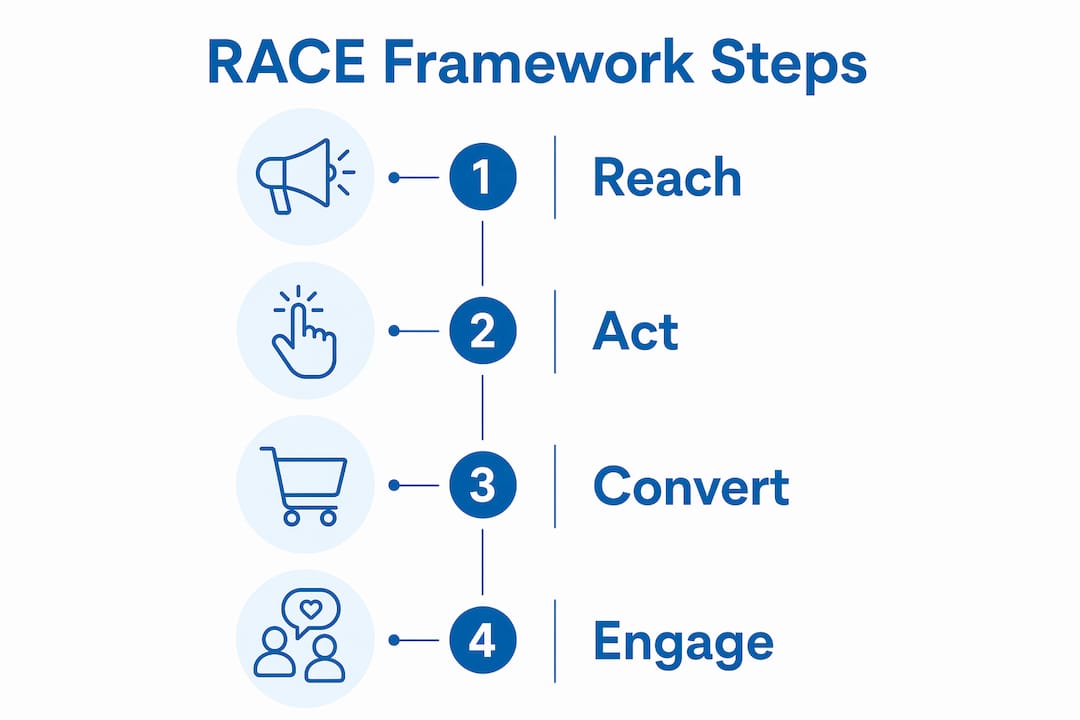
The practical value of RACE is that it forces you to think about your customer before you think about your channels. A coaching business, for example, might discover that its audience converts best through webinars (Act) and email follow-ups (Convert), not through Instagram ads. That insight changes the entire budget allocation.
Pro Tip: Map your customer journey before you open your ad account or content calendar. Channel-first planning is a frequent pitfall. Journey-first planning is what separates plans that grow businesses from plans that just generate activity.
How do you build a budget and timeline for your plan?
Budget and timeline planning is where most SMB marketing plans fall apart. Owners either underestimate costs or build timelines that ignore how long setup actually takes.

A realistic SMB digital marketing budget covers four categories: paid media (Google Ads, Meta Ads), software subscriptions (email platforms, CRM, analytics tools), content production (copywriting, design, video), and agency or freelancer fees if applicable. The exact split depends on your primary objective. A lead generation sprint will weight paid media heavily. An SEO-focused plan will weight content production.
| Budget Line Item | Example Monthly Cost | Notes |
|---|---|---|
| Paid search or social ads | $500–$2,000 | Scale based on CPA targets |
| Email marketing platform | $30–$150 | Mailchimp, ActiveCampaign, or similar |
| CRM and automation software | $50–$300 | All-in-one platforms reduce this cost |
| Content production | $200–$800 | Blog posts, graphics, short-form video |
| SEO tools | $50–$150 | Ahrefs, Semrush, or similar |
Timeline planning requires you to account for project dependencies before you schedule any campaign launch. A landing page must be live before you run paid ads. Your email sequence must be written and tested before you launch a lead magnet. Skipping this sequencing is how campaigns go live broken.
Tools like TeamGantt or Asana let you visualize milestones and dependencies in a Gantt chart format. This keeps every stakeholder aligned on what needs to happen before what. A 90-day plan typically breaks into three phases: setup and asset creation (weeks 1–3), launch and initial optimization (weeks 4–8), and performance review with scaling decisions (weeks 9–12).
Pro Tip: Review your budget against actual performance data at the 30-day mark, not just at the end of the quarter. Early signals like cost per click and lead quality tell you whether to reallocate spend before you burn through the full budget.
For a deeper look at building your full strategy around these budget decisions, the complete SMB strategy guide at Goonlinenow covers the strategic layer in detail.
Do AI tools replace human judgment in marketing planning?
AI tools do not replace human judgment in digital marketing planning. They speed up specific tasks, but the decisions that determine whether a plan succeeds still require human insight.
Here is where AI tools genuinely help:
- Market research: Tools like ChatGPT and Perplexity can cluster topics, summarize competitor positioning, and surface keyword opportunities in minutes rather than hours.
- Draft creation: AI can produce first drafts of email sequences, ad copy, and blog outlines. This cuts production time significantly.
- Reporting automation: Platforms like Google Looker Studio can pull live data into automated dashboards, removing manual reporting work.
- Variant testing: AI-powered tools can generate multiple ad or subject line variants for A/B testing without requiring a copywriter for each version.
The risk is clear. AI assists in topic clustering and draft creation, but human insight is what finalizes messaging and content pillars. An AI tool does not know your specific customer’s pain points, your brand’s tone, or why your offer is genuinely different from a competitor’s. Plans built entirely on AI output tend to be generic. Generic plans do not convert.
Effective plans combine AI with expert refinement for differentiation and growth-driving outcomes. The practical workflow is: use AI to draft and research, then apply human judgment to refine the value proposition, select the content pillars, and make the final channel decisions. AI handles the volume. You handle the strategy.
For content-specific planning, the content strategy guide at Goonlinenow shows how to build content pillars that AI tools can then support, not replace.
What working with SMB plans taught me about focused execution
After working with dozens of small business owners on their digital marketing strategies, the pattern is consistent. The businesses that grow are not the ones with the most detailed plans. They are the ones that treat their plan as a living document and update it every month based on real data.
Monthly plan updates enable continuous optimization and responsiveness to market changes. That sounds obvious, but most SMB owners build a plan in January and check it again in December. By then, the market has shifted, the data has been ignored, and the budget has been spent on tactics that stopped working in March.
The second lesson is harder to accept: over-planning kills execution. I have seen business owners spend six weeks perfecting a 30-page strategy document and then freeze when it is time to actually launch a campaign. A two-page, 90-day plan with one objective and three channels will outperform a comprehensive annual strategy that never gets executed. Start with a 90-day growth roadmap and build from there.
The third lesson is about channel selection. Every SMB owner I have worked with wants to be on every platform. LinkedIn, Instagram, TikTok, Google, YouTube, email, and a podcast. The businesses that actually grow pick two or three channels, master them, and then scale. Spreading thin is the fastest way to produce mediocre results everywhere. Many common mistakes holding small businesses back trace directly to this exact problem.
My honest recommendation: start your next plan with a SWOT analysis, map your customer journey, pick two channels, set one objective, and launch within two weeks. Imperfect execution beats perfect planning every single time.
— Go
How Goonlinenow helps you execute your marketing plan faster
Building a solid digital marketing plan is step one. Executing it without the right tools is where most SMBs lose time and money.
Goonlinenow combines marketing automation, CRM, email, SMS, funnels, and lead nurturing into one affordable platform built specifically for SMBs. You get done-for-you setup, real human support, and no contracts. Instead of juggling five separate subscriptions, you run your entire plan from one place. Businesses using Goonlinenow report up to 85% more conversions and 75% time saved within 90 days. If you are ready to move from planning to results, explore how SMB marketing automation at Goonlinenow can turn your strategy into consistent, measurable growth.
FAQ
What is a digital marketing plan?
A digital marketing plan is a written document that defines your marketing objectives, target audience, channel tactics, budget, and performance metrics for a set time period. For SMBs, a 90-day plan with one primary objective is the most effective format.
What should a digital marketing strategy include?
A digital marketing strategy should include a situational analysis, audience and journey mapping, channel selection, budget allocation, a content or campaign plan, and clear KPIs. Skipping any of these elements reduces the plan’s ability to produce measurable results.
How many channels should a small business focus on?
Small businesses should focus on 2–3 channels that align with their audience’s customer journey. Simple channel mixes like SEO and email consistently outperform scattered efforts across many platforms.
Can i use AI to write my digital marketing plan?
AI tools can speed up research, drafting, and reporting, but they cannot replace human judgment on value propositions, content pillars, and strategic decisions. The best plans use AI for efficiency and human expertise for direction.
How often should i update my digital marketing plan?
Your digital marketing plan should be reviewed and updated monthly. Monthly updates based on performance data like conversion rates and customer acquisition cost keep your plan responsive to what is actually working.