

TL;DR:
- Hiring digital professionals is a time-consuming and costly challenge for SMBs, often taking over a month and thousands of dollars per hire. Building a detailed candidate profile, selecting targeted sourcing channels, and preparing technical tools and team buy-in streamline the recruitment process effectively. Implementing structured steps, tracking key metrics, and prioritizing candidate experience enable SMBs to hire faster, smarter, and more efficiently.
Hiring digital professionals is one of the most time-consuming and expensive challenges facing small and mid-sized businesses today. The average time-to-hire sits at 44 days across all sectors, while SMBs often spend between $1,200 and $5,346 per hire. For a lean team without a dedicated HR department, that’s a serious drain on both resources and momentum. This guide gives you a practical, step-by-step framework to find, qualify, and hire the right digital talent faster, smarter, and without breaking the budget.
Key Takeaways
| Point | Details |
|---|---|
| Preparation matters | Getting tools, profiles, and buy-in in place upfront prevents delays and mis-hires. |
| Five essential steps | A clear, repeatable process helps you source, select, and onboard the right talent. |
| Avoid common mistakes | Anticipate and address pitfalls—like skipping bias checks or undervaluing skills. |
| Measure to improve | Tracking key metrics lets you refine and compete with larger firms. |
| Prioritize candidate experience | Transparency and communication attract top digital professionals even in tight markets. |
What you need before starting the digital recruitment process
Before diving into the steps, let’s clarify what you’ll need in place. Rushing into recruitment without proper groundwork is one of the top reasons SMBs waste time and money on bad hires. A little preparation upfront saves a lot of pain later.
Build your ideal candidate profile
Your Ideal Candidate Profile (ICP) is a detailed description of the person most likely to succeed in the role. It goes beyond a job title. You need to define the specific technical skills, soft skills, and experience level required. For a digital marketing manager role, for example, that might mean SEO experience, proficiency with tools like Google Analytics or a CRM, and a track record of running paid campaigns.
Soft skills matter just as much. Communication, adaptability, and the ability to work independently are critical for remote digital roles. Be specific about what “good” looks like so you can recognize it during screening.
Een efficient digital recruitment guide can help you map out those must-haves versus nice-to-haves, which makes every downstream step faster and more accurate.
Choose the right sourcing channels
Don’t try to post everywhere. Pick two or three channels that match your candidate pool and budget. Referrals from your existing team are almost always the best starting point. They’re faster, cheaper, and tend to produce candidates who already fit your culture.

Beyond referrals, LinkedIn works well for professional digital roles, while niche job boards like We Work Remotely or Remotive can surface strong candidates for fully remote positions. General platforms like Indeed are useful for volume, but expect more noise.
Gather your tools and get team buy-in
You’ll need at minimum an applicant tracking system (ATS), a skills assessment tool, and a basic interview structure. Digital tools can reduce time-to-hire by 35%, but only when your team is trained and ready to use them properly. Adoption is everything.
Get leadership alignment before you launch. If the hiring manager, team lead, and any other decision-makers aren’t on the same page about the role, timelines, and evaluation criteria, you’ll face delays at every stage. A quick 30-minute kickoff meeting prevents weeks of back-and-forth later.
Here’s a simple readiness checklist:
- Ideal Candidate Profile documented and approved
- 2 to 3 sourcing channels selected
- ATS set up with job posting and pipeline stages
- Skills assessment tool identified and tested
- Interview panel confirmed with structured question sets
- Team trained on any new tools or platforms
Professionele tip: Review the key digital recruitment benefits before finalizing your tools. Understanding what you’re optimizing for helps you choose the right technology from the start.
| Readiness area | Low readiness | High readiness |
|---|---|---|
| Candidate profile | Vague job description | Detailed ICP with hard and soft skills |
| Sourcing channels | Random job board postings | 2-3 targeted channels with sourcing plan |
| Technology | Email and spreadsheets | ATS + assessment tool integrated |
| Team alignment | No kickoff discussion | Kickoff meeting done, roles confirmed |
| Interview structure | Ad hoc questions | Standardized question set per stage |
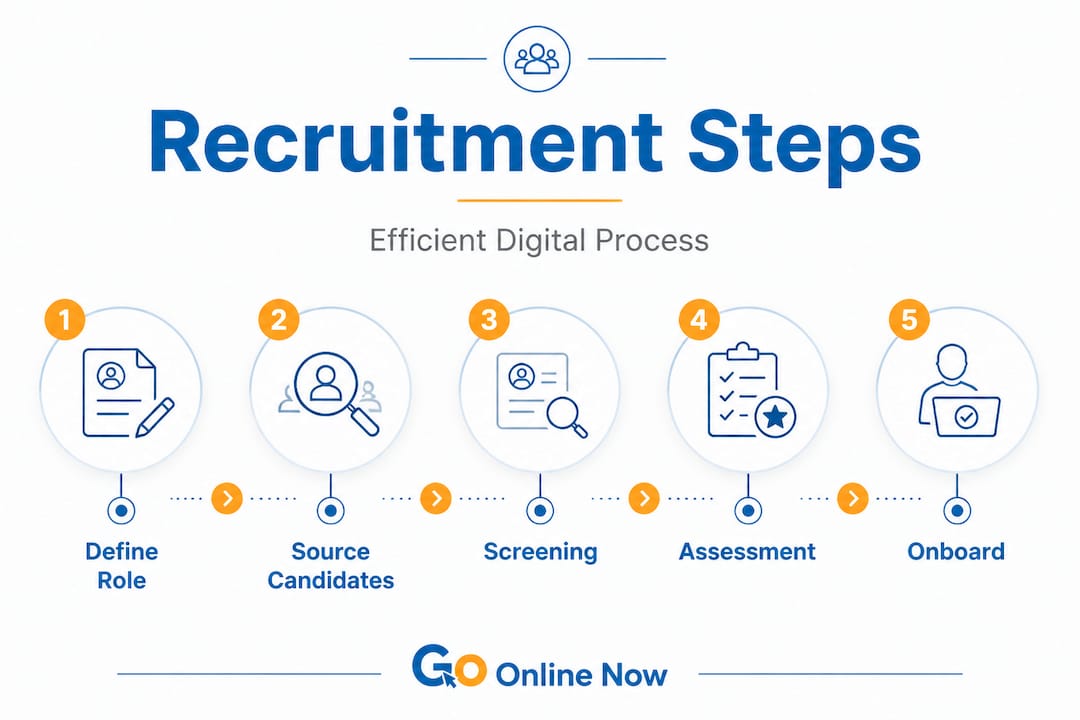
The five key steps in the digital recruitment process
With your preparation complete, you can move through the core steps efficiently. Each stage builds on the last, so skipping steps creates gaps that slow everything down.
Step 1: Define the role with precision
Write a job description that describes the outcomes you expect, not just the tasks. Instead of “manage social media accounts,” write “grow organic engagement by 20% over six months.” This attracts candidates who think in results, not just activities.
Keep the must-have list short. Every additional requirement you add to the job post reduces the number of qualified applicants. Aim for five to seven clear requirements maximum.
Step 2: Source candidates through targeted channels
Post your role on your selected channels at the same time. Spread your search across digital recruitment strategies that combine active sourcing (posting jobs) with passive sourcing (reaching out to candidates on LinkedIn). Active and passive together consistently outperform either approach alone.
Set a defined sourcing window, typically five to seven business days. After that, close the pipeline and move to screening. Leaving a role open indefinitely creates confusion and delays the whole process.
Step 3: Screen and shortlist efficiently
This is where an ATS earns its value. SMBs using ATS tools track better metrics, scale faster, and dramatically reduce manual work in the screening stage. Set up knockout questions in your ATS to automatically filter out candidates who don’t meet basic criteria.
Target a shortlist of eight to twelve candidates for skills assessment. The industry average applicant-to-hire ratio is around 180:1, so you need a reliable filter system to manage volume without burning out your team.
Step 4: Assess skills and conduct structured interviews
Skills tests are non-negotiable for digital roles. A candidate who looks great on paper may struggle with real tasks. Use practical assessments relevant to the role, such as a 30-minute content brief task for a content writer, or a short campaign analysis exercise for a digital strategist.
For interviews, use structured formats with consistent questions for every candidate. This reduces bias and makes comparison easier. Limit your interview stages to two rounds maximum. More stages than that increase drop-off rates significantly.
Professionele tip: Check your streamlined recruitment process for 2026 against current benchmarks. The industry interview-to-hire rate is 27%, so if yours is much lower, your assessment criteria may need adjusting.
Step 5: Make offers, negotiate, and onboard fast
Move fast after selecting your finalist. Top digital professionals are often interviewing elsewhere. Aim to send an offer within 24 to 48 hours of your final decision. Delays at this stage cost you great candidates.
Keep the offer clear and simple. Outline the role, compensation, start date, and any key terms in a short document. Address questions quickly and honestly. A smooth, respectful negotiation process sets the tone for the employment relationship.
Onboarding should start before day one. Send welcome materials, tool access instructions, and a first-week schedule in advance. This reduces friction and accelerates time-to-productivity.
| Recruitment stage | Benchmark target | Common SMB gap |
|---|---|---|
| Sourcing window | 5 to 7 business days | Too long, no defined close date |
| Shortlist size | 8 to 12 candidates | Too many or too few |
| Skills test completion rate | 60 to 70% | No test used at all |
| Offer acceptance rate | 75 to 85% | Below 70%, usually due to slow process |
| Time to first day | Within 2 weeks of offer | Delayed onboarding setup |
Common pitfalls and how to avoid them
Even with a step-by-step plan, some classic pitfalls can derail results. Knowing what to watch for keeps your process on track.
Overrelying on unstructured manual processes. Using spreadsheets and email threads to manage candidates leads to missed follow-ups, lost applications, and inconsistent evaluations. Even a basic ATS eliminates most of these problems quickly.
Focusing on degrees instead of skills. A candidate with a marketing degree but no hands-on digital tool experience will not outperform a self-taught specialist with a portfolio of real results. Skills-based hiring consistently produces better outcomes for digital roles.
Skipping AI bias audits. If you use AI tools to screen resumes, audit regularly for bias. Algorithmic screening can inadvertently filter out qualified candidates based on patterns that don’t predict job performance. Review a sample of filtered-out applications monthly to catch these issues early.
Leaving candidates in silence. A lack of communication is one of the top reasons candidates drop out of processes or decline offers. Keep every applicant informed at each stage, even if it’s just a brief status update. Candidates talk, and your reputation as an employer matters.
Not measuring what matters. If you’re not tracking time-to-hire, cost-per-hire, offer acceptance rate, and source quality, you’re flying blind. These metrics reveal exactly where your process leaks time and money. Review streamlining recruitment tips to build a lightweight metrics dashboard that doesn’t require a data analyst to maintain.
“The businesses that hire the best digital talent aren’t the ones with the biggest budgets. They’re the ones with the clearest process, the fastest feedback loops, and the most respectful candidate experience.”
Professionele tip: Candidate experience is your hidden recruiting tool. A smooth, transparent, and timely process tells every applicant that your business is organized and professional. That reputation attracts better candidates over time.
Tracking results and optimizing your process
Staying competitive means closing the loop between effort and results. Measuring your recruitment performance isn’t optional. It’s the only way to know if your process is improving.
The four KPIs every SMB should track
- Time-to-fill: The number of days from posting a role to having a signed offer. This reveals bottlenecks across every stage.
- Cost-per-hire: Total recruitment spend divided by the number of hires. Track this separately for each sourcing channel to identify your most efficient sources.
- Source-of-hire: Which channels actually produce your best hires? Referrals often win here, but you won’t know without tracking.
- Offer acceptance rate: If this drops below 75%, your process, your offer, or your candidate experience needs attention. Tracking these quality metrics is what separates high-performance hiring teams from those stuck in constant reactive mode.
How to use your data
Compare your numbers against industry benchmarks every quarter. If your time-to-fill is above 35 days for digital roles, look at where candidates are stalling. If your offer acceptance rate is below 75%, survey recent candidates to find out why.
Hold a short monthly check-in with your hiring team. Ten to fifteen minutes is enough to review what worked, what didn’t, and what to adjust. Small, regular improvements compound into a significantly better process over 6 to 12 months.
| KPI | Industry benchmark | Action if below benchmark |
|---|---|---|
| Time-to-fill | 16 to 35 days | Audit screening and interview stages |
| Cost-per-hire | $1,200 to $5,346 | Review channel mix and tool costs |
| Offer acceptance rate | 75 to 85% | Improve candidate communication and offer speed |
| Source-of-hire quality | Referrals often top 40% | Invest in employee referral program |
Voor SMB digital recruitment automation, the best approach is to automate your data collection inside your ATS so metrics update automatically. Manual reporting rarely gets done consistently.
Why most digital hiring advice fails SMBs (and what really works)
Most recruitment content you’ll find online is written for enterprise HR teams. It assumes you have a dedicated recruiter, an HR software budget, and the time to build elaborate competency frameworks. That’s not reality for most SMBs.
The truth is, big-company playbooks create more confusion than clarity when applied to a 10 or 20-person business. You don’t need a seven-stage interview process or a 12-page onboarding checklist. You need speed, clarity, and a sharp eye for practical skills.
What actually works for SMBs is skills-based hiring with benchmarked criteria. Stop filtering on credentials and start filtering on what candidates can actually do. Build a short practical test for every digital role you hire. This alone separates your process from 80% of competing employers.
Candidate experience is your biggest competitive advantage that nobody talks about. Enterprise companies are slow, impersonal, and often dismissive of candidates. You can move in 48 hours. You can give real feedback. You can treat people like professionals from the first email. That candidate-first design doesn’t just win you better hires. It builds your reputation as a great place to work, which compounds into a stronger talent pipeline over time.
Start simple and improve as you go. You don’t need the perfect system before you start hiring. You need a clear ICP, a structured interview, and a commitment to moving fast. Build the rest over time based on your own data and feedback. The businesses that wait for the perfect process never fill their roles. The ones that start now and iterate consistently win the talent game.
Streamline digital hiring with Go Online Now’s solutions
If this guide gave you a clearer picture of where your hiring process stands, the next step is putting it into practice with the right support.
At Go Online Now, we help SMBs cut hiring time with digital recruitment solutions designed specifically for growing businesses. Whether you’re hiring your first digital marketing specialist or scaling a remote team, our tools and expert team make every stage faster and more effective. Explore our digital recruitment solutions guide to see exactly how we support the process from sourcing to onboarding. And if you’re also looking to automate your marketing alongside your hiring, our marketing automation for SMBs platform handles both under one roof, with real human support included.
Frequently asked questions
How long should the digital recruitment process take for SMBs?
Most SMBs fill digital roles in 16 to 35 days, though the overall average sits at 44 days across all sectors. Tightening your screening and interview stages is the fastest way to close that gap.
What is the typical cost per hire for digital professionals in small businesses?
Costs typically range from $1,200 to $5,346 depending on your company size, role seniority, and sourcing methods. Using referrals and an ATS consistently brings this number down.
Do applicant tracking systems (ATS) really help small businesses?
Yes. ATS tools reduce time-to-hire by 35% and make it significantly easier to track candidates, communicate consistently, and measure results at scale. Even a simple, affordable ATS delivers a strong return for SMBs.
What is the most important metric to track in digital recruitment?
Time-to-fill is essential, but tracking offer acceptance and source quality gives you a fuller picture of where your process excels and where it needs improvement.
Aanbevolen
- Why digital recruitment matters for SMB growth in 2026 – Go Online Now
- Digital recruitment: 5 smart strategies for SMB hiring – Go Online Now
- Guide to digital recruitment: efficient hiring for SMBs – Go Online Now
- 7 key tips to streamline your digital recruitment process – Go Online Now
- ApplyGenius – AI Resume Builder for Developers