

TL;DR:
- Digital recruitment uses online platforms and automation to improve hiring speed and reach.
- Success depends on organizational readiness, fair processes, and managing bias risks.
- Focusing on candidate experience and internal process improvements maximizes digital recruitment effectiveness.
Digital tools can transform your hiring process, but only if your business is ready for them. A quantitative study shows that digital recruitment can significantly improve workforce quality and efficiency, yet the results depend heavily on organizational readiness, not just the software you choose. Many SMB owners invest in the latest hiring platforms and still struggle to fill roles with the right people. This guide cuts through the noise. You will learn what digital recruitment actually is, which tools and strategies deliver real results, how to protect against bias, and how to build a process that candidates actually enjoy.
Key Takeaways
| Point | Details |
|---|---|
| Strategic tool use | Digital recruitment boosts efficiency only when tools fit your SMB’s readiness and needs. |
| Prioritize fairness | AI and digital platforms require oversight to prevent bias and ensure a fair hiring process. |
| Candidate-first focus | Streamlining application steps and removing barriers helps you attract and retain more qualified talent. |
| Human input matters | Success comes from combining people, process alignment, and the right technology—not tools alone. |
What is digital recruitment?
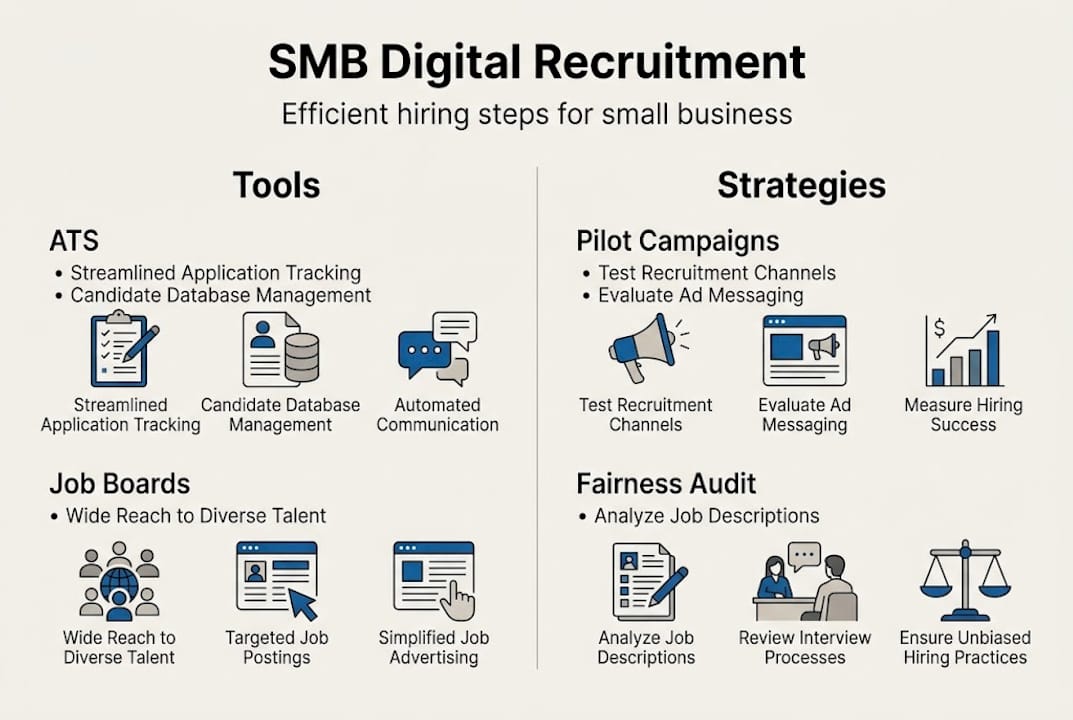
Digital recruitment is the use of online platforms, software, and automated tools to attract, screen, and hire candidates. It replaces or supplements traditional methods like newspaper ads, physical resumes, and in-person screening with faster, scalable alternatives. For SMBs, this shift is significant because it levels the playing field against larger competitors with bigger HR teams.
At its core, digital recruitment has three main components:
- Job boards and social channels: Platforms like LinkedIn, Indeed, and niche job boards let you post roles and reach thousands of candidates quickly.
- AI-powered sourcing: Algorithms scan candidate profiles, match skills to job descriptions, and surface the most relevant applicants automatically.
- Online assessments and video interviews: Tools like structured video screening and skills tests let you evaluate candidates before spending time on live interviews.
The benefits over traditional hiring are real. Speed improves dramatically. Reach expands beyond your local area. Repetitive tasks like resume sorting get automated. You can streamline SMB hiring across borders and time zones without adding headcount to your HR function.
But there is a catch. Nearly 90% of companies now use at least some AI or digital tools in hiring, yet adoption does not equal results. Many businesses plug in a new tool without adjusting their process, training their team, or auditing their job descriptions. The technology becomes a faster version of a broken system.
“Digital recruitment works best when it supports a well-designed hiring process, not when it replaces the thinking behind it.”
If you want to use an efficient hiring guide to build something that actually works, start by understanding what your current process is missing before selecting any software.
Digital recruitment tools and strategies: What works?
Once the basics are clear, the real edge comes from choosing the right strategies and tools for your hiring needs. The market is crowded, and not every platform suits every SMB. Here is a practical comparison to help you orient:
| Tool type | Best for | Key limitation |
|---|---|---|
| Applicant Tracking System (ATS) | Managing high application volume | Can filter out strong candidates |
| AI sourcing platforms | Passive candidate discovery | Requires clean data to work well |
| Social media job boards | Brand visibility and reach | Lower signal-to-noise ratio |
| Video interview tools | Early-stage screening at scale | Candidate experience varies |
| Skills assessment platforms | Reducing bias in screening | Needs role-specific calibration |
Research confirms that digital recruitment technology can significantly improve efficiency and talent match, but only when paired with organizational readiness. That means your team needs to know how to interpret the data these tools produce, not just collect it.
Here is what works for most SMBs:
- Combine automation with human review. Let AI handle initial screening, but have a real person evaluate shortlisted candidates.
- Standardize your job descriptions before posting them anywhere. Vague descriptions produce irrelevant applications regardless of the platform.
- Use integrated tools where possible. Disconnected systems create data gaps and slow down your process.
- Track your metrics. Time to hire, offer acceptance rate, and 90-day retention tell you whether your tools are actually working.
One important caution: AI in hiring can amplify existing bias, not just eliminate it. If your historical hiring data skews toward a particular demographic, AI trained on that data will replicate the pattern.

For a deeper look at what is available, explore these explained recruitment solutions En digital recruitment examples from businesses similar to yours.
Pro Tip: Before rolling out any new platform company-wide, run a pilot campaign for one role. Measure results, gather feedback from your hiring manager, and adjust before scaling.
Fairness, bias, and readiness: What you must know about digital recruitment
Technology brings not just opportunity, but responsibility. Let’s explore how bias and organizational readiness affect results.
AI in hiring is not neutral. It can reproduce or even amplify inequalities if not implemented carefully. This is not a theoretical concern. Real cases have shown AI resume screeners penalizing candidates from certain universities or filtering out women in male-dominated fields, simply because the training data reflected historical patterns.
For SMBs, the risk is especially high because you often lack a dedicated HR compliance team to catch these issues. Here is a snapshot of where bias tends to enter the process:
| Stage | Common bias risk | Mitigation |
|---|---|---|
| Job description writing | Gendered or exclusionary language | Use a bias-checking tool |
| Resume screening (AI) | Replicating historical hiring patterns | Audit outcomes by demographic |
| Video interview analysis | Facial recognition errors | Avoid automated emotion scoring |
| Skills testing | Tests not validated for the role | Use role-specific, validated assessments |
Readiness matters just as much as fairness. Before investing in digital recruitment software, ask yourself:
- Do you have clean, structured candidate data?
- Is your team trained to interpret AI-generated recommendations?
- Are your job descriptions aligned with what the role actually requires?
- Do you have a process for reviewing outcomes and catching errors?
“A tool is only as fair as the process it is built on top of.”
For a streamlined hiring process that holds up under scrutiny, start with a readiness checklist before you sign any software contract. You can also reference candidate-first recruiting strategies from SHRM to benchmark your approach against current best practices.
Pro Tip: Before selecting any digital recruitment software, conduct a simple fairness audit. Review your last ten hires for demographic patterns and check whether your current job descriptions contain exclusionary language. This takes an hour and can save you from costly mistakes.
Designing a candidate-first digital recruitment process
Building on fairness and readiness, you will see how to ensure digital recruitment delights, not frustrates, candidates.
A candidate-first philosophy means designing your hiring process around the applicant’s experience, not just your internal convenience. Clarity, transparency, and accessibility are the three pillars. When candidates know what to expect, can apply easily, and receive timely communication, your completion rates go up and your applicant quality improves.
SHRM highlights that streamlining application requirements, such as removing unnecessary degree filters, can improve results more than switching tools. This is a powerful insight. You do not always need a new platform. Sometimes you just need to simplify what you already have.
Here is a step-by-step approach to redesigning your process with candidates in mind:
- Audit your current application. Count the number of steps and required fields. Remove anything that does not directly help you evaluate a candidate.
- Make it mobile-friendly. A significant share of job seekers apply from their phones. If your form breaks on mobile, you lose good candidates immediately.
- Write clear job descriptions. List must-have skills separately from nice-to-haves. Specify the role’s day-to-day responsibilities in plain language.
- Set expectations upfront. Tell candidates how many stages the process has and how long each step takes.
- Automate status updates. Use your ATS or CRM to send confirmation emails and progress notifications automatically.
- Gather feedback. Ask candidates who drop out why they left. This data is gold for continuous improvement.
Key applicant experience essentials for SMBs:
- Simple, short application forms (under ten minutes to complete)
- Mobile-optimized career pages
- Prompt acknowledgment of every application
- Transparent timelines communicated at each stage
- Respectful, human communication at every touchpoint
Digital tools support this redesign, but they do not replace the thinking behind it. Explore smart recruitment strategies to see how other SMBs have applied these principles in practice.
Why digital recruitment success depends on people, not just platforms
Here is an uncomfortable truth most recruitment software vendors will not tell you: the majority of digital hiring failures are not caused by choosing the wrong tool. They happen because businesses underestimate the change management required to make any tool work.
We have seen SMBs invest in sophisticated AI platforms and still hire poorly, while others using basic job boards and a clear process consistently bring in great people. The difference is almost always internal. Teams that communicate why the process is changing, retrain hiring managers on new workflows, and build accountability into their recruitment steps consistently outperform those that just automate the old way of doing things.
The businesses driving smarter hiring treat their recruitment process as a living system. They review it quarterly, gather data from every hire, and adjust based on what the numbers show. Digital tools make this easier, but the discipline has to come from your team.
Stakeholder buy-in matters more than most people realize. When your hiring managers trust the process and understand how the tools work, they use them correctly. When they feel the tools were imposed on them without explanation, they work around them. That is where results fall apart.
The bottom line: invest in your people and your process first. Then choose the tools that fit.
How Go Online Now streamlines SMB recruitment
Ready to transform your hiring? Here is how Go Online Now can help.
Finding and hiring qualified digital professionals should not require juggling five different platforms and a stack of spreadsheets. Go Online Now brings recruitment, automation, and CRM together in one place, built specifically for SMBs that want results without the complexity.
Our digital recruitment solutions help you cut hiring time for SMBs without sacrificing quality. From sourcing to screening to onboarding, we guide you through every step with real human support. Whether you are hiring your first digital team member or scaling a remote workforce, our digital recruitment guide gives you the framework to do it efficiently. Reach out today and let us help you build a hiring process that actually works for your business.
Frequently asked questions
What is digital recruitment and how does it help SMBs?
Digital recruitment uses online tools and platforms to make hiring faster, broader, and more efficient for small businesses. Digital tools improve reach, speed, and workforce quality when implemented with the right process in place.
How do I avoid bias when using AI recruiting tools?
Check for fairness features, monitor outcomes regularly, and always pair AI recommendations with human judgment. AI can amplify bias if not implemented with care and ongoing oversight.
What is candidate-first recruitment, and why does it matter?
Candidate-first recruitment removes unnecessary barriers and makes the application process smoother, increasing applicant quality and completion rates. SHRM notes that eliminating degree filters and simplifying applications is often more effective than just changing tools.
Are digital recruitment platforms expensive for SMBs?
Many platforms offer scalable pricing or freemium models, but it is important to match features with your actual hiring volume and needs before committing to a paid plan.
How soon can I see results from adopting a digital recruitment solution?
Most SMBs notice measurable process improvements and faster hiring within one to three months of consistent implementation and team adoption.