
TL;DR:
- Digital marketing offers a high return on investment for small businesses, especially through email.
- A clear strategy focuses effort on 2-3 channels, combining organic and paid efforts for best results.
- Regular monthly audits and small optimizations are essential for sustainable growth and success.
Every dollar counts when you’re running a small business, and the good news is that digital marketing can return between $36 and $42 for every $1 spent on email alone. Yet many SMB owners still believe that building a strong digital presence requires a big agency budget, a team of specialists, or years of technical know-how. That belief is costing them growth. This guide breaks down exactly what a digital marketing strategy is, how to build one on a realistic budget, which channels to prioritize, and how to measure results so you can make smarter decisions starting today.
Key Takeaways
| Point | Details |
|---|---|
| Focus your strategy | Start with clear goals, a simple 5-step plan, and channels matched to your business strengths. |
| Integrate top channels | Combine 2–3 channels such as SEO, content, and email for compounding results and sustainable growth. |
| Prioritize measurement | Regularly track KPIs and optimize your plan monthly to outpace competitors and maximize ROI. |
| Own your assets | Invest first in assets you control, like your website and email list, before scaling to paid ads or social. |
What is a digital marketing strategy? Key concepts explained
Before you invest time or money, it helps to understand what a digital marketing strategy basics actually means for a business your size. At its core, a digital marketing strategy is a documented plan that defines how your business will use online channels to attract, engage, and convert your target audience. It is not the same as posting on social media three times a week or running a Google ad. Those are tactics. Strategy is the thinking behind which tactics you choose and why.
A lot of SMB owners confuse the two, and that confusion leads to scattered effort and wasted budget. You might spend hours on Instagram only to realize your customers are searching Google and never scrolling social feeds. Or you might launch a paid ad campaign before you even have a landing page that converts. Strategy prevents those costly mistakes.
Here is a widely used 5-step framework that works well for small businesses:
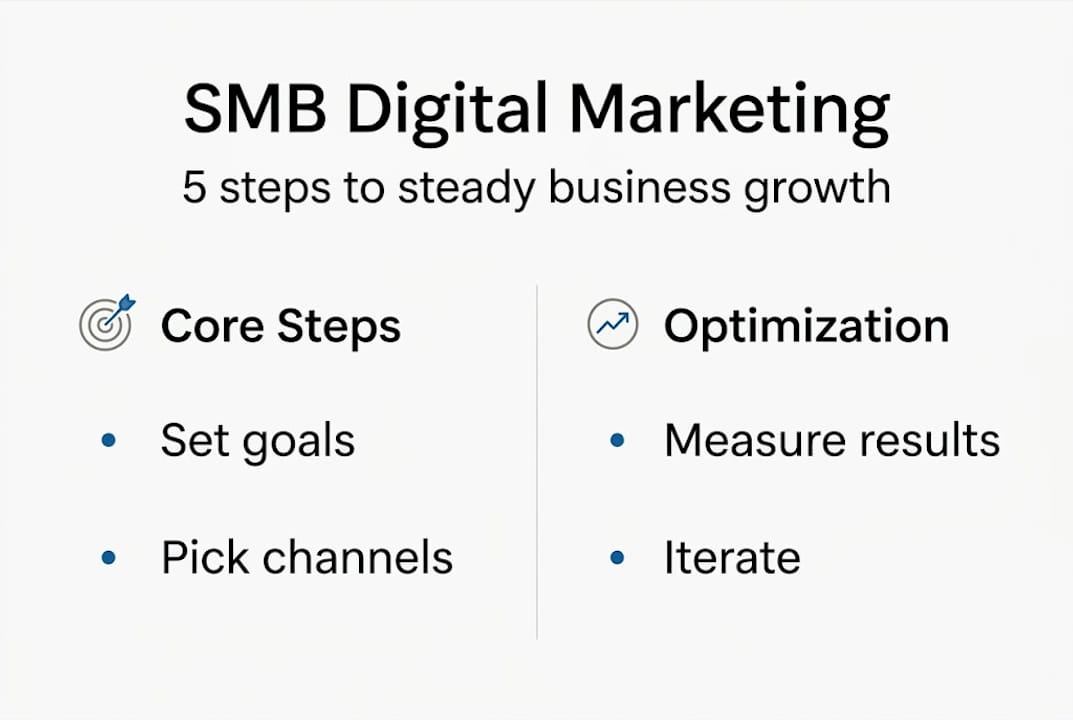
The 5-step SMB digital marketing framework: Audit your current online presence, set SMART goals (Specific, Measurable, Achievable, Relevant, Time-bound), select 2 to 3 channels that match your audience, allocate your budget wisely (for budgets under $2,000/month, 70% organic and 30% paid is a strong starting point), and measure key performance indicators like leads generated and cost per lead. This framework keeps you focused and accountable without overwhelming your resources.
This framework matters because it forces prioritization. Most SMBs that struggle with digital marketing are not failing because they lack tools. They are failing because they are trying to do everything at once with no clear direction.
Let’s also clear up a few common misconceptions:
- Digital marketing is only for big brands. False. SMBs often outperform larger competitors online because they can be more personal, agile, and niche-focused.
- You need to be on every channel. You do not. Two or three well-executed channels will always beat seven poorly managed ones.
- It requires a large budget. Organic channels like SEO, content, and email can generate strong results for under $500/month if used consistently.
- Results happen fast. Some tactics like paid ads drive immediate traffic, but lasting growth comes from compounding organic effort over time.
Core elements of a strong digital marketing strategy:
- A clear understanding of your target audience and their online behavior
- SMART goals tied to real business outcomes (leads, bookings, sales)
- A defined channel mix based on where your audience actually spends time
- A realistic monthly budget with a breakdown between organic and paid
- KPIs tracked monthly so you can adjust and improve over time
- Owned assets (your website and email list) at the center of everything
With the foundation set, you have everything you need to move into building the actual plan.
How to build an effective digital marketing strategy: The 5-step framework
Now that you understand the core concepts, let’s move step by step through the actual process of building an affordable digital marketing plan. Following this 5-step framework gives you a clear sequence to follow rather than guessing where to start.
-
Audit your current online presence. Look at your website, Google Business Profile, social media pages, and any existing email lists. What’s working? What’s getting traffic? Where are leads dropping off? A real estate agent, for example, might discover that their Google Business Profile drives more inquiries than their Facebook page, which immediately tells them where to focus energy.
-
Set SMART goals. Vague goals like “get more customers” don’t tell you whether you’ve succeeded. A SMART goal sounds more like: “Generate 30 new service inquiries per month via organic search within 90 days.” A coaching business using this kind of goal knows exactly when to celebrate and when to adjust.
-
Select 2 to 3 channels. Spreading effort across six channels with limited time and budget rarely works. A salon might choose SEO for local search, email for client retention, and Google Ads for seasonal promotions. That combination is manageable, measurable, and effective.
-
Allocate your budget. For businesses spending under $2,000/month on digital marketing, a 70/30 split is practical. Put 70% toward organic efforts like content creation, SEO, and email marketing. Reserve 30% for paid campaigns that test what resonates before you scale spend.
-
Measure KPIs monthly. Leads generated, cost per lead, email open rates, and website traffic are all simple to track with free tools like Google Analytics and your email platform’s built-in dashboard.
A strategy plan example can help you see how these steps translate into an actual documented plan for a real business type.
Organic vs. paid digital marketing comparison:
| Factor | Organic marketing | Paid marketing |
|---|---|---|
| Cost | Low (time investment) | Requires ongoing spend |
| Time to ROI | 3 to 6 months | Immediate |
| Sustainability | Builds over time | Stops when budget stops |
| Best for | Long-term growth, authority | Promotions, fast lead generation |
| Examples | SEO, content, email | Google Ads, social ads |
Pro Tip: Start with what you own and what you can measure. Your website and email list are yours forever. Social media platforms can change their algorithms overnight. Build your foundation on owned assets before investing in rented channels.

Choosing and integrating the right channels for your business
Once the core framework is set, the next decision is which channels to invest effort and budget in. The right channels depend on your audience, your industry, and your current strengths.
Here are the top-performing channels for SMBs and how to think about each:
- SEO (Search Engine Optimization): Key SMB channels include SEO as a long-term investment that builds authority and trust. It focuses on E-E-A-T (Experience, Expertise, Authoritativeness, and Trustworthiness), which Google now heavily weights. A local plumber ranking on page one for “emergency plumber near me” generates free, high-intent leads every single day.
- Email marketing: The highest ROI of any digital channel at $36 to $42 per $1 spent. It is direct, personal, and completely owned by you. An education business sending a weekly tips newsletter keeps leads warm for months before they convert.
- Paid ads: Google Ads and Meta Ads drive immediate traffic and are ideal for launches, promotions, or testing new offers. They stop working when you stop paying, so they work best as a complement to organic efforts, not a replacement.
- Social media: Best for community building and brand awareness. A fitness coach building an engaged Instagram audience can funnel followers to an email list over time.
- Content marketing: Blog posts, videos, and guides fuel your SEO, give you material to share on social, and provide value that builds trust before a sale ever happens.
The real power, as research confirms, comes from integration. Content feeds SEO. SEO drives website traffic. Your website captures email subscribers. Email nurtures leads back to your offers. Each channel reinforces the next, creating compounding returns over time.
Channel synergy benefits:
| Channel combination | Synergy effect |
|---|---|
| Content + SEO | Blog posts rank in search and drive consistent organic traffic |
| SEO + Email | Organic visitors subscribe and are nurtured through email sequences |
| Email + Social | Email campaigns can be repurposed as social posts for broader reach |
| Paid Ads + Landing Page | Ads test messaging; winning copy improves organic content too |
Best channel combinations by business type:
- Local service businesses (salons, plumbers, cleaners): SEO plus Google Business Profile plus email
- Professional services (coaches, consultants, agencies): Content plus email plus LinkedIn
- E-commerce or product sellers: Paid ads plus email plus social media retargeting
Learn more about SEO for SMB growth or explore social media strategies to go deeper on specific channels.
Pro Tip: Integrate content, SEO, and email first. This combination compounds beautifully on small budgets. A single well-optimized blog post can drive traffic for years and feed your email list continuously, without any recurring ad spend.
Measuring, optimizing, and scaling your digital marketing for growth
With your key channels chosen and integrating, the final pillar is making your strategy work for you through consistent improvement. Many SMBs set up their digital marketing and then leave it alone for months. That is one of the most common reasons growth stalls.
Here is a straightforward monthly optimization process you can follow:
-
Pull your core KPIs. Check website traffic, leads generated, email open and click rates, and cost per lead. Free tools like Google Analytics 4 and your CRM dashboard make this easy.
-
Identify your top-performing content or campaign. What drove the most leads or conversions last month? Double down on that format, topic, or channel.
-
Identify your lowest performer. Is there a channel eating budget or time without producing results? Pause it, reduce investment, or test a new approach before giving up entirely.
-
Make one or two small adjustments. Change a subject line. Update a landing page headline. Shift $100 from a low-performing ad to a better-converting one. Small changes compound.
-
Document what you tested and what happened. Even a simple spreadsheet tracking monthly changes creates a learning record that makes future decisions faster and smarter.
“Digital marketing success for SMBs requires agility. Monthly reviews, owned asset prioritization, and integrated channel strategies are what empirically separate businesses that grow from those that stay flat.” International Journal of Research and Technology in Business and Technology
This is not a complex process. It takes about one to two hours per month and delivers dramatically better results than the “set it and forget it” approach.
Affordable and free tools that make measurement simple include Google Analytics 4 for website traffic, Google Search Console for SEO performance, Mailchimp or your email platform for campaign stats, and Meta Business Suite for social media insights. If you are using an all-in-one CRM, most of these metrics are pulled together in a single dashboard automatically.
The businesses that optimize SMB strategies consistently outperform those that run bigger campaigns sporadically. Consistency and iteration beat occasional intensity every time. If you want a broader view of how these pieces connect for long-term scaling, there is a practical overview of how to grow your SMBs through structured digital planning.
Why most SMBs get digital strategy wrong—and what actually works
Here is what most guides won’t tell you: the biggest mistake SMBs make is not choosing the wrong channels. It is trying to do too much at the same time.
We have worked with business owners who were posting daily on four social platforms, running Google Ads, sending weekly emails, and still not growing. Why? Because none of those activities were connected. There was no strategy tying them together and no clear goal defining success.
The businesses that win online are not the ones spending the most. They are the ones integrating their assets most effectively. A single blog post that feeds organic search, gets emailed to your list, and is shared as social content does more than three separate ad campaigns targeting cold audiences.
Small, iterative improvements also beat major overhauls. Redesigning your entire website every year is far less effective than updating your top five pages quarterly with better content, stronger calls to action, and improved page speed. Sustainable digital growth comes from alignment, consistency, and compounding effort. The businesses that understand this outperform their competitors without outspending them.
Take your strategy further with digital marketing solutions built for SMBs
If you are ready to translate this framework into action, here’s where to find practical tools and support that take the guesswork out of digital growth.
At Go Online Now-Connect, we built our platform specifically for SMBs who want real results without the complexity or cost of enterprise tools. Our marketing automation for SMBs covers email, SMS, funnels, and lead nurturing in one place, while our done-for-you setup means you are not left to figure it out alone. From strategy and content to SEO and paid campaigns, our digital marketing services overview shows you exactly how we help SMBs turn strategy into measurable growth. No contracts. No hidden fees. Real human support included.
Frequently asked questions
What is the first step in developing a digital marketing strategy for an SMB?
Start by auditing your current online presence and marketing activities to understand your starting point. This audit process reveals what’s working, what’s missing, and where your biggest opportunities are before you spend a dollar.
How much should a small business spend on digital marketing?
A recommended approach is to allocate around 70% of your budget to organic channels and 30% to paid campaigns when spending under $2,000/month. This balance builds long-term visibility while still testing paid tactics.
Which digital marketing channel offers the best ROI for SMBs?
Email marketing typically offers the highest ROI for SMBs, returning $36 to $42 per $1 spent. It is also one of the most affordable channels to get started with.
Why is integration important for digital marketing success?
Integrated channels compound results by feeding each other, so content powers SEO, social, and email simultaneously, which boosts overall growth and customer retention far more than isolated efforts.
How often should digital marketing results be reviewed and optimized?
You should review your digital marketing strategy monthly for best results, making small adjustments to channels, content, and budget allocation to stay agile and continuously improve performance.