

TL;DR:
- Most SMBs underestimate content marketing’s accessibility, missing out on its ability to generate three times more leads at lower costs.
- Following a structured, consistent approach with proper tools and data-driven adjustments is key to scaling success and long-term growth.
Most small business owners assume content marketing is a luxury reserved for companies with large teams and bigger budgets. That assumption is costing you leads. Content marketing generates 3x more leads than traditional marketing at 62% lower cost, meaning a well-run blog or email series can outperform a paid ad campaign on a fraction of the budget. This guide breaks down exactly how to build a structured, affordable content marketing program from scratch, including the framework, tools, best practices, and pitfalls you need to know before you publish your next piece of content.
Key Takeaways
| Point | Details |
|---|---|
| Higher ROI for SMBs | Content marketing generates more leads at lower cost than traditional methods, making it ideal for small businesses. |
| Follow a proven process | A 7-step framework helps SMBs consistently produce effective content and avoid common pitfalls. |
| Leverage affordable tools | Smart use of platforms like HubSpot, CoSchedule, and Semrush boosts efficiency and impact without high costs. |
| Prioritize distribution | Splitting time evenly between content creation and distribution maximizes reach and ROI. |
| Measure what matters | Look beyond website traffic to track leads, conversions, and actual sales for true content marketing success. |
What makes content marketing guides essential for SMBs?
Now that we’ve challenged myths about content marketing’s accessibility, let’s look at why structured guides matter for small and mid-sized businesses.
Many SMB owners try content marketing without a plan. They write a few blog posts, post sporadically on social media, and then conclude it doesn’t work. The real problem isn’t content marketing itself. The problem is the absence of a repeatable system. A structured guide gives you a clear process to follow, which is the difference between random activity and a predictable lead generation engine.
The numbers back this up. Content marketing ROI averages 3:1 for B2B companies, and email marketing delivers an extraordinary $36 return for every $1 spent. These aren’t results reserved for enterprise businesses. They’re achievable for any SMB that commits to a consistent, well-planned approach.
Key advantages of content marketing for SMBs:
- Lower cost per lead: You pay mostly in time and creativity, not ad spend
- Compounding returns: A strong blog post keeps driving traffic for years, unlike a paid ad that stops the moment your budget runs out
- Brand trust: Regularly publishing useful content positions you as an expert in your field
- Flexibility: You can scale up or down based on your capacity and budget
- Higher lead quality: Content-driven leads often come in pre-educated about your offer, making them easier to convert
- SEO benefits: Quality content improves your search rankings, which increases organic visibility over time
| Metric | Content marketing | Traditional marketing |
|---|---|---|
| Cost per lead | 62% lower | Higher |
| Lead volume | 3x more | Lower |
| ROI (B2B) | 3:1 average | Varies |
| Email ROI | $36:$1 | N/A |
| Long-term value | Compounding | Diminishing |
You can explore affordable content marketing strategies that show how SMBs are achieving these results on tight budgets. For a broader foundation, the strategy guide for SMBs covers everything from goal setting to execution.

Video content and email newsletters consistently punch above their weight for SMBs with limited resources. Short-form video, in particular, requires minimal production equipment and reaches audiences across multiple platforms. Email remains the highest-ROI channel, especially when paired with marketing automation tools that handle follow-up sequences without requiring manual effort every day.
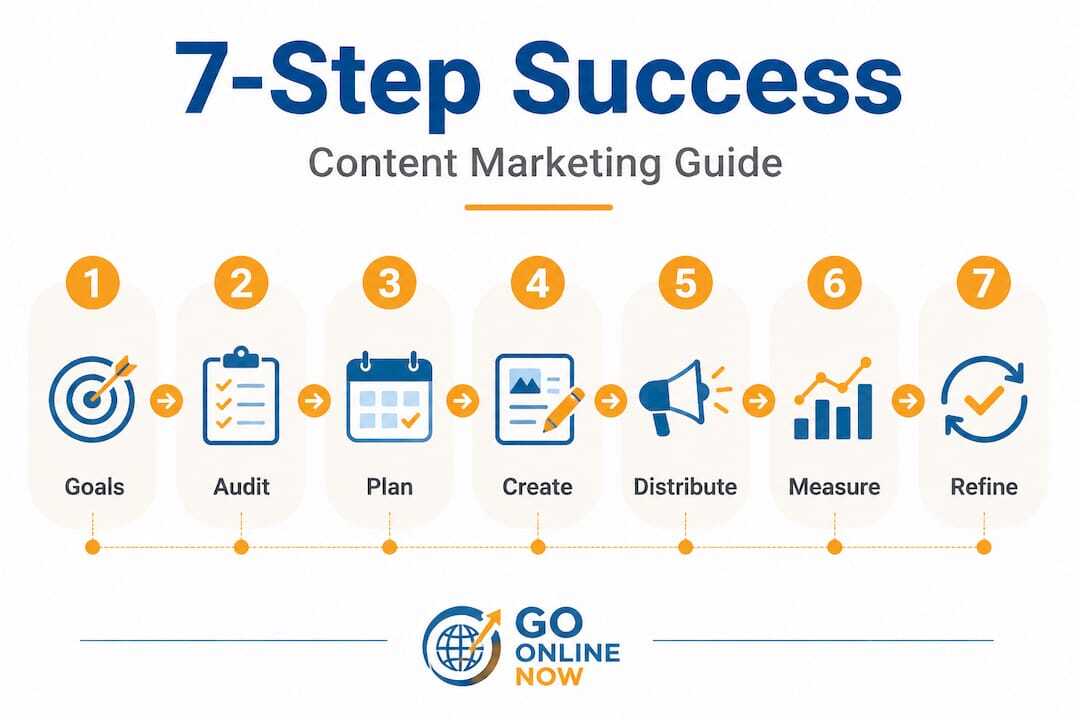
The 7-step framework for content marketing success
Understanding the value of a guide, the next question is: what proven system should you follow for content marketing success?
This 7-step framework gives you a repeatable process that adapts as your business grows. Unlike scattered advice you’ll find on most marketing blogs, this approach is sequential. Each step builds on the last.
The 7-step content marketing framework for SMBs:
- Define your goals: Decide whether you’re focusing on brand awareness, lead generation, or customer retention. Your goal shapes every other decision.
- Research your audience personas: Understand who your ideal customer is, what problems they face, and how they search for solutions. Personas don’t need to be complex. Even one well-researched profile is enough to start.
- Perform a content audit: If you’ve published anything before, evaluate what’s working and what isn’t. This step saves you from repeating mistakes and reveals existing content you can repurpose.
- Choose your CMS (content management system): A CMS is the platform where you publish your content, such as WordPress, Wix, or Squarespace. Choose one you can actually navigate without a developer on call.
- Select your content types: Blog posts, videos, emails, podcasts, infographics, and case studies all serve different purposes. Pick two or three formats that align with your audience and your capacity.
- Brainstorm content ideas: Use keyword research tools to find topics your audience is actively searching for. Prioritize low-to-medium competition keywords as an SMB so you can rank without competing against massive websites.
- Publish and manage consistently: Create a simple editorial calendar and stick to it. Consistency matters more than frequency.
| Step | Manual process | Tool-enabled process |
|---|---|---|
| Goal setting | Spreadsheet tracking | CRM with goal dashboards |
| Persona research | Interviews and surveys | Analytics and AI tools |
| Content audit | Manual URL review | SEO audit software |
| CMS setup | Developer needed | Drag and drop platforms |
| Keyword research | Manual Google searches | Semrush, Ahrefs, Ubersuggest |
| Editorial calendar | Shared spreadsheet | CoSchedule, Trello, Notion |
| Publishing | Manual scheduling | Automated scheduling tools |
The content creation process guide walks through each step in detail for teams at any skill level. If you’re just getting started, the basics of content marketing gives you the foundation you need before tackling the full framework.
Pro Tip: Begin with a content audit even if you’ve only published five articles. Look at which topics received the most traffic or engagement, then double down on those themes. Use a free tool like Google Search Console to identify which pages are already getting impressions for relevant keywords, and optimize those pages first before creating new content from scratch.
Critical best practices and pitfalls for scaling content marketing
A framework is essential, but avoiding classic mistakes and focusing efforts on what actually scales is what sets high-performing SMBs apart.
One of the most common mistakes SMBs make is expecting fast results. Content marketing is not a quick win, and most businesses start seeing meaningful traction between three and six months of consistent effort. If you abandon your strategy at the two-month mark because traffic hasn’t spiked, you’ll never realize the return on investment you’ve already started building.
Best practices for scaling content marketing:
- Publish consistently: Two solid posts per month beat ten rushed posts followed by a two-month silence
- Repurpose content across formats: Turn a blog post into an email newsletter, a short video script, and three social media posts
- Distribute intentionally: Publish on the platforms where your audience actually spends time, not every platform available
- Integrate your channels: Connect your content to your email list, CRM, and social media so leads move through your funnel automatically
- Update old content regularly: Refreshing a well-performing article with new data and examples can boost rankings without starting from scratch
“Splitting your content effort 50/50 between creation and distribution is the single biggest shift most SMBs need to make. Publishing without promoting is like printing flyers and leaving them in your storage room.”
Common pitfalls to avoid:
- Short-term thinking: Measuring success after four weeks and pivoting too early
- Keyword stuffing: Forcing too many keywords into a single piece of content damages readability and your search rankings
- Lack of measurement: Publishing without tracking performance means you can’t identify what’s working
- Ignoring your email list: Social media reach is inconsistent, but your email list is an asset you own completely
- Skipping the distribution step: Consistent publishing without promoting your content means few people ever see it
Your social media strategy for businesses should work alongside your content plan, not replace it. Social platforms are distribution channels, not a substitute for owned content on your website or email list.
Pro Tip: Don’t just track website traffic. Connect your content analytics to your CRM so you can see which blog posts, emails, or videos actually drive leads and revenue. Traffic is a vanity metric unless it converts. Knowing that one specific article generates 40% of your inbound leads tells you exactly where to invest more effort.
Affordable tools and advanced tactics for 2026
Having covered best practices, the right technology stack and advanced tactics are the final pieces for SMBs aiming to scale without breaking the bank.
You don’t need an expensive enterprise platform to run effective content marketing. Affordable all-in-one tools like HubSpot’s free tier, CoSchedule at $19 per user per month, and Semrush’s entry-level plan give SMBs access to professional-grade capabilities at a fraction of the cost of larger platforms.
| Tool | Key features | Starting price | Best for |
|---|---|---|---|
| HubSpot | CMS, email, CRM, analytics | Free tier available | All-in-one beginners |
| CoSchedule | Editorial calendar, social scheduling | $19/user/month | Content planning |
| Semrush | Keyword research, SEO audit, competitor analysis | $119.95/month | SEO-focused growth |
| Canva | Visual content creation | Free tier available | Graphics and short video |
| Mailchimp | Email automation, basic CRM | Free up to 500 contacts | Email-first strategies |
When choosing tools, prioritize your biggest bottleneck. If you’re struggling to stay organized, start with an editorial calendar tool like CoSchedule. If SEO is your weak spot, invest in Semrush first. Don’t buy every tool at once because scattered subscriptions create complexity without adding value.
Advanced tactics that deliver outsized ROI for SMBs:
- AI-assisted content creation: AI boosts ROI for 68% of content marketers, and tools like ChatGPT or Jasper can help you draft outlines, brainstorm topics, and speed up production without sacrificing quality
- Long-form content: Articles over 2,000 words consistently rank higher in search results and earn more backlinks than shorter posts
- Video repurposing: Converting a single long-form video into short clips for social media can extend your reach by two to three times without additional production effort
- Customer stories and case studies: Real results from real clients build trust faster than any promotional copy
- Content clusters: Instead of publishing random topics, build clusters of related content around one pillar topic to establish topical authority in your niche
Explore how content creation and AI tools work together to save SMBs time while increasing output quality. The key is treating AI as a starting point, not a finished product. Human review, brand voice, and genuine insight still need to come from you.
Why most SMBs miss the real power of content marketing guides
After seeing frameworks and tools, it’s worth pausing for a direct look at what genuinely separates successful small businesses from the rest.
Most SMBs that try content marketing and fail aren’t failing because they lack a tool or a framework. They’re failing because they’re chasing volume instead of depth. They publish 20 thin blog posts when three thoroughly researched, genuinely useful articles would have driven ten times the results. They jump to the newest platform every quarter instead of doubling down on what’s already working.
The businesses that win with content marketing share one common trait. They understand their customers deeply, at the problem level, not just the surface level. They know exactly what questions their buyers are asking at 11 p.m. before making a decision, and they create content that answers those questions better than anyone else.
SMBs succeed with customer-centric content that focuses on depth over volume, integrates with SEO tools like Semrush, and distributes consistently through email and social channels. The guide you follow matters far less than the discipline with which you execute it.
Here’s the contrarian truth: the best content marketing guide is the one you actually refine over time based on your own data. Document your process. Measure what works. Adjust based on real performance, not trends or what worked for someone else’s business in a different industry. The businesses that treat content marketing as a living system, not a one-time project, are the ones that build audiences and pipelines that grow year after year.
True winners don’t just follow a guide. They build their own version of it, tested against their own customers, and they update it every quarter. That’s what small business content marketing in 2026 actually looks like at its best.
Streamline your SMB growth with all-in-one digital marketing solutions
You now have a clear framework, the right tools, and the mindset to build a content marketing program that actually generates leads and revenue. The next challenge is execution, and that’s where most SMBs get stuck without the right platform behind them.
Go Online Now-Connect brings together marketing automation for conversions, content distribution, CRM, email automation, and SEO support in one affordable platform built specifically for SMBs. You don’t need to stitch together five separate subscriptions or figure it out alone. Our done-for-you setup means your automations, funnels, and lead nurturing sequences are ready to go from day one. Read our complete automation guide to see how the platform works, or explore our digital marketing services overview to find the right solution for your stage of growth. Everything you need, in one place.
Frequently asked questions
How long before content marketing shows results for SMBs?
Most small businesses start seeing measurable results from content marketing within 3 to 6 months of consistent publishing and promotion, so patience and a long-term mindset are essential.
Which affordable content marketing tools work best for SMBs in 2026?
HubSpot, CoSchedule, and Semrush are popular affordable options with features tailored to small business budgets, ranging from free tiers to entry-level plans under $120 per month.
What’s the average ROI of content marketing for SMBs?
The average ROI is 3:1 for B2B SMBs, with email marketing delivering the highest returns at approximately $36 for every $1 invested.
Is AI essential for content marketing success now?
86% of marketers now use AI in their content workflows, but effective content still requires human oversight to maintain quality, accuracy, and genuine brand voice.
Which metrics should SMBs track beyond traffic?
Track leads, revenue attribution, and conversions using integrated CRM tools for a full picture of your content ROI, because traffic without conversion data tells you very little about actual business impact.
Recommended
- Content marketing for small businesses: a 2026 guide – Go Online Now
- Understanding a Content Marketing Strategy Guide – Go Online Now
- Content Marketing Basics: Everything You Need to Know – Go Online Now
- Content Strategy Guide for SMBs: Complete Approach – Go Online Now
- Optimize local campaigns with targeted advertising route planning