

TL;DR:
- Content in digital marketing includes strategic media like text, videos, and interactive tools created to attract, educate, and convert audiences.
- It supports brand growth by building trust, improving search visibility, and nurturing leads at every stage of the customer journey.
Content in digital marketing is defined as any strategic digital media, including text, images, video, audio, and interactive tools, crafted to attract, educate, and convert an audience by delivering value before requesting a purchase. The industry term for this practice is content marketing, and it sits at the center of every effective digital marketing strategy. Whether you run a coaching business, a salon, or a professional services firm, the content you publish shapes how prospects find you, trust you, and ultimately buy from you. Understanding what content is, how it differs from channels and copywriting, and how to build a plan around it is the clearest path to growing your brand online.
What is content in digital marketing, and why does it matter?
Content is not the channel. Social media is a delivery channel. The post, video, or article you publish through that channel is the content. This distinction is critical for business owners to understand, because confusing the two leads to real strategic errors. You can have a Facebook page, an email list, and a YouTube channel, and still have no content strategy at all.

Content matters because it does the work your sales team cannot do at scale. A well-written blog post answers a prospect’s question at 2 a.m. A short video explains your service to someone who has never heard of you. An eBook captures a lead’s contact details in exchange for genuine value. Each of these assets works continuously, long after you create it.
The role of content in online marketing also extends to search visibility. Search engines rank pages, not businesses. Every piece of content you publish is an opportunity to appear in front of someone actively searching for what you offer. Without content, your website is invisible.
What types of content are used in digital marketing today?
Common content formats include blog posts, social media updates, videos (live and static), podcasts, newsletters, eBooks, templates, webinars, and interactive tools like calculators or quizzes. Each format serves a specific purpose in your marketing mix. Choosing the right format depends on your audience’s preferences and where they are in the buying process.
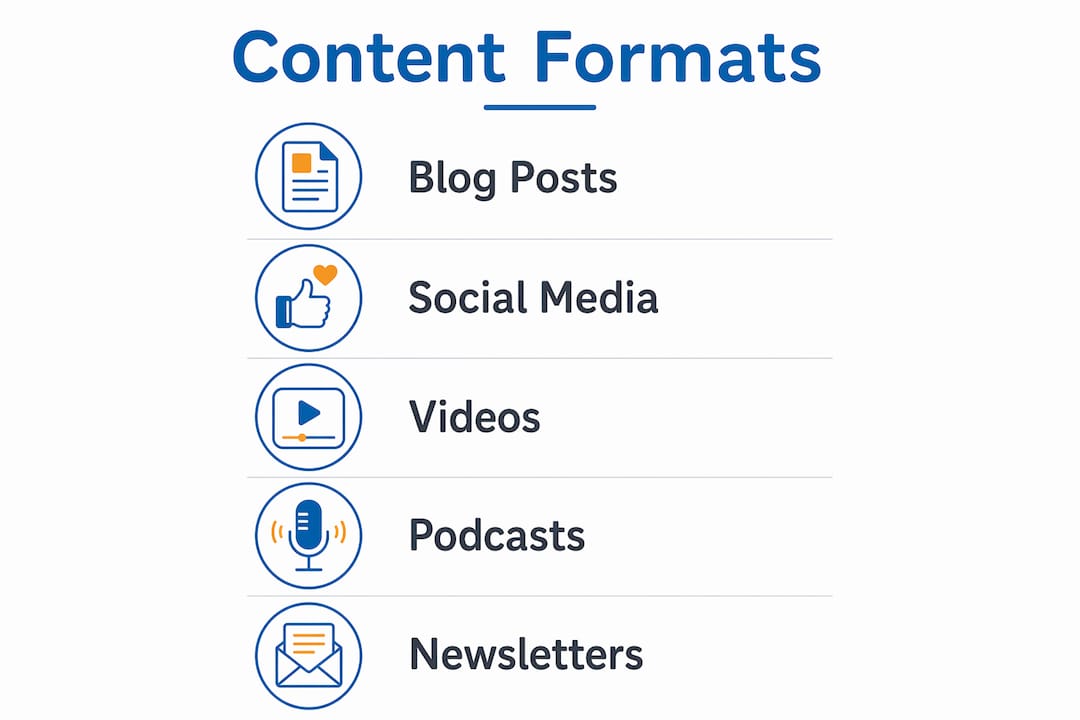
| Content Type | Primary Format | Main Objective |
|---|---|---|
| Blog post | Text | SEO and awareness |
| Social media update | Text, image, short video | Engagement and reach |
| Video (static or live) | Video | Education and trust |
| Podcast | Audio | Authority and loyalty |
| Newsletter | Nurturing and retention | |
| eBook or guide | PDF, text | Lead capture |
| Webinar | Live video | Consideration and conversion |
| Interactive tool | Calculator, quiz | Engagement and qualification |
The format you choose should match the goal you are trying to achieve. Blog posts and SEO-optimized articles drive organic search traffic. Short videos on social platforms build brand familiarity fast. Webinars and eBooks work best when a prospect already knows you and needs more detail before making a decision.
- Awareness content (blog posts, social updates, short videos) reaches cold audiences who do not yet know your brand.
- Consideration content (webinars, case studies, comparison guides) helps warm prospects evaluate your offer.
- Decision content (testimonials, demos, free trials) pushes a qualified lead toward a purchase.
Pro Tip: Repurpose one long-form piece of content into five shorter assets. A 1,500-word blog post becomes a newsletter, three social posts, a short video script, and a podcast talking point. This multiplies your output without multiplying your effort.
How does content marketing support your digital marketing strategy?
Content marketing is an inbound technique where businesses create and distribute relevant content to build trust and solve customer problems, as opposed to traditional advertising, which interrupts audiences with promotional sales pitches. This is the core difference between earning attention and buying it.
A real digital marketing strategy answers four questions: who you are targeting, where you will reach them, what assets you need at each funnel stage, and how you will measure revenue-linked outcomes. Content is the answer to the third question. Without defined assets mapped to each stage, your strategy is just a plan with no fuel.
The 3-3-3 rule offers a practical framework for focus. A digital marketing strategy should concentrate on 3 core messages, 3 primary channels, and 3 measurable outcomes. This prevents the common mistake of spreading content across every platform without depth or consistency. Most small businesses that struggle with content do so because they try to be everywhere at once.
Content also fuels every other marketing channel you use:
- SEO depends on content to rank for search terms your prospects use.
- Email marketing requires content to nurture leads between touchpoints.
- Social media needs content to generate engagement and grow reach.
- Paid advertising performs better when it leads to high-quality content rather than a generic homepage.
Pro Tip: Treat your content calendar as a business document, not a creative wish list. Assign each piece a funnel stage, a target keyword, a publish date, and a success metric before you write a single word. You can use a content calendar plan to keep your team aligned and your output consistent.
What is the difference between content, copywriting, and digital marketing channels?
Content is the “give” and copywriting is the “ask” in digital marketing. Content builds trust and educates. Copywriting aims for a specific conversion action, such as clicking a button, signing up for a trial, or making a purchase. Both are necessary. Neither replaces the other.
Here is how the three concepts relate:
- Content is a blog post that teaches your audience how to solve a problem. It builds authority and earns trust over time.
- Copywriting is the headline, call-to-action button, or landing page text that converts a reader into a lead or customer.
- Channels are the platforms and tools used to deliver both. Email, social media, search engines, and paid ads are channels, not content.
A business that only produces content without copywriting educates its audience but never converts them. A business that only uses copywriting without content has no trust foundation and pays more for every lead it generates. The most effective digital marketing programs use content to attract and nurture, then copywriting to convert.
Channels are often misunderstood as content themselves. Instagram is not content. The photo, caption, or Reel you post on Instagram is the content. This matters because your content strategy must be platform-aware without being platform-dependent. If one channel disappears or changes its algorithm, your content assets still exist and can be redistributed elsewhere.
How to create an effective content strategy for digital marketing
Building a content strategy is not complicated, but it does require discipline. Most businesses skip the planning phase and go straight to publishing. That produces random posts with no clear destination and wasted resources.
Follow these steps to build a content strategy that actually works:
-
Define your audience. Write a one-paragraph description of your ideal customer. Include their job title or role, their biggest problem, and the type of content they consume. Vague audience definitions produce vague content.
-
Set specific goals. Decide what you want content to achieve. Options include growing organic search traffic, increasing email subscribers, generating leads, or reducing sales cycle length. Each goal requires different content types and metrics.
-
Map content to the customer journey. Intentional content marketing connects with prospects at different funnel phases. Awareness content attracts strangers. Consideration content educates prospects. Decision content converts qualified leads. Every piece you create should have a clear funnel assignment.
-
Build a content calendar. Schedule content at least four weeks in advance. Assign a topic, format, channel, target keyword, and publish date to each piece. Consistency matters more than volume.
-
Measure what matters. Track metrics tied to your goals. For awareness, measure organic traffic and social reach. For lead generation, measure form completions and email sign-ups. For conversion, measure revenue attributed to content-driven leads.
-
Audit and improve. Review your content performance every 90 days. Identify which pieces drive the most traffic, leads, or conversions. Produce more of what works and cut what does not.
Mapping content to funnel stages is the single most effective way to avoid random posting. When every piece of content has a defined audience, a funnel stage, and a measurable goal, your marketing becomes a system rather than a guessing game. For practical examples of how this works in practice, the digital content creation examples resource from Goonlinenow shows how SMBs apply these principles across real campaigns.
Content is the voice, not just the vehicle
Working with SMBs across industries has shown me one pattern that holds true almost universally: businesses treat content as a task to complete rather than a voice to maintain. They hire someone to write five blog posts, publish them in a burst, and then go quiet for three months. That approach produces almost no results and leads to the conclusion that “content doesn’t work.”
Content works when it is consistent, intentional, and connected to a broader plan. Treating content as the brand voice rather than a department function changes everything. Your content is how your market hears you when you are not in the room. It is the impression a prospect forms before they ever speak to you.
The businesses I have seen grow fastest through content are not the ones with the biggest budgets. They are the ones with the clearest point of view and the discipline to publish it consistently. A real estate agent who writes one genuinely useful neighborhood guide per month will outperform a competitor who publishes ten generic posts and disappears. Depth and consistency beat volume every time.
My honest advice: stop asking “what should we post?” and start asking “what does our audience need to know at each stage of their decision?” That shift in thinking is what separates a content strategy from a content schedule.
— Go
How Goonlinenow helps you put content strategy into action
Creating great content is only half the job. Distributing it, nurturing the leads it generates, and tracking which pieces drive real revenue is where most SMBs fall short.
Goonlinenow combines marketing automation software with done-for-you content and campaign support, so your content strategy does not stall at the execution stage. The platform handles email sequences, lead nurturing, and pipeline tracking in one place, with no complex setup required. You get real human support, not a chatbot, and a team that configures your automations from day one. If you are ready to turn your content into a consistent lead generation system, Goonlinenow is built to make that happen without the overpriced subscriptions or scattered tools.
FAQ
What is content in digital marketing?
Content in digital marketing is any strategic digital media, including text, images, video, audio, and interactive tools, created to attract, educate, and convert an audience. It delivers value to the audience before requesting a purchase or commitment.
What is the difference between content and content marketing?
Content is the individual asset (a blog post, video, or podcast). Content marketing is the strategy of creating and distributing content consistently to build trust, grow an audience, and generate leads over time.
What types of content work best for small businesses?
Blog posts, short videos, email newsletters, and social media updates are the most accessible and cost-effective formats for small businesses. The best format depends on where your audience spends time and what stage of the buying journey you are targeting.
How does content support SEO?
Search engines rank individual pages, not websites. Every piece of content you publish is an opportunity to rank for a search term your prospects use. Consistent, well-structured content is the primary driver of organic search visibility.
What is the 3-3-3 rule in digital marketing strategy?
The 3-3-3 rule means focusing your strategy on 3 core messages, 3 primary channels, and 3 measurable outcomes. This framework prevents the common mistake of spreading content too thin across too many platforms without achieving meaningful results on any of them.