

TL;DR:
- A content marketing executive is responsible for the entire content marketing program, linking content output to business growth. They manage strategy, teams, budgets, and performance metrics to drive revenue and pipeline impact.
A content marketing executive is the person who owns a company’s entire content marketing program, from strategy and team management to budget control and revenue measurement. This is not a writing role. It is a leadership role that connects content output directly to business growth. The industry’s standard title for this function varies across organizations. You will see it listed as content marketing director, head of content, or content strategy manager, but the core responsibility stays the same: drive measurable pipeline and revenue through content. For SMBs, this role is especially high-stakes because every dollar spent on content must justify itself. Understanding what this position actually requires, how success gets measured, and how to build toward it gives marketing professionals and decision-makers a real advantage.
What are the primary responsibilities of a content marketing executive?
A content marketing executive owns the end-to-end strategy, team, budget, and outcomes of a company’s content marketing function. This goes far beyond publishing blog posts or managing a social calendar. The role requires setting the annual content strategy, choosing the right channel mix, and holding the entire program accountable to business results.
The day-to-day scope covers several distinct areas:
- Content strategy ownership: Setting annual goals, defining the channel mix across SEO, social, email, and sales enablement, and building editorial calendars tied to campaigns and buyer personas.
- Team management: Managing teams of writers, editors, and SEO specialists. In SMBs, this typically means overseeing 3–8 writers or freelancers and making hiring and firing decisions.
- Budget allocation: Distributing spend across content creation, distribution platforms, and technology tools. Budgets at this level often run $300,000–$600,000 annually.
- Editorial governance: Enforcing brand guidelines, maintaining narrative consistency, and building repurposing workflows so content assets work across multiple channels.
- Performance reporting: Presenting results to CMOs and executive boards using metrics tied to engagement, conversion, and revenue, not just traffic.
Companies like Disney and Klaviyo treat this role as a brand narrative protection function combined with persona-driven, sales-aligned content execution. That dual focus on brand integrity and pipeline contribution defines what separates a strong content marketing executive from a content manager who simply publishes on schedule.
Pro Tip: Build your editorial calendar in two layers: one for campaign execution and one for evergreen SEO. Campaign content drives short-term pipeline. Evergreen content compounds over time and reduces your cost per lead.

The digital content marketing manager role in an SMB often blends the responsibilities of a content and marketing manager with those of a full content strategy manager. That overlap means the person in this seat must be equally comfortable writing a creative brief and presenting a revenue attribution report.
How do content marketing executives measure success and prove ROI?
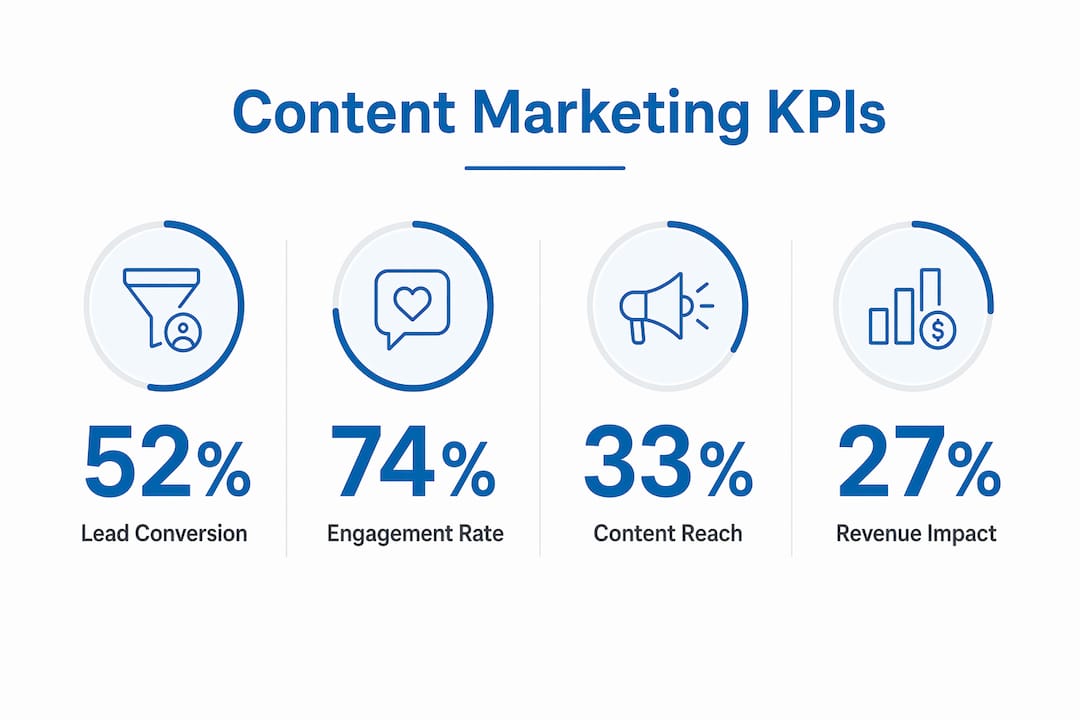
Modern content marketing leaders align all KPIs with revenue impact, AI visibility, customer experience, and operational efficiency rather than vanity metrics like raw traffic. Board-level stakeholders require pipeline attribution and sales conversion proof before they approve content budgets. This shift in expectations changes how executives must structure their reporting.
The Pipeline Impact Framework organizes content measurement across four layers:
| Layer | Metric focus | Primary audience |
|---|---|---|
| Layer 1 | Consumption: page views, time on page, downloads | Content team |
| Layer 2 | Engagement: shares, comments, email open rates | Marketing team |
| Layer 3 | Pipeline influence: leads sourced, MQLs, CPL | Demand gen, CMO |
| Layer 4 | Closed revenue: deals influenced, CAC efficiency | CFO, CEO, board |
The Pipeline Impact Framework tracks content effectiveness across all four layers, from consumption metrics to closed revenue, using multi-touch attribution. Layers 1 and 2 help the content team optimize execution. Layers 3 and 4 are what the C-suite actually cares about.
Successful executives prepare two separate dashboards. One is operational, built for the content team to track execution quality. The other is a narrative board-level report that ties content directly to revenue and operational efficiency. This separation prevents metric debates in budget meetings and keeps the conversation focused on growth.
Pro Tip: Connect your content analytics platform to your CRM. When you can show that a specific blog post or white paper influenced a closed deal, you shift from defending your budget to expanding it.
The ability to present impact-driven data is also a core interview requirement. Executive interview topics consistently cover content strategy-business alignment, pipeline attribution methods, and cross-functional leadership. Candidates who cannot explain how they measure content ROI rarely advance past the first round.
What does career progression look like for content marketing executives in SMBs?
The path from content marketer to content marketing executive is a shift in identity, not just a promotion. Most content professionals spend years getting better at writing, editing, and SEO. The executive role requires them to stop doing most of that work and start running the function that produces it.
Promotion to head of content requires shifting from producing content to running the content function, including managing people, budgets, and defending strategy quantitatively. That shift is harder than it sounds. Many strong writers resist it because they enjoy the craft. But staying too focused on writing is the most common reason talented content professionals plateau.
The career path typically follows these stages:
- Content marketing specialist: Writes, edits, and publishes content. Owns individual assets. Reports to a manager.
- Content and marketing manager: Manages a small team or group of freelancers. Starts owning channel performance and editorial calendars.
- Digital content marketing manager: Oversees multi-channel execution. Begins reporting on pipeline metrics and collaborating with demand gen and product marketing.
- Content marketing executive or head of content: Owns the full function. Manages hiring, resource allocation, and editorial governance. Defends strategy to the CMO using pipeline data.
The compensation jump is significant. Advancing to head of content increases total cash compensation by approximately $60,000–$100,000 and shifts the role focus from writing to leadership. Budget responsibility at this level typically runs $300,000–$600,000 annually.
The skills that matter most at the executive level are not creative. They are operational: hiring and managing writers, negotiating with demand gen and product marketing peers, defending budget decisions with data, and building systems that produce consistent output without constant supervision. If you want to know how to become a content marketer who reaches this level, the answer is to start managing people and metrics before you have the title.
What strategies and best practices enable effective content marketing leadership in SMBs?
Effective content marketing leadership in an SMB runs on systems, not talent alone. The most productive content executives treat editorial governance as an operations function, not a creative one. That means building processes that produce consistent, measurable output regardless of which team member is executing on any given week.
The core practices that separate high-performing content programs from average ones include:
- Campaign-linked editorial calendars: Every piece of content maps to a campaign, a persona, and a stage in the customer journey. Content created without this context rarely contributes to pipeline.
- Brand guidelines with teeth: Brand consistency policies are only useful if they are enforced. Running editorial governance as an operational system with documented standards and repurposing workflows maximizes asset usage and ROI.
- Repurposing workflows: A single long-form article can become a LinkedIn post series, an email sequence, a short video script, and a sales enablement one-pager. Building this workflow into your production process multiplies output without multiplying cost.
- AI-assisted production: AI tools now handle first drafts, content briefs, keyword clustering, and performance analysis. The role of AI in content strategy has grown from optional to expected at the executive level. Using AI to handle repeatable tasks frees your team to focus on strategy and quality control.
- Cross-functional alignment: Content executives who meet weekly with sales and demand gen teams produce content that actually gets used. Sales enablement content that sits unused in a shared drive is a budget waste, not a content win.
Pro Tip: Audit your content library every quarter. Identify your top 10 performing assets by pipeline influence, then build a repurposing plan around those specific pieces. High-performing content rarely gets the distribution it deserves.
Examples of content marketing that consistently boost brand visibility share one trait: they are built on audience research, not assumptions. Persona-driven content aligned to the full customer journey outperforms generic thought leadership every time. For SMBs with limited budgets, this focus on relevance over volume is the most efficient path to content ROI.
What I’ve learned about succeeding in this role that most articles won’t tell you
The biggest mistake I see content marketing executives make is measuring what is easy instead of what matters. Sessions, impressions, and social shares are easy to pull from a dashboard. They are also nearly useless in a budget conversation with a CFO. The executives who keep their budgets and grow their teams are the ones who can walk into a board meeting and say, “Our content influenced $X in closed revenue last quarter.”
The second trap is stakeholder neglect. Content does not operate in isolation. If your demand gen lead does not trust your content calendar, they will build their own. If your sales team does not use your enablement materials, you are producing content for no one. Building those relationships is not optional. It is part of the job description.
AI is changing the execution side of this role faster than most people expected. The content teams that use AI for drafts, briefs, and distribution planning are producing more output at lower cost. That efficiency gain is real. But AI does not replace the judgment required to connect content to revenue. That judgment is what makes a content marketing executive worth the salary.
The digital marketing executive who wins long-term is the one who builds systems, develops people, and reports on impact. Everything else is just activity.
— Go
How Goonlinenow helps content marketing executives scale their impact
Content marketing executives in SMBs face a specific challenge: they need to execute at scale without enterprise-level resources. Goonlinenow’s marketing automation software for SMBs gives marketing leaders the tools to automate lead nurturing, track content-driven pipeline, and connect email and SMS campaigns directly to CRM data.

When your content program runs on a platform that connects execution to measurement, you stop guessing about ROI and start proving it. Goonlinenow combines marketing automation, CRM, and done-for-you setup in one affordable system. Marketing leaders who want to tie content directly to revenue without adding headcount or complexity can explore the full platform at Goonlinenow.
FAQ
What does a content marketing executive do?
A content marketing executive owns the full content marketing function, including strategy, team management, budget, and performance measurement. The role focuses on connecting content output directly to pipeline and revenue, not just traffic or engagement.
How is a content marketing executive different from a content marketing specialist?
A content marketing specialist creates and publishes individual content assets. A content marketing executive manages the team, sets the strategy, controls the budget, and reports results to senior leadership using revenue-linked metrics.
What skills are most important for a content marketing executive?
The most critical skills are team leadership, budget management, multi-touch attribution reporting, and cross-functional collaboration with sales and demand gen teams. Writing ability matters less at this level than operational and analytical judgment.
How do content marketing executives prove ROI to the C-suite?
Effective executives prepare two dashboards: one operational report for the content team and one board-level narrative that ties content directly to closed revenue and cost-per-lead efficiency. Connecting content analytics to CRM data is the most direct path to credible ROI reporting.
What is a realistic salary range for a head of content or content marketing executive?
Advancing to head of content increases total cash compensation by approximately $60,000–$100,000 compared to a senior content marketer role. Budget responsibility at this level typically runs $300,000–$600,000 annually.