

TL;DR:
- Most SMB content workflows lack structure, leading to wasted time, reduced quality, and missed opportunities. Implementing a simple, ownership-based process helps teams produce consistent content efficiently and measure effectiveness effectively. AI tools can boost productivity when integrated with proper governance and human oversight.
Most content creators in small businesses know the feeling well. You have ideas, you have channels, and you have goals. What you often lack is a repeatable system that turns all three into consistent output without the chaos. A broken content creation workflow costs you more than just time. It costs you quality, team morale, and opportunities you never got to publish. This guide walks you through exactly how to build, automate, and refine a workflow that works for a lean team, with real frameworks, AI integration tips, and the metrics that actually tell you whether it’s working.
What a content creation workflow really means for SMBs
A content creation workflow is not the same as a content strategy. Your strategy answers what to create and why. Your workflow answers how it gets done, who does each part, and when it moves to the next stage. Without that distinction, even the best strategy stalls at execution.
For SMBs, a practical workflow covers six core components:
- Ideation: Generating and filtering content ideas tied to business goals
- Planning: Assigning topics to a calendar with deadlines and formats
- Production: Writing, designing, recording, or building the actual content
- Review: Editing, approving, and quality-checking before it goes live
- Distribution: Publishing across the right channels at the right times
- Measurement: Tracking performance and feeding insights back into the process
The SMB context adds its own constraints. You are likely working with a small team, limited budget, and no dedicated content operations manager. That means your workflow has to be lean and scalable from day one. Think of it the way content science researchers describe it: content strategy functions like an operating system that governs creation, quality, and scalability. Your workflow is the code that makes that system run.
Pro Tip: Start with a one-page workflow map before building anything in a tool. Draw the six stages as boxes, add who owns each one, and identify where handoffs happen. That visual alone will reveal your biggest bottleneck.

Building your workflow step by step
A solid content production process does not require expensive software or a large team. It requires sequence and ownership. Here is a framework built for SMBs that you can implement in a single week.
-
Run a content audit first. Before creating anything new, catalog what you already have. Skipping audits is the most common cause of content strategy failure in the first year. Identify what is performing, what needs updating, and what should be retired.
-
Hold a monthly planning session. Block two to three hours once a month to map content to your customer journey. Monthly planning sessions help SMBs define a 30 to 60 day calendar and reduce the risk of falling behind. Come out of each session with topics, formats, assigned owners, and due dates.
-
Create a content brief for every piece. A brief is a one-page document that includes the target keyword, audience, goal, outline, and tone. It eliminates back-and-forth between writers and approvers. A brief written in 15 minutes saves an hour of revision later.
-
Draft with a defined scope. Set word count targets and outline requirements before writing begins. This keeps drafts on track and makes editing faster. For efficient content production, clear ownership and task breakdown reduce bottlenecks at every stage.
-
Edit in structured passes. Do not read a draft once and call it done. Run separate passes for structure, argument clarity, grammar, and SEO. This is where most teams cut corners, and where most quality problems originate.
-
Optimize before publishing. This means checking title tags, meta descriptions, internal links, image alt text, and keyword placement. Build a checklist so nothing gets skipped under deadline pressure.
-
Schedule distribution across channels. Do not publish manually every time. Set up a publishing calendar that includes not just your blog but also email, social, and any repurposing formats.
-
Assign a governance reviewer. Someone on the team should own the final quality check. This is not the same person who wrote the piece. Fresh eyes catch what familiarity misses.
Pro Tip: Batch similar tasks together. Write three drafts in one session instead of one per day. Review all briefs in a single block. Batching cuts context-switching costs and typically saves two to four hours per week for a solo content creator.
Using AI to optimize content workflows
AI tools have moved from experimental to practical in most SMB content teams. Used correctly, they accelerate your workflow without replacing the human judgment that keeps your brand credible.
The biggest immediate win is content repurposing. AI-driven repurposing workflows can cut what used to take a full day down to about 40 minutes, with AI handling the first adaptation in two to three minutes and a human reviewer spending five to ten minutes polishing the output. That is a real productivity shift, not a marginal gain.
Where AI causes problems is when teams treat its output as final. AI exposes weaknesses in governance and internal standards. Without clear brand voice guidelines and quality rules, AI-generated content magnifies inconsistencies rather than hiding them. The fix is a human-in-the-loop editing pass.
A practical three-phase editing pipeline works like this:
- Phase 1, structural audit: Check whether the draft has a strong hook, logical flow, and a clear conclusion before touching the prose.
- Phase 2, live editing loop: Revise line by line for clarity, tone, and argument density.
- Phase 3, scoring pass: Rate the piece across defined criteria such as hook strength, argument quality, and closing power. Human scoring passes prevent the blind spots that come from emotional attachment to your own drafts.
Another high-impact practice is building a modular prompt library. Standardized AI prompts structured around Role, Context, and Constraints keep brand voice consistent across every piece of AI-assisted content without manual corrections every time. Version these prompts the same way you would version a style guide.
You can also reduce research time significantly. AI-powered tools that cut research time by up to 60% free up your team to focus on the analysis and positioning that actually differentiates your content.
Measuring and refining your workflow
You cannot improve what you do not measure. Most SMB content teams track publishing frequency and social shares, then wonder why the effort is not producing leads. The metrics that matter connect workflow efficiency to business outcomes.
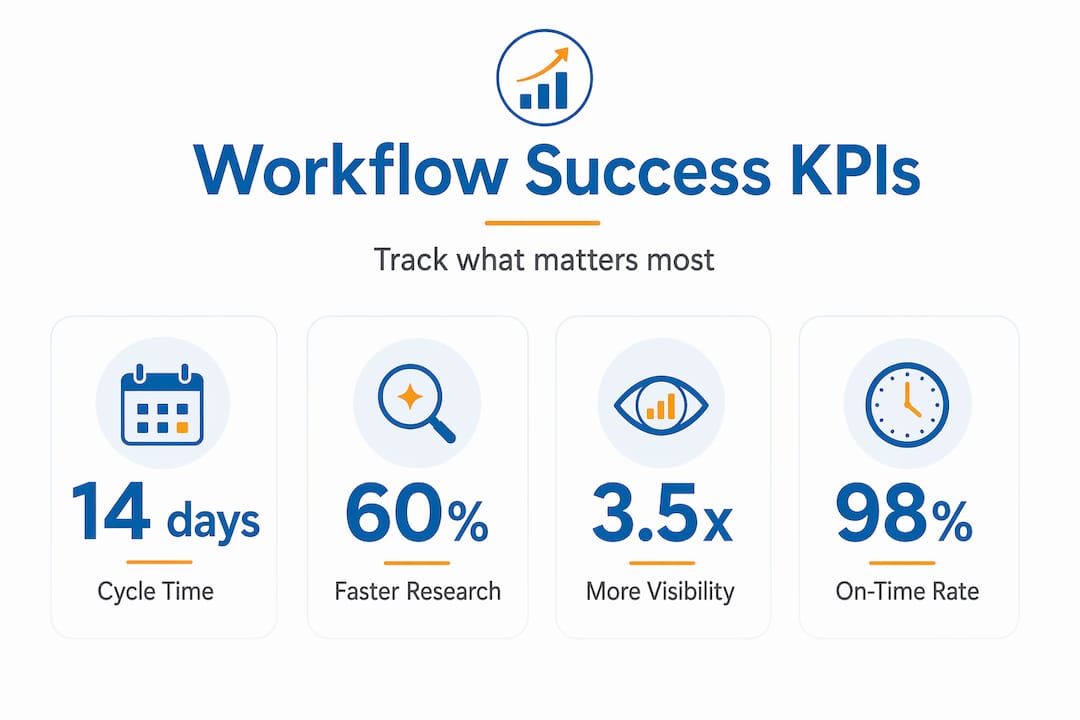
| KPI | What it measures | Why it matters |
|---|---|---|
| Content production cycle time | Days from brief to publish | Reveals bottlenecks in your workflow stages |
| Revision rate | Edits per piece before approval | High rates signal weak briefs or unclear ownership |
| Organic traffic per piece | Sessions driven by each asset | Connects content quality to SEO performance |
| AI search visibility | Mentions in AI-generated answers | Critical for reach in 2026 content strategy |
| Lead conversion rate | Contacts generated per content piece | Ties content directly to business growth |
The visibility metric deserves special attention. Modern content strategy now requires auditing both traditional Google search and AI search engines like ChatGPT, because these platforms evaluate expertise differently. Content that ranks on Google but never surfaces in AI-generated answers is leaving a growing portion of your audience unreached.
Review your workflow metrics monthly, not quarterly. A monthly cadence lets you spot problems before they compound into a quarter of wasted output. Pair your metrics review with a short retrospective. Ask what slowed production this month, what performed better than expected, and what one change would have the most impact. That question, asked consistently, is how good workflows become great ones. Building an effective digital content strategy means treating measurement as part of the process, not an afterthought.
Common workflow pitfalls to avoid
Even well-designed workflows break down when teams cut corners or skip steps under pressure. These are the five failure points that show up most often.
- Skipping the content audit. Teams that launch into production without reviewing existing assets often duplicate effort or miss opportunities to update high-performing content that just needs a refresh.
- Over-relying on AI without governance. Content audits are foundational for successful AI integration. Without regular governance checks, AI hallucinations and outdated information creep into your content and damage authority.
- Unclear role definition. When two people think they own the same task, it either gets done twice or not at all. Every stage of your workflow needs a single named owner, not a team.
- Ignoring repurposing. Publishing a blog post and moving on wastes most of its value. A single well-researched article can become a LinkedIn post, an email newsletter section, a short video script, and a social graphic. Build repurposing into the workflow, not as an afterthought.
- Collecting data but not acting on it. Analytics without a feedback loop is just noise. Effective measurement must connect to workflow decisions, meaning your metrics review should result in a specific change to the next production cycle.
Pro Tip: Create a simple one-page “workflow health check” and run it at your monthly planning session. Rate each stage from one to five on clarity, speed, and quality. Any stage scoring below three gets one targeted fix before the next cycle.
My take on content workflows after years in SMB marketing
I have worked with dozens of small and mid-sized businesses on their content operations, and the pattern I see most often is not a lack of ideas. It is a lack of structure around the ideas they already have. Teams sit on great concepts for weeks because no one knows who is supposed to move it forward next.
The moment a business installs a real workflow, something shifts. Writers stop waiting for direction. Approvers stop getting surprised by drafts. Publishing becomes predictable. And creative burnout drops because people are no longer grinding through the same uncertainty every week.
On AI integration, my honest view is that most teams adopt it too fast and too broadly before they have the governance in place. AI drafts need structured human critique to prevent generic output. I have seen the role of AI in content strategy work beautifully when the human editing layer is non-negotiable, and I have seen it quietly erode a brand’s voice when teams skip that step to save twenty minutes.
The lean content teams I respect most treat their workflow like a living document. They run it, measure it, fix one thing, and run it again. They do not wait for a perfect system before starting. They build the system while producing content, and they get better every month.
If you are just starting out, do not let complexity be the obstacle. A workflow scrawled on a whiteboard is more useful than a sophisticated tool no one uses. Start simple. Add structure as your team grows. That is the real content creation guide that actually works in practice.
— Go
How Goonlinenow helps you run a better content workflow
Building a structured content workflow is much easier when your tools work together instead of pulling your team in different directions.

Goonlinenow is built specifically for SMBs that want to manage content planning, distribution, and lead nurturing without juggling five separate platforms. The platform brings together email automation, CRM, and content scheduling in one place, so the workflow you build actually gets executed consistently. If you are ready to connect your content efforts to real business results, SMB marketing automation from Goonlinenow gives you the infrastructure to do it without enterprise pricing or a six-month setup. You can also explore the creative content production service to get done-for-you support at every stage of your workflow.
FAQ
What is a content creation workflow?
A content creation workflow is a repeatable process that takes content from idea to publication through defined stages including ideation, briefing, drafting, editing, and distribution, with clear ownership at each step.
How many steps should a content workflow have?
Most effective SMB workflows cover six to eight steps. The key is not the number of steps but whether each one has a clear owner, defined output, and a handoff point to the next stage.
How does AI fit into a content creation workflow?
AI works best at specific stages such as research, first drafts, and repurposing, but always needs a human editing and scoring pass to maintain quality and brand consistency.
Why do content workflows fail in small businesses?
The most common causes are skipping content audits, unclear role ownership, and failing to act on performance data. Workflows that lack a monthly review cycle tend to drift back into ad hoc production within two to three months.
What metrics should I track to measure workflow performance?
Track production cycle time, revision rate, organic traffic per piece, and lead conversion rate. In 2026, also monitor AI search visibility to capture the growing share of queries answered by AI platforms.