

TL;DR:
- Most SMBs mistakenly believe a strong digital content strategy requires a large team or budget, leading to reactive and inconsistent efforts. A focused, intentional plan aligning content with clear goals, audience personas, and distribution habits is essential for measurable growth. Implementing a simplified, step-by-step framework and using smart resource allocation helps small businesses maximize impact and drive revenue.
Most small and mid-sized business owners assume a strong digital content strategy requires a large marketing team, a generous budget, or a fancy agency on retainer. That belief keeps many SMBs stuck in reactive mode, posting sporadically and hoping something sticks. The truth is that content marketing for small businesses works best when it is focused and intentional rather than high-volume. This article walks you through a clear, proven framework with a real-world example you can adapt, practical budgeting guidance, and measurement tips that connect directly to business growth.
Key Takeaways
| Point | Details |
|---|---|
| Strategy over volume | Focusing your content efforts with a clear strategy beats random high-volume posting every time. |
| Frameworks drive results | Using a proven, step-by-step framework helps SMBs align their goals, resources, and channels for measurable success. |
| Budget smartly | Allocating budget across planning, creation, and distribution maximizes your return, even with limited resources. |
| Repurpose content | Reusing high-performing content across channels saves money and boosts engagement and reach. |
| Measure what matters | Track conversions, engagement, and pipeline results—not just output—to continuously optimize your strategy. |
What is a digital content strategy and why does it matter?
A digital content strategy is not just a list of topics to write about. It is a deliberate plan that covers your purpose, your audience, the types of content you create, where and when you publish, and how you measure results. HubSpot defines content strategy as the planning, creation, publication, management, and governance of content, structured around a step-by-step framework that ties every action to a business goal.
For SMBs, this definition carries extra weight. Unlike large enterprises with dedicated content teams, small businesses need every piece of content to do real work. Without a strategy, you end up with random blog posts, inconsistent social media activity, and no clear way to know what is actually driving leads or sales. That wastes time and money, two things small businesses can rarely afford to lose.
A strong strategy gives you:
- Clear goals tied to business outcomes like lead generation, brand awareness, or customer retention
- Defined personas so every piece of content speaks directly to your ideal customer
- A content audit process to identify gaps and opportunities in what you already have
- Selected content types matched to where your audience actually spends time
- A system to analyze what is working and what needs to change
“The businesses winning at content are not the ones producing the most. They are the ones who filter ruthlessly, focusing on what genuinely serves their audience and moves their business forward.”
Skipping this structure leads to common pitfalls: publishing without purpose, chasing trends instead of building authority, and measuring the wrong things. A documented strategy changes all of that.
Core steps: A proven digital content strategy framework
Knowing what a strategy is and actually building one are two different things. Let’s walk through the execution sequence that works consistently for SMBs.
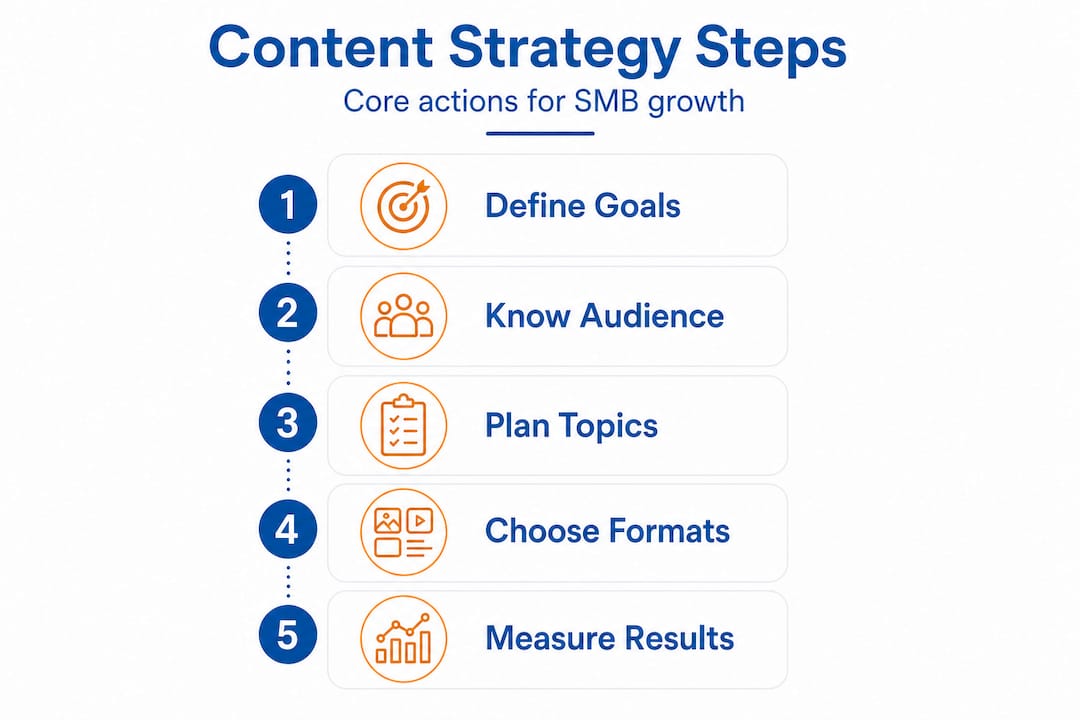
HubSpot’s step-by-step framework outlines the following stages: define your goal, conduct persona research, run a content audit, choose your content management system (CMS), determine your content types, brainstorm ideas, publish, and analyze. That sequence is not arbitrary. Each step builds on the last, reducing guesswork and wasted effort.
Here is how to apply it:
- Define a single primary goal. Do you want more website traffic, more leads, or more paying customers? Pick one for your first quarter.
- Build a simple customer persona. Identify your ideal buyer’s role, challenges, and preferred content formats. One solid persona beats five vague ones.
- Audit what you already have. Review existing blog posts, social content, and emails. Identify what performed well and what you can refresh or repurpose.
- Choose your CMS and tools. Pick a platform that your team can actually use consistently, without a steep learning curve.
- Select two or three content types. Blog posts, short videos, and email newsletters are strong starting points for most SMBs.
- Build a content calendar. Map out topics, formats, channels, and publishing dates for the next 90 days.
- Publish and distribute. Create the content, then actively distribute it across chosen channels rather than waiting for people to find it.
- Analyze and adjust. Review results every 30 days and make one or two targeted improvements.
Semrush’s guide for small businesses reinforces that documenting your strategy and selecting priority formats are the two most impactful decisions you can make early on. Written strategies are not bureaucratic exercises. They are accountability tools.
Here is a simple comparison that shows the difference between ad hoc posting and a disciplined approach:
| Factor | Ad hoc publishing | Disciplined strategy |
|---|---|---|
| Content direction | Random topics | Goal-aligned topics |
| Consistency | Irregular | Planned calendar |
| Audience targeting | General | Persona-driven |
| ROI tracking | Rare or none | Monthly review |
| Resource use | Reactive and wasteful | Planned and efficient |
| Long-term results | Low and unpredictable | Compounding over time |
You can explore a detailed SMB content strategy guide or a guide to content marketing management to deepen your planning before you start.
Pro Tip: Do not try to master every format at once. Pick the one or two types that best match your audience’s habits and your team’s strengths. Consistency in fewer formats outperforms sporadic effort across many.
Budgeting and resource allocation for digital content success
Once you have a framework, the next logical question for SMBs is how much to budget and how to maximize that investment. The good news is that content marketing budgets for SMBs vary widely based on business size, but most small businesses invest between $1,000 and $10,000 per month across all content activities. The most common monthly spend range falls between $5,001 and $10,000 for companies with 10 or more employees.
HubSpot’s marketing budget guidance recommends allocating your budget across four core activities: strategy and planning, content creation and production, distribution and amplification, and performance optimization. Here is a practical allocation model for a mid-range SMB budget:
| Budget category | Recommended allocation | Example (at $3,000/month) |
|---|---|---|
| Strategy and planning | 15% | $450 |
| Content creation | 50% | $1,500 |
| Distribution and promotion | 25% | $750 |
| Analysis and optimization | 10% | $300 |
Most SMBs make the mistake of putting almost everything into creation and nothing into distribution. That is like printing flyers and never handing them out.
Here are creative ways to stretch your content budget without cutting corners:
- Repurpose before you create. Turn one strong blog post into a social media series, an email newsletter, and a short video script.
- Use templates. Canva, email tools, and content calendars with pre-built structures save significant design and planning time.
- Leverage user-generated content. Customer testimonials, reviews, and case studies cost very little to collect and perform extremely well.
- Batch your production. Dedicate one day per week to creating multiple pieces at once rather than starting from scratch each time.
- Hire selectively. Freelancers for specific tasks like copywriting or design can be more cost-effective content marketing solutions than full-time hires.
Explore affordable content marketing strategies for more specific tactics that work at different budget levels.
A practical digital content strategy example for SMBs
To move from concepts to actual growth, let’s see how this plays out in a real SMB model. A concrete, quarterly content engine is one of the most effective approaches available to small businesses with limited resources.

According to a content engine case study for SMBs, the most practical structure combines a gated asset (something valuable enough that visitors exchange their email address for it), an ungated preview (a free sample like a blog post or video), multi-channel repurposing, and a lead capture system tied to the most valuable piece.
Here is how a typical quarterly plan looks in practice:
- Create one gated asset. This could be a practical guide, checklist, or short video course. It serves as your primary lead magnet for the quarter.
- Write four blog posts that preview or support the gated asset. Each post targets a relevant search term and ends with a call to action linking to the gated download.
- Publish 20 to 30 social posts across LinkedIn and one other platform, repurposed from your blog content. Mix short tips, questions, and visuals.
- Send four email newsletters to your existing list featuring highlights from the blog posts and a repeated push to the gated asset.
- Host or publish one webinar or live Q&A session connected to the asset’s topic. This drives direct engagement and positions you as an authority.
Content benchmarks show that the median company produces 11 to 20 blog posts, 51 to 100 social posts, and 3 to 5 webinars per quarter. You do not need to match those numbers right away. Starting with a smaller, more intentional output and scaling from there is a smarter path.
Pro Tip: Once your gated asset gains traction, extract quotes, statistics, and key sections from it. Use those pieces across your social channels, in email subject lines, and as pull quotes in your blog posts. One strong asset can fuel three to four weeks of content with minimal extra effort.
Quick wins for boosting engagement and lead conversion on a limited budget:
- Add a clear call to action at the end of every blog post and email
- Use specific, benefit-driven headlines instead of generic ones
- Include one or two visuals per blog post to improve time-on-page
- Test two subject lines for each email campaign using an A/B split
- Respond to every comment on social posts within 24 hours to boost algorithmic reach
Review step-by-step content marketing guides and a digital media strategy example to see how this framework adapts across different industries.
Measuring and optimizing your content strategy’s impact
Every strong strategy needs accountability. Creating content without measuring its results is the same as running a campaign with no budget tracking. You have no way of knowing what to double down on and what to stop.
Research shows that 75% of content teams track engagement metrics, 67% track brand awareness, 59% track conversions, and 54% track pipeline influence. That last number matters most for SMBs: does your content actually bring in qualified leads and contribute to revenue?
The metrics every SMB content strategy should track include:
- Organic traffic to blog posts and landing pages (signals SEO performance)
- Email open rates and click-through rates (reveals whether your messaging connects)
- Conversion rate on gated assets (shows how well your lead magnets perform)
- Social engagement rate (likes, shares, and comments as a percentage of reach)
- Pipeline influence (how many deals touched a piece of content before closing)
- Content-attributed leads per month (the clearest indicator of ROI)
“Value is not found in how much content you produce. It lives in how your audience interacts with it and whether it builds a real relationship with your community.”
— Inspired by insights from Refinery29’s content approach
Use these numbers to guide your 30-day reviews. If a particular blog post drives high traffic but low conversions, improve the call to action. If one email topic consistently outperforms others, build a whole campaign around that theme. Build a clear digital marketing strategy for SMBs to connect your content results to broader business goals.
What most SMBs miss about content strategy and what actually drives results
Here is an uncomfortable truth. Most SMBs that struggle with content are not struggling because they produce too little. They are struggling because they distribute too little, repurpose almost nothing, and measure things that do not connect to revenue.
The instinct to create more, to post more frequently and on more platforms, is understandable. But it is often the wrong lever to pull. The insight behind zero-click content trends is revealing: the businesses gaining the most ground are the ones investing in propensity, meaning the likelihood that a specific audience segment will take a specific action, rather than just chasing volume.
What actually moves the needle for SMBs is a combination of three things: a focused topic cluster (three to five core subjects you own rather than broad topics you occasionally touch), a distribution habit (actively sharing content in places where your audience already hangs out), and a repurposing system (turning each asset into multiple formats before moving on to something new).
Pro Tip: The highest-performing content teams spend roughly equal time on ideation, distribution, and reuse. If your team spends 80% of its time on creation and almost nothing on the other two stages, you are leaving most of your investment on the table.
Explore online marketing strategy examples that show how focused businesses outperform larger competitors through smarter planning rather than bigger budgets.
Smarter tools and next steps for your digital content strategy
Armed with clarity and a real-world playbook, here is how you can take your strategy further with the right tools and tailored guidance.
Building and executing a digital content strategy takes more than good intentions. It takes consistent workflows, automated follow-up, and a system that keeps your leads from falling through the cracks after they engage with your content.
At Go Online Now-Connect, we combine a marketing automation guide for SMBs with a fully integrated CRM for SMBs so your content strategy connects directly to your lead pipeline. From automated email sequences triggered by content downloads to a unified inbox that captures every inquiry, our platform removes the friction between content and conversion. Our digital marketing services overview shows exactly how our skilled team helps SMBs execute strategy without the overhead of a full agency. Done-for-you setup included, no contracts required.
Frequently asked questions
What’s the difference between a digital content strategy and just planning blog posts?
A digital content strategy covers your purpose, target audience, formats, workflows, budgets, and how you measure success, not just the topics or posting schedule. HubSpot defines it as the planning, creation, publication, management, and governance of content.
How much should a small business budget for digital content strategy?
Benchmarks show most SMBs invest from $1,000 to $10,000 monthly depending on size, with funds spread across planning, creation, distribution, and optimization. Averi’s cost benchmarks and HubSpot’s budget allocation guidance both point to that range as a healthy starting point.
What channels should be prioritized in a digital content strategy for SMBs?
Start with one or two primary channels like a blog and LinkedIn, then gradually scale as you track what works for your audience. Semrush’s small business guide emphasizes being selective and repurposing what already works before expanding to new channels.
How can an SMB repurpose content effectively under budget constraints?
Repurposing means adapting key assets into multiple formats and distributing them across several channels, extending reach without extra creation costs. Design your strategy around repurposing and channel distribution rather than constantly creating from scratch.
What metrics matter most for evaluating digital content strategy success?
SMBs should measure both engagement metrics and direct conversion or pipeline influence, not just content output volume. Research confirms that 75% of teams track engagement, 67% track brand awareness, 59% track conversions, and 54% track pipeline influence.