

TL;DR:
- A digital content marketing manager handles strategy, SEO, analytics, AI optimization, and cross-team collaboration.
- Building systems and workflows is essential for sustainable, scalable content marketing success.
- Measuring meaningful metrics like organic traffic and revenue proves content strategy effectiveness.
Most business owners assume content marketing is simply about publishing blogs or posting on social media a few times a week. In reality, a skilled digital content marketing manager orchestrates a far more strategic operation, one that ties together SEO, editorial planning, cross-functional teamwork, performance analytics, and increasingly, AI-powered optimization. This guide breaks down exactly what that role demands, which tools and frameworks make it work, and how you can apply these strategies to drive real, measurable growth for your business.
Key Takeaways
| Point | Details |
|---|---|
| Role clarity | A digital content marketing manager leads strategy, planning, and execution across digital channels. |
| Tool mastery | Success relies on knowing the right analytics, automation, and editorial tools for each task. |
| Workflow systems | Structured workflows improve consistency and accelerate content output. |
| Insightful measurement | Tracking meaningful KPIs—like revenue, engagement, and conversions—proves real content value. |
| Preparedness | Anticipating and addressing digital hazards protects growth and ensures content ROI. |
What does a digital content marketing manager really do?
The title sounds straightforward, but the scope is anything but. A digital content marketing manager develops and executes content strategies, manages SEO, content calendars, AI/LLM optimization, digital PR, and cross-functional collaboration to drive organic traffic, engagement, and revenue. That is a wide mandate that requires both creative thinking and analytical discipline.
This role is fundamentally different from a traditional content manager or a social media coordinator. Where a traditional content manager might focus on writing and editing, the digital content marketing manager is accountable for the entire content ecosystem, from ideation and production to distribution, performance tracking, and iteration.
Here is a quick comparison to make that distinction clear:
| Responsibility | Traditional content manager | Digital content marketing manager |
|---|---|---|
| Primary focus | Writing and editing | Strategy, SEO, and revenue impact |
| SEO involvement | Minimal | Core to every decision |
| Analytics | Basic traffic review | Deep KPI analysis and reporting |
| AI/LLM integration | Rarely involved | Active optimization for AI search |
| Cross-team collaboration | Limited | Central to daily workflow |
| Digital PR | Not typical | Manages agency relationships |
| Editorial calendar | Single channel | Multi-channel: blog, email, social, PR |
Cross-functional collaboration is where this role truly multiplies its impact. When content strategy aligns with sales, product, and customer success teams, the resulting content answers real buyer questions, shortens sales cycles, and builds brand authority. A good content strategy for SMBs is never built in isolation.
Daily, weekly, and monthly duties at a glance:
- Daily: Review content performance dashboards, respond to editorial feedback, coordinate with writers and designers, monitor trending topics and algorithm updates
- Weekly: Update editorial calendar, review SEO rankings, audit content pipeline, sync with PR agency or partners, check email and social campaign performance
- Monthly: Produce stakeholder reports, conduct content audits, adjust strategy based on KPI trends, plan next quarter’s content themes, evaluate tool performance
Core skills and must-know tools for effective content marketing management
Understanding what the job entails leads naturally to the next question: what does it actually take, in terms of skills and technology, to excel in this role? The answer is a blend of analytical thinking, editorial judgment, and smart use of software.

The responsibilities include SEO strategy execution, blog management, LLM content optimization, and digital PR agency management. Each of these demands a distinct skill set, and the best managers develop fluency across all of them.
Core skills every content marketing manager needs:
- SEO and keyword research: Understanding search intent and how to structure content for both human readers and search engines
- Analytics and data interpretation: Reading traffic, engagement, and conversion data to make informed decisions
- Editorial planning: Developing content themes, managing contributors, and maintaining consistent brand voice
- AI and LLM optimization: Structuring content so it surfaces in AI-generated search results, not just traditional search
- Digital PR: Building relationships with publishers, managing outreach campaigns, and securing earned media
- Automation and workflow management: Using tools to reduce manual tasks and keep production on schedule
- Cross-team communication: Translating content strategy into clear briefs for designers, developers, and sales teams
The role of AI in digital marketing has expanded rapidly, and content managers who ignore it are already falling behind. Optimizing content for large language models, meaning structuring answers clearly, using schema markup, and building topical authority, is now a core competency, not an optional extra.
Here is a practical tool stack mapped to key tasks:
| Content task | Recommended tool category | Examples |
|---|---|---|
| SEO research and tracking | SEO platform | Ahrefs, Semrush, Google Search Console |
| Content creation and editing | AI-assisted editor | Surfer SEO, Clearscope, Jasper |
| Editorial calendar management | Project management | Notion, Asana, Trello |
| Email marketing | Automation platform | Go Online Now-Connect, Mailchimp |
| Social scheduling | Social media tool | Buffer, Hootsuite, Later |
| Analytics and reporting | Analytics platform | Google Analytics 4, Databox |
| CMS and publishing | Content management | WordPress, Webflow |
Building your own content tech stack does not need to be complicated. Follow a simple process: start with your core CMS and analytics, add an SEO tool, then layer in scheduling and automation. Use your digital marketing checklist to confirm you are not missing critical functions. A solid SEO strategy for SMB growth depends on having the right tools in place from day one.
Pro Tip: Audit your tech stack every quarter. Tool bloat is a real problem. If a platform is not actively saving you time or improving output quality, cut it. Fewer, better-integrated tools always outperform a sprawling collection of disconnected subscriptions.
Workflow frameworks for content planning and execution
Once you have assembled the right skills and tools, the next challenge is building workflows that bring order, visibility, and speed to your marketing efforts. Without a clear process, even talented teams produce inconsistent output and miss deadlines.
A digital content marketing manager develops and executes content strategies, manages SEO, content calendars, LLM optimization, and drives cross-functional collaboration. All of that requires a repeatable system, not improvisation.
A practical content creation workflow from idea to publication:
- Idea generation: Gather topic ideas from keyword research, sales team feedback, customer questions, and competitor gap analysis
- Content brief: Write a detailed brief including target keyword, audience, angle, word count, internal links, and CTA
- Assignment: Assign to writer or AI-assisted creator with a clear deadline
- First draft review: Check for accuracy, brand voice, SEO alignment, and completeness
- Editing and optimization: Refine for readability, add supporting data, optimize headers and meta description
- Design and media: Add visuals, infographics, or video embeds as needed
- Approval: Route through stakeholder or legal review if required
- Publishing: Schedule via CMS, confirm technical SEO elements are in place
- Distribution: Share via email, social, and PR channels according to the promotion plan
- Performance review: Check metrics at 7, 30, and 90 days post-publication and update content as needed
For quarterly planning, map your content themes to business goals. If Q3 is focused on lead generation, your blog, email, and social content should all support that objective with consistent messaging. A well-built complete content strategy guide will help you align these themes across every channel.
Dashboards for marketing analytics are essential for keeping cross-functional teams aligned. When everyone can see the same real-time KPIs, approval cycles shorten and decisions become faster.
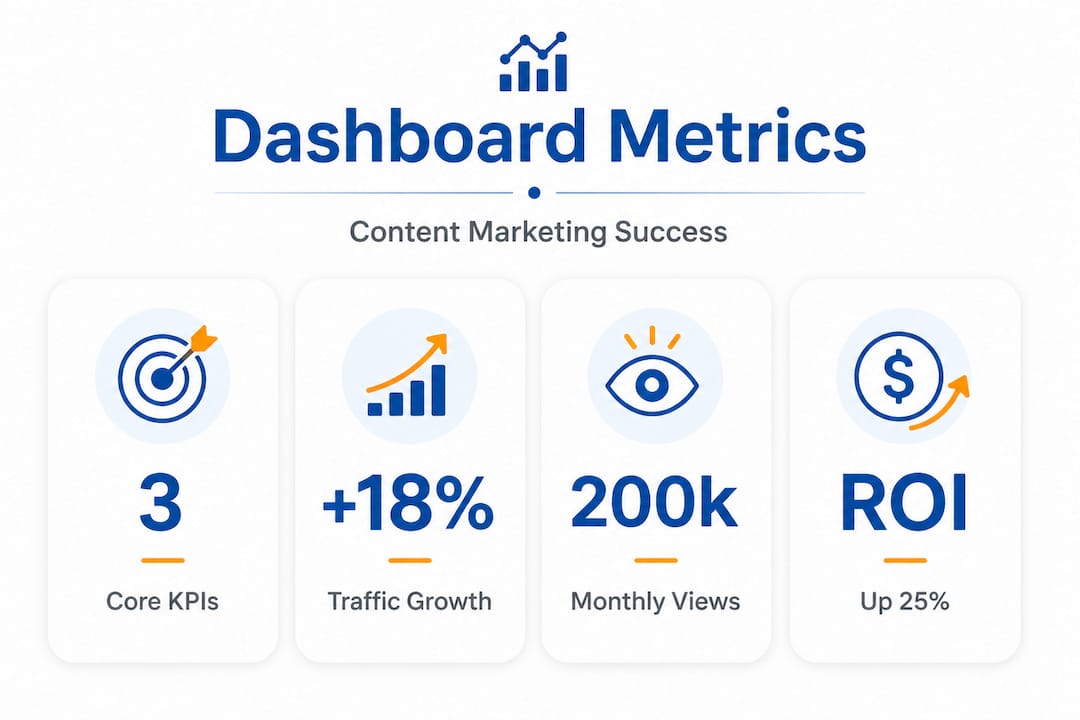
Pro Tip: Build a shared dashboard that shows content pipeline status, live traffic data, and campaign performance side by side. When your writer, designer, and sales lead can all see the same numbers, you eliminate the “what’s the status?” back-and-forth that kills productivity.
Metrics that matter: How to measure content marketing success
With a workflow in place, the final piece is ensuring you are capturing meaningful results and proving the value of your content investment. Too many teams celebrate page views while ignoring the metrics that actually connect content to business outcomes.
Organic traffic, engagement, and revenue are the outcomes driven by effective content marketing management. But not all traffic is equal, and not all engagement signals growth.
“Vanity metrics tell you what happened. Actionable metrics tell you what to do next. The difference between the two is whether the data changes a decision.”
Top content marketing metrics and what they actually indicate:
- Organic traffic: Volume and quality of visitors arriving via search, a direct signal of SEO health
- Keyword rankings: Position tracking for target terms, showing visibility trends over time
- Engagement rate: Time on page, scroll depth, and return visits indicate content relevance
- Conversion rate: Percentage of readers who take a desired action, such as signing up or requesting a demo
- Assisted revenue: Revenue influenced by content at any point in the buyer journey, not just the last click
- Backlinks earned: A measure of content authority and digital PR effectiveness
- Email open and click rates: Signals of list health and content resonance with your audience
Revenue increase is a direct, measurable result of content-driven strategies when you track the full customer journey, not just first-touch attribution. Understanding content marketing metrics in depth helps you build reports that stakeholders actually care about.
When reporting to leadership or clients, focus on three to five metrics tied directly to business goals. Avoid presenting a wall of numbers. Instead, show trend lines, highlight wins, and explain what you are adjusting based on the data. Tracking marketing effectiveness this way builds credibility and trust. Pairing this with SEO trends and growth data gives your reports additional context and forward-looking insight.
Navigating digital challenges: SEO, platform migrations, and AI disruption
With your content engine running smoothly and KPIs tracked, it is just as important to anticipate and expertly handle unexpected disruptions and evolving digital risks. The content landscape shifts constantly, and the managers who thrive are the ones who build resilience into their systems.
Platform migrations require SEO protection, including careful URL mapping and redirects, to maintain traffic and revenue. This is one of the most overlooked risks in digital marketing, and the consequences of getting it wrong can take months to recover from.
Common digital hazards every content marketing manager must prepare for:
- Algorithm updates: Google’s core updates can shift rankings overnight. Diversify traffic sources and focus on content quality rather than short-term optimization tricks
- Platform migrations: Moving to a new CMS or domain without a proper redirect strategy can destroy years of SEO equity
- AI-generated content risks: Thin, low-value AI content is increasingly penalized. Use AI to assist, not replace, genuine expertise and editorial judgment
- Outdated content accumulation: Old posts that no longer rank or serve readers dilute your site’s authority. Schedule regular content audits
- Broken internal links: As content is updated or removed, internal linking structures break, hurting both user experience and crawlability
Protecting SEO equity during a website migration requires a documented plan that covers URL mapping, 301 redirects, schema markup preservation, sitemap updates, and post-launch analytics verification. Skipping any of these steps risks significant traffic loss. Staying current with SEO trends 2026 helps you anticipate what search engines will prioritize next.
Continuous learning is not optional in this field. Algorithm changes, new AI tools, and shifting audience behaviors mean the strategies that worked last year may need significant updates today. Build learning time into your schedule, not as a luxury, but as a core professional practice. Applying current digital marketing tips for SMBs and revisiting your digital marketing strategies regularly keeps your approach sharp and competitive.
Pro Tip: Always have a documented migration plan before touching your site architecture. Test all redirects, check analytics tracking, and verify search console data within 48 hours of launch. Catching issues early prevents weeks of traffic recovery work.
Why great content marketing management is about systems, not silver bullets
Here is a perspective worth sitting with: most content marketing failures are not caused by bad content. They are caused by the absence of a system.
We have seen businesses invest heavily in a single viral campaign or a trending content format, get a short-term spike, and then watch results flatline because there was nothing underneath to sustain momentum. A hero tactic, no matter how clever, cannot replace a repeatable process. The businesses that win consistently are the ones that build flexible systems and then iterate on them relentlessly.
Think of it like a kitchen. A great chef can improvise a brilliant dish once. But a great restaurant delivers quality consistently because it has standardized recipes, trained staff, and reliable processes. Your content marketing operation works the same way. The editorial calendar, the approval workflow, the performance dashboard, these are your recipes. They are what make quality scalable.
The uncomfortable truth is that most SMBs chase the next content trend instead of fixing the fundamentals. They want the viral post before they have a consistent publishing schedule. They want AI-generated content at scale before they have a clear brand voice. The order matters enormously.
“Your workflow and measurement systems are your real competitive advantage. Tactics come and go. A well-built system compounds over time.”
If you are serious about sustainable growth, focus first on building the process, then on optimizing individual outputs. That is the approach that drives compounding results over months and years, not just weeks. Explore digital growth tips for SMBs to see how this systems-first mindset applies across your broader digital strategy.
Take your content marketing strategy further with SMB-focused solutions
The strategies in this guide are powerful, but they work best when supported by the right infrastructure. For SMBs ready to move from scattered tools to a unified system, the difference in speed and results is significant.

Go Online Now-Connect brings together marketing automation tools, CRM, email, SMS, and analytics into one affordable platform built specifically for growing businesses. You do not need a large team or a complex tech stack to execute a professional content marketing operation. Our done-for-you setup means you can be running automated workflows, lead nurturing sequences, and performance dashboards within days. Explore the full role of digital marketing services and see our complete digital marketing services overview to find the right fit for your business goals.
Frequently asked questions
What is the main responsibility of a digital content marketing manager?
A digital content marketing manager is responsible for planning, executing, and optimizing online content strategies to drive engagement, traffic, and revenue. This includes managing SEO, content calendars, AI/LLM optimization, digital PR, and cross-functional collaboration.
Which skills are most important for content marketing management?
Strong skills in SEO, analytics, editorial planning, automation tools, and cross-team communication are critical for success. The role also increasingly requires LLM content optimization and digital PR agency management.
How do you measure the effectiveness of a content marketing strategy?
Track engagement, organic traffic, conversion rates, and revenue growth tied directly to content efforts. Organic traffic, engagement, and revenue are the clearest signals of whether your content strategy is delivering real business impact.
What should SMBs watch out for during a website migration or replatforming?
Protect existing SEO with proper URL mapping, redirects, and post-launch tracking to prevent traffic and revenue loss. Platform migrations require SEO protection at every stage, from planning through post-launch verification.
Recommended
- Complete Guide to Why Digital Marketing Matters – Go Online Now
- Understanding a Content Marketing Strategy Guide – Go Online Now
- Why digital marketing matters for SMEs: a practical guide – Go Online Now
- Content marketing for small businesses: a 2026 guide – Go Online Now
- Content Marketing Essentials: Boost Visibility With AI
- Marketing managers’ role in digital strategy for SMBs