

Most small businesses believe effective digital marketing requires deep pockets and dedicated teams. Yet recent data shows that 96.55% of content gets zero traffic, not because of insufficient budgets, but due to misaligned strategies. The truth is that affordable, focused digital marketing can drive substantial growth when you understand which channels deliver results. This guide reveals proven strategies backed by 2026 data, showing you how to build sustainable visibility, convert more leads, and scale your business without breaking the bank.
Key takeaways
| Point | Details |
|---|---|
| SEO and content marketing | Sustainable organic traffic lowers acquisition costs over time compared to paid channels. |
| PPC advertising | Instant visibility with flexible budgets lets you test and scale campaigns quickly. |
| AI-powered email automation | Saves over 120 hours annually while boosting open rates by up to 23%. |
| Channel focus | Concentrating on 2 to 3 channels with consistent effort yields better ROI than scattered attempts. |
| Test before scaling | Start with small budgets you can afford to lose, then scale what works. |
Harnessing SEO and content marketing for sustainable growth
Search engine optimization delivers the lowest customer acquisition cost of any digital channel because SEO provides lower customer acquisition cost through sustainable organic traffic. Once your content ranks, it continues attracting visitors without ongoing ad spend. This makes SEO the foundation of cost-effective digital marketing for small businesses.
Google’s 2026 algorithm updates reinforce what matters most: helpful, in-depth, and user-centric content ranks higher than keyword-stuffed pages. The search engine now uses AI-driven semantic search to understand user intent, rewarding content that genuinely answers questions. Small businesses that focus on solving customer problems rather than gaming algorithms see sustained rankings.
Yet most small business content fails to gain traction. Common mistakes include targeting overly competitive keywords, neglecting mobile optimization, and publishing thin content that doesn’t satisfy search intent. Understanding SEO trends for small business 2025 helps you avoid these pitfalls and build authority in your niche.
Content marketing amplifies your SEO efforts by establishing expertise and trust. When you consistently publish valuable guides, case studies, and how-to articles, you attract qualified traffic that’s more likely to convert. This approach requires patience but builds compounding returns over months and years.
Pro Tip: Create pillar content around your core services, then build supporting articles that link back to these comprehensive guides. This internal linking structure signals topical authority to search engines while helping visitors navigate your expertise.
Effective content marketing follows these principles:
- Answer specific customer questions at each stage of their buying journey
- Use clear language that speaks directly to your audience’s pain points
- Include real examples and data that demonstrate your expertise
- Optimize for featured snippets by providing concise, direct answers
- Update existing content regularly to maintain relevance and rankings
Small businesses often overlook the connection between content marketing basics and lead generation. Your content should guide readers toward clear next steps, whether that’s downloading a resource, booking a consultation, or making a purchase. Strategic calls to action placed naturally within valuable content convert better than aggressive sales pitches.
Developing a content strategy for SMBs means identifying the topics your ideal customers search for, then creating the best possible answers. Use tools like Google Search Console to find queries you already rank for, then optimize those pages. This low-hanging fruit approach delivers faster results than chasing competitive keywords.
“Content marketing is about creating value first and capturing value second. When you solve problems through your content, customers naturally turn to you when they’re ready to buy.”
Leveraging paid advertising and PPC for instant visibility
While SEO builds long-term traffic, PPC advertising offers flexible budgeting and immediate visibility. You can launch campaigns today and see results within hours, making paid ads ideal for testing offers, promoting time-sensitive campaigns, or accelerating growth while your organic strategy matures.

Pay-per-click platforms like Google Ads and social media advertising give you precise control over spending. Set daily budgets as low as $10 to test messaging and targeting, then scale investment in campaigns that deliver positive returns. This flexibility makes PPC accessible even for businesses with limited marketing budgets.
Real results prove the value of strategic paid advertising. Beatrice Bakery achieved a 4.99% sales increase with improved conversion rates using targeted digital ads. Their success came from testing different ad formats, refining audience targeting, and optimizing landing pages based on performance data.
| Platform | Best For | Typical Cost | Speed to Results |
|---|---|---|---|
| Google Ads | High-intent searches | $1 to $5 per click | Immediate |
| Facebook/Instagram | Visual products, local services | $0.50 to $3 per click | 1 to 3 days |
| B2B services, professional services | $5 to $10 per click | 3 to 7 days |
Successful PPC campaigns require more than just budget. Your ads must speak directly to customer needs, and your landing pages must deliver on the promise made in the ad. Disconnect between ad messaging and landing page experience kills conversions and wastes budget.
AI-powered advertising platforms increasingly automate bid optimization and audience targeting. Google’s Smart Bidding and Facebook’s Advantage+ campaigns use machine learning to maximize your return on ad spend by showing ads to users most likely to convert. These tools level the playing field, letting small businesses compete without hiring specialized agencies.
Key elements of effective PPC campaigns include:
- Clear, benefit-focused ad copy that addresses specific pain points
- Tight keyword targeting that matches search intent
- Landing pages optimized for conversions with minimal distractions
- Regular testing of ad variations to improve click-through rates
- Conversion tracking to measure actual business results, not just clicks
Understanding digital marketing strategies for SMEs helps you integrate paid advertising with your broader marketing efforts. PPC works best when it supports your content marketing and SEO, driving traffic to valuable resources that nurture leads over time.
Staying current with digital marketing tips 2025 ensures your campaigns leverage the latest platform features and best practices. Advertising platforms constantly evolve, and small improvements in targeting or ad format can significantly impact your results.
Maximizing email marketing with AI-powered automation
Email remains one of the highest-ROI marketing channels, and AI automation makes it more powerful than ever. AI-powered email marketing platforms grow 34% year-over-year as businesses recognize the efficiency gains and performance improvements these tools deliver.
The time-saving benefits alone justify automation investment. Automation saves SMBs over 120 hours annually while improving open rates by up to 23%. Instead of manually segmenting lists and scheduling sends, AI handles these tasks based on subscriber behavior and engagement patterns.
Smart send-time optimization represents one of AI’s most valuable contributions to email marketing. Traditional email campaigns send to everyone at once, regardless of when recipients typically engage. AI chooses optimal send times per recipient for 15% to 25% higher open rates, dramatically improving campaign performance without additional effort.
Pro Tip: Start with welcome email automation for new subscribers. This single sequence can generate 320% more revenue per email than promotional broadcasts because it reaches people when they’re most engaged with your brand.
Implementing effective email automation follows these steps:
- Segment your list based on customer behavior, purchase history, and engagement level
- Create automated sequences for key customer journey stages like welcome, onboarding, and re-engagement
- Use AI personalization to customize subject lines and content based on individual preferences
- Test different sending frequencies to find the sweet spot between staying top-of-mind and overwhelming subscribers
- Monitor metrics like open rates, click-through rates, and conversions to continuously refine your approach
Personalization extends beyond using someone’s first name. Modern AI analyzes past behavior to predict which products or content each subscriber will find most relevant. This behavioral targeting converts better than demographic segmentation because it’s based on actual actions rather than assumptions.
Small teams gain disproportionate advantages from automation. A single person can manage sophisticated email marketing that would previously require multiple staff members. This efficiency lets you compete with larger competitors while maintaining the personal touch that small businesses do best.
Exploring marketing automation for SMBs reveals how email integrates with other channels like SMS, social media, and web personalization. The most effective strategies coordinate messaging across touchpoints, creating consistent experiences that guide customers toward conversion.
Businesses implementing automation software boosting conversions report significant improvements in lead nurturing and customer retention. Automated follow-ups ensure no lead falls through the cracks, while triggered campaigns re-engage customers at critical moments.
Creating your focused digital marketing strategy for 2026
Strategy beats tactics every time. Rather than trying everything at once, focusing on 2 to 3 channels and consistent posting yield the best digital marketing results. This focused approach lets you master each channel’s nuances and build momentum through regular execution.
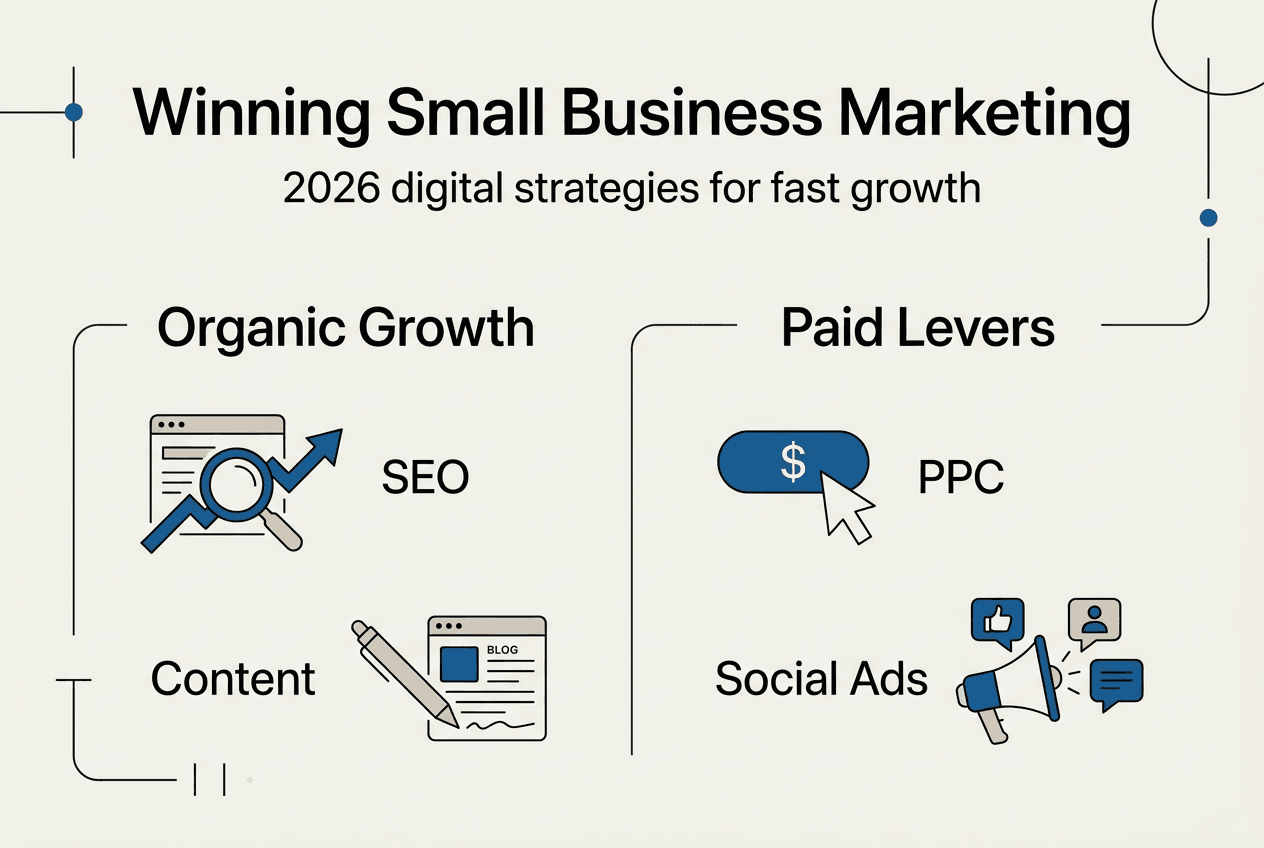
Budget allocation requires both courage and restraint. Start with what you can afford to lose while testing channels before scaling. Allocate small amounts to different channels, measure results rigorously, then double down on what works. This disciplined approach minimizes risk while maximizing learning.
Your strategy should integrate the tactics covered in this guide:
- SEO and content marketing for sustainable organic growth
- Targeted PPC campaigns for immediate visibility and testing
- AI-powered email automation for efficient lead nurturing
- Consistent social media presence on platforms where your customers spend time
- Regular performance analysis to identify opportunities and eliminate waste
Pro Tip: Block specific time each week for marketing execution, not just planning. Consistency matters more than perfection, and regular action compounds over time into significant results.
| Strategy Element | Implementation Timeline | Expected Results |
|---|---|---|
| SEO foundation | 3 to 6 months | Increasing organic traffic and lower acquisition costs |
| Content publishing | Ongoing weekly | Growing authority and search rankings |
| PPC testing | 2 to 4 weeks | Immediate traffic and conversion data |
| Email automation | 1 to 2 months setup | Higher engagement and automated nurturing |
Measurement separates successful strategies from wasted effort. Track metrics that directly connect to business outcomes like leads generated, conversion rates, and customer acquisition cost. Vanity metrics like social media followers or website visits matter less than actions that drive revenue.
Adapt your strategy based on data, not assumptions. If a channel consistently underperforms despite optimization efforts, reallocate that budget to better-performing channels. Flexibility and willingness to pivot distinguish growing businesses from those stuck in ineffective patterns.
Understanding why digital marketing matters for SMBs provides the strategic context for tactical decisions. Your marketing should align with business goals, target your ideal customers, and differentiate you from competitors.
Implementing top marketing tips for SMBs accelerates your progress by avoiding common mistakes and leveraging proven best practices. Learn from others’ successes and failures to shorten your path to results.
Leverage marketing automation software to accelerate your SMB growth
Executing the strategies in this guide becomes exponentially easier with the right tools. Marketing automation software helps SMBs convert leads faster and grow sustainably by coordinating campaigns across channels, tracking customer interactions, and automating repetitive tasks that drain your time.
The challenge most small businesses face isn’t knowing what to do but finding the capacity to do it consistently. Automation tools integrate SEO, content marketing, paid ads, and email campaigns for efficiency, letting small teams achieve results that previously required much larger marketing departments.
Explore marketing automation software boosting SMB conversions to see how businesses like yours achieve 85% more conversions and save 75% of their marketing time. These solutions handle the technical complexity while you focus on strategy and customer relationships.
Discover how marketing automation software driving growth creates sustainable systems that work around the clock. From capturing leads to nurturing them through automated sequences, the right platform becomes your most productive team member.
Learn about marketing automation software proven ROI and how other SMBs justify their investment through measurable results. The best solutions pay for themselves quickly through increased efficiency and higher conversion rates.
Frequently asked questions
What is the most cost-effective digital marketing strategy for small businesses?
SEO combined with content marketing offers sustainable, low-cost acquisition over time because organic traffic continues flowing without ongoing ad spend. Paid ads complement this foundation by providing immediate visibility when budget allows, letting you test offers and accelerate growth while your organic strategy matures.
How can small businesses measure the success of their digital marketing efforts?
Track metrics like conversion rates, click-through rates, and return on ad spend that directly connect to revenue. Use analytics and automation dashboards to monitor campaign performance in real time, then adjust strategies based on data rather than assumptions.
What role does AI play in enhancing digital marketing for SMBs?
AI personalizes email send times and content for higher engagement, saving over 120 hours annually while improving open rates by up to 23%. Automation reduces the need for extra hiring by handling tasks like audience segmentation, bid optimization, and performance analysis that previously required manual effort.
How should small businesses allocate their digital marketing budgets in 2026?
Start with affordable channels and budgets you can afford to lose while testing different approaches. Scale budgets for channels that show positive ROI and strong conversions, reallocating funds from underperforming tactics to maximize overall marketing effectiveness.
Recommended
- Tips for small business growth: smart strategies for 2026 – Go Online Now
- 8 Digital Marketing Tips for Small Businesses in 2025 – Go Online Now
- Understanding Digital Marketing Strategies for SMEs – Go Online Now
- Understanding Digital Growth Strategies for SMBs – Go Online Now
- Digital marketing checklist 2026: practical steps for small business success