

TL;DR:
- Online reputation management involves continuously monitoring, influencing, and improving your business’s online perception. It is more effective when businesses proactively build positive content and reviews to prevent damage from negative feedback.
Online reputation management (ORM) is the ongoing process of monitoring, influencing, and improving how your business is perceived across the web. 54% of consumers trust online reviews over personal recommendations or company claims. That single fact makes ORM one of the highest-return activities a small or mid-sized business can invest in. Whether you run a salon, a coaching practice, or a real estate firm, your digital reputation shapes buying decisions before a prospect ever contacts you. This guide walks you through every step of a proven ORM framework for SMBs so you can build trust, attract customers, and protect what you have built.
What are the essential steps in the online reputation management process?
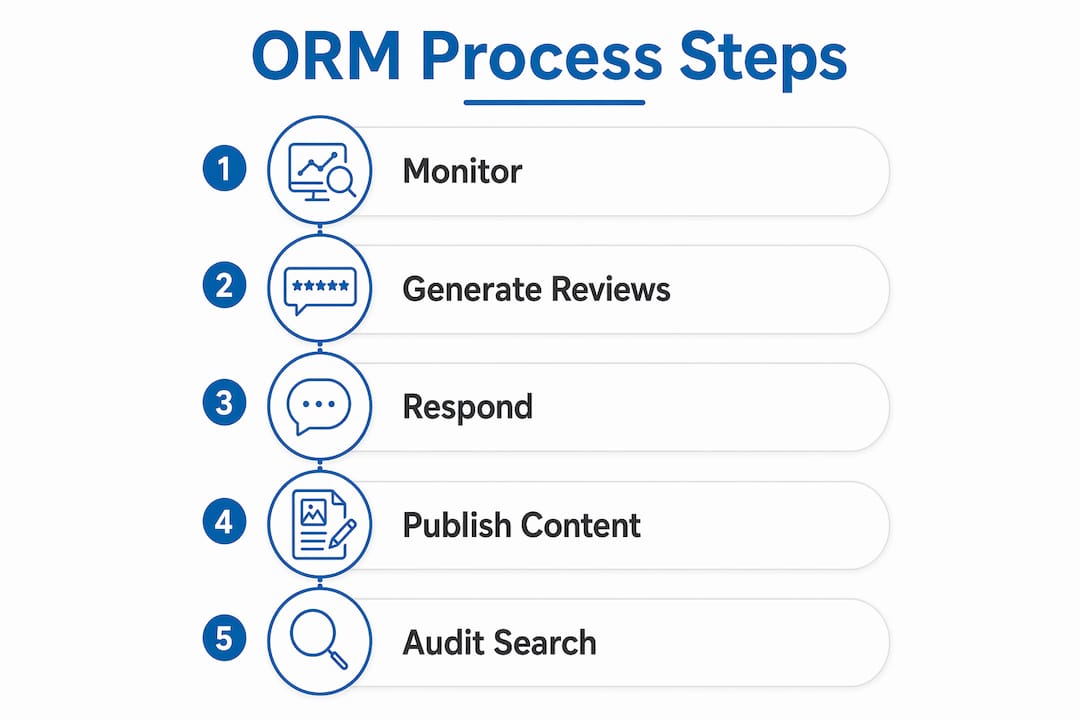
The online reputation management process follows five repeatable steps. Each step builds on the last, creating a system that works whether you have one location or ten.

1. Set up monitoring
Monitoring is the foundation of every ORM strategy. Set up Google Alerts for your business name, key staff names, and your primary service terms. Add social listening coverage across Facebook, Instagram, LinkedIn, and X. ORM must cover diverse platforms beyond Google, including AI-powered search summaries and niche forums like Reddit. A business that only watches Google misses a growing share of the conversations that shape its reputation.
2. Generate reviews consistently
Reviews do not arrive on their own. Build a review request workflow that sends a personalized message within 48 hours of service completion. Professional SMBs see search result movement 3–6 months after implementing a 48-hour review request workflow. Timing matters because customer satisfaction peaks shortly after a positive experience, making that the ideal moment to ask.
3. Respond to every review within 24 hours
Speed and tone both count here. Responding to all new reviews within 24 hours using personalized templates maintains a professional brand tone while saving time. A template gives you structure; personalization shows the customer you actually read their feedback. Never copy and paste the same response word for word across multiple reviews.
4. Publish reputation-building content
Content is your best long-term tool for controlling what people see first. Publishing superior, relevant content is the most effective way to outrank negative results and correct your online reputation. Blog posts, case studies, and client success stories all give search engines authoritative material to rank above older negative content.
5. Audit your search results regularly
Run a monthly search audit using your business name, your name, and your top service terms. Check Google autocomplete suggestions and the “People also ask” box. These surfaces reveal what potential customers are already thinking about your business before they click anything.
Professionele tip: Set a recurring calendar reminder for the first Monday of each month to run your full search audit. Consistency matters more than perfection.
How does proactive ORM differ from reactive ORM?
Proactive ORM means building your reputation before problems arise. Reactive ORM means responding after damage has already occurred. The difference in cost and stress between the two is significant.
Here is what each approach looks like in practice:
- Proactive ORM involves publishing authoritative content regularly, requesting reviews on a set schedule, and monitoring brand mentions weekly. The goal is to make positive, accurate content the dominant result for any search about your business.
- Reactive ORM kicks in after a negative review goes viral, a complaint appears on a high-authority site, or a news article misrepresents your business. At that point, you are spending time and money to undo damage rather than build value.
- Cost comparison: Proactive investment in ORM is consistently less costly than reactive damage control. Crisis response often requires outside help, legal review, and significant time away from running your business.
- Control: Proactive ORM gives you a content library and review base to fall back on. If a negative incident does occur, a strong existing reputation absorbs the impact far better than a thin or absent one.
- Long-term positioning: ORM’s goal is to ensure accurate, representative information is what potential customers see first. Proactive content creation is the most direct path to that outcome.
The practical takeaway is straightforward. Invest in your reputation when business is good, and you will spend far less defending it when something goes wrong. Reactive ORM is not a strategy. It is a cost you pay for skipping the strategy.
What tools and technologies support an efficient ORM workflow?
The right tools reduce the manual work of reputation monitoring and make it possible to stay consistent without hiring a full-time team.
- Review management platforms consolidate reviews from Google, Yelp, Facebook, and industry-specific directories into a single dashboard. They send alerts when new reviews arrive and often include response templates.
- Social listening tools track brand mentions across social media, blogs, and forums in real time. They flag conversations you would otherwise miss, especially on platforms you do not actively post on.
- Workflow automation handles the review request sequence automatically after a job is marked complete in your CRM. This removes the most common failure point in review generation, which is simply forgetting to ask.
- AI search monitoring is a newer requirement. ORM now requires monitoring AI-powered search summaries and niche forums since these increasingly influence consumer decisions. Tools that track how AI search engines like Perplexity or Google’s AI Overviews describe your business are becoming standard practice.
- Audit tools scan your search results and flag negative content, outdated listings, and inconsistent business information across directories.
When choosing tools, match the feature set to your actual team size. A solo operator needs a simple dashboard with alerts. A business with a dedicated marketing person can use more advanced workflow automation and reporting.
Professionele tip: Before paying for a standalone reputation tool, check whether your existing marketing automation software already includes review management. Many all-in-one platforms cover this at no extra cost.
How can SMBs use review and search data to grow their business?
Reviews are not just a reputation signal. They are market research your customers paid for with their time. Negative reviews reveal recurring complaint trends that, when addressed, drive real operational improvement alongside reputation gains.
The most effective approach is to maintain a root cause document. Every time a negative review mentions a specific issue, log it. When the same complaint appears three or more times, that is a signal worth acting on, not just responding to.
| Recurring complaint | Root cause example | Operational fix |
|---|---|---|
| Long wait times | Understaffed during peak hours | Adjust scheduling or add booking slots |
| Slow follow-up | No automated response system | Add CRM automation for lead replies |
| Inconsistent service quality | No staff training standard | Create a service checklist |
| Wrong information online | Outdated directory listings | Run a monthly listing audit |
Search data adds another layer. Fixing negative autocomplete suggestions and AI citations starts with identifying harmful terms and producing updated, authoritative content to correct AI data sources. If Google autocomplete suggests something negative when someone types your business name, that suggestion is being driven by existing content. Publishing accurate, high-quality content on the same topic gives search engines and AI models a better source to reference.
Most SMB owners underestimate how much Google’s “People also ask” box and AI-generated summaries shape first impressions. A prospect who sees a negative autocomplete suggestion may never click through at all. Monitoring these surfaces monthly and responding with targeted content is one of the highest-leverage reputation activities available to a small business.
What I have learned about ORM after working with SMBs
Most SMB owners treat reputation management as a fire drill. They ignore it until something burns, then scramble to put it out. I understand why. When you are running a business day to day, monitoring reviews feels like a low-priority task compared to serving customers or closing sales.
But here is what I have seen consistently: the businesses that invest in a simple, repeatable ORM process before they need it are the ones that weather negative incidents without lasting damage. A strong base of positive reviews and authoritative content acts as a buffer. One bad review barely moves the needle when you have 80 good ones.
The area I see SMBs underestimate most in 2026 is AI-influenced reputation. When a potential customer asks an AI assistant about your business, the answer it generates comes from whatever sources that AI has indexed. If those sources are outdated or negative, the AI will say something inaccurate. Publishing fresh, authoritative content is the only reliable way to correct that. Waiting for AI models to self-correct is not a plan.
My honest recommendation is to integrate ORM into your broader marketing automation strategy from day one. Treat it as a system, not a reaction. The businesses that do this consistently see compounding returns over 6–12 months that no one-time crisis response can replicate.
— Go
How Goonlinenow helps SMBs manage reputation without the manual work
Running a consistent ORM process takes time most SMB owners do not have. Goonlinenow builds review management, response automation, and content scheduling directly into its marketingautomatiseringssoftware, so your reputation system runs alongside your sales and marketing without needing a separate tool or team.
The platform consolidates review alerts, automates your 48-hour review request workflow, and gives you a single inbox for responding to feedback across platforms. Setup is done for you, with no contracts and no hidden fees. If you want a reputation management process that actually runs without constant manual effort, Goonlinenow is built for exactly that. You can also explore how SMB reputation strategies connect to broader growth goals on the Goonlinenow resource hub.
Veelgestelde vragen
What is the online reputation management process?
The online reputation management process is a structured cycle of monitoring brand mentions, generating reviews, responding to feedback, publishing authoritative content, and auditing search results. The goal is to ensure accurate, positive information appears first when potential customers search for your business.
How long does it take to see results from ORM?
Professional SMBs typically see measurable search result movement 3–6 months after implementing a consistent review request and content publishing workflow. Results compound over time as your review volume and content library grow.
What is the difference between proactive and reactive ORM?
Proactive ORM builds your reputation through consistent content and review generation before problems occur. Reactive ORM addresses damage after a negative incident. Proactive ORM is consistently less costly and gives you far more control over your brand narrative.
Which platforms should SMBs monitor for reputation management?
SMBs should monitor Google, Facebook, Yelp, industry-specific directories, Reddit, and AI-powered search summaries. ORM has shifted from a Google-only focus to a multi-platform requirement, since AI search tools and niche forums increasingly influence consumer decisions.
How should SMBs respond to negative reviews?
Respond within 24 hours using a personalized template that acknowledges the specific complaint, apologizes where appropriate, and offers a resolution path. Never copy and paste identical responses. Treating negative reviews as diagnostic feedback, rather than attacks, leads to better responses and real operational improvements.