

TL;DR:
- A digital marketing plan connects your business goals to online channels, tactics, budgets, and measurable results.
- Focusing on clear objectives, audience insights, and ongoing measurement creates a more effective strategy than bloated plans.
A digital marketing plan, also called an internet marketing plan, is a structured blueprint that connects your business goals to specific online channels, tactics, budgets, and measurable outcomes. Without one, you are spending money on disconnected activities that rarely compound into growth. The good news: you do not need a 40-page document. A focused, practical internet marketing plan built around clear objectives, audience insight, and honest measurement will outperform any bloated strategy deck. This guide walks you through a real internet marketing plan example, step by step, with industry-specific variations and a measurement framework you can use immediately.
What does a strong internet marketing plan example include?
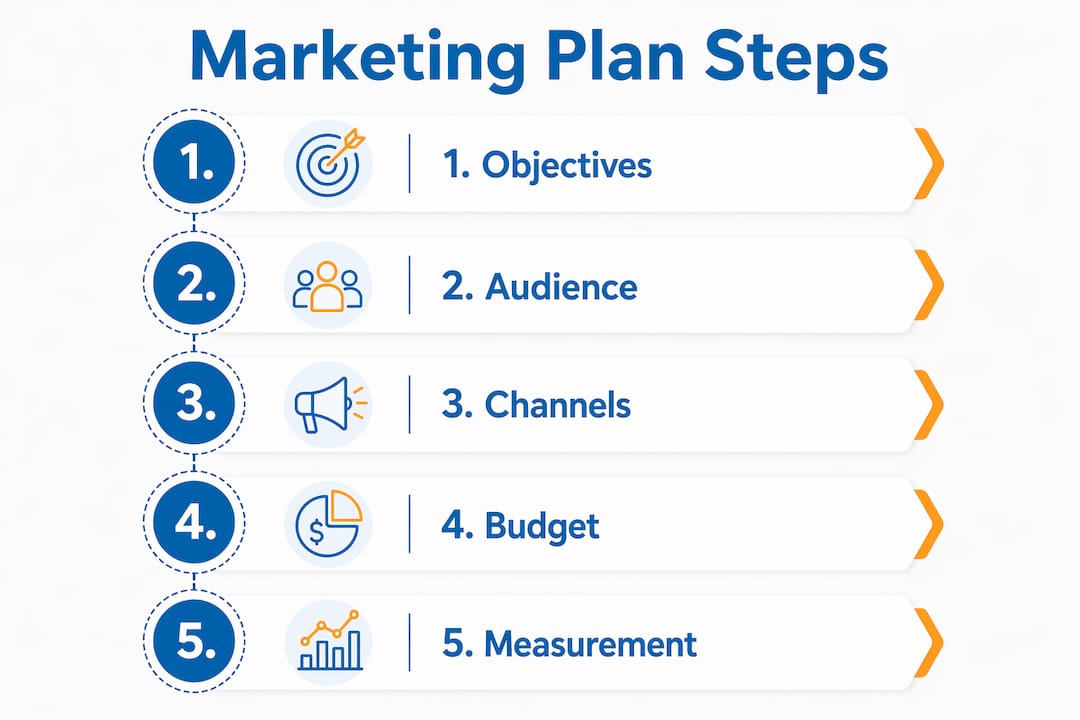
A well-built digital marketing plan follows five ordered steps: objectives and success metrics, audience and customer journey mapping, channel and tactic selection, budgeting and timeline, and measurement with ongoing optimization. Each step builds on the previous one, so skipping ahead creates gaps that show up later as wasted spend or unclear reporting. Think of it as a chain. Break one link and the whole thing loses tension.
Step 1: Set SMART objectives
Your objectives define everything else. A SMART objective example looks like this: “Increase product signups by 30% by the end of Q2, with organic search contributing 40% of new signups at a cost per signup below $18.” That level of specificity tells your team exactly what to build toward and makes success undeniable at review time.
Step 2: Map your audience and their journey
Audience mapping goes beyond demographics. You need to understand where your customers discover you, what questions they ask before buying, and what friction points cause them to drop off. Tools like Google Analytics 4 and Meta Audience Insights give you behavioral data to build this picture accurately.

Step 3: Choose your channel mix
Your channel selection should follow your audience, not trends. Common high-performing combinations for SMBs include SEO plus Google Ads for demand capture, email marketing for nurture, and social media for awareness. Spreading budget across too many channels early is one of the most common mistakes small business owners make.
Step 4: Build your budget and timeline
Digital marketing budgets typically allocate 40 to 60% to core channels, 10 to 30% to experiments and marketing technology, and 5 to 10% as contingency. That structure gives you enough flexibility to test without gambling your core spend. A quarterly timeline works better than annual planning for most SMBs because markets shift faster than yearly cycles allow.
Professionele tip: Start with one core objective for your first 90 days. Trying to grow traffic, leads, and brand awareness simultaneously at the start dilutes your focus and makes it nearly impossible to diagnose what is working.
Step 5: Measure, report, and optimize
Measurement is not a final step. It is a continuous loop. Set your KPIs before launch, review them weekly, and adjust tactics monthly. The plan is a living document, not a filed report.
How does industry type shape your digital marketing strategy sample?
Tailoring your digital marketing plan to your industry and customer journey is not optional. A one-size-fits-all approach consistently underperforms because the buying cycle, decision triggers, and channel preferences vary significantly across sectors. The RACE Growth model (Reach, Act, Convert, Engage) gives you a flexible structure to customize planning by industry while keeping your objectives consistent.
The table below shows how three common industries differ in their planning priorities:
| Industrie | Primary channel focus | Typical lead time | Key SMART metric example |
|---|---|---|---|
| FMCG / Retail | Paid social, SEO, email | Days to weeks | 20% increase in online sales in 60 days |
| Financial services | Content, SEO, paid search | Weeks to months | 15% rise in qualified lead form submissions per quarter |
| High tech / SaaS | SEO, webinars, email nurture | Months | 30% increase in free trial signups by Q3 |
The practical implication here is significant. A real estate coach running Google Ads with a two-day follow-up sequence is using a retail-style approach for a financial-services-length buying cycle. That mismatch burns budget. Matching your plan to your actual customer journey is where most SMBs find their biggest efficiency gains. For strategy examples tailored to SMBs, the channel mix and timeline need to reflect how your specific customers actually make decisions.
What is a full-funnel inbound marketing plan example?
A 360 inbound marketing plan covers the entire customer lifecycle through five connected stages: Attract, Engage, Convert, Nurture, and Expand. This approach differs from traditional segmented plans because every stage feeds the next, creating compounding pipeline value rather than isolated campaign results.
Here is how each stage works in practice:
- Attract: SEO-optimized blog content, YouTube videos, and podcast appearances pull in cold audiences searching for solutions. This is where Google Search Console and keyword tools like Semrush or Ahrefs identify the exact queries your buyers use.
- Engage: Long-form guides, webinars, and interactive tools deepen interest and build trust. A B2B SaaS company, for example, might run a monthly webinar series that converts 12% of attendees into trial users.
- Convert: Landing pages, lead magnets, and free trials capture contact information. This stage lives or dies on your offer clarity and page load speed.
- Nurture: Personalized email sequences and SMS follow-ups move leads toward a purchase decision. Automation tools make this scalable without adding headcount.
- Expand: Post-purchase onboarding, loyalty programs, and referral campaigns turn customers into repeat buyers and advocates. This stage is where lifetime value is built.
Professionele tip: Map a specific channel and one KPI to each funnel stage before you launch. Without that structure, you will end up optimizing for top-of-funnel traffic while your conversion rate quietly bleeds out at the bottom.
The full-funnel model works especially well for service businesses, coaches, and professional service providers because the relationship and trust-building stages (Engage and Nurture) are where deals are actually won. For a complete SMB growth guide, integrating these five stages into a single connected plan is the difference between a marketing calendar and a real growth system.
How do you build a credible measurement plan?
A measurement plan is a blueprint that maps your business goals to specific tracking metrics, defines which user actions matter, and guides your Google Analytics 4 and Google Tag Manager configuration before you go live. Without it, you collect enormous amounts of data that tell you very little. Setting it up after launch means you have already lost weeks of clean data.
Follow this numbered sequence to build yours:
- Define your primary business goal. For most SMBs, this is leads, signups, or direct sales. Write it as a SMART statement.
- Identify the micro-conversions that lead to it. These include page views of key content, form starts, email opens, and add-to-cart events.
- Assign KPIs to each funnel stage. Funnel-stage KPIs prevent vanity metrics from hiding where leads actually drop off. Use sessions for reach, lead form completions for action, purchases for conversion, and repeat visit rate for engagement.
- Configure GA4 and Google Tag Manager. Set up event tracking for every micro-conversion before your first campaign goes live.
- Run incrementality testing. Standard last-click attribution consistently undervalues upper-funnel activity. A Rocket Mortgage campaign, for example, generated 23% more value than conventional attribution models predicted once incrementality testing was applied. That gap represents real budget decisions being made on incomplete information.
“Brand-building campaigns properly measured with incrementality testing empower confident investment decisions and shift marketing from a cost center to a growth driver.” — Think with Google
The practical takeaway: treat your measurement setup as a pre-launch requirement, not a post-launch cleanup. Every week you run campaigns without proper tracking is a week of optimization data you can never recover.
What I have learned from building marketing plans with SMBs
After working with hundreds of small and mid-sized businesses on their digital marketing plans, the pattern I see most often is not a lack of ideas. It is a lack of constraint. Owners want to run Google Ads, build an Instagram presence, launch a podcast, and redesign their website simultaneously in the first quarter. The result is that nothing gets done well enough to generate data worth learning from.
The plans that actually produce results share one quality: they start with a single, specific objective and build every tactic around proving or disproving that one thing. Once you have evidence that a channel works, you scale it. Once you have evidence it does not, you cut it without guilt. That is not timid planning. It is how you build a marketing system that compounds over time.
I also see SMBs consistently skip the measurement blueprint step because it feels technical. That is the most expensive shortcut you can take. Running campaigns without GA4 event tracking and a clear KPI hierarchy is like driving with no dashboard. You might be going fast, but you have no idea if you are heading toward your destination. The marketing tips for SMBs that actually move the needle are almost always about doing fewer things with better measurement, not adding more tactics to an already crowded plan.
— Go
Put your internet marketing plan into action with Goonlinenow
Building a solid digital marketing plan is only half the work. Executing it consistently, tracking results accurately, and following up with leads at the right moment is where most SMBs lose momentum.
Goonlinenow is built specifically for this challenge. The platform combines marketing automation for SMB conversions with an all-in-one CRM, email and SMS nurture sequences, and done-for-you setup so your plan runs without requiring a full marketing team. Clients see up to 85% more conversions and 75% time saved within 90 days. No contracts, no hidden fees, and real human support from day one. If you are ready to move from planning to execution, Goonlinenow gives you the tools and the team to make it happen.
Veelgestelde vragen
What is a digital marketing plan?
A digital marketing plan is a structured document that defines your online marketing objectives, target audience, channel tactics, budget, and KPIs. It connects business goals to specific digital activities and measurement systems to guide execution and optimization.
What should a digital marketing strategy include?
A strong digital marketing strategy includes SMART objectives, audience and customer journey mapping, channel selection, a quarterly budget breakdown, and a measurement plan with funnel-stage KPIs. The five-step structure is the most widely used framework for practical planning in 2026.
How do I tailor my plan to my industry?
Use a framework like the RACE Growth model to align your tactics with your specific customer journey and lead time. A financial services business needs a longer nurture sequence than a retail brand, and your channel mix and KPIs should reflect that difference.
How does incrementality testing improve my marketing plan?
Incrementality testing measures the true causal impact of your campaigns rather than relying on last-click attribution, which routinely undervalues upper-funnel activity. The Rocket Mortgage example showed 23% more value than standard models predicted, which directly affects budget allocation decisions.
Do I need a free digital marketing strategy template to get started?
A template helps you organize your thinking, but the most important step is defining one clear objective before filling in any section. Start with your 90-day goal, then work backward through channels, budget, and measurement to build a plan that is specific to your business rather than generic.