

TL;DR:
- Small businesses should focus on simplicity and customer retention for effective digital marketing.
- Building a focused, measurable strategy with 2-4 channels outperforms complex, scattered efforts.
- Prioritizing retention and consistent systems leads to sustainable growth and higher profitability.
Many small business owners believe online marketing requires a big budget, a dedicated tech team, or a dozen different tools running at once. That belief stops a lot of growth before it even starts. The truth is that simplicity and customer retention are the real drivers of effective digital marketing for smaller businesses. You don’t need to do everything. You need to do the right things consistently. This article walks you through practical examples and a clear framework you can apply to your own business starting today.
Key Takeaways
| Point | Details |
|---|---|
| Integrated channel mix | Combining channels like SEO, social media, and email drives more results than using just one approach. |
| Retention focus | Keeping current customers is simpler and more affordable than always finding new ones. |
| Simplicity beats complexity | Simple strategies tailored to your business avoid overwhelm and encourage consistency. |
| Smart channel selection | Pick the channels that best fit your goals, budget, and resources—don’t try to be everywhere at once. |
| Measure and refine | Continuous measurement and adjustment help avoid wasted spend and maximize your marketing ROI. |
What makes a successful online marketing strategy?
An online marketing strategy is your written plan for attracting, engaging, and retaining customers through digital channels. For small and mid-sized businesses (SMBs), the most effective strategies are not the most complex ones. They are the ones that focus your limited time and budget on channels that actually reach your audience and keep them coming back.
Think of it this way: a solo coach or a local salon owner does not have the same resources as a Fortune 500 brand. So the strategy needs to match the reality. That means choosing a manageable mix of channels, staying consistent, and measuring what works before spending more.
According to an integrated channel approach recommended for small businesses, the most effective strategies combine multiple touchpoints while keeping the overall system simple enough for a small team to maintain. You can review a practical digital marketing checklist for SMBs to benchmark your current setup against what a well-rounded strategy looks like.
Here are the critical success factors every SMB strategy should include:
- Clear, specific goals tied to revenue or customer retention
- A focused channel mix of two to four platforms you can maintain consistently
- Audience segmentation so your messaging speaks to different customer types
- Regular measurement using free tools like Google Analytics or built-in platform insights
- Retention mechanics such as loyalty programs, email follow-ups, and review requests
- Operational simplicity so the system can run even when you are busy
“A small business doesn’t need to be everywhere online. It needs to be consistent where its customers already are, and it needs to make those customers feel valued enough to come back.” This is the mindset shift that separates thriving SMB marketers from those who burn out chasing trends.
A step-by-step online marketing strategy example
With a clear understanding of the key success factors, let’s walk through a proven, step-by-step example you can personalize for your own business. The Digital Marketing Institute outlines a practical 8-step process that works well for SMBs because it is simple, replicable, and easy to adjust as you grow.
Here is how to build your strategy from scratch:
- Define your business goals. Be specific. “Get more clients” is not a goal. “Add 10 new coaching clients per month at $500 each” is a goal you can build a plan around.
- Identify your target audience. Create a basic customer profile. What do they search for online? What problems do they want solved? Where do they spend time digitally?
- Audit your current online presence. Check your website, social profiles, Google Business Profile, and any existing email list. Know your starting point.
- Choose your primary channels. Based on where your audience spends time, select two to four channels. Most SMBs do well starting with SEO, email, and one social platform.
- Set your budget and resource plan. Decide how much time and money you can dedicate weekly. Consistency beats occasional big pushes every time.
- Create a content and messaging plan. Map out what you will say, how often, and in what format. Simple editorial calendars work fine.
- Launch and execute. Start with your highest-priority channel and add others gradually as systems become stable.
- Measure, learn, and adjust. Review your results monthly. Double down on what works and cut what does not.
Here is a summary table showing each step, the recommended channel, and the main goal:
| Stap | Focus area | Recommended channel | Primary goal |
|---|---|---|---|
| 1 | Goal setting | Internal planning | Clarity and direction |
| 2 | Audience research | Surveys, Google, social | Know your customer |
| 3 | Presence audit | Website, Google, social | Identify gaps |
| 4 | Channel selection | SEO, email, social | Focused reach |
| 5 | Budget planning | Internal planning | Sustainable spend |
| 6 | Content planning | Blog, email, posts | Consistent messaging |
| 7 | Execution | Chosen channels | Generate results |
| 8 | Measurement | Analyse-instrumenten | Optimize performance |
Real example: A local bookkeeping firm wants to grow its client base. They start by setting a goal to increase monthly inquiries by 20%. Their audience is small business owners who search Google for tax help. So they invest in local SEO, publish two blog posts per month answering common tax questions, and send a monthly email newsletter to their existing client list. After 90 days they track which blog posts generate the most inquiries and write more content on those topics. That is it. Simple, focused, and measurable.

You can explore detailed guidance through our essential online marketing strategies resource and a full digital marketing strategy plan example to see how these steps translate into a real-world document you can adapt.
Pro Tip: Start with one or two channels, measure them for at least 60 days before adding more. Scaling too fast creates chaos and makes it impossible to know what is actually working. Use the insights from our small business digital growth guide to pace your expansion smartly.
Choosing the right marketing channels for your business
Once you have a process, deciding on the right marketing channels is critical to getting results with minimal waste. Not every channel suits every business. A real estate agent benefits enormously from local SEO and video walkthroughs. A yoga studio might thrive on Instagram and email. A B2B consultant may get the best results from LinkedIn and a targeted email sequence.
Integrated channel selection maximizes reach while maintaining cost control, which is exactly what resource-limited SMBs need. The key is matching the channel to the audience, not chasing whatever is trending.
Here is a comparison of the major digital marketing channels for SMBs:
| Kanaal | Pros | Cons | Estimated cost | Best fit |
|---|---|---|---|---|
| Zoekmachineoptimalisatie | Long-term, cost-effective, high trust | Takes time to rank, requires consistent content | Low to medium | Service businesses, local businesses |
| E-mailmarketing | High ROI, owned audience, great for retention | Requires list building, regular content | Low | All SMBs, especially those with repeat customers |
| Social media (organic) | Brand awareness, community building | Time-intensive, algorithm dependent | Low (time cost) | B2C businesses, visual brands |
| Paid ads (PPC/social) | Fast results, targeted reach | Can be expensive, needs expertise | Medium to high | Businesses with budget for testing |
| Loyalty programs | Boosts retention, encourages referrals | Requires setup and management | Low to medium | Retail, salons, service businesses |
| Contentmarketing | Builds authority, supports SEO | Slow to build momentum | Low to medium | Coaches, consultants, service providers |
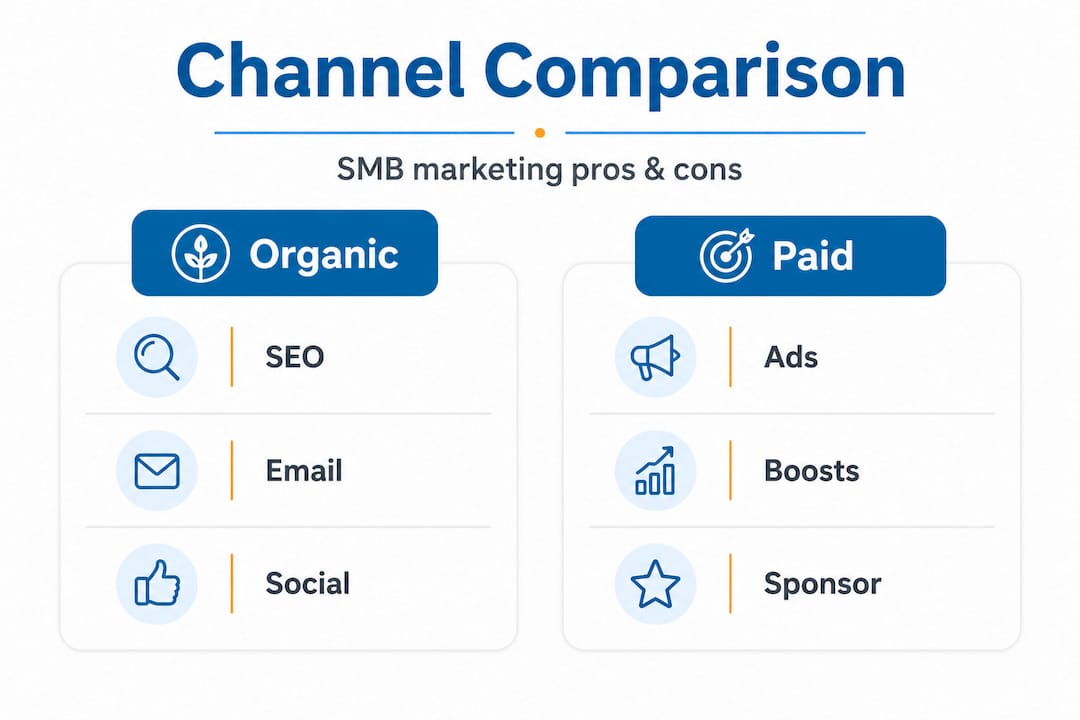
The most common mistake SMBs make is trying to use every channel at once. That leads to spreading your effort too thin, producing mediocre content across many platforms, and burning out your team or yourself. Focus beats volume every time.
Key tips for channel selection:
- Start with where your customers already are. Survey your existing clients. Ask them how they found you and where they spend time online.
- Pick channels you can sustain. A blog you update twice a year hurts more than it helps. Choose channels you can realistically feed with consistent content.
- Invest in retention from the start. Email marketing and loyalty programs cost very little but deliver some of the highest returns in digital marketing.
- Gebruik online marketing boosts to increase local visibility before investing in expensive paid campaigns.
You can also explore effective digital marketing strategies specifically designed for SMBs to see how businesses similar to yours are combining channels with strong results.
Pro Tip: Word of mouth is still a marketing channel. Encourage every satisfied customer to leave a Google review. Reviews improve your local SEO ranking and build trust with new visitors, all without spending a single dollar on ads.
Avoiding common pitfalls in SMB digital marketing
Knowing what to do matters, but avoiding typical SMB mistakes saves you frustration and money. Here’s what to watch for before you invest time or budget into a new strategy.
These are the four most common pitfalls small businesses face in digital marketing:
- Over-complicating the strategy. Many businesses try to implement too many tactics at once. The result is a fragmented system nobody manages well. Stick to a lean, focused plan and expand only after your foundation is solid.
- Neglecting customer retention. Acquisition gets all the attention, but keeping existing customers is far more profitable. Loyal customers spend more, refer others, and cost less to maintain. Yet most SMB marketing plans focus almost entirely on attracting new customers and ignore the ones they already have.
- Not measuring results. Running campaigns without tracking performance is like driving without a dashboard. You cannot improve what you do not measure. Set up basic analytics from day one, even if it is just tracking website visits and email open rates.
- Over-relying on paid advertising. Paid ads can create fast visibility, but paid media is complex and can drain your budget quickly without the right targeting and tracking in place. Many SMBs spend heavily on ads before building the organic and retention foundations that make paid campaigns actually profitable.
“Acquiring a new customer can cost five times more than retaining an existing one. Yet most small business marketing budgets allocate the majority of spend toward finding new leads. Flipping that ratio even slightly can produce dramatic results.”
This is worth taking seriously. If your current email list is sitting unused, or you have no follow-up process for past clients, you are leaving money on the table every week. Check out top marketing tips for SMBs to see how businesses are fixing these gaps with simple, low-cost tactics.
Statistic to consider: Studies suggest that increasing customer retention by just 5% can boost profits by anywhere from 25% to 95%. That kind of return is hard to match through paid acquisition alone.
Our take: Simplicity and retention first, growth follows
After years of working with SMBs across industries, from coaching businesses to salons to professional services, we have seen the same pattern play out repeatedly. Business owners get excited about the latest social media trend or a new ad platform, build a complicated system around it, and then abandon the whole thing three months later when results do not match expectations.
The conventional wisdom that you need to “do all the things” online is wrong for most small businesses. It is a trap. The brands that grow steadily are not the ones running 10 channels simultaneously. They are the ones who picked two or three channels, got very good at them, and built systems to run them consistently without burning out.
Retention is almost always the most underrated strategy. When you focus on nurturing your existing customers through regular email contact, personalized offers, and genuine follow-up, you create a stable revenue base that funds your growth efforts. Acquisition becomes easier and cheaper because your satisfied customers refer new ones.
Sustainable marketing also means building systems that do not depend entirely on you. Automated email sequences, scheduled social posts, and a CRM (customer relationship management) tool that tracks every lead and client interaction free up your mental energy for the work that actually grows the business. You can find practical, up-to-date guidance in our digital marketing tips to see how to build these systems without overcomplicating them.
Our honest take: start smaller than you think you need to, measure obsessively for 60 to 90 days, and then scale what works. That boring approach consistently outperforms the flashy, complicated ones.
Streamline your online marketing with integrated tools
You now have a clear, practical framework for building and executing an online marketing strategy that actually fits your business. The next question is: do you have the right tools to make it run without friction?
Integrated marketing platforms make it possible to manage your email campaigns, CRM, lead follow-up, and social scheduling from a single dashboard, saving hours every week and reducing the chance that a lead slips through the cracks. At Go Online Now-Connect, we built our system specifically for SMBs that want results without the complexity or the price tag of enterprise tools. Explore our marketingautomatiseringssoftware to see how automation can boost conversions, check out our all in one CRM for small business to manage every client relationship in one place, and learn how all-in-one marketing can cut costs while driving real growth.
Frequently asked questions
What is the simplest online marketing strategy for SMBs?
A simple online marketing strategy uses just a few key channels, such as SEO and email, focused on retaining current customers. Simplicity and retention are the two most important drivers of sustainable results for small businesses.
What are the essential elements of an online marketing strategy example?
Essentials include clear goals, a focused channel mix, personalized messaging, and regular performance measurement. The Digital Marketing Institute’s 8-step process provides a replicable framework any small business can adapt.
Why is customer retention more cost-effective than acquisition?
Retaining existing customers costs significantly less and adds revenue stability compared to constantly sourcing new leads. Research consistently shows that retention is more affordable than acquisition and produces higher lifetime customer value.
When should SMBs use paid advertising as part of their strategy?
Paid ads work best for short-term visibility boosts but require careful tracking and expertise to avoid wasted spend. Paid media drives demand but can drain budgets quickly without the right measurement systems in place.
How often should a small business review its marketing strategy?
Review your strategy at least quarterly to confirm your tactics still align with your current goals and market conditions. Monthly check-ins on key metrics like traffic, leads, and conversions help you catch problems early and adjust before they become costly.
Aanbevolen
- Effectieve digitale marketingstrategieën om uw MKB te laten groeien – Ga nu online
- What Is SMB Digital Strategy and Why It Matters – Go Online Now
- Verhoog uw omzet: de beste marketingtips voor succes in het MKB – ga nu online
- Online Marketing Explained: Easy Steps for SMB Growth – Go Online Now
- 7 Winning Paid Media Campaign Examples for CrossFit Gyms