

TL;DR:
- Effective online reputation management involves small businesses monitoring, responding to, and generating reviews across multiple platforms to build trust and improve search visibility. Consistent, timely responses and proactive review requests, especially via SMS, drive higher ratings and customer engagement. Managing reputation across Google, Yelp, Facebook, and industry directories is essential for long-term growth and competitiveness in 2026.
Online reputation management for small business is the process of consistently monitoring, responding to, and cultivating customer feedback across multiple platforms to build trust and drive growth. 54% of consumers trust online reviews more than personal recommendations from friends or family. That single statistic reframes your Google reviews from a vanity metric into a direct revenue driver. One negative review left unanswered can cost your business roughly 30 potential customers. The industry term for this practice is “online reputation management,” or ORM, and for SMBs it requires no more than 2–3 hours per week to run effectively.
What does online reputation management for small business actually involve?
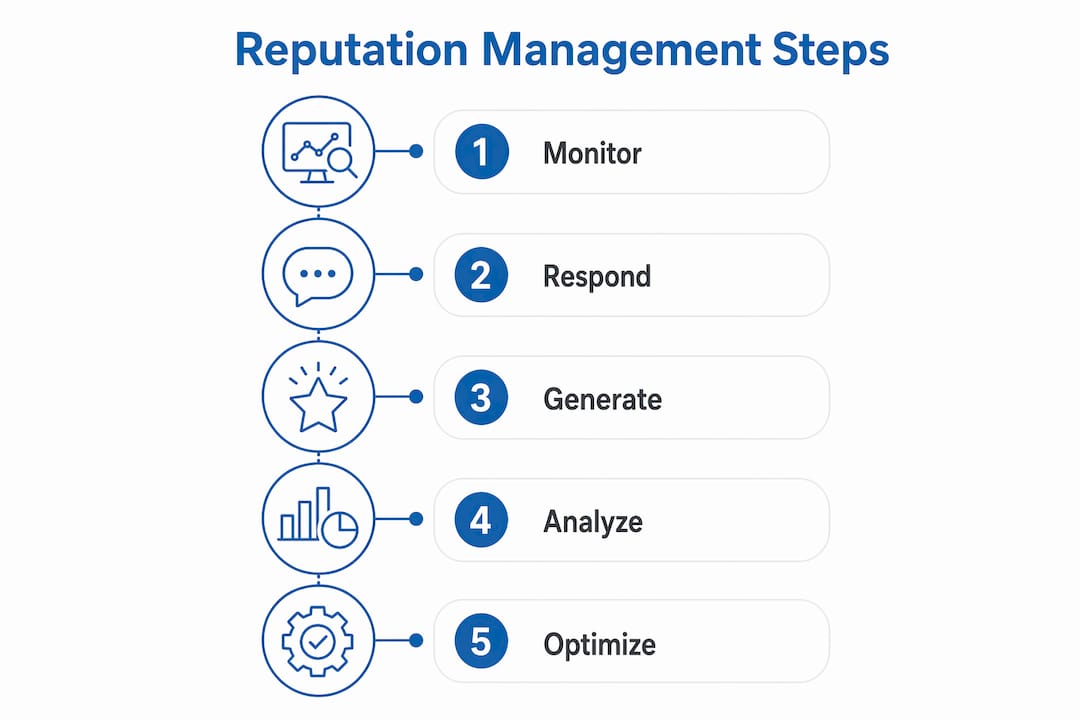
ORM covers four core activities: monitoring, responding, generating, and analyzing. Each one feeds the next, creating a cycle that builds trust over time rather than just putting out fires.
Here is how the process breaks down in practice:
-
Monitor brand mentions and reviews across Google Business Profile, Yelp, Facebook, and any niche directories relevant to your industry. A salon owner needs to watch StyleSeat. A contractor needs Houzz and Angi. Monitoring means you know what customers say before a bad review compounds.
-
Respond to every review within 24–48 hours. Positive reviews deserve a thank-you that feels personal, not copy-pasted. Negative reviews need a calm, professional reply that acknowledges the issue and moves the conversation offline. 89% of consumers read business responses to reviews, so your reply is not just for the unhappy customer. It is a public signal of how you run your business.
-
Generate new reviews proactively. Waiting for customers to leave reviews on their own produces a slow trickle. A structured request process, timed right after a positive interaction, produces a steady flow. The timing and channel matter enormously here, which is covered in detail below.
-
Analyze review data as an operational audit. Patterns in negative feedback reveal real service gaps. If three customers in one month mention slow response times, that is not a reputation problem. It is an operations problem wearing a reputation costume. Proactive reputation marketing treats review insights as a continuous improvement tool, not just a PR exercise.
Professionele tip: Set up a shared inbox or unified dashboard that pulls reviews from all platforms into one view. Checking five separate apps daily is the fastest way to let responses slip past the 48-hour window.
Reputation management for SMBs is a revenue generation activity. Businesses that engage reviewers consistently see higher ratings, more repeat customers, and better local search rankings. It is not damage control. It is marketing.

How can small businesses monitor and respond to reviews efficiently?
Efficient reputation monitoring starts with the right tools and a fixed weekly routine. Reputation management software consolidates reviews, monitors brand mentions, and automates alerts, saving significant time as review volume grows. Free tools like Google Alerts cover basic brand mention tracking at no cost. Paid platforms add review aggregation, sentiment analysis, and automated response prompts.
A practical weekly workflow looks like this:
- Monday morning (30 minutes): Check all review platforms for new reviews. Flag any that need a response before end of day.
- Wednesday (20 minutes): Review Google Alerts and social media mentions. Respond to any comments or tags from the past 48 hours.
- Friday (30 minutes): Send review requests to customers served earlier in the week. Log any recurring complaints for your operations review.
That structure keeps you inside the 24–48 hour response window without requiring daily attention. Consistency matters more than perfection here.
Response quality drives real business outcomes. A Harvard Business Review study found that hotels that engaged reviewers actively saw a 0.12 star rating increase after consistent engagement. That may sound small, but moving from 4.1 to 4.2 stars on Google can shift your ranking in local search results. For a step-by-step breakdown of the full process, the reputation management guide for SMBs from Babylove Growth covers each stage in practical detail.
Professionele tip: When responding to a negative review, never argue or get defensive. Acknowledge the experience, apologize briefly, and invite the customer to contact you directly. This approach protects your public image while giving you a real chance to fix the issue.
The goal of monitoring is not to catch problems after they spread. It is to respond fast enough that a single bad review never defines your overall rating.
What are the most effective strategies for generating positive reviews?
Timing and channel are the two variables that determine whether a review request works. Most small business owners ask for reviews too late or through the wrong medium, and then wonder why response rates are low.
The most effective approach follows these principles:
- Send requests 24–48 hours after service completion. Customer satisfaction peaks in the window right after a positive experience. Waiting a week means the emotional high has faded and the request feels like an afterthought.
- Use SMS over email. SMS review requests carry a 98% open rate, compared to roughly 20% for email. That gap is not marginal. It means for every 100 review requests you send by email, only 20 people even see the message. SMS gets 98 of those same 100 people to open it.
- Add QR codes at the point of service. A QR code on a receipt, a table card, or a checkout counter lets satisfied customers leave a review in under 60 seconds. Place them at moments of delight, right after a great haircut, a completed repair, or a successful coaching session.
- Segment your customer list. Not every customer is equally likely to leave a positive review. Prioritize requests to customers who have expressed satisfaction directly, either verbally or through a post-service survey. This increases both volume and average rating.
Here is a comparison of review request channels by effectiveness:
| Kanaal | Open rate | Best timing | Effort to set up |
|---|---|---|---|
| SMS | 98% | 24–48 hrs post-service | Low with automation |
| ~20% | 24–48 hrs post-service | Very low | |
| QR code (in-person) | Varies | At moment of delight | Low (one-time setup) |
| Verbal ask | High | Immediately post-service | None |
The data points to SMS as the clear leader for review generation tactics. Pairing SMS requests with an automated follow-up sequence removes the manual effort entirely and keeps your review volume growing without adding to your weekly workload.
Why does reputation management beyond Google matter in 2026?
Google Business Profile is the most important single platform for local reputation, but it is not the only one that affects your visibility. AI search engines aggregate data from Yelp, Facebook, industry-specific directories, and social platforms when ranking local businesses. A business with strong Google reviews but no presence on Yelp or Facebook gives AI-driven search tools an incomplete picture, which can suppress visibility in results.
The platforms that matter depend on your industry. A restaurant needs Yelp and TripAdvisor. A real estate agent needs Zillow and Realtor.com. A fitness studio needs Mindbody and ClassPass. Claiming and maintaining your profile on the two or three platforms most relevant to your industry takes less than an hour to set up and pays dividends in search visibility for years.
The practical steps for multi-platform reputation management are straightforward:
- Claim your business profile on every relevant platform, even if you do not actively post there.
- Keep your name, address, and phone number identical across all listings. Inconsistencies confuse search algorithms and reduce trust.
- Monitor each platform at least once a week using a consolidated tool or a simple checklist.
- Respond to reviews on secondary platforms with the same speed and care you apply to Google.
For a deeper look at how reputation management for SMEs connects to long-term trust and growth, Goonlinenow covers the full picture across platforms and industries. Ignoring non-Google platforms is no longer a minor oversight. In 2026, it is a visibility gap that competitors with broader presence will fill.
What I have learned about building a reputation system that actually lasts
After working with hundreds of SMB owners on their digital presence, the pattern I see most often is this: business owners treat reputation management as something they do when things go wrong. A bad review appears, they panic, they respond, and then they go quiet again until the next crisis.
That approach is the most expensive way to manage your reputation. It costs you in lost customers, in time spent on damage control, and in the mental energy of reacting instead of leading.
The businesses that build strong, durable reputations do one thing differently. They treat review generation and response as a weekly business operation, the same way they treat invoicing or inventory. They schedule it, they automate what they can, and they review the data monthly to spot service gaps before those gaps become public complaints.
The shift toward AI-driven search in 2026 makes this even more urgent. AI tools do not just read your Google rating. They synthesize your presence across every platform where customers talk about you. A business with 50 Google reviews and nothing elsewhere looks thin to an AI search engine compared to a competitor with 30 Google reviews and active profiles on four other platforms.
My honest advice: start with the ORM process for SMBs and build your weekly routine before you invest in any paid tool. The habit matters more than the software. Once the habit is solid, automation makes it faster. But no tool fixes a business that never responds to its customers.
— Go
How Goonlinenow helps SMBs automate reputation and customer engagement
Managing your reputation manually works at low volume. As your business grows, the review requests, responses, and monitoring tasks multiply faster than your available hours.
Goonlinenow’s marketing automation software for SMBs includes built-in reputation management features: automated SMS and email review requests timed to your service workflow, a unified inbox that pulls reviews from multiple platforms, and alert systems that flag new mentions within minutes. Clients report up to 85% more conversions and 75% time saved within 90 days. Setup is done for you, there are no contracts, and real human support is included. If you are ready to put your reputation growth on a consistent schedule, Goonlinenow gives you the tools and the team to make it happen.
Veelgestelde vragen
What is online reputation management for small business?
Online reputation management for small business is the practice of monitoring, responding to, and generating customer reviews and brand mentions across digital platforms to build trust and attract new customers. It includes Google, Yelp, Facebook, and industry-specific directories.
How much time does reputation management take each week?
Most small business owners can manage their online reputation effectively by dedicating 2–3 hours per week to monitoring platforms and responding to reviews. Automation tools reduce this time further as review volume grows.
Does responding to negative reviews actually help?
Yes. 89% of consumers read business responses to reviews, and a professional reply to a negative review signals accountability to every future customer who sees it. Consistent engagement also correlates with measurable rating improvements over time.
Which review request channel works best for small businesses?
SMS outperforms email significantly for review requests. SMS open rates reach 98% compared to roughly 20% for email, making it the most reliable channel for generating new reviews when sent 24–48 hours after service completion.
Do I need to manage platforms beyond Google?
Yes. AI-driven search engines pull data from Yelp, Facebook, and niche directories when ranking local businesses. Neglecting non-Google platforms reduces your visibility in AI-powered search results, which are increasingly how customers find local services in 2026.