

TL;DR:
- Online reputation marketing is a proactive strategy that uses positive reviews and authoritative content to build trust and drive sales. It focuses on creating a strong brand story before problems occur, unlike reputation management, which reacts to issues. Implementing continuous review collection, content publishing, and monitoring helps small businesses grow and maintain credibility in the digital space.
Online reputation marketing is defined as the proactive commercial strategy of using positive customer reviews, authoritative content, and strategic promotion to build a trustworthy brand image that drives conversions. The industry term for the broader discipline is online reputation management (ORM), but reputation marketing is its growth-focused counterpart. Where ORM reacts to problems, reputation marketing builds the story before problems arise. For small and mid-sized business owners, this distinction matters enormously. Buyer behavior research shows that 98% of consumers read online reviews before making a purchase decision, and 87% use Google specifically to evaluate local businesses. Your reputation is not just a reflection of your brand. It is your most powerful sales tool.
What is online reputation marketing, and how does it differ from ORM?
Reputation marketing is a proactive commercial strategy that builds positive brand perception through reviews and content, while online reputation management is reactive and focuses on damage control. Both disciplines work together, but they serve different purposes and operate on different timelines.
Online reputation management is a continuous four-stage cycle: monitor, analyze, act, and maintain across channels like search engines, review platforms, social media, news sites, and forums. It kicks in when something goes wrong. A negative review appears, a complaint trends on social media, or a news story misrepresents your business. ORM is the fire extinguisher.
Reputation marketing, by contrast, is the fire prevention system. It actively generates positive reviews, publishes authoritative content, and promotes your brand story so that when a prospect searches your name, they find a compelling, trust-building narrative. Brands that proactively build reputation consistently outperform those that only defend it.
| Factor | Reputation marketing | Reputatiebeheer |
|---|---|---|
| Goal | Build positive brand narrative | Contain and repair damage |
| Timing | Ongoing and proactive | Reactive, triggered by issues |
| Primary tactics | Reviews, content, social proof | Response, removal, suppression |
| Business impact | Drives growth and conversions | Protects existing credibility |
| Best for SMBs | Long-term brand building | Crisis response |
Professionele tip: Start reputation marketing before you need it. Businesses that build a strong review base and content library before a crisis hits recover faster and lose fewer customers when problems do occur.
Key components of an effective reputation marketing strategy
Reputation marketing is not a single tactic. It is a system of interconnected activities that reinforce each other over time.
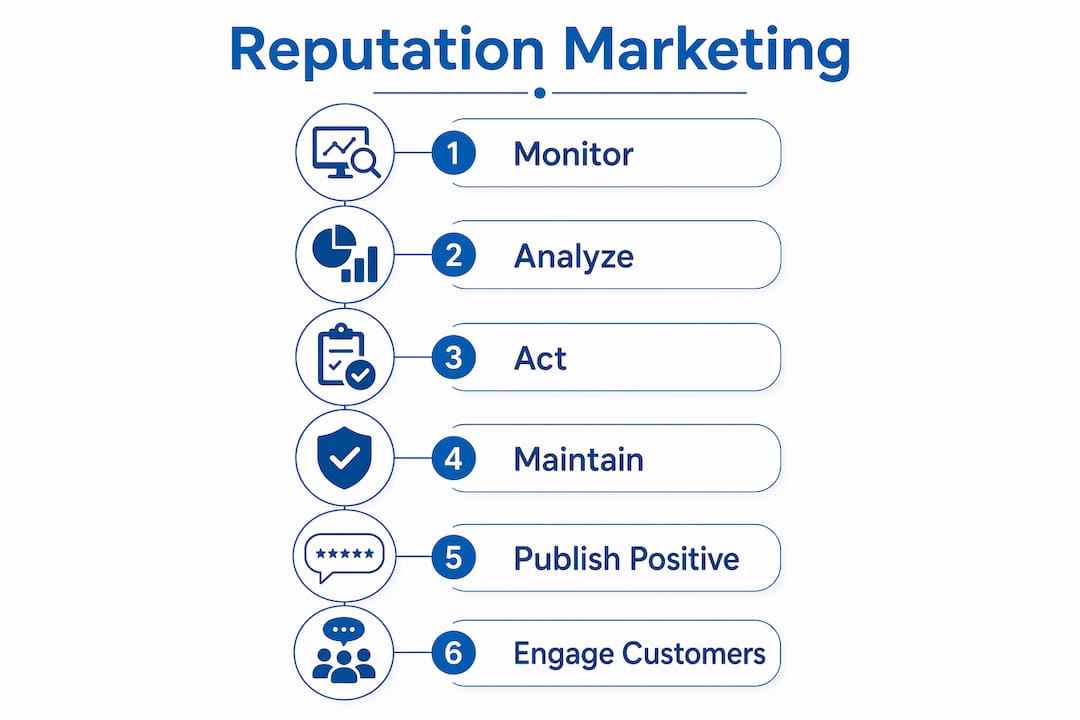
Generating and showcasing reviews
The volume and recency of your reviews matter more than a perfect rating. A 4.2-star rating with 400 recent reviews typically outperforms a 4.8-star rating with only 12 old reviews in terms of buyer confidence. Recency signals that your business is active and consistently delivering. Prioritize Google Reviews as your primary platform, then layer in industry-specific sites relevant to your sector.

Content marketing as reputation fuel
Authoritative content, including case studies, how-to articles, client testimonials, and thought leadership posts, reinforces your brand’s credibility in search results. When a prospect searches your business name, the first page of results tells your story. You want to control that story with content you created, not content others wrote about you.
Search engine result management
Pushing positive content to the top of search results is one of the most underrated tactics in reputation marketing. Publish consistently on your website, earn mentions from credible third-party sites, and optimize your Google Business Profile. This approach builds a buffer of positive content that naturally pushes less favorable results further down the page.
Here are the core tactics that form a complete reputation marketing program:
- Google Reviews and industry platforms: Actively request reviews after every positive customer interaction.
- Case studies and testimonials: Publish detailed success stories on your website and share them on social media.
- Thought leadership content: Write articles that demonstrate expertise in your field.
- Social proof signals: Display review counts, star ratings, and client logos prominently on your website.
- Community engagement: Respond to every review, positive or negative, to show you are attentive and professional.
Professionele tip: Automate your review request process. Send a follow-up message 24–48 hours after a service is completed, when customer satisfaction is highest. Platforms like Goonlinenow include built-in review request automation that removes the manual effort entirely.
Why online reputation marketing is critical for SMB growth
The business case for reputation marketing is direct and measurable. A one-star improvement on Yelp correlates with a 5–9% increase in revenue. That is not a marginal gain. For a small business generating $500,000 annually, a one-star improvement could mean $25,000 to $45,000 in additional revenue without adding a single new marketing channel.
Reputation marketing also influences your search rankings. Google’s local search algorithm factors in review quantity, recency, and response rate. A business with 200 recent reviews and active owner responses ranks higher than a competitor with 20 old reviews and no engagement. Your reputation directly affects how many people find you in the first place.
“Facts tell, but emotions sell.” Reputation marketing works because it curates a narrative of reliability and trust that connects with customers emotionally before they ever speak to you. That emotional connection, built through consistent reviews and authentic content, is what converts a browser into a buyer.
The long-term benefits of sustained reputation marketing extend beyond revenue. Strong reputation programs improve recruitment, because talented people research employers before applying. They improve partnership opportunities, because vendors and collaborators check your credibility. They also reduce customer acquisition costs, because word-of-mouth referrals increase when your online presence reinforces what happy customers already say privately.
Brands emphasizing proactive reputation marketing achieve better long-term growth and customer loyalty than those focused solely on reactive management. The difference compounds over time. A business that starts building its review base today will have a significant advantage over a competitor that waits for a crisis to prompt action.
You can learn more about proven reputation strategies specifically designed for SMBs to see how this plays out in practice.
How to implement a reputation marketing program for your business
A practical reputation marketing program does not require a large budget or a dedicated marketing team. It requires consistency and a clear process.
-
Audit your current reputation. Search your business name on Google, Yelp, and any industry-specific platforms. Note your average rating, review count, and the content that appears on the first page of results. This baseline tells you where to focus first.
-
Claim and complete all profiles. Your Google Business Profile, Facebook page, and any relevant industry directories should be fully completed with accurate contact information, photos, and a description of your services.
-
Build a review request system. Ask every satisfied customer for a review. Make it easy by sending a direct link to your Google review page via SMS or email. Timing matters: send the request within 24 hours of a positive interaction.
-
Publish content that builds authority. Write one article or case study per month that demonstrates your expertise. Share client success stories with permission. Post consistently on the social platforms your customers use.
-
Respond to every review. Thank customers for positive reviews with a specific, personal response. Address negative reviews calmly and constructively. Prospects read your responses as carefully as they read the reviews themselves.
-
Monitor your brand signals weekly. Check Google autocomplete for your business name. Autocomplete suggestions showing terms like “scam” or “lawsuit” signal a reputation issue that needs immediate attention, often before visible negative content appears in search results.
-
Measure and adjust monthly. Track your average star rating, review volume, and the sentiment of new reviews. Compare month over month to identify trends and adjust your outreach accordingly.
Professionele tip: Check your brand name in Google’s autocomplete bar every week. Type your business name and pause before pressing enter. The suggestions that appear reveal what people are searching for in connection with your brand. This is one of the fastest ways to catch a reputation problem early.
For a detailed walkthrough of the full process, the step-by-step reputation guide for SMBs covers monitoring and improvement in practical depth.
The mindset shift that most SMB owners miss
Most small business owners treat their online reputation the way they treat their car insurance. They think about it only when something goes wrong. That reactive mindset is the single biggest mistake I see SMBs make with their digital presence.
The businesses that grow consistently are the ones that treat reputation as a marketing asset, not a liability to manage. They collect reviews the way a sales team collects leads. They publish content the way a retailer stocks shelves. They respond to feedback the way a great customer service team handles calls. It is a daily practice, not a quarterly cleanup.
The other misconception I encounter constantly is that reputation marketing is about accumulating as many five-star reviews as possible. It is not. Reputation marketing shapes a compelling brand story that resonates emotionally. A business with 300 reviews averaging 4.3 stars, with thoughtful owner responses and detailed customer stories, is far more persuasive than a business with 50 perfect ratings and no engagement. Authenticity outperforms perfection every time.
Emerging tools, including AI-powered sentiment analysis and multichannel monitoring platforms, are making it easier to track brand signals across dozens of channels simultaneously. Real-time monitoring tools now integrate social listening, sentiment analysis, and engagement across 30 or more digital channels. The technology is accessible to SMBs today in ways it was not three years ago. The businesses that adopt these tools now will build a compounding advantage that is very difficult for slower competitors to close.
— Go
How Goonlinenow helps SMBs build reputation on autopilot
Reputation marketing works best when the process runs consistently in the background, without requiring your manual attention every day.
Goonlinenow is built specifically for SMBs that want to grow without adding complexity. The platform includes automated review request sequences sent via SMS and email, a unified inbox for responding to reviews and messages across channels, and content scheduling tools that keep your brand visible consistently. You get the full marketingautomatiseringssoftware stack, including CRM, funnels, and reputation management, in one affordable system with done-for-you setup and real human support. No contracts, no hidden fees, and no tech headaches. Your reputation builds while you focus on running your business.
Veelgestelde vragen
What is online reputation marketing?
Online reputation marketing is the proactive strategy of using positive reviews, authoritative content, and strategic promotion to build a trustworthy brand image that drives customer conversions. It differs from reputation management in that it focuses on growth rather than damage control.
How does online reputation marketing differ from online reputation management?
Reputation marketing is proactive and builds a positive brand narrative through reviews and content. Reputation management is reactive and focuses on monitoring and responding to negative feedback or crises.
Why does online reputation matter for small businesses?
A one-star improvement in a business’s rating correlates with a 5–9% increase in revenue, and 87% of consumers use Google to evaluate local businesses before making a purchase decision.
How do I start improving my online reputation?
Audit your current search presence, claim all business profiles, build a consistent review request process, and publish content that demonstrates your expertise. Responding to every review is one of the highest-impact steps you can take immediately.
What tools help with reputation marketing for SMBs?
Platforms that combine review automation, social listening, and multichannel engagement give SMBs the most complete picture of their brand health. Goonlinenow includes these capabilities within its all-in-one reputation management tools designed specifically for small and mid-sized businesses.