

TL;DR:
- A social media marketing plan is a documented roadmap that links business goals to content actions and performance metrics.
- Creating clear, measurable goals using the SMART framework and analyzing the target audience help guide platform selection and content strategy.
A social media marketing plan is a documented roadmap that connects your business goals to specific content actions, platform choices, and performance metrics. Without one, you are posting randomly and hoping for results. The industry term for this process is “social media strategy,” and it covers everything from audience research to content scheduling to monthly reporting. This guide walks you through how to create a social media marketing plan using proven frameworks like SMART goals, content pillars, and 30 to 90-day planning cycles. Tools like Buffer, Sprout Social, and monday.com have shaped the best practices covered here, and you will leave with a clear, repeatable process you can start this week.
How to set clear, measurable social media marketing goals
Goal setting is the first step in any effective social media plan, and skipping it is the single biggest mistake SMB owners make. Random acts of content lead to random results. You need a destination before you plan the route.

The SMART framework gives you that destination. SMART-doelen are Specific, Measurable, Achievable, Relevant, and Time-bound. That structure prevents vague aspirations like “grow our Instagram” from replacing real targets like “gain 500 new Instagram followers by march 31.”
Common SMART goals for SMBs include:
- Brand awareness: Reach 10,000 unique accounts on Facebook within 60 days
- Lead generation: Drive 200 website visits per month from LinkedIn posts
- Customer retention: Achieve a 15% engagement rate on email-linked social posts each quarter
- Revenue support: Generate 20 inbound inquiries per month from social media by june 30
Once your goals are set, choose 2 to 3 KPIs per goal. Tracking too many metrics dilutes your focus and pulls attention toward vanity numbers like total likes. Engagement rate, click-through rate, and conversion rate are the metrics that connect social activity to real business outcomes. You can track these inside native platform analytics or through tools like Sprout Social and Hootsuite.
Professionele tip: Link every social media goal directly to a business metric, such as revenue, retention, or awareness. Goals tied to business outcomes are far easier to defend when budget conversations come up.
Who is your audience and where do they spend time online?
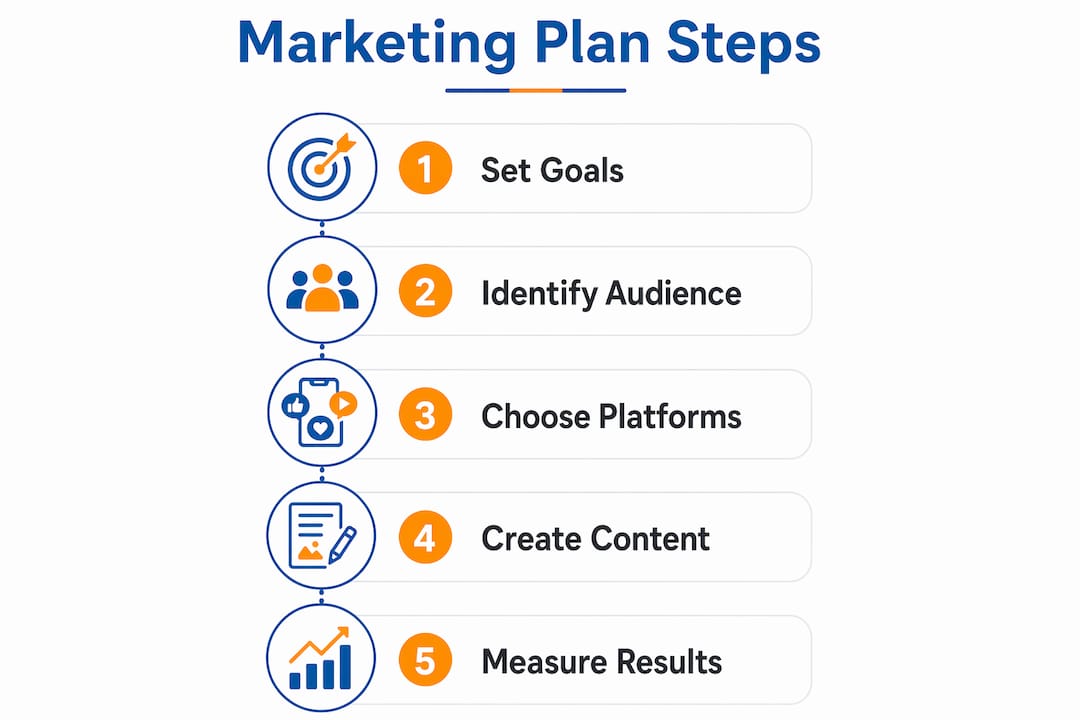
Knowing your audience is what separates relevant content from content that gets ignored. You cannot choose the right platform, tone, or format until you know exactly who you are trying to reach. This step directly shapes every decision that follows.
Use these four steps to build a clear audience picture:
- Analyze your existing customers. Pull data from your CRM or sales records. Look at age, location, job role, and purchase behavior. Patterns in your current buyers reveal who your best prospects are.
- Study your competitors. Look at which platforms they post on, what content gets the most engagement, and what their followers are saying in comments. This reveals where your shared audience is active.
- Use social listening tools. Platforms like Sprout Social and native tools like Facebook Audience Insights show you demographic breakdowns and interest categories for your followers.
- Build one or two buyer personas. A persona is a one-page profile of your ideal customer, including their goals, frustrations, preferred platforms, and the type of content they engage with most.
For a social media target market exercise to work, you need to be specific. “Women aged 25 to 45 who own small service businesses and use Instagram daily” is a usable persona. “Small business owners” is not.
Professionele tip: Check the comment sections on your top-performing posts. The language your audience uses to describe their problems is the exact language you should use in your content.
Which platforms should you use and what content pillars should you build?
Platform selection is where most SMBs waste the most time and money. Successful social media plans focus on quality and audience-centric platform selection rather than maintaining a presence on every network. Pick two platforms where your audience is most active and commit to those fully before expanding.
Content pillars are the thematic categories that organize everything you post. A salon might use three pillars: education (hair care tips), social proof (before and after photos), and promotion (seasonal offers). Every post fits into one of these categories, which keeps your feed consistent and purposeful.
| Platform | Best for | Content format | SMB fit |
|---|---|---|---|
| Visual products, lifestyle brands | Reels, Stories, carousels | High for retail, food, beauty | |
| B2B services, professional coaching | Articles, text posts, short video | High for consulting, education | |
| Local services, community building | Posts, events, ads | High for local SMBs | |
| TikTok | Younger audiences, entertainment | Short video | High for fashion, food, fitness |
| DIY, home, fashion, food | Pins, idea boards | High for product-based businesses |
Balance your content mix between evergreen posts (content that stays relevant for months) and timely posts (seasonal promotions, trending topics, news). A practical ratio is 70% evergreen to 30% timely. That ratio keeps your calendar manageable and your content useful long after the publish date.
How to build and manage a social media content calendar
A content calendar is the operational core of your social media plan. Without one, you default to posting when you remember to, which breaks consistency and makes performance measurement nearly impossible. A 90-day planning cycle acts as an operational playbook that includes your calendar, campaign timelines, and KPI checkpoints.
Here is how to build yours:
- Gather content ideas first. Brainstorm 20 to 30 post ideas per month using your content pillars as categories. Pull from customer questions, product updates, industry news, and seasonal events.
- Decide your posting cadence. Start with three to five posts per week per platform. Consistency matters more than volume. Posting daily for two weeks and then going silent for a month hurts your reach.
- Map key dates. Mark product launches, holidays, sales events, and industry dates on your calendar before filling in regular posts. These anchor points shape the rest of your schedule.
- Batch your content creation. Set aside one day per week or two days per month to write captions, design graphics, and record videos in bulk. Batching reduces the daily mental load significantly.
- Schedule in advance. Tools like Sprout Social and Planable let you schedule posts weeks ahead and manage approval workflows. Structured approval processes prevent last-minute chaos and keep your content on strategy.
Sprout Social recommends breaking your first month into weekly sprints: week one for goal setting and metrics, week two for platform and brand presence, and weeks three and four for content planning and scheduling. That sprint structure gives you a clear starting point even if you are building your plan from scratch.
Professionele tip: Connect each scheduled post to a specific goal and KPI inside your calendar. A post tagged to “lead generation” with a click-through rate target teaches you far more than an untagged post ever will.
How do you measure and improve your social media marketing plan?
Measurement turns your social media plan from a one-time document into a living system. Treating your plan as a repeatable operating rhythm with regular reviews is what separates businesses that grow from those that plateau.
Use this three-tier review schedule:
- Weekly check-ins (15 minutes). Review reach, engagement, and click-through rates for the past seven days. Flag any posts that significantly over or underperformed. Adjust next week’s schedule if needed.
- Monthly reviews (1 hour). Compare results against your SMART goals. Identify which content pillars drove the most engagement and which platforms delivered the most traffic or leads. Use this data to shift your content mix.
- Quarterly evaluations (half day). Step back and assess the full strategy. Are your goals still aligned with business priorities? Do your platforms still match where your audience spends time? Revise your plan for the next quarter based on what the data shows.
| Metric | What it measures | Review frequency |
|---|---|---|
| Bereik | How many unique accounts saw your content | Weekly |
| Engagement rate | Likes, comments, shares as a percentage of reach | Weekly |
| Click-through rate | Clicks to your website from social posts | Monthly |
| Conversion rate | Leads or sales generated from social traffic | Monthly |
| Follower growth rate | Net new followers over a set period | Quarterly |
Linking social media goals to business revenue makes your reporting credible inside your organization. When you can show that a LinkedIn campaign generated 40 inbound leads last quarter, you have a business case for continued investment. Vanity metrics like total impressions cannot do that. You can find a practical framework for tracking these outcomes in this social media goals guide.
For a broader view of how your social media activity connects to website performance, a resource like this website KPIs guide covers the measurement tools and reporting routines that tie it all together.
What I have learned from watching SMBs build their first social media plans
Most SMB owners I work with start in the same place: they have been posting for months, they have a decent following, and they have no idea whether any of it is working. The plan exists in someone’s head, not on paper. That is the core problem.
The fix is not a better tool or more content. The fix is sequence. monday.com defines a complete plan as spanning from strategy definition all the way to scalable execution and reporting. That full arc matters. Businesses that skip the goal-setting and audience steps and jump straight to content creation are building on sand.
The second pattern I see is platform overextension. A two-person team cannot maintain a quality presence on Instagram, LinkedIn, Facebook, TikTok, and Pinterest simultaneously. The result is thin, inconsistent content everywhere instead of strong, consistent content somewhere. Pick two platforms. Do them well. Expand only when you have the capacity and the data to justify it.
The third thing I have found is that the businesses that grow fastest treat their social media plan as a quarterly operating document, not a one-time project. They review it, revise it, and recommit to it every 90 days. That cycle is what creates compounding results over time. A digital marketing plan for small businesses follows the same principle: build, measure, and refine on a regular schedule.
— Go
How Goonlinenow helps you execute your social media plan faster
Building a social media plan is one thing. Executing it consistently while running a business is another challenge entirely.
Goonlinenow gives SMB owners the tools to automate campaign scheduling, track engagement across channels, and report on performance without juggling five separate platforms. The all-in-one system combines marketing automation for SMBs with CRM, email, and lead management in one place. You get done-for-you setup, real human support, and no hidden fees. Whether you are building your first social media plan or scaling an existing one, Goonlinenow removes the operational friction so you can focus on strategy and growth.
Veelgestelde vragen
What is a social media marketing plan?
A social media marketing plan is a documented strategy that aligns your business goals with specific content actions, platform choices, and performance metrics. It typically includes audience personas, content pillars, a publishing calendar, and a measurement framework.
How do I start writing a social media plan from scratch?
Start by setting SMART goals tied to business objectives, then define your audience, choose two platforms where they are most active, and build a content calendar around three to five content pillars. Tools like Buffer and Sprout Social offer free templates to speed up this process.
How often should I review my social media marketing plan?
Review your plan weekly for performance data, monthly for goal progress, and quarterly for full strategy alignment. Operationalizing your plan in monthly or quarterly cycles produces the most meaningful data for optimization.
What are the most important KPIs for a social media plan?
Track 2 to 3 KPIs per goal to stay focused. Engagement rate, click-through rate, and conversion rate are the metrics most directly tied to business outcomes, while reach and follower growth rate provide useful context for brand awareness goals.
How do I choose which social media platforms to include in my plan?
Choose platforms based on where your specific audience spends the most time, not where you personally prefer to post. Start with two platforms, build consistency there, and use performance data to decide whether expansion makes sense after 90 days.