
TL;DR:
- A digital campaign is a structured, time-bound set of online activities designed to achieve a specific business goal, such as generating leads or launching a product. It differs from ongoing digital marketing by being focused, intensive, and with a clear start and end date to deliver measurable results. Effective campaigns require strategic planning, audience targeting, channel selection, consistent messaging, and real-time adjustments to maximize success.
A digital campaign is a structured, time-bound set of coordinated online activities designed to achieve a specific business goal, such as generating leads, launching a product, or driving seasonal sales. In the industry, you’ll also hear this called a digital marketing campaign, and both terms refer to the same thing: a focused effort with a defined start date, end date, objective, and measurable outcome. Unlike general brand presence online, a digital campaign has a beginning, a purpose, and a finish line. For marketing professionals and small business owners, understanding this distinction is the difference between spending money on activity and spending money on results.
What is a digital campaign and what types exist?
Digital marketing campaigns require five core elements to function: a clear objective, a defined audience, selected channels, an allocated budget, and measurable KPIs. Without all five, you have activity, not a campaign. The most common types of digital campaigns each serve a different strategic purpose, and choosing the right type depends on where your audience is and what you want them to do.

Here is a breakdown of the six primary campaign types:
| Campaign Type | Primary Channel | Typical Use | Key Benefit |
|---|---|---|---|
| SEO Campaign | Google, Bing | Long-term organic visibility | Compounding traffic over time |
| PPC Campaign | Google Ads, Meta Ads | Immediate lead generation | Fast, measurable results |
| Social Media Campaign | Instagram, LinkedIn, TikTok | Brand awareness, engagement | Direct audience interaction |
| Email Campaign | Mailchimp, Klaviyo | Nurturing leads, retention | High ROI, personal reach |
| Content Marketing Campaign | Blog, YouTube, Podcasts | Authority building, SEO | Trust and long-term traffic |
| Influencer Campaign | Instagram, YouTube | Product launches, reach | Borrowed credibility |
De most effective strategies combine 3 to 5 of these channels simultaneously rather than relying on one. That combination matters because each channel reaches your audience at a different stage of their decision process. A PPC ad catches someone searching with intent. An email nurtures someone already familiar with your brand. A content piece builds trust before they ever search for you.
- SEO campaigns work best for businesses with a 3 to 6 month runway and a content team.
- PPC-campagnes suit product launches or time-sensitive promotions where speed matters.
- Email campaigns consistently deliver the highest return on investment for SMBs with an existing contact list.
- Influencer campaigns work well for consumer products targeting younger, urban audiences who respond to peer recommendations.
Professionele tip: Don’t build your campaign around the channel you’re most comfortable with. Build it around where your customer is most likely to take action. A local service business often gets better results from Google Ads and email than from Instagram, regardless of how popular Instagram feels.
How does a digital campaign differ from ongoing digital marketing?
This is one of the most misunderstood distinctions in marketing, and it costs businesses real money. Campaigns are temporary, focused, and more intensive than ongoing digital marketing, designed to achieve specific short-term goals within a defined window. Ongoing digital marketing, by contrast, is continuous brand presence management: posting regularly on social media, maintaining your website’s SEO health, and sending a monthly newsletter.
Think of it this way. Ongoing marketing keeps the lights on. A campaign turns them up.
The practical differences matter when you’re allocating budget and attention:
- Intensity: A campaign demands concentrated effort across multiple channels at once. Ongoing marketing operates at a sustainable, lower-intensity pace.
- Coordination: Campaigns require all channels to carry the same message at the same time. Your Google Ads, email, and social posts should all reinforce each other during the campaign window.
- Budget allocation: Campaign budgets are front-loaded and time-specific. Ongoing marketing budgets are distributed evenly across the year.
- Measurement: Campaigns have a clear start and end point, making ROI calculation straightforward. Ongoing marketing results are harder to attribute to a single period.
Many businesses fail by treating campaigns with the same low-intensity approach as daily social media updates. They run a “campaign” that looks identical to their regular content, with no increase in frequency, no unified message, and no defined end date. The result is that the campaign disappears into the background noise of their regular activity and produces no measurable lift.
What makes digital campaigns effective?
Effective campaigns are built on planning, not instinct. Here is a practical sequence that works for marketing professionals and small business owners alike.
-
Define one primary objective. A campaign focused on lead generation looks completely different from one focused on brand awareness. Trying to achieve both simultaneously usually achieves neither. Pick one goal and build everything around it.
-
Identify your audience with precision. Digital marketing allows precise targeting based on interests, behaviors, and location, unlike traditional media’s broad reach. Use this capability. A real estate agency running a campaign for first-time buyers should target by age range, location, and renter status, not just “anyone interested in property.”
-
Select 3 to 5 channels that align with your audience’s behavior. A B2B software company gets better campaign results from LinkedIn and email than from TikTok. A local salon gets better results from Instagram and Google Ads than from LinkedIn. Channel selection should follow audience behavior, not trends.
-
Build creative assets that carry one consistent message. Your ad copy, email subject line, landing page headline, and social post should all reinforce the same core message. Inconsistency across channels confuses the audience and reduces conversion rates.
-
Monitor KPIs in real time and adjust mid-campaign. Effective campaign management involves constant monitoring with mid-flight adjustments rather than a “set and forget” approach. If your email open rate is strong but your landing page conversion is low, fix the landing page before the campaign ends, not after.
-
Set a clear end date and post-campaign review. Campaigns without an end date drift into ongoing marketing and lose their intensity. Schedule a review within one week of the campaign closing to capture what worked before the data gets stale.
A critical mistake many businesses make is focusing campaigns on channels rather than the customer journey. Success depends on delivering the right message to the right person at the moment it is relevant, regardless of platform. A customer who just clicked your Google Ad should land on a page that continues the exact conversation the ad started. That continuity is what converts.
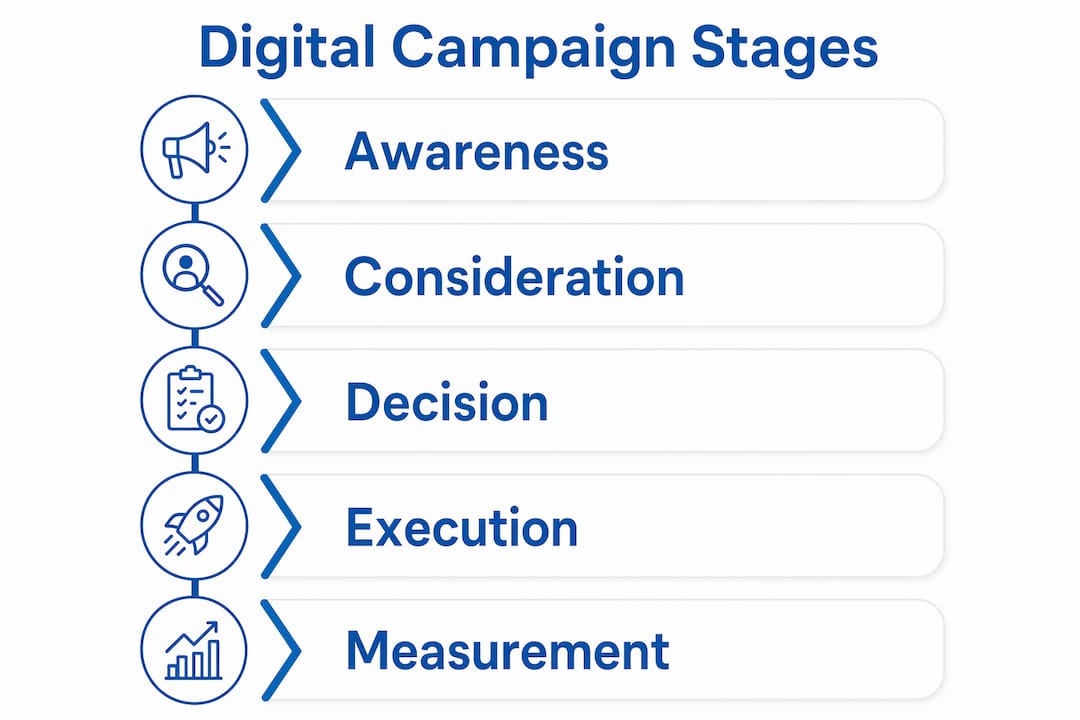
Professionele tip: Map your campaign to three stages of the customer journey: awareness, consideration, and decision. Assign at least one channel and one message to each stage. Most SMB campaigns fail because they only address the decision stage and skip the first two entirely.
What are the benefits and limitations of digital campaigns?
Digital campaigns offer speed and scale that traditional marketing cannot match. Digital campaigns can reach 500,000 people in a single constituency within 24 hours, a reach that is impossible through door-to-door or print advertising alone. For SMBs, this means a well-funded campaign on Google Ads or Meta can compete with much larger brands in terms of visibility.
The core benefits of digital campaigns include:
- Measurability: Every click, open, conversion, and cost per acquisition is trackable. You know exactly what your campaign produced.
- Speed: A Google Ads campaign can go live in hours. A direct mail campaign takes weeks.
- Cost efficiency: You set the budget and can pause spending the moment results drop. Traditional media requires upfront commitments.
- Schaalbaarheid: A campaign that works at $500 can often be scaled to $5,000 with predictable results.
The limitations are real and worth acknowledging. Digital campaigns struggle to build the depth of trust that face-to-face interaction creates. For high-value or high-trust purchases, such as financial services, healthcare, or premium consulting, digital alone rarely closes the deal.
“The most successful digital campaigns are hybrid efforts combining online content with real-world events to amplify authenticity and engagement.”
For sensitive or high-trust categories, a hybrid approach works best. A financial advisor running a digital campaign for retirement planning gets better results when the campaign drives registrations to a live webinar or in-person seminar, not just a contact form. The digital campaign creates awareness and interest. The human interaction closes the trust gap. Explore multi-channel campaign approaches to see how SMBs are combining these methods effectively in 2026.
What I’ve learned from running digital campaigns for SMBs
After working with small business owners across coaching, real estate, and professional services, one pattern stands out clearly. The businesses that get the best results from digital campaigns are not the ones with the biggest budgets. They are the ones that treat campaigns as distinct, high-priority projects rather than extensions of their regular marketing activity.
The most common failure I see is the “set and forget” campaign. A business owner sets up a Google Ads campaign, writes one email, and posts twice on Instagram, then waits for results. When nothing happens, they conclude that digital marketing doesn’t work for their industry. What actually happened is that they ran an ongoing marketing activity at campaign intensity for two weeks and expected campaign-level results.
The second pattern worth noting is the obsession with a single channel. I’ve seen businesses spend their entire campaign budget on Facebook Ads because that’s where they feel comfortable, ignoring the fact that their audience is actively searching on Google and reading industry newsletters. Combining channels for better reach is not optional for competitive markets. It’s the baseline.
My honest recommendation: before you spend a dollar on a campaign, write down the one thing you want the audience to do, the one message you want them to hear, and the one metric that will tell you whether it worked. If you can’t answer all three in one sentence each, you’re not ready to run the campaign yet.
— Go
Run smarter digital campaigns with Goonlinenow
Running a digital campaign across multiple channels takes coordination, timing, and the right tools. Goonlinenow gives SMBs everything they need in one place: email automation, SMS follow-ups, lead funnels, CRM tracking, and paid campaign management, all without the complexity or cost of enterprise platforms. Instead of juggling five separate tools and losing leads between them, you manage your entire campaign from a single dashboard with real human support included. If you’re ready to turn your next campaign into measurable growth, explore how marketingautomatiseringssoftware from Goonlinenow can handle the execution while you focus on strategy. You can also see proven campaign ROI results from SMBs already using the platform.
Veelgestelde vragen
What is a digital campaign in simple terms?
A digital campaign is a time-bound, goal-oriented set of online marketing activities designed to achieve one specific outcome, such as generating leads, driving sales, or building brand awareness. It uses channels like Google Ads, email, social media, and content to reach a defined audience within a set timeframe.
How is a digital campaign different from digital marketing?
Digital marketing is the ongoing practice of building your brand online. A digital campaign is a temporary, intensive effort within that practice, focused on a single goal with a clear start and end date.
What are the main types of digital campaigns?
The six primary types are SEO campaigns, PPC campaigns, social media campaigns, email campaigns, content marketing campaigns, and influencer campaigns. Each serves a different objective and works best when combined with two or more complementary types.
How long should a digital campaign run?
Most effective digital campaigns run between two and eight weeks, depending on the objective and budget. Product launches often run two to four weeks. Brand awareness campaigns may run six to eight weeks to build sufficient frequency with the audience.
What is the most important element of a successful digital campaign?
A clearly defined objective tied to a measurable KPI is the single most important element. Without it, real-time KPI monitoring and mid-campaign adjustments become impossible, and you have no way to determine whether the campaign succeeded.