

TL;DR:
- Successful small business marketing requires clear goals, targeted audience research, and focused channel selection.
- Consistent monitoring, testing, and adjusting strategies based on data drive campaign effectiveness and ROI.
- Automation tools streamline execution, allow quick optimization, and help small businesses compete with larger brands.
Running a marketing campaign for small business growth is harder than it looks. You’re competing against brands with full marketing departments, five-figure ad budgets, and agencies on retainer. Most small business owners either overspend on channels that don’t convert or underinvest because they’re not sure where to start. This guide cuts through that confusion. You’ll get a clear process for setting up your campaign, executing it across the right channels, tracking what matters, and improving as you go. No guesswork. No fluff. Just a practical roadmap that works for real businesses with real constraints.
Building the foundation for your marketing campaign
Before you spend a single dollar or write a single post, you need to answer four questions. Who are you trying to reach? What do you want them to do? What makes you different? And how will you know if it worked?
Most small business owners skip straight to tactics and wonder why their campaigns fall flat. The prep work is where campaigns are won or lost.
Start with a single, measurable objective. Your campaign goal should be specific, not broad. “Get more customers” is not a goal. “Generate 50 qualified leads from local homeowners aged 30 to 55 in the next 60 days” is a goal. Clarity here shapes every decision that follows, from your channel selection to your messaging.
Know your audience before you spend. Dig into your existing customer data. Look at who buys from you most often, who spends the most, and who refers others. If you’re newer and don’t have that data yet, look at online communities, review platforms, and social conversations where your ideal customer is already talking. Audience research is not optional. Investing 20% or more of your budget in segmentation and creative testing produces the highest ROI for small businesses.
Here are the key prerequisites to check off before launch:
- Define your campaign objective (awareness, leads, sales, retention)
- Document your ideal customer profile including demographics, behaviors, and pain points
- Audit your budget, available time, and team capacity honestly
- Write a clear unique selling proposition that separates you from local competitors
- Set 3 to 5 KPIs you will track throughout the campaign
Professionele tip: Write your USP as a one-sentence statement that a 10-year-old could understand. If you struggle to explain why someone should choose you over the shop down the street, your audience will struggle too.
How to plan and launch your campaign
With your foundation in place, it’s time to build the actual campaign. Think of this as a five-stage process.
-
Select your channels based on where your audience already is. A local restaurant should prioritize Instagram, Google Business Profile, and email. A B2B service provider gets more traction from LinkedIn and targeted email sequences. Optimizing your Google Business Profile puts your business in the local map pack above organic results, for free. That’s a channel no small business should ignore.
-
Develop messaging tailored to each channel. What works on Instagram does not work in an email subject line. Your core message stays consistent, but the format, tone, and length adapt. An Instagram post is visual and short. An email nurture sequence is personal and specific. A Google ad is direct and keyword-driven. Tailor each piece to fit how people use that platform.
-
Schedule and automate your distribution. This is where small businesses gain real efficiency. Marketing automation for small teams makes it possible to run multi-channel campaigns without having someone manually post, email, or follow up every day. Tools that connect your CRM, email, and social scheduling can handle the repetitive execution while you focus on the work only you can do.
-
Include a direct, specific call to action. Vague CTAs kill conversions. “Learn more” is not a CTA. Research shows that a specific offer like 20% off a first purchase is far more effective at converting digital engagement into actual visits or purchases. Be specific about what you want people to do next.
-
Test before you go all-in. Run a small test with two or three creative variations before committing your full budget. This applies to ad images, email subject lines, and landing page headlines. The data from a small test is worth more than your best guess.
Here’s a channel comparison to help you prioritize based on your goals:
| Kanaal | Best for | Approximate cost | Time to results |
|---|---|---|---|
| E-mailmarketing | Nurturing leads, retention | Low | 1 to 4 weeks |
| Google Bedrijfsprofiel | Local visibility | Free | 1 to 2 weeks |
| Social media ads | Awareness, traffic | Medium | 1 to 3 weeks |
| SEO-inhoud | Long-term traffic | Low to medium | 3 to 6 months |
| Local digital ads | Foot traffic, local leads | Medium | 1 to 2 weeks |
Email marketing delivers $36 for every $1 spent, making it one of the most cost-effective channels available to small businesses. It’s also one you fully own, unlike social platforms that can change their algorithm overnight.

Professionele tip: If you’re launching on a tight budget, start with email and Google Business Profile. Both can deliver results without paid spend, and they compound over time.
Managing your campaign once it’s live
Launching is not the finish line. What you do during the campaign often determines whether it succeeds or stalls.
The most important habit to build is checking your metrics consistently, not obsessively. Pick two or three core metrics aligned with your campaign objective and review them weekly. For lead generation campaigns, watch cost per lead and conversion rate. For awareness campaigns, track reach and engagement. For sales campaigns, track revenue attributed to the campaign and return on ad spend.
- Adjust targeting before adjusting budget. If your ads are not converting, the problem is usually audience targeting or messaging, not the amount you’re spending. Narrow your geographic or demographic targeting before you add more money.
- Refresh your creative every two to three weeks. Ad fatigue is real. The same image and headline loses effectiveness quickly. Localized digital ad spend for small businesses increased 18% year over year because more owners are discovering that targeted, locally relevant creative outperforms generic content.
- Use remarketing to convert warm prospects. People who visited your website or engaged with your content already showed interest. Remarketing ads to that audience consistently outperform cold traffic campaigns. Set up a simple pixel-based retargeting campaign if you’re running paid ads.
- Avoid chasing vanity metrics. Page likes, follower counts, and impressions feel good but don’t pay your bills. Keep your focus on metrics tied to real business outcomes: leads generated, appointments booked, products sold.
Professionele tip: Set a campaign review date at launch, not after. Block 30 minutes every Friday to check your numbers. Teams that review weekly catch problems early and fix them before they drain the budget.
Measuring results and learning from every campaign
Once your campaign wraps, the real learning begins. This step is the most skipped and the most valuable.
Start by comparing your results against the KPIs you set before launch. Did you hit your lead target? What was the actual cost per acquisition? Which channel performed best? Write the answers down in a simple one-page document. That document becomes the input for your next campaign.
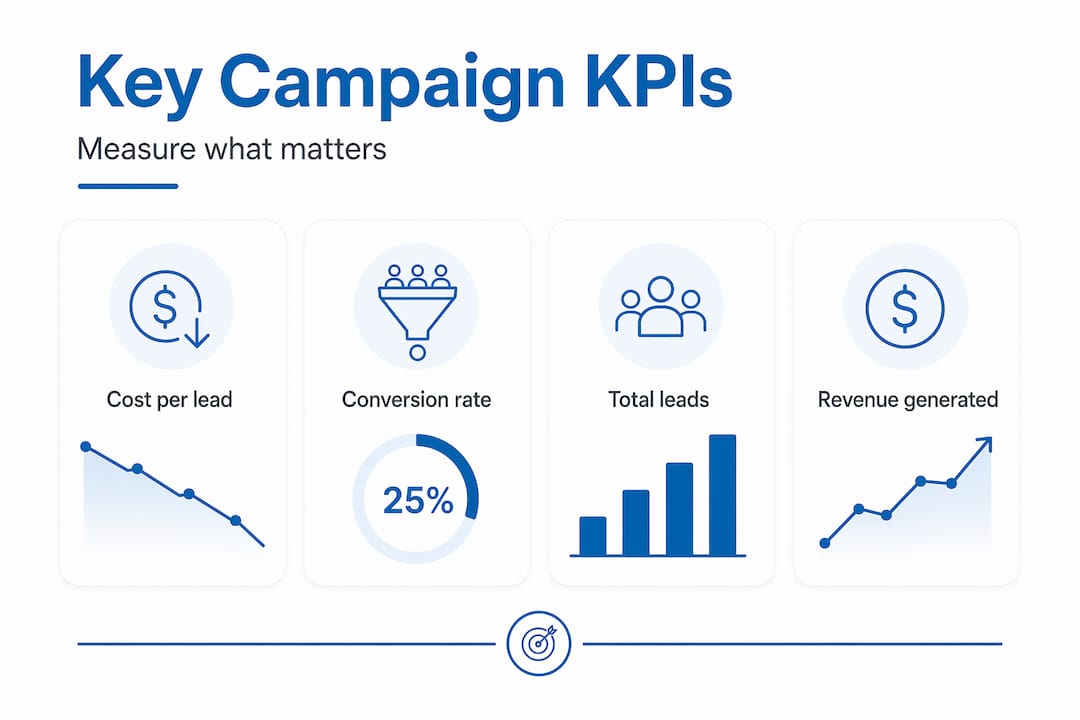
| Metric | What it tells you |
|---|---|
| Cost per lead | How efficiently you’re acquiring new prospects |
| Conversion rate | How well your offer and CTA are performing |
| Customer lifetime value | Whether the customers you acquired are worth the spend |
| Return on ad spend | The revenue generated per dollar of paid advertising |
| Channel attribution | Which platform actually drove results |
Beyond the numbers, look at your CRM data. Which leads became customers? Which ones went cold? Understanding that pattern tells you whether your campaign attracted the right audience or just a lot of people who were never a good fit. This is where marketing automation benefits become very clear: automated tracking makes this analysis fast and accurate rather than a manual headache.
The brands that grow consistently are not the ones with the biggest budgets. They’re the ones that apply what they learn. Document your wins, document your failures, and carry that knowledge into the next campaign.
Digital marketing tools that simplify everything
The best advertising strategies for small businesses today combine human creativity with automated execution. Here’s what good automation does for your campaigns:
- Saves time on repetitive tasks. Automated email sequences, scheduled social posts, and follow-up SMS messages run without manual effort after setup.
- Reduces human error. No missed follow-ups, no forgotten lead responses, no inconsistent messaging.
- Enables multi-channel execution. Marketing automation platforms integrate campaign management, CRM, creative tools, and financial oversight into one workflow.
- Makes real-time optimization possible. You see what’s working and shift resources quickly rather than waiting for a monthly report.
- Keeps you competitive. Hyper-local targeting campaigns have achieved a cost per lead under $5 for brick-and-mortar businesses, a result that was once only accessible to businesses with large agencies.
For a deeper look at selecting the right tools, the marketing automation checklist for SMBs from BabyLoveGrowth is a practical starting point.
My honest take on small business marketing campaigns
I’ve seen hundreds of small business marketing campaigns across industries, and the pattern that separates the ones that work from the ones that don’t is surprisingly consistent. It’s not budget. It’s not the channel. It’s whether the owner was willing to stay in learning mode after launch.
The businesses I’ve worked with that grew the fastest were not the ones with the slickest ads. They were the ones that committed to testing small, measuring honestly, and adjusting fast. Small teams can pivot and optimize faster than any large competitor. That’s a genuine structural advantage most small business owners don’t realize they have.
What I’ve also learned is that the biggest waste in small business marketing is not a bad channel choice. It’s a fuzzy goal. When you don’t know exactly what success looks like, you can’t recognize it when it happens. And you definitely can’t replicate it.
My advice? Write your goal at the top of a whiteboard before you build anything. Keep it visible throughout the campaign. Every decision you make, every dollar you spend, should connect back to that goal.
Combine that discipline with even basic automation, and you’ll outperform most local competitors who are still running campaigns on instinct. The data is there for the taking. Use it.
— Go
Take your next campaign further with Goonlinenow
Building a marketing campaign for small business success takes strategy, consistency, and the right tools in place. Goonlinenow makes all three easier to achieve.
Goonlinenow combines marketing automation for SMBs with an all-in-one CRM, email and SMS automation, lead nurturing, and real human support. You get done-for-you setup, no hidden fees, and a platform built specifically for businesses that don’t have time for complex tech. Whether you’re running your first campaign or your fiftieth, having your tools, data, and execution in one place changes how fast you can move. See how Goonlinenow helps small businesses drive measurable growth without the enterprise price tag.
Veelgestelde vragen
What is the first step in a small business marketing campaign?
Define a specific, measurable objective before selecting any channels or creating content. Your goal, whether it’s lead generation, brand awareness, or direct sales, determines every other decision in the campaign.
Which marketing channels work best for small businesses?
Email marketing and Google Business Profile offer the strongest return for small businesses with limited budgets. Email delivers $36 for every $1 spent, making it one of the most cost-effective options available.
How do I know if my marketing campaign is working?
Track KPIs aligned to your original goal, such as cost per lead, conversion rate, and revenue attributed to the campaign. Review these weekly rather than waiting until the campaign ends.
How much should a small business spend on marketing?
There’s no universal answer, but allocating at least 20% of your campaign budget to audience segmentation and creative testing produces the highest returns, according to SMB case study data.
Can small businesses compete with larger companies in marketing?
Yes. Small teams make faster decisions and can pivot campaigns in real time, which is a structural advantage over larger competitors with longer approval chains and slower execution.