

TL;DR:
- Effective online campaigns in 2026 rely on strategic platform selection, audience targeting, and continuous optimization. SMBs should focus on Meta, Google, and video platforms like TikTok, balancing budget allocation and creative native messaging for better results. Transparency, real-time AI-driven adjustments, and marketing automation are essential trends for maximizing campaign success.
An online campaign is a structured digital marketing effort designed to achieve specific business goals through coordinated advertising, content, and outreach across digital channels. For marketing professionals and business owners at small to mid-sized companies, the difference between a campaign that converts and one that drains budget comes down to platform selection, targeting precision, and continuous optimization. Social media advertising alone is projected to reach $640 billion by 2030, rising from 33% to 44% of total online ad spend. That number signals one thing clearly: the competition for digital attention is intensifying, and only well-structured campaigns will win.
What platforms define a successful online campaign in 2026?
Platform selection is the single most consequential decision in any digital marketing campaign. Choose the wrong channel and even a brilliant creative will underperform. The dominant players in 2026 are Google Ads, Meta (Facebook and Instagram), YouTube, and TikTok, each with distinct strengths and cost profiles.
Meta owns Facebook and Instagram, accounting for 54% of social media ad revenue in 2025, rising to nearly 70% when China is excluded. Google Ads commands search intent, capturing users who are actively looking for solutions. YouTube and TikTok dominate video consumption, and video drives over 60% of total social media ad revenue. That dominance makes video formats like Reels, Shorts, and TikTok clips non-negotiable for any brand prioritizing engagement.
The cost and performance gap between platforms is significant. Here is how the major platforms compare in 2026:
| Platform | Avg. CPC | Conversiepercentage | Avg. ROAS |
|---|---|---|---|
| Google-advertenties | $4.22 | 3.75% | 4.2x |
| Meta-advertenties | $0.97 | 0.89% | 5.8x |
| Combined use | Lower blended CPC | Higher overall CVR | Up to 35% lower CPA |
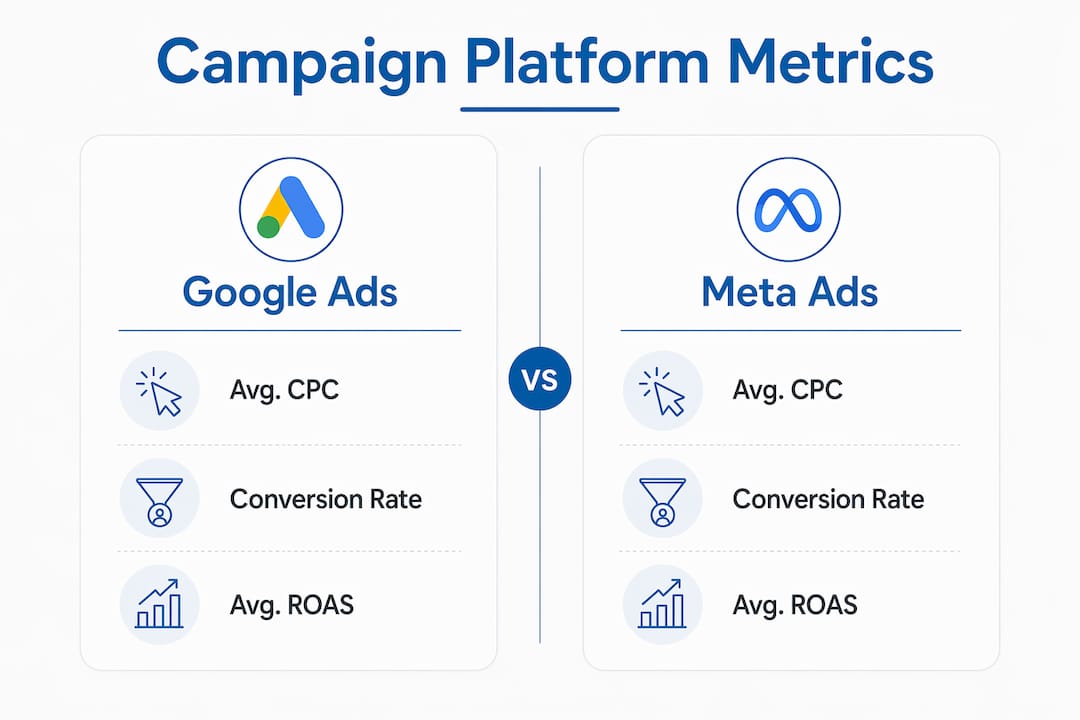
Google-advertenties average CPC of $4.22 reflects its high purchase-intent audience, making it expensive but efficient for bottom-of-funnel conversions. Meta’s lower CPC makes it ideal for awareness and retargeting at scale, particularly for SMBs with tighter budgets. Explore 7 types of digital campaigns to understand which formats align with your specific business goals before committing budget.
Video completion rates also differ by platform. Meta platforms achieve 71% video completion versus YouTube’s 54%. This means short-form video on Meta delivers stronger message retention per dollar spent, a critical insight for SMBs allocating limited creative resources.
Professionele tip: If your product requires visual demonstration, prioritize Meta Reels or TikTok for awareness, then retarget engaged viewers on Google Search. This combination captures both discovery and purchase intent without duplicating spend.
Which online campaign strategies deliver measurable success for SMBs?
The most effective online advertising strategies for SMBs share three characteristics: precise audience segmentation, platform-native creative, and a multi-stage funnel structure. Generic campaigns that broadcast to everyone convert no one.

Audience segmentation means going beyond age and location. Effective social media targeting tactics include behavioral data, purchase history, lookalike audiences built from existing customers, and interest-based layering. A real estate agency targeting first-time buyers performs better with income-range filters and life-event targeting than with broad geographic ads.
Creative messaging must respect platform culture. Dove’s 2026 Reddit campaign is the clearest proof of this principle. Dove published unfiltered customer reviews that matched Reddit’s community language, generating over 1 billion impressions and a measurable sales lift. The campaign succeeded because it felt native to the platform, not like an ad dropped into a community. Authentic consumer language, amplified through out-of-home and influencer channels, created a multi-touch effect that polished brand copy never could.
For funnel structure, the most reliable approach for SMBs combines Meta for top-of-funnel awareness with Google Search for retargeting. Cross-platform funnel strategies using this model reduce cost-per-acquisition by 35 to 45%. That is a material budget saving that compounds over a full campaign cycle.
Key metrics to track throughout your campaign:
- ROAS (Return on Ad Spend): The primary efficiency metric. Meta averages 5.8x; Google averages 4.2x. Know your baseline before optimizing.
- Conversion rate by channel: Isolate which platform closes the sale versus which one initiates discovery.
- Cost per lead (CPL): Especially relevant for service businesses where the sale happens offline.
- Engagement rate: Measures creative resonance before conversion data is statistically significant.
- Landing page bounce rate: A high bounce rate signals a disconnect between ad promise and page delivery.
Professionele tip: Never run a single ad creative per ad set. Test at least three variations per audience segment. Algorithms need creative diversity to find the highest-performing combination, and you need the data to make informed decisions.
How to choose and optimize your budget for online campaigns
Budget allocation is where most SMB campaigns fail. The instinct to spread spend evenly across platforms produces mediocre results everywhere. Focused allocation with clear stage-based logic produces measurable outcomes.
Start with platform minimums for algorithm learning. Meta’s algorithm requires roughly 50 conversion events per week per ad set to exit the learning phase. Below that threshold, performance data is unreliable and optimization is guesswork. For Google Ads, a daily budget below $20 to $30 in competitive categories rarely generates enough impressions for meaningful testing. These are not arbitrary figures. They reflect how platform algorithms are built to function.
Here is a practical budget framework for SMBs at different stages:
- Early-stage SMB (monthly budget: $500 to $1,500): Allocate 70% to Meta for awareness and lead generation, 30% to Google retargeting. Focus on one audience segment and one product or service. Avoid splitting attention.
- Growth-stage SMB (monthly budget: $1,500 to $5,000): Split 50/50 between Meta and Google. Introduce YouTube pre-roll for video-heavy products. Begin A/B testing landing pages to improve conversion rates.
- Established SMB (monthly budget: $5,000 and above): Run full-funnel campaigns across Meta, Google, and YouTube. Invest in dedicated landing pages per campaign. Use automation tools to manage bid strategies and budget pacing.
Attribution is the hidden complexity in budget decisions. A customer who clicks a Meta ad, leaves, searches on Google three days later, and converts through a branded search term will appear as a Google conversion in last-click models. Multi-touch attribution models, available in Google Analytics 4 and Meta Ads Manager, give a more accurate picture of which channels contribute to the sale. Without this view, you risk defunding the awareness channels that started the journey. Reviewing effective SMB marketing strategies can help you build attribution logic into your campaign structure from the start.
Dynamic budget reallocation matters as much as initial allocation. Review performance weekly. Shift budget toward ad sets with ROAS above your target and pause those consistently below. Automation tools improve ROAS by 3.8x on average within six weeks of onboarding, which means the sooner you introduce automated bid management, the faster your budget works harder.
What emerging trends should marketers adopt in 2026 online campaigns?
The defining shift in 2026 digital marketing campaigns is the expectation of transparency. Advertisers now demand detailed reporting, faster responsiveness, and clear explanations of targeting decisions throughout a campaign’s active period. Advertiser feedback from 2026 reveals that insufficient ongoing optimization and poor communication are the top reasons campaigns underperform relative to expectations. This is not a creative problem. It is a process problem.
Key trends shaping effective digital outreach in 2026:
- AI-driven real-time optimization: Platforms like Google Performance Max and Meta Advantage+ use machine learning to adjust bids, placements, and creative combinations automatically. These tools reduce manual workload and improve efficiency, but they require clean data inputs and clear conversion goals to function correctly.
- Community-driven campaigns: Dove’s Reddit success demonstrates that authentic campaign messaging built around real consumer language outperforms polished brand copy in community environments. Brands that participate in platform culture rather than interrupt it earn stronger engagement.
- Commerce-enabled video ads: Shoppable video formats on TikTok, Instagram, and YouTube allow users to purchase directly from the ad unit. For product-based SMBs, this shortens the conversion path significantly.
- Frequency management: Ad fatigue is a measurable performance killer. Monitor frequency scores in Meta Ads Manager. When frequency exceeds 3 to 4 impressions per user per week, engagement drops and CPM rises. Rotate creative proactively.
“Advertiser demand in 2026 increasingly prioritizes transparency, reporting cadence, and responsiveness over just optimization metrics alone.” For SMBs working with agencies or platforms, this means building reporting checkpoints into every campaign contract from day one.
Learn how to build a social media strategy for 2026 that incorporates these trends before your competitors do.
What I’ve learned running campaigns for SMBs that most guides won’t tell you
After working with dozens of small and mid-sized businesses on their digital marketing campaigns, one pattern stands out above all others: the businesses that succeed are not the ones with the biggest budgets. They are the ones that pick two platforms, learn them deeply, and resist the pressure to be everywhere at once.
The data supports platform complementarity. Meta and Google together reduce cost-per-acquisition by 35 to 45% compared to either platform alone. But that only works when each platform has a clear role in the funnel. When SMBs treat both platforms as conversion channels simultaneously, they cannibalize their own results and confuse their attribution data.
Transparency is the other lesson that rarely appears in campaign guides. Advertisers who receive clear, regular reporting on where their budget goes and why targeting decisions were made consistently report higher satisfaction and better campaign outcomes. This is not just a vendor relationship issue. It applies internally too. When your marketing team can explain to leadership exactly what a campaign is doing and why, budget approvals come faster and strategy adjustments happen before problems compound.
My honest recommendation: start with one well-funded campaign on Meta, measure everything for 30 days, then layer in Google retargeting. Do not add TikTok or YouTube until you have a proven creative format and a clear ROAS baseline. Patience in the early stages pays off in the optimization phase. And always connect your campaigns to a CRM so lead quality, not just lead volume, informs your next budget decision.
— Go
Run smarter campaigns with marketing automation
Running a successful online campaign requires more than great creative and the right platform. It requires systems that track leads, nurture prospects, and report results without adding hours to your week.
Goonlinenow is built for exactly this. The platform combines marketing automation for SMBs with an all-in-one CRM, email and SMS nurturing, and done-for-you setup at a price that makes sense for growing businesses. Clients report up to 85% more conversions and 75% time saved within 90 days. If you are ready to turn your next digital marketing campaign into a repeatable growth system, explore how automation drives proven ROI for businesses like yours.
Veelgestelde vragen
What is an online campaign in digital marketing?
An online campaign is a coordinated series of digital marketing activities, including paid ads, content, email, and social media, designed to achieve a specific business goal such as brand awareness, lead generation, or sales.
Which platform is better for SMBs: Google Ads or Meta Ads?
Meta Ads offer a lower average CPC of $0.97 versus Google’s $4.22, making them more accessible for SMBs with limited budgets. However, combining both platforms reduces cost-per-acquisition by 35 to 45%, making the hybrid approach the most cost-effective strategy.
How much should a small business spend on an online campaign?
Early-stage SMBs typically see results starting at $500 to $1,500 per month, with 70% allocated to Meta and 30% to Google retargeting. Budget should scale once a proven creative format and ROAS baseline are established.
How do I measure if my digital marketing campaign is working?
Track ROAS, conversion rate by channel, cost per lead, and landing page bounce rate. Use multi-touch attribution in Google Analytics 4 or Meta Ads Manager to understand which channels contribute to conversions across the full customer journey.
Why is video so important for online campaigns in 2026?
Video formats like Reels, Shorts, and TikTok videos account for over 60% of total social media ad revenue. Meta video ads achieve a 71% completion rate, making short-form video the highest-engagement format available to advertisers today.