
TL;DR:
- An online marketing strategy is a coordinated, goal-driven plan that aligns channels and tactics to attract customers and grow revenue. Small businesses must differentiate strategy from tactics, ensuring every activity supports a clear strategic objective to avoid wasted effort. Focusing on a few high-impact channels, measuring key outcomes, and maintaining consistent, coordinated efforts lead to sustainable growth.
Most business owners assume online marketing means posting on social media, running a few ads, and hoping for the best. But scattered activity is not a strategy, and it rarely produces consistent growth. An online marketing strategy is a documented plan for how your business uses online channels to attract customers, generate leads, and grow revenue in a coordinated, goal-driven way. This guide breaks down exactly what that means, how to build one that fits your resources, and how to measure whether it’s actually working.
Key Takeaways
| Point | Details |
|---|---|
| Strategy beats tactics | Coordinating your marketing activities with clear goals delivers better results than random actions. |
| Focus on high-impact channels | Choose the few online channels where your audience actually engages, not just what’s trendy. |
| Measure what matters | Track real business outcomes like leads and revenue, not just vanity metrics like likes and clicks. |
| Keep it simple | Overcomplicating your marketing setup kills momentum—simplicity and consistency outperform chaos. |
Defining online marketing strategy: More than just tactics
Now that we’ve established the need for strategy, let’s break down what sets it apart from just “doing more marketing.”
Many small business owners use the terms strategy and tactics interchangeably. They are not the same thing, and confusing them is one of the most common reasons marketing budgets get wasted. A strategie is your coordinated plan, the decisions you make about goals, audience, and channels working together. Tactics are the individual actions you take within that plan, such as writing a blog post, sending an email campaign, or boosting a social media post.
As digital strategy experts put it, effective online marketing is about coordination and trade-offs, not random posting or running disconnected campaigns. That distinction matters enormously for businesses with limited time and money.
Here’s a quick comparison to make this concrete:
| Strategy | Tactics |
|---|---|
| “We will grow leads by 30% in 6 months using SEO and email” | Writing weekly blog posts optimized for search |
| “We will target local buyers aged 35-55 who search for our service” | Running a Google search ad with location targeting |
| “We will nurture new contacts into buyers over 60 days” | Sending a 5-email welcome sequence |
| “We will build brand authority in our niche” | Publishing a monthly expert newsletter |
Notice how each tactic makes sense because it serves a defined strategic goal. Without that connection, you end up with strategy vs tactics examples where businesses do plenty of activity but produce very little measurable result.
Common pitfalls of a “tactics only” approach include:
- Posting on every social platform because competitors do, without knowing if your customers are there
- Running paid ads before understanding your target customer’s buying journey
- Chasing trending content formats while ignoring which channels actually convert for your business
- Changing direction every month based on gut feeling rather than data
De SMB digital strategy essentials that separate high-growth businesses from struggling ones nearly always come down to this: they have a documented plan, and every tactic connects to it deliberately.
“Strategy without tactics is the slowest route to victory. Tactics without strategy is the noise before defeat.” This idea applies directly to small business marketing, where wasted effort is never free.
Core components of a practical online marketing strategy
Understanding what a strategy is sets the foundation. Next, let’s outline the practical steps to actually build one for your business.
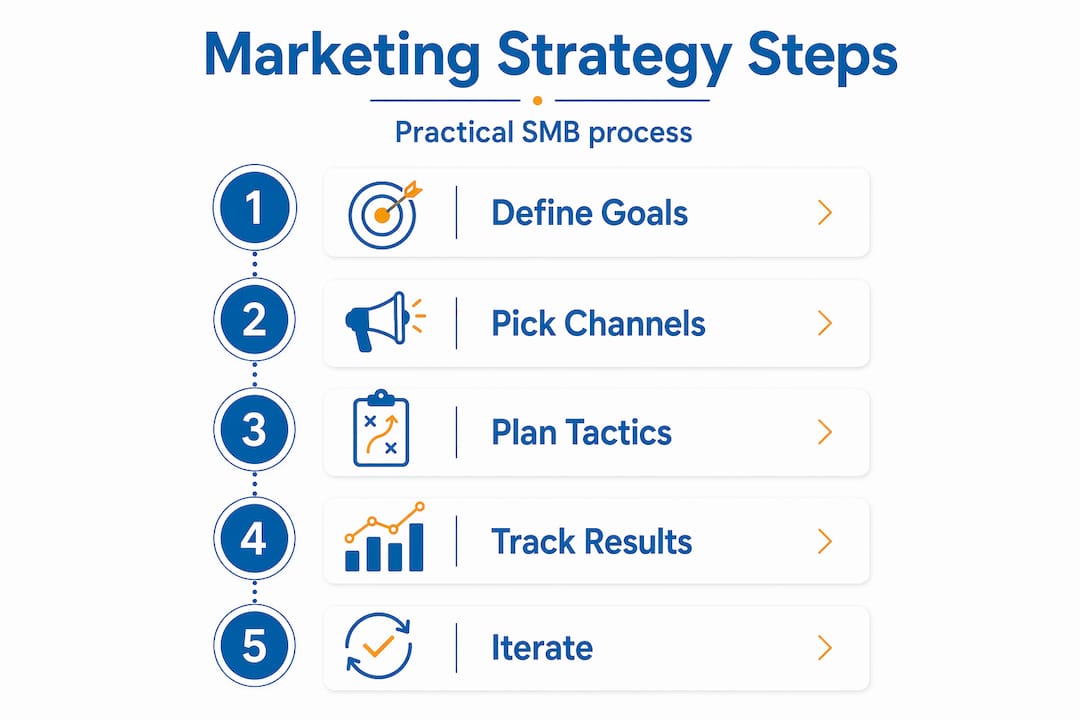
A practical SMB online marketing strategy doesn’t need to be a 40-page document. It needs to be clear, actionable, and tied to real numbers. According to digital marketing basics for small business, a sound approach typically starts with setting measurable goals, doing audience research, choosing a limited set of channels, and defining what KPIs (Key Performance Indicators, the metrics you track to measure progress) will guide your decisions.
Here’s a step-by-step process you can follow:
- Set specific, measurable goals. “Get more customers” is not a goal. “Generate 50 new leads per month by Q3” is. Define exactly what you want to achieve and by when.
- Research your target audience. Identify who your best customers are, what problems they have, where they spend time online, and how they prefer to receive information. Use surveys, Google Analytics, and even conversations with existing clients.
- Choose a focused set of channels. Based on your audience research, pick two or three channels where your customers are most active and where your budget gives you the best chance of reaching them. Resist the urge to be everywhere.
- Define your KPIs. Match your goals to specific, trackable numbers. Use the table below as a starting point.
- Set a realistic budget and timeline. Know what you can spend per month and how long you’ll give each channel to produce results before evaluating performance.
- Create a simple content and execution calendar. Even a basic spreadsheet that maps out what you’ll publish, where, and when is enough to keep execution consistent.
| Business goal | Example KPI to track |
|---|---|
| Generate more leads | Number of form submissions per month |
| Increase website traffic | Organic sessions per month |
| Improve sales conversion | Lead-to-customer conversion rate |
| Grow email list | New subscribers per week |
| Boost repeat business | Customer retention rate |
Pro Tip: Pick two to three channels you can execute consistently before adding more. Consistency on fewer channels always outperforms sporadic effort across many. Use your digital marketing checklist to audit what you’re doing now and identify gaps before building new activities.
Choosing the right online channels for your business
After determining the main strategy components, your next step is deciding which channels deserve your limited time, energy, and budget.
This is where many SMBs make a costly mistake. They choose channels based on popularity rather than fit. Just because short-form video is trending doesn’t mean it’s the right channel for a B2B accounting firm or a local dental practice. Channel selection should always come back to two questions: where are your customers, and where does your investment produce the most return?
For most small businesses starting out, focusing on SEO and email is the most ROI-oriented approach. SEO (Search Engine Optimization) helps customers discover you when they are actively searching for what you offer. Email gives you a direct, owned connection to your audience that no algorithm can take away. Paid advertising can accelerate results but works best as a complement to these foundations, not a replacement for them.
Email marketing, in particular, consistently delivers some of the highest average ROI of any digital channel for small businesses, often cited at $36 or more returned for every $1 spent. That’s not an accident. Email reaches people who have already raised their hand and said they want to hear from you. That’s a warmer, more ready audience than a cold social media follower.
To identify your best channels, work through these questions:
- Where do your customers search for solutions like yours? (Google, YouTube, industry forums?)
- Which platforms show actual buying signals for your product or service category?
- What does your competitor analysis reveal about where traffic and engagement concentrate?
- Do you have the resources to execute well on this channel consistently, or will it become a half-done effort?
- Can you measure ROI from this channel within a reasonable timeframe?
Pro Tip: Pick one or two “must win” channels first and go deep before expanding. Shallow presence across six platforms will almost always underperform a strong, consistent presence on two. For businesses looking at search visibility, exploring affordable SEO solutions can be a practical starting point for building organic traffic without a large agency budget.
Jouw SMB marketing strategies should reflect your audience’s actual behavior, not marketing trends. And when you’re ready to scale with campaigns, a solid campaign guide for SMBs can help you structure your efforts for measurable outcomes.
Measuring success and iterating: Smarter marketing for SMBs
Identifying channels is only half the battle. Let’s close the loop with how to actually measure if your marketing efforts are working and continually improve.

A strategy without measurement is just a plan on paper. The businesses that grow consistently are the ones that look at their numbers regularly, ask honest questions, and make adjustments based on real data. This doesn’t require sophisticated analytics tools or a dedicated data team. It requires discipline and a simple review process.
Before anything else, separate vanity metrics from value metrics. Vanity metrics feel good but don’t connect to revenue. Value metrics show real business impact.
- Vanity metrics: Social media likes, total followers, page views, email open rate in isolation
- Value metrics: Leads generated, cost per lead, lead-to-sale conversion rate, revenue from a specific channel, customer acquisition cost
As strategic marketing planning benchmarks suggest, your strategy should always be tied to measurable outcomes like leads, pipeline, and revenue rather than engagement metrics that look impressive in a report but don’t move your business forward.
“What gets measured gets managed. Measure outcomes like leads or revenue, not just likes or clicks.”
Here’s a simple monthly review process you can follow:
- Pull your KPI numbers. Gather data from your website analytics, email platform, CRM, and ad accounts every month on a set date.
- Compare against your goals. Are you on track, behind, or ahead? Identify which channels are performing and which are underdelivering.
- Identify one key win and one key problem. Keep it focused. Don’t try to fix everything at once.
- Make one strategic adjustment. Change a subject line approach, shift budget to the better-performing channel, or test a new call-to-action. One change at a time lets you understand what’s actually working.
- Document your findings. Keep a simple log of what you tested, what changed, and what the result was. Over six months, this becomes an invaluable record of what works for your specific business.
The most important habit is iteration based on performance, not hunches or trends. If email is bringing you leads and Instagram is not, double down on email. For more practical growth tips for SMBs, there are specific frameworks designed to help you build this review habit without it becoming a burden.
Why “less but coordinated” wins for SMB online marketing
You’ve seen how to build, channel, and measure strategy. Now here’s a hard-won truth about what really leads to sustainable growth for smaller businesses.
The “be everywhere” advice you’ll hear from many marketing consultants is genuinely dangerous for small and mid-sized businesses. It sounds like ambition. In practice, it destroys execution quality and burns out small teams. We’ve seen it repeatedly: a business owner launches a podcast, starts a YouTube channel, tries to post daily on three social platforms, runs email campaigns, and manages paid ads, all at once. Six weeks later, nothing is done well, and nothing is measured properly.
The businesses that grow steadily do something counterintuitive. They do less, but they do it with complete coordination. One or two channels. A clear content rhythm. Consistent follow-up sequences. Every piece of activity pointing toward the same goal. That kind of focused, repeatable effort compounds over time in a way that scattered activity never will.
Some guidance, including operational approaches outlined in small business marketing resources, emphasizes keeping your setup light and manageable. Fewer tools, simpler workflows, and a small number of high-impact channels will almost always outperform an over-engineered system that no one has time to maintain properly.
More tools do not equal more growth. More coordination does. A small team running a well-defined, two-channel strategy with clear KPIs and a monthly review process will consistently outperform a larger team doing a dozen things with no strategic connective tissue.
Pro Tip: Use simple marketing workflows to keep execution consistent. Map out the exact steps for each recurring activity, who does it, and when, so nothing depends on memory or motivation on any given day. Starting with a guide to keep your digital marketing simple will show you how to build systems that run reliably without adding complexity.
Next steps: Tools and resources to put your strategy in motion
To put these strategy insights into practice and make your marketing efforts smoother, consider these proven SMB-tailored tools.
The strategy frameworks in this guide are designed to be practical and immediately applicable. But having the right tools in place makes the difference between a strategy that stays in a document and one that actually runs your marketing day to day.
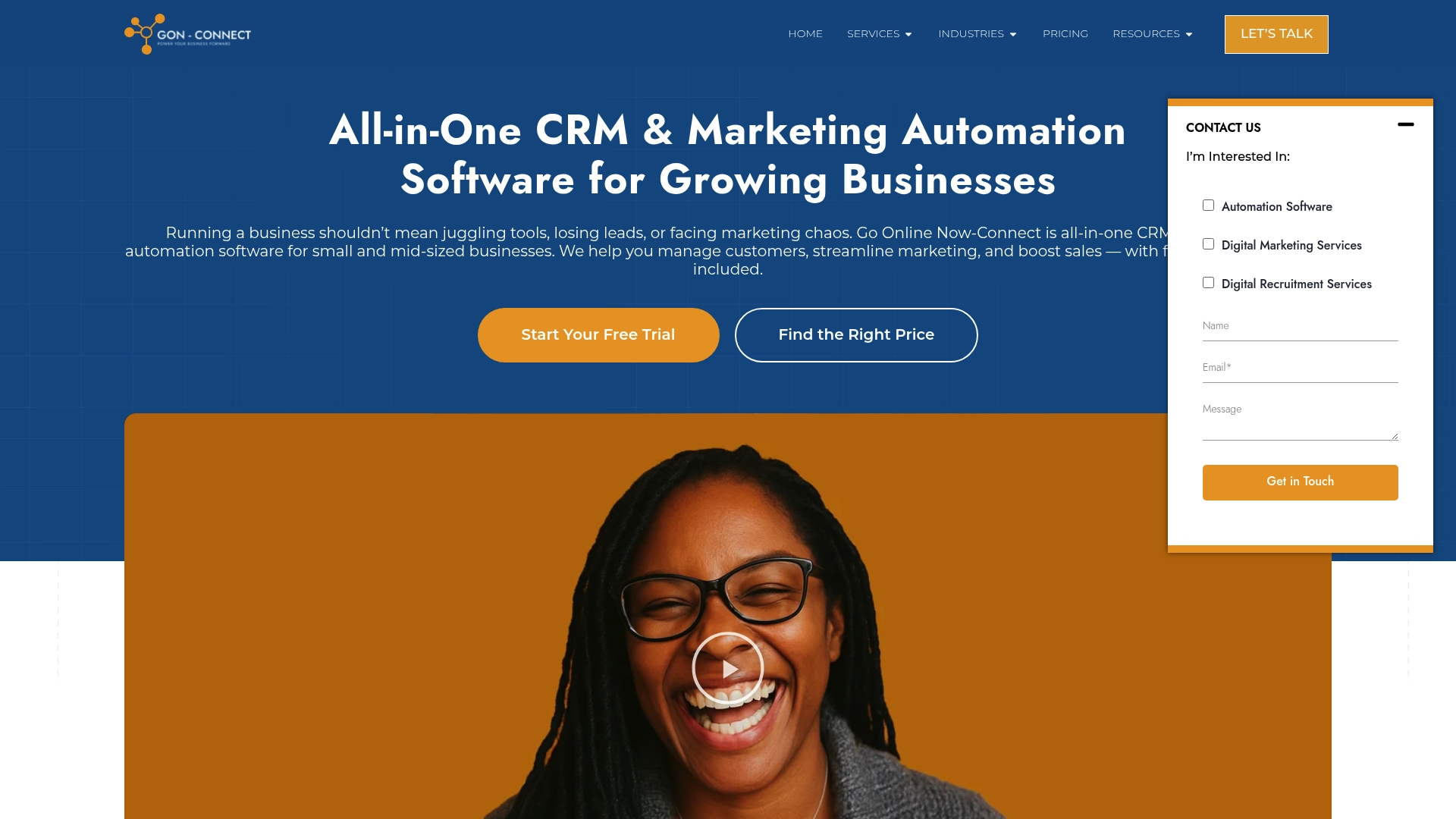
Go Online Now-Connect combines marketing automation for SMBs with a complete CRM, funnels, email sequences, and reputation management, all in one system that’s built for business owners who don’t have time for scattered software subscriptions. Our done-for-you setup means your automations and workflows are configured by a real team, not left for you to figure out alone. And with our all-in-one CRM, you get unified contact management, appointment scheduling, and pipeline tracking without the complexity or cost of over-engineered enterprise platforms. Everything you need, in one place.
Frequently asked questions
What is the difference between an online marketing strategy and a digital marketing campaign?
A strategy is the overall plan that coordinates your activities toward a business goal, while a campaign is a single focused effort within that plan, like a product launch or a seasonal promotion. Think of the strategy as the playbook and campaigns as individual plays.
What are the most important channels for an SMB starting out?
SEO and email are usually the top priorities for return on investment, with social media and paid ads as secondary options based on where your specific audience spends their time and shows buying intent.
How do I know if my online marketing strategy is working?
Track clear KPIs tied to real business outcomes like lead volume and revenue growth, not just traffic or follower counts, and review them consistently each month to see whether your results are improving over time.
Should I try every online marketing channel available?
No. Prioritize a focused set of channels that fit your audience’s actual behavior and your available resources, then optimize those before expanding. Spreading too thin too soon is one of the most common growth blockers for small businesses.
How often should I update my online marketing strategy?
Revisit your strategy at least every quarter, or immediately after any significant business change such as a new product line, a shift in your target market, or a major budget adjustment. Regular reviews keep your plan aligned with where your business is actually headed.