

TL;DR:
- Small and mid-sized businesses now widely use automation to increase efficiency and compete effectively.
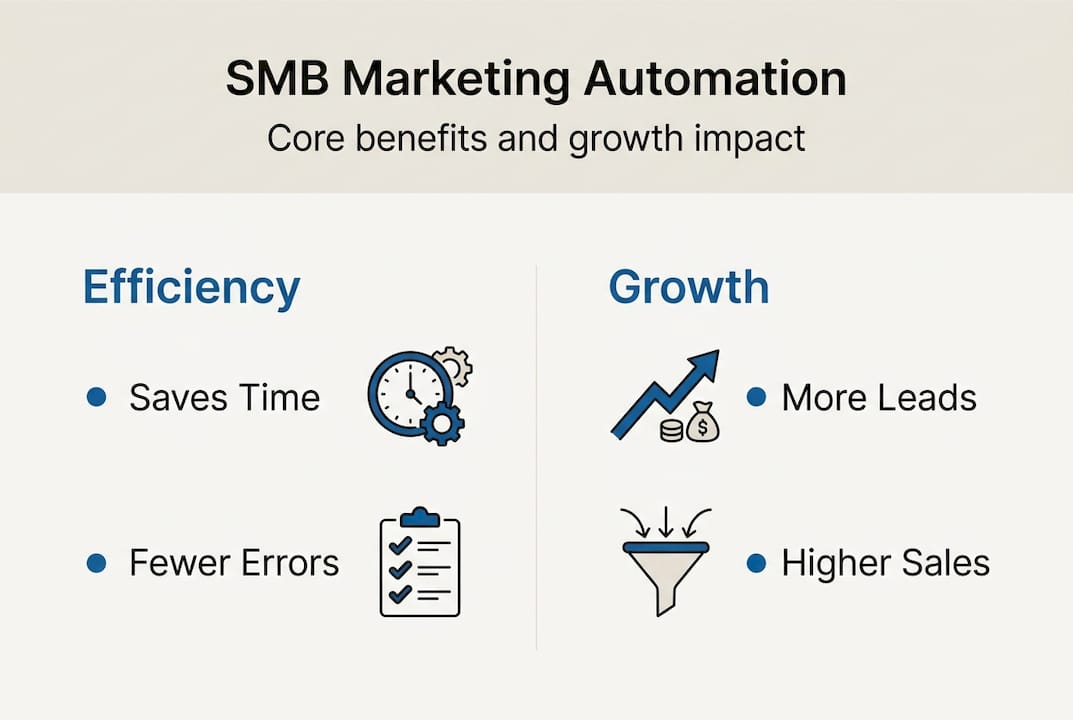
- Automation helps SMBs save time, scale without extra hires, and improve lead management and conversions.
- Successful automation requires quality content, strategic planning, and balancing technology with human interaction.
Marketing automation was once considered a luxury reserved for large corporations with deep pockets and dedicated IT teams. That assumption is now outdated. Today, small and mid-sized businesses are using automation to reduce campaign setup time by 50% and compete with players far above their weight class. If you’re running a lean operation and wondering how to do more without burning out your team, this article walks you through the real, proven advantages of marketing automation and how to apply them starting now.
Key Takeaways
| Point | Details |
|---|---|
| Big efficiency wins | Marketing automation frees up hours weekly and enables small teams to scale their impact quickly. |
| Lead generation boost | Automated workflows deliver more quality leads and higher conversion rates for SMBs. |
| Higher marketing ROI | SMBs see average returns over 500% and improved decision-making with analytics-driven automation. |
| Hybrid approach works best | Combining automation with authentic human touch prevents impersonal messaging and supports sustainable growth. |
Why automation matters for SMBs today
Running a small business means wearing many hats. You’re managing customer relationships, chasing leads, sending follow-ups, and trying to stay visible online, all at the same time. The result? Important tasks get delayed, opportunities slip through the cracks, and your team hits a wall.
This is exactly where marketing automation steps in. It handles the repetitive, time-consuming work so your team can focus on what actually moves the needle: building relationships, closing deals, and serving customers well.
Here’s what automation directly addresses for SMBs:
- Limited bandwidth: Automation runs campaigns, sends follow-ups, and scores leads even when your team is offline.
- Inconsistent outreach: Automated workflows ensure every lead gets the right message at the right time, every time.
- Slow response times: Trigger-based systems respond to customer actions instantly, which is critical for conversions.
- Scaling without hiring: You can grow your pipeline without growing your payroll.
The numbers back this up. Marketing automation delivers a 544% ROI and helps a team of five operate with the output of a team of fifty. That’s not a small edge. That’s a structural advantage.
For SMBs weighing their options, marketing automation gives SMBs scalability and efficiency that was previously only accessible to enterprise-level companies. The playing field has shifted, and the tools are now affordable and accessible.
Want to understand how this connects to real cost savings? Explore how you can save costs with automation and see the impact on SMB growth in concrete terms.
Professionele tip: Don’t try to automate everything at once. Pick one repetitive task, like sending a follow-up email after a lead fills out a form, and automate that first. Small wins build confidence and momentum.
Streamlining operations: Save time and scale effortlessly
Now that the value of automation is clear, let’s see how it delivers operational breakthroughs for your small business.
Time is your most limited resource. Every hour your team spends on manual data entry, scheduling, or sending individual emails is an hour not spent on strategy or growth. Automation reclaims those hours at scale.
Here are the most valuable tasks to automate first:
- Lead follow-up emails — Respond to new inquiries automatically within minutes of a form submission.
- Appointment reminders — Reduce no-shows by sending automated SMS or email reminders.
- Lead nurture sequences — Guide prospects through your funnel with pre-built email workflows.
- Reporting and analytics — Pull performance data automatically instead of building manual spreadsheets.
- Contact tagging and segmentation — Organize your CRM automatically based on user behavior.
De automation of repetitive tasks is where most SMBs feel the impact first. Your team stops doing the same thing over and over and starts focusing on higher-value work.
“SMBs that adopt automation can reduce onboarding from weeks to days, gain back hours per week, and spend 50% less time on campaign setup.”
Scaling without adding headcount is one of the biggest advantages. When a workflow handles lead nurturing automatically, you don’t need to hire another sales rep just to keep up with volume. You grow smarter, not just bigger.

Comparing automation versus manual marketing makes the efficiency gap obvious. Manual processes are prone to human error, inconsistency, and delay. Automated workflows are precise, consistent, and always on.
Professionele tip: Use trigger-based workflows tied to specific customer actions, like visiting a pricing page or opening an email, to deliver the most relevant response at exactly the right moment. This is how automation for small teams creates outsized results.
Driving more leads, better nurture, and higher conversion
Once you’re running more efficiently, the next leap is maximizing every sales opportunity through better automated lead management.
Generating leads is only half the job. The other half is nurturing them until they’re ready to buy. Most SMBs lose potential customers not because they lack interest but because the follow-up was too slow, too generic, or simply didn’t happen.
Automation fixes this. With lead scoring, you can identify which prospects are most engaged and prioritize them automatically. With nurture sequences, you stay top of mind without lifting a finger.
Top engagement workflows every SMB should consider:
- Welcome sequences for new subscribers or leads
- Re-engagement campaigns for cold contacts who haven’t responded in 30 or 60 days
- Post-purchase follow-ups to encourage reviews and repeat business
- SMS follow-ups after missed calls or form submissions
- Social retargeting triggers based on website visit behavior
Personalized workflows and lead scoring drive 39% more deals, a 50% increase in deals closed, and 80% of marketers report more leads overall. Those are results worth paying attention to.
| Factor | Manual lead management | Automated lead management |
|---|---|---|
| Response time | Hours to days | Seconds to minutes |
| Follow-up consistency | Inconsistent | 100% consistent |
| Lead scoring | Manual guesswork | Data-driven and automatic |
| Personalisatie | Beperkt | Dynamic and behavior-based |
| Conversion rate | Lower | Significantly higher |
Automated journeys support cross-channel engagement with dynamic personalization, meaning your leads receive messages tailored to their behavior across email, SMS, and social, all without manual effort.
For a deeper look at boosting conversions with automation, or to explore the latest automation trends for SMBs, there’s a clear path forward. Understanding the full automation process for small business helps you build a system that actually converts.
Professionele tip: Speed to lead matters more than almost any other factor. Responding to a new inquiry within five minutes makes you 100 times more likely to connect than waiting 30 minutes. Automate that first response immediately.
Analytics, ROI, and smarter decision-making
With conversion and scale unlocked, it’s time to look at the numbers and how analytics and ROI measurement drive impactful marketing decisions.
One of the biggest frustrations for SMB owners is not knowing what’s actually working. You spend money on ads, send emails, and post on social media, but without clear data, you’re guessing. Marketing automation changes that entirely.
Modern automation platforms provide real-time dashboards, campaign attribution, and performance tracking that tie every action to a measurable result. Marketing automation delivers real-time pipeline visibility and an average return of $5.44 for every $1 spent over three years. That’s a compelling case for any budget-conscious SMB owner.
| KPI | Benchmark with automation |
|---|---|
| ROI per $1 spent | $5.44 average over 3 years |
| Positive ROI in year one | 76% of businesses |
| Campaign setup time reduction | Up to 50% |
| Increase in qualified leads | Up to 80% |
| Deals closed improvement | Up to 50% |
Advanced analytics tie campaigns directly to ROI, improving accountability across every channel. Instead of wondering whether your email campaign drove any sales, you can see exactly how many leads it generated, which ones converted, and what the revenue impact was.
This level of visibility helps you invest more confidently. If one channel is outperforming another, you shift budget quickly. If a workflow isn’t converting, you adjust it before it costs you more. Explore the full picture of automation ROI gains and use automation tips for SMBs to maximize every dollar you spend.
Real-time data also reduces the anxiety of running a small business. When you can see your pipeline, open rates, and conversion metrics at a glance, decisions become clearer and faster.
A practical perspective: What most SMBs miss about automation
After seeing what automation can do, it’s important to separate hype from reality with a frank look at the risks and keys to long-term success.
Here’s the truth most automation vendors won’t tell you: automation amplifies what you already have. If your messaging is weak, automation just sends weak messages faster. If your offer isn’t compelling, no workflow will save it.
Too many SMBs flip the switch on automation and expect it to do the thinking for them. It doesn’t. You still need strong content, genuine understanding of your customer, and a clear value proposition. Automation is the engine, but you still need to steer.
There’s also a real risk of over-automation. Risks include hidden costs, poor messaging, and privacy concerns, and SMBs that blast generic automated messages often damage trust rather than build it.
The smartest approach is a hybrid one. Automate the repetitive and the scalable, but preserve human touchpoints for early sales conversations, complex objections, and high-value relationships. Think of personalization in automation not as a feature toggle but as a discipline. Done right, automation feels personal. Done wrong, it feels like spam.
Start with intention, not just efficiency.
Ready to put automation to work for your SMB?
To make the leap from theory to results, the right technology partner makes all the difference. Here’s where to start.
Go Online Now-Connect is built specifically for SMBs that want real results without the complexity or the inflated price tag. Our all-in-one platform combines email automation, CRM, SMS, funnels, and lead nurturing in one simple system, with done-for-you setup and real human support included.
Whether you’re just getting started or ready to scale, we have the tools and the team to help you move fast. Explore how our automation software for SMB conversions works, review our proven automation ROI data, or see how our software for SMB growth can transform your business. No contracts. No hidden fees. Just results.
Frequently asked questions
What are the most common tasks SMBs automate in marketing?
SMBs typically automate email follow-ups, lead scoring, social media posting, and reporting to save time and increase consistency. Automating follow-ups and reports alone saves many small teams several hours every week.
How much can SMBs expect to save with marketing automation?
Many SMBs see a 50% reduction in campaign setup time and a 25% increase in marketing ROI within the first year. Small businesses report these gains consistently across industries and team sizes.
Does automation replace human staff in SMBs?
Automation helps teams do more with less but works best when paired with personal relationship-building and authentic content. Automation allows a small team to operate like a larger one but should be blended with manual relationship-building at key touchpoints.
What are the risks of marketing automation for SMBs?
Potential downsides include sending impersonal messages, incurring hidden costs, and facing data privacy challenges. Risks include poor setup, privacy issues, and generic messaging that damages customer trust.
How do SMBs get started with marketing automation?
Begin by automating a single repetitive process, track results, and expand as your team gains confidence. Starting small with automation is the most recommended approach for SMBs new to the technology.