

TL;DR:
- Marketing automation helps SMBs improve lead conversion and stay competitive without large teams.
- Affordable, user-friendly tools enable small businesses to automate routine tasks and scale efficiently.
- Starting with simple workflows like follow-up emails and regularly reviewing automation maximizes growth.
Most small business owners assume marketing automation is reserved for companies with big budgets and dedicated tech teams. That assumption is costing them real revenue. 75% of SMBs using automation see measurable lead conversion improvements, and 63% outperform their competitors. These aren’t Fortune 500 companies. They’re businesses just like yours, running leaner and smarter by letting the right tools handle repetitive tasks. This guide breaks down what marketing automation actually means for small and mid-sized businesses in 2026, how it drives measurable growth, which features matter most, and how to get started without overcomplicating things.
Key Takeaways
| Point | Details |
|---|---|
| Automation drives results | SMBs using automation see major lead conversion gains and outperform competitors. |
| Affordable, user-friendly tools | Modern solutions are accessible and scalable for small and midsize companies. |
| Start simple for success | Begin with a single workflow and gradually expand as you see results. |
| Continuous improvement matters | Regularly review and enhance your automation setup to unlock the full benefit. |
Ready to Put These Strategies into Action?
Get expert guidance on using marketing automation to save time, increase conversions, and grow your business.
What does marketing automation mean for SMBs in 2026?
Marketing automation is the use of software to handle repetitive marketing tasks automatically, without you or your team doing them manually every time. Think of it as a system that sends the right message to the right person at the right moment, whether that’s a follow-up email after a form submission, a reminder text before an appointment, or a lead scoring update when someone visits your pricing page.
For SMBs, this matters because time and staff are limited. You can’t afford to have someone manually sending hundreds of follow-up emails or tracking every lead by hand. Automation handles that for you, consistently and accurately.
There are still several common misconceptions that hold SMB owners back from exploring automation:
- It’s only for large companies. Not true. Most modern platforms are built with small businesses in mind.
- It’s too expensive. Affordable options exist at every budget level, many starting under $100 per month.
- It requires a tech team to manage. Today’s tools are designed for non-technical users, with drag-and-drop builders and guided setup.
- It feels impersonal. When done right, automation actually makes your communication feel more timely and relevant.
- It replaces human connection. It doesn’t. It frees up your team to focus on higher-value conversations.
Modern automation tools cover a wide range of functions: email sequences, SMS campaigns, social media scheduling, lead nurturing workflows, CRM integration, and reputation management. You can explore the latest 2025 marketing automation trends to see how the landscape has shifted in favor of smaller businesses.
“70% of SMBs globally are embracing marketing automation to stay competitive.”
This shift is significant. Just a few years ago, automation was primarily an enterprise tool. Today, platforms are purpose-built for businesses with small teams and limited resources. Understanding why SMBs need automation is the first step toward using it effectively. The tools have caught up with your needs, and the data confirms adoption is accelerating fast.
How marketing automation accelerates growth and conversions
With a clear understanding of what automation is, let’s see exactly how it delivers stronger results for your business.
The difference between manual and automated marketing isn’t just about speed. It’s about consistency, timing, and scale. Here’s a direct comparison:
| Factor | Manual marketing | Automated marketing |
|---|---|---|
| Lead response time | Hours to days | Seconds to minutes |
| Follow-up consistency | Inconsistent, human-dependent | 100% consistent, rule-based |
| Average conversion rate | Lower, due to delays and gaps | Higher, due to timely touchpoints |
| Team time required | High | Low |
| Schaalbaarheid | Limited by headcount | Scales without adding staff |
The numbers back this up. 75% of SMBs using automation experience improved lead conversions, and the automation ROI for SMBs becomes clear quickly once a basic system is in place.
Here’s how an automated customer journey typically outperforms a manual one:
- A lead fills out your contact form. The system instantly sends a personalized welcome email and assigns a lead score based on their behavior.
- Over the next few days, a sequence of educational emails is delivered automatically, building trust without any manual effort.
- If the lead visits your pricing page, the system flags them as high-intent and notifies your sales rep in real time.
- A follow-up SMS is sent within minutes, increasing the chance of a conversation while interest is high.
- If there’s no response, a re-engagement sequence kicks in automatically after a set period.
This kind of structured journey is what drives SMB growth in a way that manual processes simply can’t replicate at scale.

Pro Tip: For SMBs just getting started, automating follow-up emails and lead scoring delivers the fastest return. These two steps alone can dramatically reduce response time and improve your close rate without requiring a complex setup.
The must-have features of affordable, user-friendly automation solutions
Understanding impact is one thing, but choosing the right tool is another. So which automation features matter most for smaller businesses?
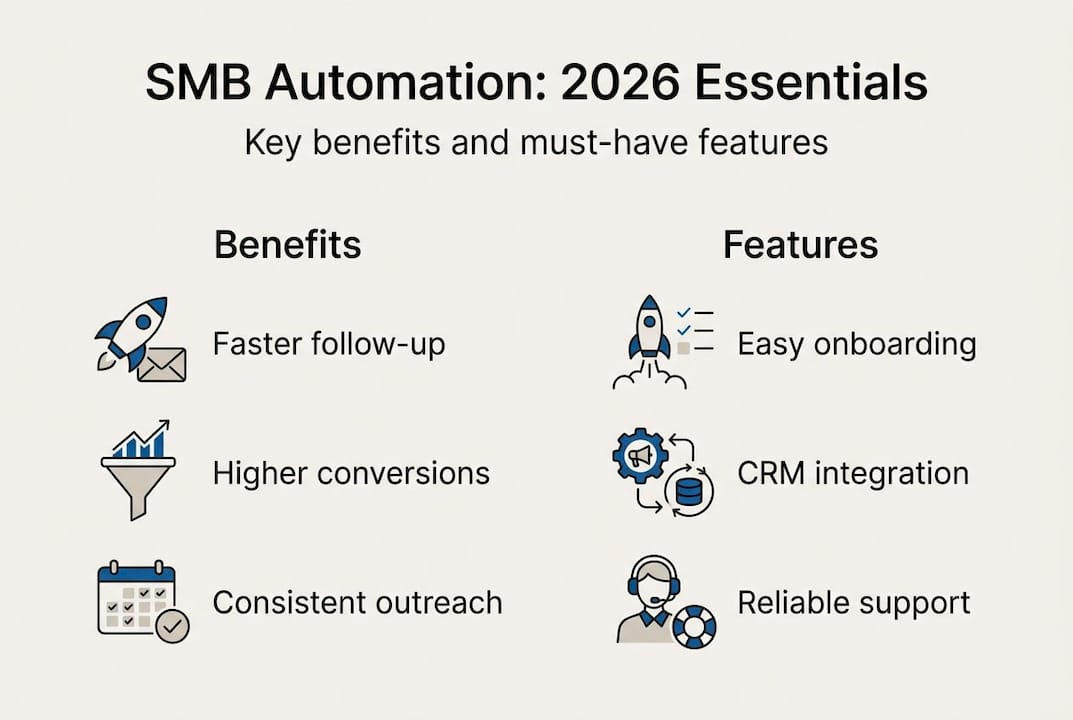
SMBs are choosing platforms based on ease of use and affordable pricing, not just feature volume. A tool with 200 features you never use is less valuable than one with 20 that work exactly as needed. Here’s a quick comparison of what to look for:
| Functie | Why it matters for SMBs |
|---|---|
| Easy onboarding and setup | Reduces time to first result |
| Drag-and-drop workflow builder | No coding required |
| CRM-integratie | Keeps contacts and data in one place |
| Email and SMS automation | Covers the most common touchpoints |
| Reporting and analytics | Shows what’s working and what isn’t |
| Responsive customer support | Critical when you hit a roadblock |
| Transparent pricing | No surprises on your monthly bill |
When evaluating tools, focus on these must-have features:
- Simple CRM integration so your leads, contacts, and deals are always in sync
- Drag-and-drop workflow builder that lets you set up automations visually
- Email and SMS automation for timely, multi-channel follow-up
- Built-in reporting so you can track open rates, conversions, and pipeline movement
- Live onboarding support to help you get set up correctly from day one
- Flat, transparent pricing with no hidden fees or surprise upgrades
You can review the full automation benefits for SMEs to understand how these features translate into real business outcomes. For practical guidance, the top automation tips for small businesses offer a solid starting point.
Pro Tip: Before signing up for any platform, ask specifically about onboarding support and whether setup is included. Many tools charge extra for this. The best ones include live help at no additional cost.
Applying marketing automation: Steps for SMBs to get started in 2026
Once you’ve selected the right features, it’s time to put automation into practice for real business gains.
Getting started doesn’t have to be overwhelming. The key is to move deliberately and build on what’s working. Follow these steps:
- Define your goals clearly. Are you trying to improve lead follow-up, increase appointment bookings, or reduce customer churn? Specific goals lead to better automation design.
- Audit your current tools. List every platform you’re using for email, CRM, scheduling, and communication. Identify overlap and gaps.
- Pilot with one process first. Choose a single workflow, like a post-inquiry follow-up sequence, and automate that before expanding.
- Monitor results for 30 to 60 days. Track open rates, response rates, and conversions. Let data guide your next move.
- Scale up gradually. Once your first workflow is performing well, add another. Build your system layer by layer.
Many SMBs stumble during implementation. Here are the most common mistakes to avoid:
- Overcomplicating the setup before seeing results from simpler workflows
- Skipping goal definition, which makes it impossible to measure success
- Undertraining your team on how to use and interpret the automation system
- Automating too many processes at once, leading to confusion and errors
- Ignoring the data, and running automations without reviewing performance regularly
The payoff for getting this right is significant. 63% of SMBs with automation outperform their competitors, and a well-built automation strategy for SMBs is one of the most reliable ways to gain a lasting edge. Start small, learn fast, and grow from there.
Why most SMBs underuse automation—and how to avoid it
Here’s something most guides won’t tell you: implementing automation is not the same as benefiting from it. Many SMBs only scratch the surface of what their platforms can do. They set up one email sequence and call it done. That’s not automation working for you. That’s automation sitting idle.
The real gains come when automation is connected directly to your sales pipeline and customer retention efforts. Not just scheduled emails, but triggered workflows based on actual behavior, lead scores tied to real buying signals, and follow-up sequences that adapt based on what a contact does or doesn’t do.
Our advice: start with one workflow, but schedule a quarterly review to assess what else can be automated and improved. Ask yourself what your team is still doing manually that a rule-based system could handle.
“Don’t mistake automation for autopilot. True results take continuous adjustment.”
The underused automation benefits are often hiding in plain sight. Review your platform’s feature list every few months. Chances are, there are tools you’re paying for and not using that could meaningfully improve your results.
Make Marketing Automation Work for Your Business
Discover how the right automation strategy can help you save time, improve conversions, and scale your marketing more efficiently.
Find the right marketing automation solution for your SMB
Ready to tap into the power of marketing automation? The right platform makes all the difference, and it doesn’t have to be complicated or expensive to deliver real results.
At Go Online Now-Connect, we built our SMB automation software specifically for business owners who want results without the technical headache. Our done-for-you setup, transparent pricing, and live onboarding support mean you’re never left figuring things out alone. Whether you want to understand your automation ROI before committing or see how automation fits into driving SMB growth, we’re here to help. Book a free consultation or explore our platform today.
Frequently asked questions
What is the main benefit of marketing automation for SMBs in 2026?
75% of SMBs using automation see improved lead conversions, making faster and more consistent follow-up the single biggest advantage. It gives small businesses a competitive edge without requiring a larger team.
Is marketing automation too expensive or complex for small businesses?
No. Many platforms in 2026 are designed for ease of use and priced to fit SMB budgets, letting you automate key workflows without any technical expertise.
What are the most important marketing automation features for SMBs?
SMBs prioritize ease of use, CRM integration, and reliable support. Top features include simple onboarding, drag-and-drop workflow setup, email and SMS automation, and built-in reporting.
How quickly can SMBs see results from automation?
Most SMBs begin seeing improvements in lead response and conversions within the first few months. Starting with a focused workflow like follow-up emails delivers fast, measurable results without a long setup period.
Can automation be customized for different business needs?
Yes. Modern automation tools let you tailor workflows to your specific sales cycle, audience segments, and preferred channels. Customizable platforms are now standard, making it easy to build a system that fits your business exactly.