

Marketing managers at small and midsize companies often juggle endless tasks just to keep their campaigns running smoothly. Limited resources make it tough to balance the personal touch of manual marketing with the growing demand for speed and accuracy. As more businesses turn to technology, understanding the core differences between marketing automation and manual marketing can help you find the right balance for your team, saving valuable time and making your efforts more consistent.
Marketing Automation vs Manual: Core Concepts
Marketing automation represents a strategic shift from traditional manual marketing approaches, enabling small and midsize businesses to streamline complex processes with technology-driven solutions. Unlike manual methods that rely on individual effort and repetitive tasks, marketing automation transforms how businesses engage customers, track interactions, and optimize campaign performance.
At its core, marketing automation replaces time consuming manual workflows with intelligent software systems that can execute tasks automatically. These systems handle critical functions like email sequencing, lead scoring, customer segmentation, and performance tracking with precision and consistency. Small businesses gain significant advantages through marketing automation platforms that eliminate repetitive administrative work and create scalable communication strategies.

The fundamental difference between manual and automated marketing lies in efficiency and scalability. Manual marketing requires constant human intervention – composing individual emails, tracking customer interactions separately, and managing contact lists through spreadsheets. Automated systems, conversely, integrate these processes seamlessly. They can trigger personalized communications based on specific customer behaviors, track engagement metrics in real time, and adapt campaigns dynamically without continuous manual input.
Pro tip: Start small by automating one repetitive marketing process, like welcome email sequences or lead nurturing campaigns, to experience immediate productivity gains and build confidence in marketing automation technologies.
How Automation Transforms SMB Marketing
Small and midsize businesses are experiencing a revolutionary shift in marketing strategies through advanced automation technologies. AI-driven marketing tools are enabling organizations to compete more effectively by transforming traditional manual processes into intelligent, data-driven campaigns that deliver unprecedented efficiency and personalization.
Automation fundamentally changes how SMBs approach customer engagement by replacing labor-intensive tasks with intelligent systems. These technologies can automatically segment audiences, personalize messaging, track customer interactions, and generate predictive insights without constant manual intervention. By implementing sophisticated marketing automation platforms, businesses can scale their outreach efforts while maintaining high levels of customer relevance and reducing operational costs.
The transformation goes beyond simple task replacement. Automation empowers SMBs to develop more sophisticated marketing strategies that were previously accessible only to large enterprises with substantial resources. Through integrated tools that combine customer data, behavioral tracking, and intelligent communication triggers, small businesses can create complex, responsive marketing ecosystems that adapt in real time to changing customer preferences and market dynamics.
Pro tip: Begin your automation journey by mapping out three repetitive marketing tasks that consume significant time and select targeted automation solutions to streamline those specific processes.
Manual Marketing: Strengths and Drawbacks
Manual marketing represents a traditional approach that relies on direct human interaction and personalized communication strategies. Manual market research techniques enable businesses to capture nuanced customer insights through qualitative methods like interviews, focus groups, and open-ended surveys that automated systems often overlook.
The core strengths of manual marketing lie in its flexibility and depth of human connection. Marketing professionals can adapt messaging in real-time, respond to subtle emotional cues, and craft highly personalized communication strategies that resonate deeply with individual customers. These approaches excel in scenarios requiring complex interpretation, emotional intelligence, and creative problem-solving that algorithmic systems struggle to replicate.
However, manual marketing also presents significant challenges for small and midsize businesses. The process is inherently time-consuming, labor-intensive, and difficult to scale consistently. Human-driven marketing efforts are prone to inconsistencies, can generate higher operational costs, and lack the precision tracking capabilities of automated platforms. Small businesses must carefully balance the authentic personal touch of manual marketing with the efficiency and analytical power of technological solutions.
Here’s a comparison of marketing automation and manual marketing across key business factors:
| Factor | Marketing Automation | Manual Marketing |
|---|---|---|
| Scalability | Easily handles large campaigns | Difficult to expand consistently |
| Personalization | Automated but data-driven | Highly tailored, human touch |
| Cost Over Time | Reduced per-transaction cost | Labor costs increase with volume |
| Error Risk | Low, software minimizes mistakes | Higher, depends on human accuracy |
| Data Analytics | Real-time reporting | Manual tracking, less precise |
Pro tip: Develop a hybrid marketing strategy that combines manual relationship-building techniques with automated tools to maximize personalization while improving operational efficiency.
Cost, ROI, and Scalability Compared
Marketing automation and manual marketing represent fundamentally different investment strategies for small and midsize businesses, with distinct implications for cost, return on investment, and operational scalability. Cost structures differ dramatically between these approaches, with manual marketing requiring continuous human labor and automation demanding upfront technological investment.
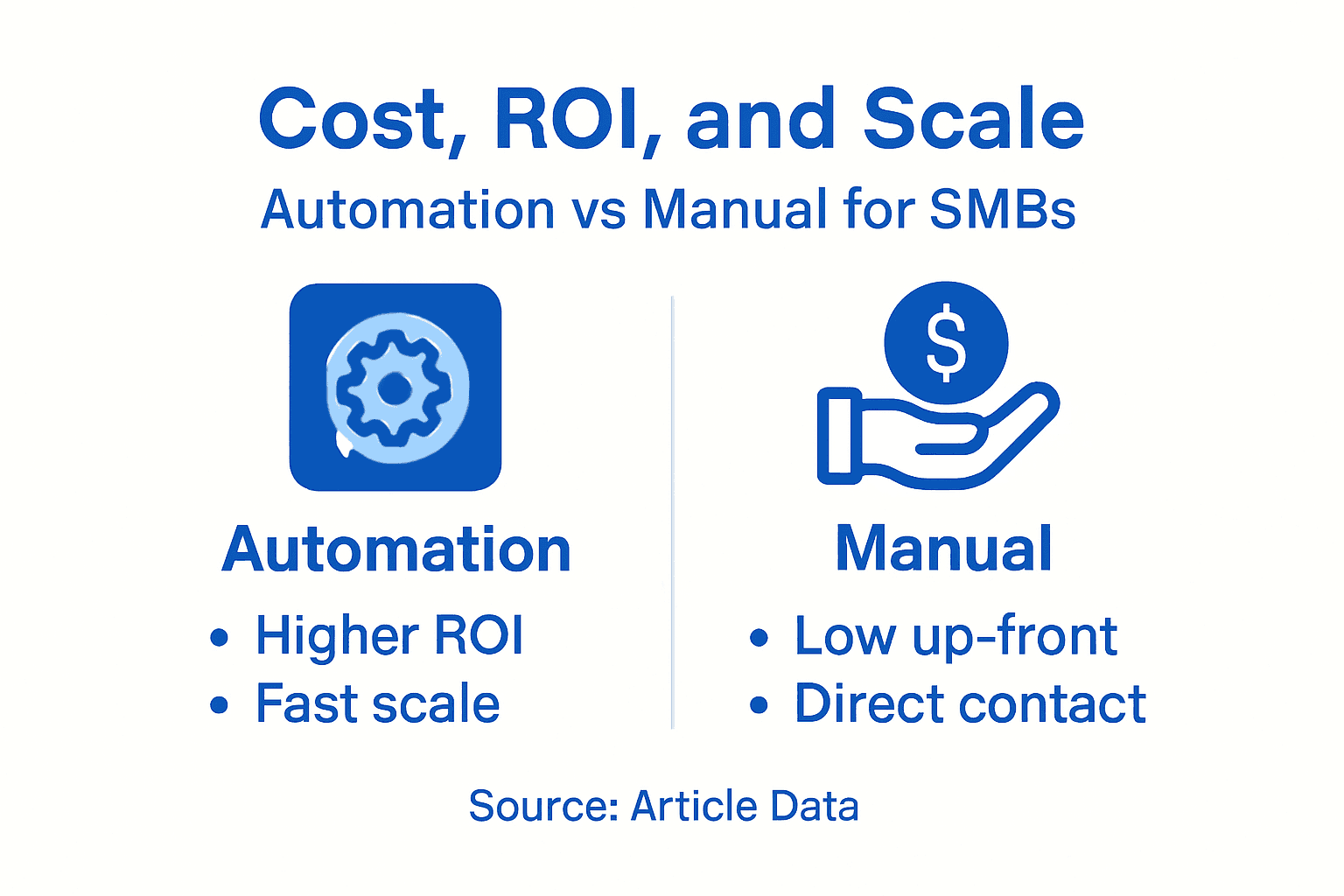
In terms of initial expenses, manual marketing appears less costly, leveraging existing human resources and minimal technological infrastructure. However, the long-term financial picture reveals a different narrative. Automation technologies enable businesses to reduce per-transaction marketing costs, minimize human error, and generate more consistent revenue streams. The scalability of automated systems allows businesses to expand marketing efforts without proportionally increasing labor expenses, creating a more efficient economic model.
Return on investment (ROI) becomes particularly compelling when comparing these approaches. Manual marketing relies heavily on individual performance, making consistent results challenging to achieve. Automated marketing platforms provide detailed analytics, allowing businesses to track campaign performance, optimize spending, and demonstrate clear financial impact. Small businesses can measure precise metrics like customer acquisition cost, conversion rates, and revenue generated per marketing dollar spent, enabling more strategic resource allocation.
Pro tip: Calculate your current marketing labor costs and compare them against potential automation investments to understand your true potential savings and efficiency gains.
When to Automate or Go Manual for SMBs
Small and midsize businesses face critical strategic decisions when determining whether to implement automated or manual processes. The key is understanding which tasks benefit most from technological intervention versus those requiring human nuance and personalized interaction.
Automation works exceptionally well for repetitive, high-volume tasks with clear, predictable patterns. These include customer support inquiries, billing processes, email marketing campaigns, and standard lead nurturing workflows. Businesses can dramatically reduce operational costs and minimize human error by systematically identifying and automating rule-based activities that consume significant administrative time without requiring complex decision-making.
Conversely, tasks demanding emotional intelligence, complex problem-solving, and strategic relationship-building remain best handled manually. Customer interactions requiring deep empathy, sales negotiations involving intricate customization, and high-stakes client communications benefit from direct human engagement. The most effective approach for SMBs is often a hybrid model that leverages automation’s efficiency while preserving human touch in critical interaction points, ensuring both operational streamlining and meaningful customer connections.
For quick reference, here are examples of tasks best suited for each approach:
| Task Type | Best Approach | Reason |
|---|---|---|
| Billing and invoicing | Automation | Rule-based and repetitive |
| High-stakes negotiation | Manual | Requires emotional intelligence |
| Welcome email sequence | Automation | Triggered by predictable customer action |
| Customer interviews | Manual | Insights driven by human conversation |
Pro tip: Conduct a comprehensive workflow audit to categorize tasks by complexity, frequency, and potential automation impact before implementing any technological solutions.
Unlock Efficiency and Personalization for Your SMB Today
Struggling to balance the time-consuming manual marketing tasks with the growing demand for personalized customer engagement? This article highlights how marketing automation software can transform your daily workflows by reducing repetitive tasks and scaling your campaigns without losing the human touch. If you’ve faced challenges around managing lead nurturing, email sequencing, or tracking customer interactions, embracing automation tools designed specifically for small and midsize businesses can be a game changer.
Discover how Go Online Now-Connect delivers an all-in-one, affordable marketing automation solution combined with real human support that helps SMBs save time and boost conversions. Our platform unifies CRM, email marketing automation, funnels, and lead nurturing into one simple system with done-for-you setup included. Start your journey to smarter growth by exploring our Automation Archives – Go Online Now and Digital Marketing Archives – Go Online Now to learn more about practical tools tailored for businesses like yours. Visit Go Online Now to see how our platform helps you automate efficiently while maintaining the personalized communication your customers expect.
Frequently Asked Questions
What is marketing automation?
Marketing automation is a technology-driven approach that streamlines marketing processes, allowing businesses to execute tasks automatically, such as email campaigns, lead scoring, and performance tracking.
How does marketing automation improve efficiency for SMBs?
Marketing automation replaces repetitive manual workflows with intelligent software systems, enabling businesses to enhance customer engagement and track interactions without constant human intervention.
What are the main benefits of manual marketing compared to automation?
Manual marketing offers flexibility and deep personal connections with customers, allowing marketers to respond in real-time and create highly tailored communication strategies.
When should SMBs choose marketing automation over manual marketing?
SMBs should consider automation for repetitive, high-volume tasks with predictable patterns, like email marketing. Manual marketing is better suited for tasks requiring emotional intelligence and complex problem-solving.