

Running a service-based business in the United States means juggling countless daily tasks while trying to build lasting customer relationships. The search for affordable ways to improve marketing results without extra manual work is a familiar challenge. Marketing automation offers practical solutions by replacing tedious tasks with efficient systems that support smarter decision-making and better customer engagement. In this guide, you will learn what marketing automation is, why it matters, and how the right tools can help American small businesses boost efficiency and see more value from every marketing effort.
Understanding Marketing Automation for SMBs
Marketing automation has emerged as a transformative strategy for small and medium-sized businesses seeking to streamline their digital marketing efforts. At its core, marketing automation represents a powerful technological approach that enables businesses to replace manual, repetitive marketing tasks with intelligent, efficient systems.
According to recent research, marketing automation supports critical decision-making processes by providing SMBs with sophisticated tools to enhance operational efficiency. The key capabilities of marketing automation include:
- Automated lead nurturing and segmentation
- Personalized customer journey tracking
- Systematic campaign management
- Real-time performance analytics
- Integrated communication across multiple channels
Small businesses can leverage marketing automation to achieve significant strategic advantages. Efficient digital marketing process management enables companies to create more targeted, responsive marketing strategies without requiring extensive manual intervention.
The technology works by connecting various marketing tools and platforms, allowing businesses to create sophisticated, automated workflows that respond dynamically to customer behaviors and preferences. This means SMBs can now execute complex marketing strategies that were previously accessible only to large enterprises with substantial marketing budgets.
Pro tip: Start with one or two key automation processes and gradually expand your marketing automation strategy as you become more comfortable with the technology.
Core Features and Common Types
Marketing automation has evolved into a sophisticated ecosystem of tools designed to help small and medium-sized businesses optimize their digital marketing strategies. Marketing automation software integrates multiple critical functionalities that transform how businesses engage with potential customers.
The core features of marketing automation platforms typically encompass:
- Lead Generation Tools
- Automated lead capture forms
- Lead scoring mechanisms
- Prospect tracking systems
- Campaign Management
- Multi-channel campaign creation
- Automated email sequencing
- Performance tracking dashboards
- Customer Segmentation
- Behavioral targeting
- Demographic filtering
- Custom audience creation
Workflow Automation represents another critical component, enabling businesses to create sophisticated, trigger-based marketing processes. AI-driven personalization platforms now allow SMBs to develop highly customized customer journeys that adapt in real-time based on individual user interactions.

Common types of marketing automation tools range from specialized solutions to comprehensive platforms. These include standalone email marketing tools, full-featured CRM integrations, and advanced AI-powered systems that combine multiple marketing functions into a single, streamlined interface.
Here’s a summary showing how different types of marketing automation tools address business needs:
| Tool Type | Best For | Main Benefit | Potential Limitation |
|---|---|---|---|
| Standalone Email Tool | Targeted campaigns | Specific email features | Limited integration options |
| All-in-One Platform | Complete workflow management | Centralized data and control | Higher upfront costs |
| CRM Integration | Customer relationship tracking | Unified sales and marketing | May require complex setup |
| AI-Powered System | Adaptive personalization | Advanced customer insights | Technical learning curve |
Pro tip: Select a marketing automation tool that offers scalability and integrates seamlessly with your existing business systems to maximize efficiency and minimize disruption.
How Automation Drives Growth and ROI
Automation technologies are revolutionizing growth strategies for small and medium-sized businesses by transforming traditional operational approaches. By systematically reducing manual workloads and enabling more intelligent decision-making, marketing automation creates substantial opportunities for scalable business expansion.
The key growth drivers of marketing automation include:
- Operational Efficiency
- Reduced manual task management
- Faster response times
- Streamlined workflow processes
- Customer Engagement
- Personalized communication
- Targeted marketing campaigns
- Enhanced customer experience
- Strategic Resource Allocation
- Redirecting human capital to high-value tasks
- Data-driven strategic planning
- Continuous performance optimization
Productivity Gains represent a critical aspect of automation’s impact. Automation adoption correlates directly with higher profitability for SMBs, allowing teams to focus on strategic initiatives rather than repetitive administrative tasks. This shift enables businesses to reallocate resources toward innovation, customer relationship development, and core business growth strategies.
By leveraging real-time data and AI-powered insights, marketing automation empowers SMBs to create more responsive, adaptive marketing approaches that continuously improve performance and maximize return on investment.
Pro tip: Implement automation incrementally, starting with one or two key processes to minimize disruption and gradually expand your technological capabilities.
Comparing Solutions: All-In-One vs. Standalone Tools
Marketing automation solutions present SMBs with two primary strategic approaches for streamlining digital marketing efforts. Understanding the nuanced differences between all-in-one platforms and standalone tools can help businesses make more informed technology investment decisions.
Key considerations for evaluating marketing automation solutions include:
- All-In-One Platforms
- Unified data management
- Simplified workflow integration
- Reduced subscription costs
- Consistent user experience
- Standalone Tools
- Specialized feature depth
- Flexible selection of best-of-breed solutions
- Potential for advanced functionality
- Customizable tool combinations
Integration Complexity represents a critical factor in tool selection. All-in-one platforms dramatically reduce technical overhead by providing seamless connections between marketing functions, eliminating the need for complex third-party integrations that standalone tools often require. This approach minimizes data synchronization challenges and reduces the technical expertise needed to manage marketing technology stacks.
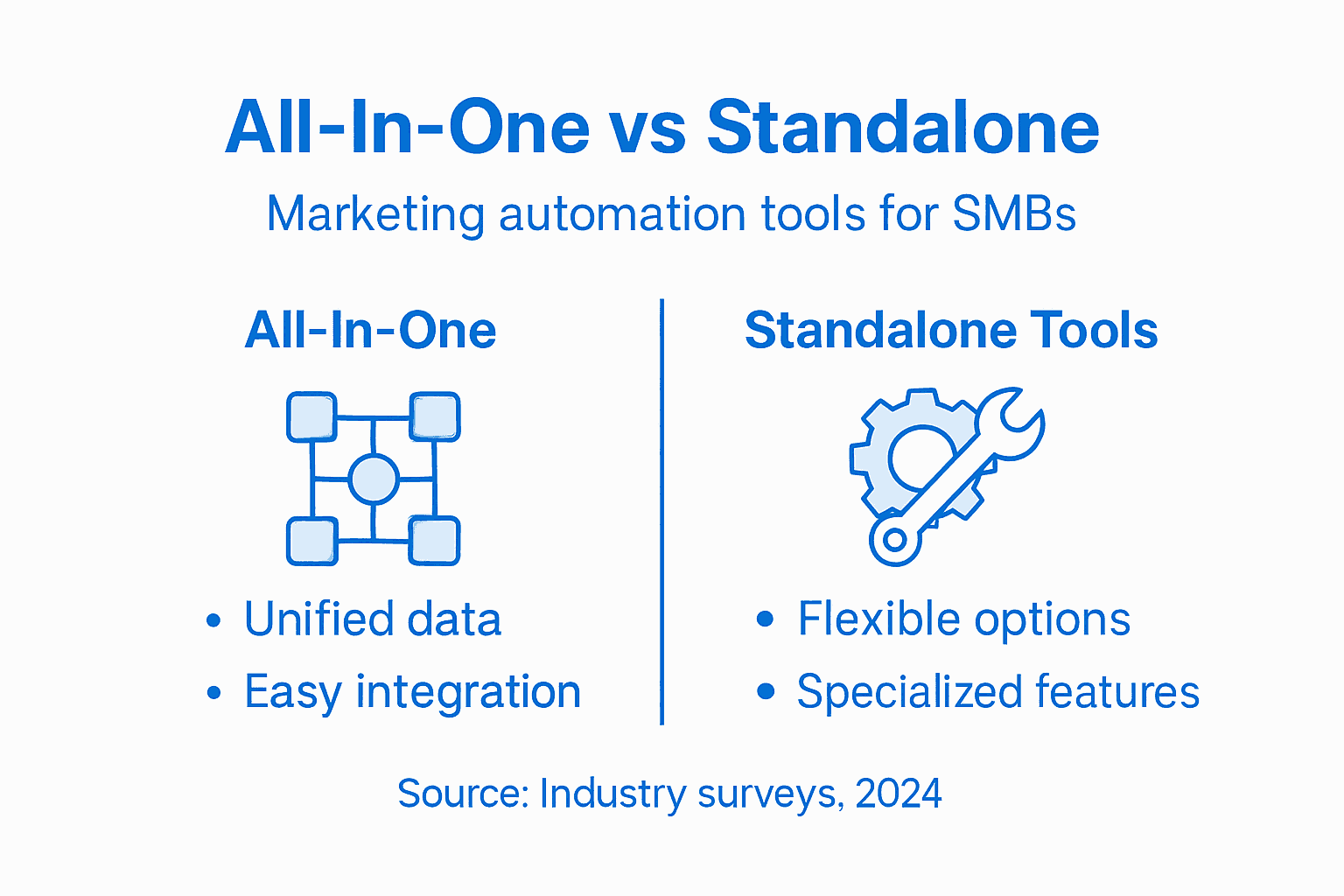
For most small and medium-sized businesses, the consolidated approach of an all-in-one platform offers superior cost-effectiveness, simplified management, and more streamlined operational workflows. The integrated nature of these solutions allows teams to focus on strategic marketing initiatives rather than managing multiple disconnected software platforms.
Pro tip: Conduct a thorough audit of your current marketing processes before selecting a solution, identifying specific integration needs and potential workflow bottlenecks.
Key Costs, Challenges, and Risks for SMBs
Marketing automation adoption presents complex challenges for small and medium-sized businesses navigating technological transformation. Understanding these potential barriers is crucial for developing strategic implementation approaches that minimize financial and operational risks.
The primary challenges SMBs encounter include:
- Financial Constraints
- High upfront technology investment
- Limited budget for advanced tools
- Training and implementation expenses
- Operational Complexities
- Technical integration difficulties
- Data migration challenges
- Skill gap in technical expertise
- Compliance and Security Risks
- Data privacy regulations
- Cybersecurity vulnerabilities
- Cross-platform data protection
Technology Investment requires careful strategic planning. SMBs must manage unpredictable automation costs while ensuring scalable, secure solutions that align with their specific business needs. This involves conducting thorough cost-benefit analyses and selecting platforms that offer flexible, modular approaches to minimize financial exposure.
Successful navigation of these challenges demands a pragmatic approach that balances technological innovation with financial prudence. SMBs must prioritize solutions offering comprehensive support, transparent pricing, and robust security features to mitigate potential implementation risks.
The table below compares common challenges faced by SMBs when implementing marketing automation and practical ways to address them:
| Challenge | Business Impact | Practical Solution |
|---|---|---|
| Financial Constraints | Slows adoption, limits growth | Prioritize essential features first |
| Integration Complexity | Workflow disruption | Seek platforms with easy connectivity |
| Skill Gap | Reduces effectiveness | Invest in targeted training |
| Data Privacy Risks | Legal exposure risks | Follow regulations, use secure tools |
Pro tip: Conduct a comprehensive technology audit and pilot test automation tools before full-scale implementation to identify potential integration challenges and budget requirements.
Mistakes to Avoid When Adopting Automation
Marketing automation adoption requires strategic planning to prevent costly implementation errors that can undermine business growth. Small and medium-sized businesses must approach automation with a clear, methodical strategy to maximize technological investments and avoid potential pitfalls.
The most common mistakes SMBs encounter include:
- Strategic Misalignment
- Unclear marketing objectives
- Lack of comprehensive implementation planning
- Mismatched tool capabilities with business needs
- Technical Execution Errors
- Inadequate audience segmentation
- Over-automation of customer interactions
- Neglecting data quality management
- Operational Oversights
- Insufficient cross-department collaboration
- Poor lead nurturing processes
- Ignoring performance analytics
Content and Personalization represent critical areas where SMBs frequently stumble. Marketing automation requires balanced human insights to create meaningful customer experiences. Successful implementation demands more than just technological deployment—it requires a nuanced understanding of customer journeys and strategic content development.
Navigating these challenges requires a holistic approach that combines technological capability with strategic thinking. SMBs must view marketing automation as an evolving process of continuous learning and optimization, rather than a one-time technological implementation.
Pro tip: Develop a comprehensive implementation roadmap with clear milestones, conduct regular performance audits, and remain flexible in your automation strategy.
Transform Your SMB Growth with Simplified Marketing Automation
Small and medium-sized businesses face real challenges like complex technology setup, costly software, and fragmented tools that slow down growth and burn valuable time. The article highlights how marketing automation software can streamline lead nurturing, campaign management, and CRM workflows—but only when these solutions are simple, affordable, and tailored to SMB needs.
If you want to overcome these hurdles, consider Go Online Now-Connect. Our all-in-one marketing automation software offers everything SMBs need including email marketing automation, lead management and CRM, and reputation management in one easy platform. Paired with real human support and done-for-you setup, you avoid the frustration of scattered tools and technical roadblocks.
Take control of your marketing and sales growth without overpaying or drowning in complexity. Explore our Automation Archives – Go Online Now to learn how automation can truly drive ROI and operational efficiency. Dive into practical digital strategies with our Digital Marketing Archives – Go Online Now for expert guidance on campaign success.
Ready to grow smarter, not harder? Visit Go Online Now to get started with a platform designed exclusively for SMBs. Let us help you harness the power of marketing automation and CRM in a cost-effective, scalable way backed by real support. Take your next step today.
Frequently Asked Questions
What are the key benefits of using marketing automation software for SMBs?
Marketing automation software helps small and medium-sized businesses streamline their marketing efforts by automating repetitive tasks, improving operational efficiency, enhancing customer engagement, and enabling more targeted marketing campaigns. This technology allows SMBs to focus on strategic initiatives by reducing manual workloads and improving response times.
How can marketing automation improve lead nurturing and segmentation?
Marketing automation improves lead nurturing by implementing automated workflows that engage prospects based on their behaviors and preferences. This includes personalized messaging, timely follow-ups, and dynamic segmentation that ensures the right content reaches the right audience at the right time.
What are the differences between all-in-one marketing automation platforms and standalone tools?
All-in-one marketing automation platforms offer unified data management, simplified integrations, and reduced costs, making them ideal for startups and SMBs. Standalone tools, on the other hand, can provide specialized features and advanced functionalities but may require more complex integrations and management.
What common mistakes should SMBs avoid when adopting marketing automation?
Common mistakes include strategic misalignment, inadequate audience segmentation, and neglecting data quality management. SMBs should develop a comprehensive implementation plan, ensure clear marketing objectives, and maintain ongoing optimization to avoid these pitfalls.
Recommended
- Marketing Automation Software: Complete Guide for SMBs – Go Online Now
- Marketing Automation Software: Complete Guide for SMBs – Go Online Now
- Marketing Automation Software: Smarter Growth for SMBs – Go Online Now
- 7 Affordable Marketing Automation Tips for SMB Success – Go Online Now
- How AI is Revolutionizing Mobile Game Marketing – playablemaker.com How AI is Revolutionizing Mobile Game Marketing