

Juggling dozens of customer emails, follow-ups, and campaign reports often leaves SME teams feeling stretched thin. For owners and marketers in the United States or United Kingdom, finding ways to handle growth without hiring more staff is a constant challenge. Marketing automation software offers a practical answer, letting small businesses handle repetitive marketing tasks efficiently and redirect precious time toward real customer engagement and creative problem-solving.
Marketing automation software for SMEs explained
Marketing automation software takes repetitive marketing tasks off your team’s plate automatically. Instead of manually sending emails, tracking leads, or managing campaigns, the software does it for you—consistently and at scale.
For SMEs, this means your small team can handle the workload of a much larger marketing department. One person can nurture hundreds of leads simultaneously while staying focused on strategy instead of busywork.

Business Process Automation in SMEs reduces time spent on routine tasks, allowing your employees to focus on creative activities that actually drive growth. This is the real value: freed-up brain power for the work that matters.
What marketing automation actually does
Here are the core functions that most platforms handle:
- Lead nurturing: Automatically send targeted messages to prospects based on their behavior
- Email campaigns: Schedule and send bulk emails triggered by customer actions
- Lead segmentation: Group contacts by characteristics so messaging stays relevant
- Campaign reporting: Track performance metrics automatically without manual data entry
- Customer engagement: Keep conversations going without constant manual follow-up
Marketing automation software specifically automates marketing-related repetitive processes like lead nurturing, segmentation, and campaign reporting, making marketing operations more efficient for SMEs.
Why SMEs need this
Does your team spend hours every week on data entry, list management, or sending follow-up emails? That’s the problem automation solves.
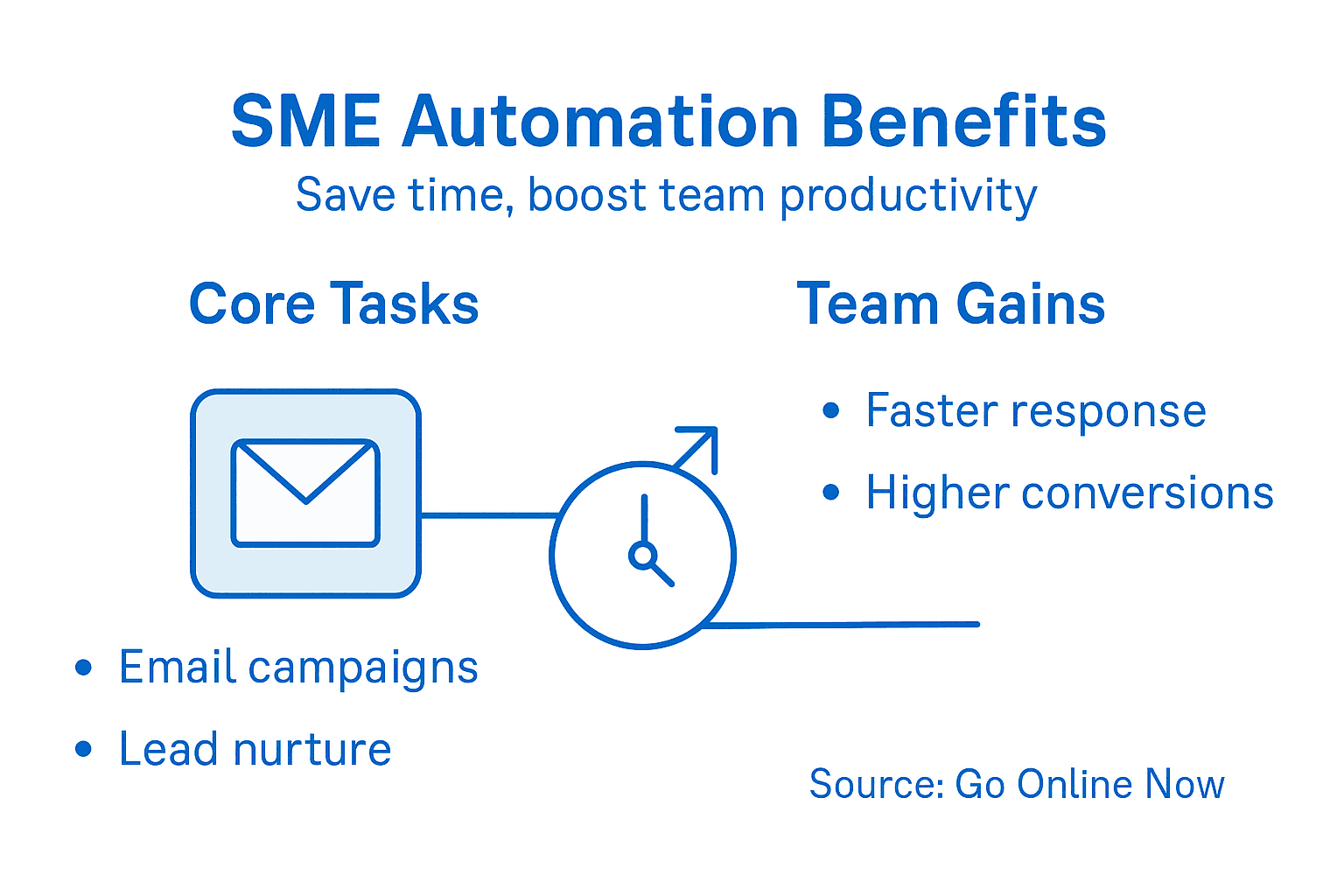
Digitalization offers SMEs the opportunity to improve competitiveness by accessing new markets and enhancing operational efficiency. Marketing automation supports better resource allocation and growth potential globally.
Without automation, growth hits a ceiling. You can’t hire fast enough to keep pace. With it, your existing team scales their impact without burning out.
Marketing automation is the bridge between having a small team and delivering big-company customer experiences.
Real results: SMEs using these platforms typically see improved response times, higher conversion rates, and teams that actually have time to think strategically instead of drowning in admin.
Pro tip: Start by automating your email nurture sequence—identify your top 3 repetitive email campaigns and set them to trigger automatically based on customer actions. This single automation often saves 5+ hours per week and immediately improves response consistency.
Types of marketing automation and core features
Marketing automation software comes in different flavors, but they all share the same goal: handle repetitive tasks so your team doesn’t have to.
Understanding which type fits your SME helps you choose the right tool. Not every business needs every feature, and picking the wrong platform wastes money and time.
The three main types
Marketing automation software broadly falls into three categories: marketing intelligence tools, automation platforms, and marketing analytics tools. Each serves a different purpose in your customer journey.
Marketing intelligence tools track what your prospects are doing. They monitor behavior signals—website visits, email opens, content downloads—to tell you when someone is ready to buy.
Automation platforms are the workhorses. They nurture leads automatically, score them based on engagement, and move them into your sales pipeline when they’re sales-ready. This is where most SMEs focus their efforts.
Marketing analytics tools measure what actually worked. They show you conversion rates, ROI, and campaign performance so you can optimize what’s next.
Here’s a quick reference comparing the three main types of marketing automation tools for SMEs:
| Type | Main Role | Typical Users | Key Benefit |
|---|---|---|---|
| Marketing Intelligence | Monitors prospect behavior | Marketing analysts | Timely sales signals |
| Automation Platforms | Automates campaigns and leads | Small marketing teams | Scalable lead nurturing |
| Marketing Analytics Tools | Measures performance and ROI | Decision-makers, managers | Data-driven strategy |
Core features every SME needs
Regardless of type, look for these essential capabilities:
- Email marketing: Send automated, triggered emails based on customer actions
- Omnichannel campaigns: Reach prospects via email, SMS, social, and web simultaneously
- Customer segmentation: Divide your audience into groups so messaging stays relevant
- Lead scoring: Automatically rank prospects by purchase readiness
- CRM integration: Connect your automation with customer data for a unified view
- Performance reporting: Track metrics without manual data crunching
The best platform is the one your team will actually use. Complexity kills adoption.
These features streamline complex marketing workflows and let small teams punch above their weight. When everything connects properly, one person manages what used to take three.
Pro tip: Start with email marketing and lead scoring—these two features alone typically deliver the fastest ROI for SMEs. Once your team masters those, expand to other channels and features based on what your customers actually respond to.
How automation drives SME growth and efficiency
Automation isn’t just about saving time—it’s about redirecting your team’s energy toward work that actually grows your business. When systems handle repetitive tasks, people focus on strategy, creativity, and relationships.
For SMEs competing against larger companies, this shift is the real competitive advantage.
Freeing up resources for what matters
Automation enables SMEs to streamline processes, reduce manual errors, and free up valuable human resources for innovation and customer engagement. Instead of your best person drowning in data entry, they’re building relationships and solving client problems.
Your team becomes more productive instantly. One marketing person with automation handles the workload of three without it. That’s not hyperbole—it’s math.
Growing faster without hiring faster
Implementing business process automation allows SMEs to accelerate routine tasks and focus resources on strategic growth initiatives. You reach more customers without adding headcount proportionally.
This is scalability without the payroll burden. Your fixed costs stay manageable while revenue potential climbs.
Here’s where real growth happens:
- Reach more prospects: Nurture hundreds of leads simultaneously without manual effort
- Convert faster: Personalized campaigns at scale show prospects exactly what they need
- Retain better: Automated follow-ups keep customers engaged after the sale
- Make smarter decisions: Data-driven insights replace guesswork
- Close deals quicker: Sales-ready leads arrive automatically, reducing cycle time
Automation doesn’t replace your team—it multiplies what they can accomplish.
The efficiency multiplier effect
When marketing automation connects with your CRM, something powerful happens. Every customer interaction feeds data that makes the next interaction smarter. Campaigns improve. Conversion rates climb. Revenue compounds.
SMEs using automation typically see improved response times, higher conversion rates, and teams that actually have capacity to think strategically instead of executing busywork.
The math is straightforward: more output with the same input equals efficiency. And efficiency is how small businesses beat big ones.
Pro tip: Measure your team’s current time spent on repetitive tasks for one week. That’s your baseline. After implementing automation, measure again at 90 days. Most SMEs discover they’ve recovered 10+ hours per week per person—time they immediately redirect to revenue-generating work.
Cost, risk, and ROI: What SMEs must know
Marketing automation isn’t free, but the math usually works out. The real question isn’t whether you can afford it—it’s whether you can afford not to use it.
Let’s break down what you’re actually looking at financially and strategically.
The investment reality
SMEs considering marketing automation must weigh upfront costs, ongoing subscription fees, and potential integration expenses against expected benefits. Most platforms charge monthly subscriptions ranging from $50 to $500+ depending on features and contact volume.
Beyond software costs, factor in implementation time, team training, and potential consulting help. These aren’t small numbers for tight budgets.
However, here’s what matters: these upfront costs are typically recovered within 3-6 months through improved efficiency and higher conversion rates.
The real risks to consider
Costs are predictable. Risks are trickier. Common challenges include:
- Technology misalignment: Choosing the wrong platform wastes money and time
- Data privacy concerns: Handling customer data comes with legal responsibility
- Resource constraints: Implementation requires time your team might not have
- Adoption resistance: Tools only work if your team actually uses them
- Integration headaches: Connecting to existing systems can be complex
Adopting AI-based marketing automation entails financial investment and strategic risk for SMEs, including technology adoption barriers and capability gaps. The good news: these risks are manageable with proper planning.
The ROI that actually happens
When done right, most SMEs see positive ROI within 90 days.
Real returns come from increased marketing effectiveness, higher conversion rates, and improved customer engagement. One SME owner we worked with recovered $15,000 in team productivity within four months.
ROI is strongest when you align technology with business goals and invest in team training. Start small, measure results, then expand.
Most SMEs see:
- 40-60% reduction in time spent on marketing tasks
- 25-50% improvement in lead quality and conversion rates
- Ability to nurture 3-5x more prospects with the same team
- Better customer data for smarter decision-making
The investment pays for itself through recovered productivity alone. Everything else is upside.
Pro tip: Before committing, request a free trial or demo focused on your top three pain points. Calculate your team’s current hourly cost, multiply by hours spent weekly on manual marketing tasks, then compare that annual cost against the platform’s annual subscription. The difference is usually shocking—and that’s your minimum ROI baseline.
Comparing automation platforms for SMEs
Not all marketing automation platforms are created equal. The right choice depends on your budget, team size, technical comfort level, and specific marketing needs.
Choosing poorly means paying for features you don’t need or struggling with tools that don’t fit your workflow. Let’s break down what matters.
What to evaluate
Before comparing specific platforms, understand your priorities. Different SMEs need different things.
Decide which factors matter most:
- Ease of use: Can your team learn it quickly without extensive training?
- Budget: Does it fit within your monthly marketing spend?
- Scalability: Will it grow with you, or will you outgrow it in a year?
- Feature set: Does it handle your specific needs (email, SMS, CRM, analytics)?
- Integration: Does it connect to your existing tools and systems?
- Support: Is help available when you need it?
These aren’t equally important for every business. A solopreneur prioritizes simplicity. A growing agency needs robust automation and integrations.
Popular platforms for SMEs
Popular marketing automation platforms for SMEs include HubSpot, Mailchimp, and ActiveCampaign, each offering varying features like email marketing, CRM integration, automation workflows, analytics, and multichannel campaign management.
HubSpot excels at all-in-one functionality. It combines CRM, email, landing pages, and analytics in one platform. Best for: SMEs wanting one unified system. Budget: $50-$3,200+ monthly.
Mailchimp is the simplest entry point. Email marketing is excellent, automation is basic, and the free tier works for startups. Best for: Budget-conscious businesses starting small. Budget: Free to $350+ monthly.
ActiveCampaign balances power and usability. Strong automation, CRM, and sales tools without HubSpot’s complexity. Best for: Growing SMEs needing sophisticated workflows. Budget: $25-$229+ monthly.
Leading platforms powered by AI offer advanced tools such as predictive analytics, personalization at scale, and dynamic content creation for SMEs seeking competitive advantages.
Review how leading SME automation platforms differ at a glance:
| Platform | Strengths | Best For | Starting Cost |
|---|---|---|---|
| HubSpot | All-in-one unified system | SMEs needing integrated features | $50/month |
| Mailchimp | Simple email focus | Startups, limited budgets | Free tier offered |
| ActiveCampaign | Advanced automation, CRM | Growing teams, complex workflows | $25/month |
How to decide
The best platform is the one that solves your biggest problem right now.
Don’t buy based on feature lists. Most platforms have 80% overlap. You’re paying for the 20% that matters to you specifically.
Request demos focused on your workflow. Test the free tier if available. Talk to current SME users. Ask specifically about implementation support and training.
Your decision matters for 12-24 months. Choose wrong, and switching costs time and data migration headaches. Choose right, and you’ve got a foundation for growth.
Pro tip: Create a simple spreadsheet listing your top 10 must-have features and nice-to-haves. Score each platform 1-5 for each feature, then multiply your “must-have” scores by 2. The platform with the highest total score typically becomes your best fit—not because it’s perfect, but because it matches your actual priorities.
Unlock Real Growth with Simple, Affordable Marketing Automation for SMEs
This article highlights the challenge many SMEs face managing repetitive marketing tasks while trying to scale efficiently and deliver big-company customer experiences. If you are tired of spending hours on manual email sequences, lead nurturing, and campaign reporting, you are not alone. Key pain points include time-consuming busywork, complex and expensive platforms, and limited resources to grow strategically. The good news is that marketing automation software can relieve these pressures by streamlining lead management, segmentation, and performance tracking in one easy system.
At Go Online Now, we understand that small businesses need a solution that is clear, affordable, and designed for real-world SME challenges. Our Automation Archives share success stories and expert insights on marrying powerful automation with human support. We combine marketing automation tools with an all-in-one CRM and digital marketing services tailored specifically for service providers and SMBs. Stop paying for over-engineered platforms and start saving up to 75% of your marketing time while increasing conversions by up to 85% within 90 days.
Ready to reclaim your time and scale smarter?
Explore our Digital Marketing Archives for actionable strategies or visit Go Online Now to get started with a done-for-you setup and real support from experts. Don’t wait for your competitors to outpace you. Harness the power of simple marketing automation today and grow your business with confidence.
Frequently Asked Questions
What are the main benefits of using marketing automation software for SMEs?
Marketing automation software allows SMEs to handle repetitive marketing tasks efficiently, freeing up time for strategic activities, improving response times, and increasing conversion rates without the need for additional hiring.
How can marketing automation improve lead nurturing for SMEs?
Marketing automation improves lead nurturing by automatically sending targeted messages based on prospect behavior, allowing a single team member to nurture hundreds of leads simultaneously without manual effort.
What core features should SMEs look for in marketing automation platforms?
SMEs should look for features such as email marketing, customer segmentation, lead scoring, omnichannel campaigns, CRM integration, and performance reporting to effectively manage their marketing efforts.
How can SMEs measure the return on investment (ROI) from marketing automation?
SMEs can measure ROI from marketing automation by tracking improvements in efficiency, conversion rates, and overall marketing effectiveness, typically seeing positive returns within 90 days of implementation.
Recommended
- Marketing Automation Software: Complete Guide for SMBs – Go Online Now
- Marketing Automation Software: Complete Guide for SMBs – Go Online Now
- Marketing Automation Software: Smarter Growth for SMBs – Go Online Now
- 7 Affordable Marketing Automation Tips for SMB Success – Go Online Now
- Online Marketing in 2025 – Advertise Solution