

Most American small and medium businesses are searching for smarter ways to connect with customers, especially as budgets tighten and digital expectations grow. With over 80 percent of American marketing directors planning to increase automation spending by 2025, finding affordable, user-friendly solutions is no longer just a trend, it is a necessary strategy for growth. This guide provides clear insights into marketing automation software, revealing how the newest tools empower American businesses to enhance engagement and conversion rates efficiently.
What Is Marketing Automation Software in 2025
Marketing automation software represents a revolutionary approach to digital marketing that transforms how small and medium businesses manage customer interactions. At its core, marketing automation consolidates multi-channel communication strategies into intelligent, streamlined systems designed to maximize efficiency and engagement.
In 2025, marketing automation goes beyond basic task management. These sophisticated platforms integrate artificial intelligence and advanced data analytics to create hyper-personalized customer experiences. The software automates complex marketing processes like lead generation, customer segmentation, email campaigns, social media scheduling, and performance tracking—all within a unified ecosystem. Modern tools can now predict customer behavior, recommend targeted content, and dynamically adjust marketing strategies in real time.

Key capabilities of marketing automation software now include comprehensive features that empower businesses to work smarter. These typically encompass:
Here’s a summary of how automation features impact small business outcomes:
| Automation Feature | Core Benefit | Business Impact |
|---|---|---|
| AI-driven personalization | More relevant communication | Higher customer engagement |
| Intelligent lead scoring | Prioritized sales outreach | Increased conversion rates |
| Multichannel integration | Streamlined workflows | Efficient marketing spend |
| Data analytics | Informed decision-making | Improved ROI and strategy |
- Intelligent lead scoring and nurturing
- Automated email and SMS campaign management
- Advanced customer segmentation
- Cross-platform analytics and reporting
- AI-powered personalization engines
- Integrated customer relationship management
Pro tip: Select marketing automation software that offers seamless integration with your existing business tools to maximize efficiency and minimize technical complexity.
Types of Marketing Automation Tools for SMBs
Small and medium businesses have access to a diverse range of marketing automation software categories designed to streamline their digital marketing efforts. These tools are strategically crafted to help entrepreneurs maximize their marketing efficiency without requiring extensive technical expertise or substantial financial investment.
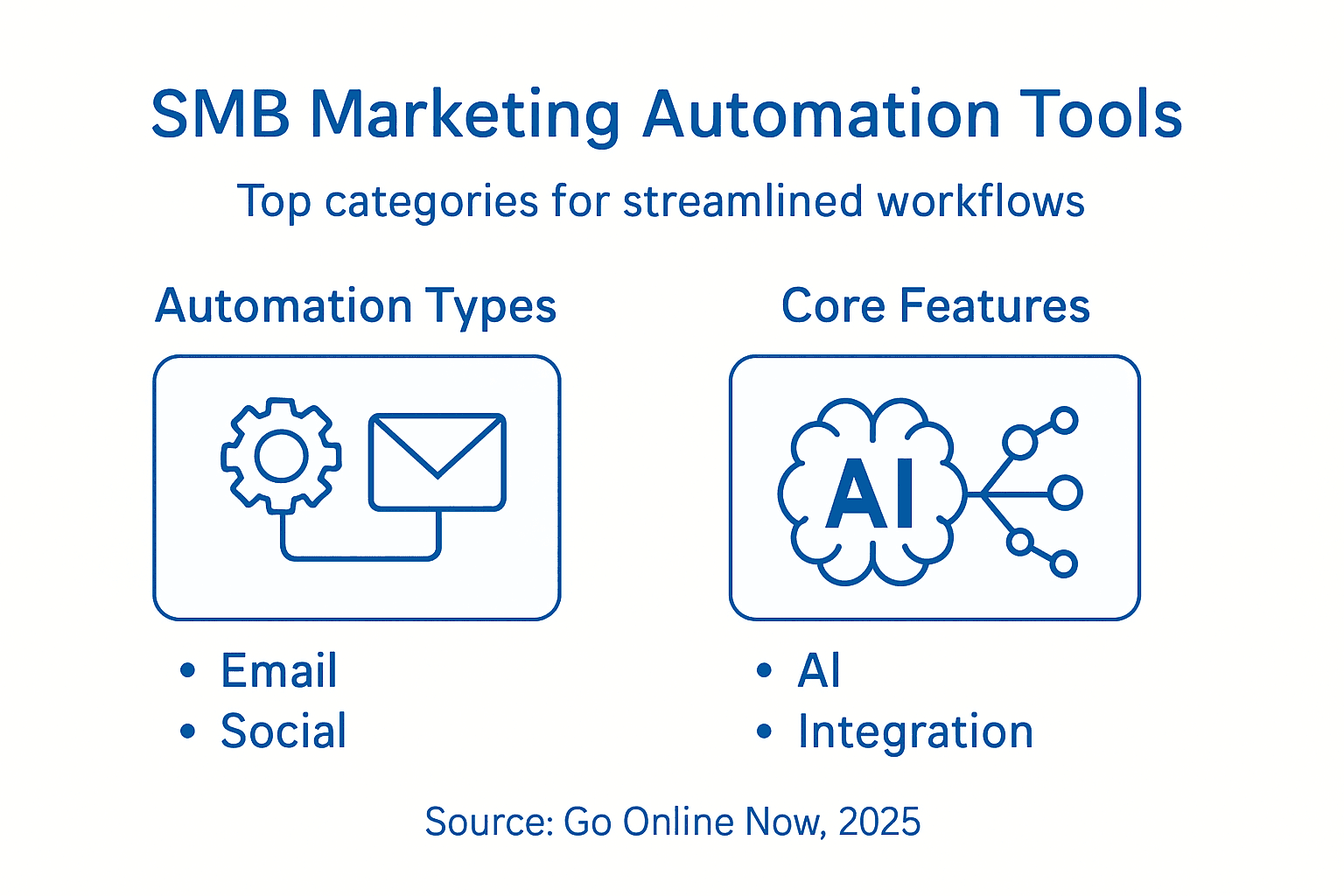
The primary types of marketing automation tools for SMBs can be categorized into several key segments. Email marketing automation platforms enable businesses to create targeted campaigns, segment audiences, and track engagement metrics automatically. Social media management tools help schedule posts, analyze performance, and maintain consistent online presence across multiple channels. Customer relationship management (CRM) systems integrate marketing activities with sales tracking, providing a comprehensive view of customer interactions and potential leads.
More advanced marketing automation solutions now incorporate artificial intelligence and machine learning capabilities. These sophisticated tools offer capabilities such as:
- Predictive lead scoring
- Automated customer segmentation
- Personalized content recommendations
- Real-time performance analytics
- Cross-channel campaign management
- Intelligent workflow automation
Specific tool categories include:
- Email marketing automation platforms
- Social media scheduling software
- Customer relationship management systems
- Analytics and reporting tools
- Lead generation and nurturing platforms
- Multichannel marketing integration solutions
Pro tip: Prioritize marketing automation tools that offer seamless integration with your existing business software to minimize technical complexity and maximize operational efficiency.
How Automation Enhances Customer Engagement
Marketing automation has revolutionized how businesses interact with customers by enabling precise, personalized communication strategies. By leveraging advanced technologies, companies can now create more meaningful and targeted interactions that resonate deeply with individual customer preferences and behaviors.
The core of automation’s impact lies in its ability to transform traditional, one-size-fits-all marketing approaches into highly sophisticated, intelligent engagement systems. Personalization engines now analyze customer data in real-time, allowing businesses to craft messages that feel individually tailored. For instance, automated systems can track customer browsing history, purchase patterns, and interaction preferences to generate hyper-relevant content, recommendations, and communication timing that significantly boost engagement rates.
Advanced automation tools offer several key engagement enhancement mechanisms:
- Dynamic content customization
- Predictive interaction modeling
- Intelligent response triggering
- Behavior-based communication segmentation
- Automated feedback analysis
- Contextual messaging optimization
These sophisticated approaches enable businesses to create more human-like, empathetic interactions without sacrificing efficiency. By understanding and anticipating customer needs through data-driven insights, automation transforms traditional marketing from a broadcast model to a responsive, interactive dialogue.
Pro tip: Configure your marketing automation tools to balance personalization with authenticity, ensuring automated communications feel genuinely helpful rather than mechanically generated.
Financial Benefits and ROI for Small Businesses
Small businesses can dramatically transform their financial performance through strategic business process automation, which offers substantial economic advantages beyond traditional marketing approaches. By implementing intelligent automation technologies, entrepreneurs can unlock significant cost savings, improve operational efficiency, and redirect valuable resources toward growth-oriented activities.
Marketing automation specifically delivers measurable financial benefits by optimizing key revenue-generating processes. Cost reduction becomes tangible through decreased manual labor, minimized human error, and more efficient marketing spend. Automated systems enable businesses to generate more leads, nurture customer relationships, and convert prospects at a fraction of traditional marketing costs. This approach allows small businesses to compete more effectively with larger competitors by maximizing their limited marketing budgets.
Key financial advantages of marketing automation include:
- Reduced customer acquisition costs
- Improved lead conversion rates
- Enhanced sales team productivity
- More accurate marketing spend attribution
- Streamlined operational workflows
- Predictable revenue generation
The return on investment for small businesses becomes increasingly clear when examining the comprehensive impact of automation. By freeing up team members from repetitive tasks, companies can reallocate human capital toward strategic initiatives that directly contribute to bottom-line growth. Sophisticated automation tools provide granular analytics that help business owners make data-driven decisions, continuously optimize marketing strategies, and incrementally improve financial performance.
Pro tip: Implement a phased automation strategy, starting with one or two key processes to minimize initial investment and demonstrate measurable financial improvements.
Common Pitfalls and How to Avoid Them
Small businesses often encounter significant challenges when implementing marketing automation, with many struggling to achieve their desired outcomes due to common digital transformation mistakes. Understanding these potential roadblocks is crucial for developing a strategic approach that maximizes the potential of automation technologies.
One of the most critical pitfalls involves poor system integration and data management. Fragmented data ecosystems can undermine the effectiveness of marketing automation, leading to inefficient campaigns and missed opportunities. Businesses frequently make the mistake of implementing tools without considering how they will work together, resulting in siloed information and disconnected customer experiences. Successful automation requires a holistic approach that ensures seamless communication between different platforms and maintains data integrity.
Key pitfalls to watch for include:
- Inadequate data quality and management
- Lack of clear automation strategy
- Insufficient team training and adoption
- Overlooking personalization requirements
- Unrealistic expectations about implementation
- Neglecting continuous optimization
Navigating these challenges requires a methodical and patient approach. Small businesses should start with clearly defined objectives, invest in comprehensive team training, and implement automation in manageable phases. By focusing on incremental improvements and maintaining flexibility, companies can build robust automation strategies that evolve with their specific business needs and customer expectations.
This table compares common pitfalls with strategies to avoid them:
| Common Pitfall | How It Affects SMBs | Best Practice to Avoid Damage |
|---|---|---|
| Poor system integration | Fragmented data, lost synergy | Select compatible tools, plan integration |
| Lacking a clear strategy | Inefficient campaigns | Define measurable goals and objectives |
| Insufficient staff training | Low adoption, user errors | Provide ongoing education and support |
| Unrealistic expectations | Disappointment, wasted investment | Start with phased implementation |
Pro tip: Conduct a thorough audit of your existing marketing processes and data systems before implementing any automation tools to identify potential integration challenges and alignment opportunities.
Unlock Smarter Marketing Automation with Go Online Now-Connect
The challenge many SMBs face in 2025 is managing complex marketing automation without wasting time or money on over-engineered platforms. This article highlights the need for simple, integrated marketing automation tools that personalize, automate, and streamline your marketing efforts without complicated setups or overwhelming costs. Key pain points include the struggle with fragmented systems, lack of clear automation strategy, and the desire to boost customer engagement while improving ROI. Go Online Now-Connect meets these needs by combining marketing automation software, a unified all-in-one CRM, and expert digital marketing services into one affordable, easy-to-use platform.
For entrepreneurs and growing businesses frustrated by scattered tools and technical headaches, our platform offers done-for-you setup and real human support, helping you automate email, SMS, funnels, lead nurturing, and more. With proven results of up to 85% more conversions and 75% time saved within 90 days, Go Online Now-Connect turns the promise of marketing automation into real business growth. Discover how to simplify your marketing journey with solutions designed for small business realities.
Explore more about automation strategies in our Automation Archives – Go Online Now and dive into practical digital marketing insights on our Digital Marketing Archives – Go Online Now. Ready to grow smarter and faster?
Start your transformation today at Go Online Now and experience the most affordable, all-in-one marketing automation software created specifically for SMBs and SMEs. Don’t wait—simplify your marketing, save precious time, and accelerate growth now.
Frequently Asked Questions
What are the main benefits of marketing automation in 2025?
Marketing automation in 2025 offers several key benefits, including enhanced efficiency, AI-driven personalization, intelligent lead scoring, and improved customer engagement through hyper-personalized communication. These systems streamline marketing processes and optimize resource allocation.
How can marketing automation improve my small business’s financial performance?
Marketing automation can lead to reduced customer acquisition costs, improved lead conversion rates, and enhanced productivity among sales teams. By automating repetitive tasks, businesses can focus resources on strategic growth initiatives, ultimately increasing ROI.
What types of tools fall under marketing automation suitable for small businesses?
Small businesses can utilize various marketing automation tools, including email marketing platforms, social media management tools, CRM systems, and analytics/reporting software. Each serves specific functions to streamline marketing processes effectively.
What are some common pitfalls when implementing marketing automation?
Common pitfalls include poor system integration, lack of a clear strategy, insufficient team training, and unrealistic expectations about the technology. To avoid these issues, businesses should approach automation systematically, define clear goals, and ensure comprehensive team training.
Recommended
- Digital Marketing Workflow 2025: Complete Guide – Go Online Now
- Why Small and Midsized Businesses Need Marketing Automation in 2024 – Go Online Now
- Maximize Your Marketing ROI with Advanced Automation Tools | Go Online Now
- Marketing Trends in 2025: Essential Guide for SMBs – Go Online Now
- Role of Banners in Marketing: Boosting Brand Visibility –
- 7 Top-Trends in der Lasertechnik 2025 für den Mittelstand – Laserdienstleistungen